On Elephants and Riders

This week’s learning draws inspiration from ‘Switch’ by Chip and Dan Heath.

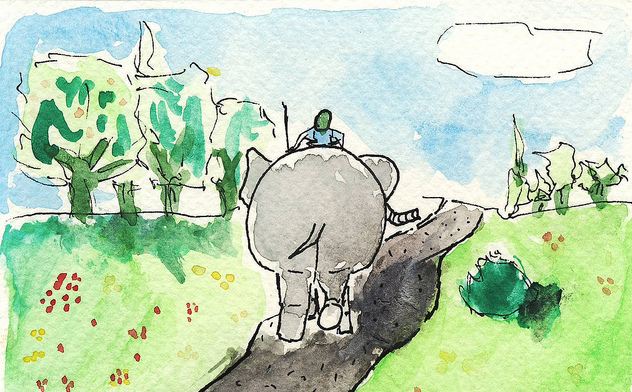
Jonathan Haidt developed a very interesting way of describing the relationship between our emotional and rational sides.

He describe the emotional side as the elephant and rational side as the rider.

Perched atop the elephant, the rider seems to have control. However, his situation is very precarious because IF they disagree, there is only one winner. And you will recognize this if you have ever over eaten, called up an ex at midnight, skipped the gym, procrastinated, said something you regretted, abandoned piano lessons and so on. :)

The weakness of the elephant is evident. It is lazy and goes for short term pay off – eg: ice cream vs being thin. When change fails, it is generally because of the elephant.
However, the elephant is also the reason for love, compassion and sympathy – it’s the elephant that gets things done as it has the energy and drive.

Our rider, while responsible for logic, tends to over analyze and over think things and can brainstorm about ideas for hours without really doing anything!

It is only when we understand the nature of our elephants and riders can we truly understand how to bring about change – both in ourselves and in our organizations. For real change, we will need to appeal to both because we need both the rider’s direction and planning as well as the elephant’s energy.

I found the elephant and rider analogy VERY powerful. I find myself applying this to all the goals and tasks I set for myself. The applications for this are endless – appealing to both the elephant and the rider matters in our daily conversations, important presentations, any change effort and probably most importantly, in understanding and managing ourselves.

Here’s to appealing to both our elephant and rider this week!

Switching Off

It’s been many weeks since I’ve taken a break of sorts.

Today has turned out to be the day.

Since afternoon, I’ve been feeling a certain numbness that signals it’s time for a switch off. So, many plans have been shelved. It’s time for a break. (and that’s the bottom line cos’..)

This is unlike the usual weekend – which is a web of activity. And this weekend was the same till this afternoon.

There were a stream of learnings waiting to be plugged in today thanks to the learning filled last few weeks.

I almost began typing one out but decided today’s learning had to be about today’s learning.

Switching off.

Have a nice evening.

PS: I’m very excited about reading ‘Gifts Differing’ by Isabel Briggs Myers. I bought the book yesterday and can’t wait to spend some time with it. Yes, I am weird. And I’m still trying to understand myself. :) More to follow..

Owls, Larks and Hummingbirds

The theory goes that there are ‘owls’, ‘larks’ and ‘hummingbirds’. Owls are people who work better at night while Larks are those who work better in the morning. And of course, the Hummingbirds are those who can do both.

Going by this definition, I was your classic owl. Before work-life began, getting up in the morning meant an unproductive and dreary day. Over time though, I’ve begun to wonder if my ‘owl’ tendencies were a result of my expression of rebellion in my teenage years. My grandparents didn’t at all appreciate the fact that I was up studying at inhuman hours (in their definition atleast). Over time, of course, they came to accept it. And, in hindsight, I think I loved doing something they disapproved with good enough results. (My way is better, etc..)

I used to like working into the night primarily because it was productive. No interruptions or disturbances at the inhuman hours. Interestingly, by that argument, waking up early works just as well.

One year into work life, I seem very happy being a ‘lark’. My ideal day starts at 6am, followed by my ‘hour of power’ and then the work day. I’ve noticed over time that my days just flow better when I wake up early vs staying up late. And now, the challenge is to find the discipline to get my regular quota of sleep and wake up early enough.

So, again, by the definition, I must now be a ‘hummingbird’.

Let’s consider the situation for a moment here. As a university student, being an ‘owl’ is natural order. Going to sleep before 2AM was rare. That changes when you start working of course.

Of late, I’m realizing that what looks like a people problem is often a situation problem. In this case, while it’s not a ‘problem’ in the traditional sense of the world, I’m beginning to wonder if the behavior is just a manifestation of the situation.

I have more questions than answers on this one. I began wondering about this when I thought of university – if you go by the ‘owl’ and ‘lark’ view of the world, it would seem that >90% of university students are ‘owls’. Now, that can’t be true, can it?

So, when are you most productive? And does this ‘owl’ and ‘lark’ view of the world make sense to you? Looking forward to your comments.. 

Contagious

A groundbreaking Harvard Medical School led by Dr Nicholas A Christakis once revealed that Obesity is contagious. For the purposes of the study, they followed 12067 subjects for 32 years. And they found that when someone became obese, the odds of that person’s close friends becoming obese tripled.

Proximity didn’t matter. It even spread across geographies. What happens is that we change our idea of what is an acceptable body type by looking at the people around us.

Another study showed that when college males were paired with a dormitory roommate who drank frequently in high school, they saw their GPA’s drop by 0.25 on average.

Marriage, smoking, shaking hands to greet someone, wearing fashionably fluffy boots and investing in Google are a few examples of an endless list of contagious behavior.

We imitate people around us especially when a situation is ambiguous. For ambiguous situations, think starting in a new job or starting out as a freshman in university.

Essentially, if we want to change things, we have to pay close attention to social signals.

I was very inspired when I heard this on ‘Switch’ this morning. It brings to attention (again) the question of the season – Who do you spend your time with? :)

And more importantly, the presence of a behavior like ‘marriage’ amidst low GPA’s and tobacco reinforces that fact that all kinds of behavior have hope.

The Silicon valley has proved that over time with an incredible tolerance for failure and mistakes.

Perhaps the daily learning habit and ‘learner’ behavior will get contagious as well. Someday.

JLM Inspiration

I’ve mentioned the community at AVC a bunch of times on this blog. I find the whole concept of a community inspirational and at the risk of repeating myself, hope to have such a community on this blog.

One of the most inspiring community members is Jeff Minch a.k.a. ‘JLM’. He brings a wealth of experience and insights to the comments at AVC thanks to his varied experiences as a successful CEO and entrepreneur. Today’s quote of the day on my Tumblog was one from JLM as well.

There are 3 types of people in this world – some light fires, others tend to them and then there are those who spend their life pissing on the fire. Avoid them at all costs.

JLM also had a comment to make once in the (now famous, on this blog atleast) Fred Wilson School of Blogging which inspires me to no end. I’ve just taken a small excerpt that I’ve thought about from time to time.

‘It is not about your blog — which is just a tool — it is about your voice which is generous, genuine, instructive, constructive, consistent and steady.

Even in those things with which you disagree, you are not disagreeable and that is a rare trait indeed.’

I find myself incredibly inspired by these words. They have been stuck in my mind every since I read them as they summarize most of what I would like to stand for. I hope I get there..

And I also hope our community will find it’s own JLM along the way.

We will get there. I hope. And believe.


Update: I’d let JLM know about this over a Disqus thread and he promptly left a lovely comment. I was reminded of the quote ‘We are what we repeatedly do’ as I was reading the comment. It spoke of humility, enthusiasm and inspiration all at once – all those things that I associate JLM with.

Thanks again JLM. We hope to have you back on this blog. I hope. I believe. :)

Short. But Meaningful

It’s been a good 5 years since I left home (Chennai) and 1 year now since I effectively left my 2nd home (Singapore). Thanks to having worked in a start-up almost all through university, my vacations were generally short 2 week affairs as the summer/winter breaks were times suited to focusing on work without the hassle of exams.

That hasn’t changed with work, of course. If anything, the breaks have become shorter.

Over time, I’ve gone through a learning curve when it comes to taking trips back ‘home’ or to ‘home-like’ places to meet loved ones, close friends, family. In my first few trips, I used to try and jam everything and everyone in. So, my breaks were never truly ‘breaks’. They felt like work. And I never had enough of anything. When I was meeting one friend, I had to ensure I was off soon because a whole bunch of such catch ups would be ruined. Heck, I was busier during vacations than any other time of the year!

I also realized I often came back from such ‘breaks’ unsatisfied. They were busy, but not meaningful.

There were 2 big realizations that changed that. The first was the importance of putting ourselves on top of the holiday priority list and the second was by focusing on making catch ups and conversations meaningful.

The first required a lot of practice in terms of using my self discipline muscle to say ‘NO’ when a No was required. And the second has involved a real effort to have few catch ups, but to keep them meaningful.

I was in Singapore for a few days to get my Permanent Residency and this realistically meant one weekend and maybe a couple of other evenings of catch up time. And the focus on keeping it meaningful was, hence, paramount. The way our lives go these days, we can talk so much without really saying anything. And when you live a few thousand miles away and get to meet only for a couple of hours every few months, such conversations can be both frustrating and useless. Meeting friends/loved ones at nice restaurants, at old ‘haunts’ or in a different environment altogether have worked well for me as great environments to catch up. Playing Risk all night with friends, as I always realize, is another fantastic excuse to spend time and connect.  :)

And as is the case with relationships, staying in touch while being away also help us pick up from where we left off. As a friend put it nicely, you can’t tune in and tune out of relationships. You’re either in them or are getting phased out.

There’s no perfect formula to making such meets meaningful. Most of all, I’ve found that it takes a desire to make them count. And I’ve found that I’m quite enjoying such ‘catch up’ trips of late as I’m getting better at managing myself and my energy during these trips. This trip was one such example.

It was short. But meaningful. 

Charles Schulze Philosophy

Most of you have probably received this forward via email at some point in your lives. I had too.

But, there’s also a special truth about great learnings – they touch a chord every time we remember them. So, when I received this today, I thought I would share..


The following is the philosophy of Charles Schulz, the creator of the ‘Peanuts’ comic strip.

You don’t have to actually answer the questions. Just ponder on them.

1. Name the five wealthiest people in the world.

2. Name the last five Heisman trophy winners.

3. Name the last five winners of the Miss America pageant.

4 Name ten people who have won the Nobel or Pulitzer Prize.

5. Name the last half dozen Academy Award winners for best actor and actress.

6. Name the last decade’s worth of World Series winners.

How did you do?

The point is, none of us remember the headliners of yesterday.

These are not second-rate achievers.

They are the best in their fields.

But the applause dies.

Awards tarnish.

Achievements are forgotten.

Accolades and certificates are buried with their owners.

Here’s another quiz. See how you do on this one:

1. List a few teachers who aided your journey through school.

2. Name three friends who have helped you through a difficult time.

3. Name five people who have taught you something worthwhile.

4. Think of a few people who have made you feel appreciated and special.

5. Think of five people you enjoy spending time with.

Easier? The lesson:

The people who make a difference in your life are not the ones with the most credentials, the most money or the most awards.

They simply are the ones who care the most.

Let’s spend a moment a moment thinking about those who’ve made a difference in our lives. And if you haven’t written to them in a long time, do send them a note.. :)

Oh, and don’t worry about the world coming to an end today. It’s already tomorrow in Australia!

Be Yourself! Everyone Else Is Taken!

The Snail and the Kick

Last night, a few of us had a long post dinner conversation. It was one of those long conversations where we mused about a whole slew of things including the ‘other side’ of Steve Jobs, family vs career prioritizations, work-life balance and how we derive our self worth.

A great discussion. 
We were on our way out when one of us noticed a snail crossing the tiny path we were walking through. 
‘Must take it one year of it’s life to cross this path.’ – He remarked with a smile. 
‘Imagine how great it would be for the snail if we gave it a kick.’ – I mused ‘It may not realize it but we would save it a couple of years at least and it would be see so much more in it’s lifetime..’ 
‘Makes me wonder how often we need such a kick. Might be painful but…’ 
He trailed off, leaving all of us in thought for a few moments.
How often do we such a ‘kick’ that shifts our paradigms, makes us uncomfortable and accelerates our learning and growth? And most importantly, how often do we seek that ‘kick’? 

John Rubedeau: Interview II – RealAcad Mondays

Picking up from last week’s RealAcad Monday, we have an interview with Professor John Rubedeau here thanks to Justin Yiu, a fellow RealAcader from Stanford’11. I was at the camp with Justin, who is now just starting out on his career as an Actuarial Analyst. Justin just graduated from the University of Michigan and is a wonderful presenter, a basketball star, huge Kobe Bryant fan and a great guy.

During our time together, Justin spoke of his admiration for his English Professor, John Rubedeau. He spoke of John as a fantastic teacher who inspired his students to think different. And I am very glad Justin took time off his busy schedule to interview John. I couldn’t help but smile as I read John’s responses to our questions.

I am very excited about this interview for many reasons. This is a first for this blog on many levels and I look forward to your comments, feedback and suggestions for questions for future interviews.


Bio: John Rubadeau is currently a Senior Lecturer at the University of Michigan. Before his teaching career, John was a social worker for the Red Cross in Europe. He obtained his doctorate at Georgia State University and began teaching at the University of Michigan in 1987. Through his inspirational lectures, he hopes to makes students love the English language. John won the Golden Apple in 2005 which is awarded to the faculty member who best inspires and engages his students through the course’s subject material. During his free time he writes books, catches up with students, and plays with his two dogs.


1. What inspires/drives you?

What drives me is that I have been fortunate enough to find a career that I love. I so enjoy going to class every day, anticipating my happy interactions with my students. The real joy I get is preparing them to enter the real world where knowledge of written English is paramount to their success. I feel that I have a certain storehouse of knowledge that very few people have, and I take great pleasure in transmitting that knowledge to my students.

As we progress in this technological age and people are getting away from reading books and writing, I see that the skills that I have learned are becoming increasingly more valuable in the marketplace of idea, and I get a great joy out of helping my students progress in their careers.

2. What has been the most defining moment of your life so far?


This is probably not what you’re looking for, but the most defining moments of my life are when I discovered, first through experience and then through voluminous amounts of reading, that there could not be a providential God. Raised as a firm believer in the Roman Catholic Church, one who believed that praying to God would serve as a way to communicate with him, I was, over ten years, made aware that if there is a God who answers one’s prayers, then there must be a God who does not answer one’s prayers.

So, with an alcoholic father, a mother who spent the last five years of her life as a vegetable at a public welfare hospital, as a father who lost his first and third sons at eight and a half months, and a man whose wife died when she was thirty, I lost my faith. And this loss of faith has changed my life, surprisingly, I think, in a much better way. I suppose frequent death between the ages of twenty and thirty would affect any person’s view of life.

3. What advice would you have for future leaders?

I’ve never aspired to be a leader, so I feel ill-prepared to offer anyone advice about leadership. I do not have a high opinion of those who would lead others. I think it’s a character flaw. I’m always reminded of the great English axiom, “Politicians (substitute here the name of any person in any profession) are like soap in the tub; the scum always rises to the top.”

John on teaching for over a quarter of a century at the University of Michigan
 I reflected on my life and come to the conclusion that I could not have designed a better life for me than the life I’ve lived.
 
I would like to be able to say that at the end of my career as well. :)

More on RealAcad Mondays

On Popcorn and Situations

This week’s learning draws inspiration from ‘Switch’ by Dan and Chip Heath-

On a Saturday afternoon in the year 2000, movie goers had settled in their seats for the movie ‘Payback’. They were given soft drink and popcorn.
There was something unusual with the popcorn though – it was wretched! It had been popped 5 days earlier and was stale.

Half got a medium size bucket while the remaining got a large size. Both buckets were so big that no one could finish either. At the end of the movie, researchers measured the amount of popcorn that was eaten. The results were stunning – People with large buckets ate 53% more i.e. 21 extra hand dips and 173 extra calories.

Imagine someone gave you the popcorn study results without mentioning the bucket sizes. You would see that some ate a little, some ate a lot while some seemed to be testing the limits of the human stomach! Armed with a data set like that, you could easily jump to the conclusion that there are some gluttons that need serious motivation to adopt a healthier lifestyle.

But, wait a minute. What you realize from the story is that you don’t need to worry about people’s attitudes and motivations. If you want people to eat less popcorn, just give them smaller buckets!

What looks like a people problem is often a situation problem..

What looks like a people problem is often a situation problem. Simple. And Profound.
I am finding Chip and Dan Heath’s book to be a gold mine. Many more stories to come in the coming weeks..

Here’s to tweaking situations to change behavior this week!