Observing vs. Judging

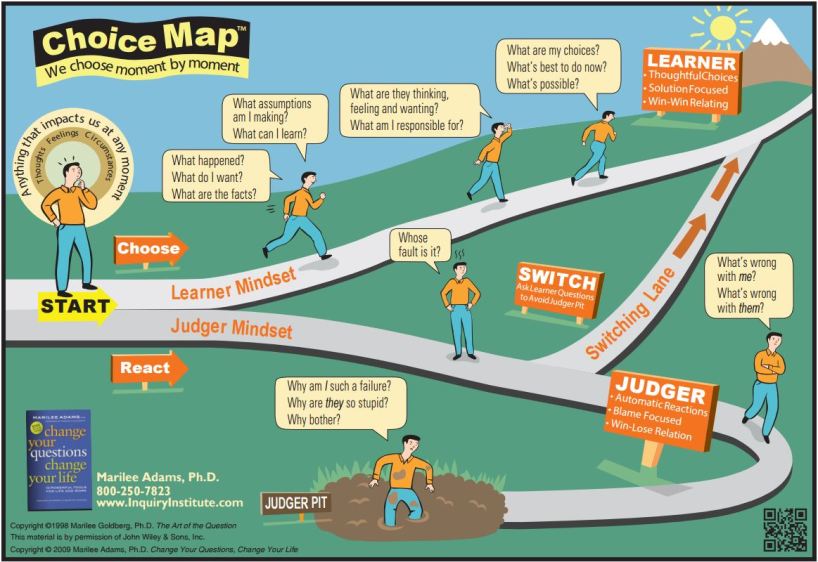
One of the biggest changes in my attempts to change my own behavior in the past 2 years or so has been in the realm of observing vs. judging.

As an example, let me pick on a current trend – I haven’t been meditating in the last week and a half. I generally do so first thing in the morning but, due to a combination of a cold and a couple of disruptions, I’ve been waking up later than usual. In some ways, the core issue is disruption in the morning routine. The usual instinct would be to ask “judging” questions and attempt to use a firm hand – e.g. force myself to get back to routine tomorrow.

However, the approach I take instead is to just observe. In observing, I find myself asking learning questions, e.g, “why is this happening?”, “what are the consequences of this trend?” and even “how long will this continue?” I am my own guinea pig. :-) In addition to this, I also take note of a weekly count of meditation sessions during my week review time on Saturday.

Over time, I’ve built confidence in the fact that observing coupled with the act of measuring consistently tends to bring the changes I want to bring. And, this happens because I take off the pressure that judgment brings.

An example of this approach has been exercise – over 60 weeks that I have data for in the current system (I have some old data too elsewhere), my average exercise sessions in a week has gradually increased with time. It currently stands at 5.2 which means roughly 4 x 25 min sessions and 1.5 days of walking 10,000 steps at least. This is better than it was last year and the improvement has come from the same observe and measure process. Similarly, my average meditation count for 60 weeks is 1.7. However, if I take a 1 year look at this, we’re at 2.7 (3 is the target).

As with all meaningful life learnings, the guiding principles are consistent. In this case, it is playing the long game and focusing on learning questions versus judging questions.
observing, measuring, learning, judging

It is just the applications that are different.

Approaching mock interviews or presentations

Mock interviews or presentations are an opportunity to refine your own judgment of how to approach the real thing well. Too often, they’re viewed as a place to receive feedback you never thought of.

If you have a good mock interviewer or audience, the likelihood you will get good feedback is high. But, that isn’t the point as it is only useful in the short run.

The way to approach practice of any sort is to use your coach’s (in this case, your mock interviewer’s or audience’s) feedback to train your own judgment on when things are done well. This means that the onus is on you to look at your performance critically before the session and walk in with a hypothesis on what needs to get better. All these hypotheses then get tested and validated, or not.

Practice with a coach is both great and important. But, you’re going to need to develop the discipline to coach yourself over time. Besides, game time is an exercise in solitude and listening to your own gut.

It is best to be prepared for that.

mock interviews,presentationsSource

Clubs that don’t accept you

There are many who live by the Groucho Marx quote – “I don’t want to belong to any club that will accept me as a member.” The principle here is that you should always be “reaching” for something better.

This makes sense in some contexts but, like most popular quotes, is horrible advice in many contexts. The principle underlying the execution of the idea is constant comparison. “Is associating with them going to make me look better?” And, the issue with this is that we’re always trying to find the next thing. That, in turn, means we’ll never stop to appreciate what we have.

My counter point to the Groucho Marx quote would be – “Look around, become aware of all the clubs that have accepted you (when they didn’t really need to) and make your acceptance count.”

Life is better when we commit to what we have and stop comparing. Better clubs will open their door for us when we do things of value. I think it is just important to realize that them opening their doors doesn’t just make us better. At that point, it makes them better too.

And, more than ever, it is those who took a chance on you when you got started who deserve all the credit in the world.

clubs that don't accept youSource

Out on a limb

Facts about going out on a limb –

  • You have to wrestle fear and self-doubt before you can do so
  • The feeling of putting yourself out there when you ask for a favor you didn’t need to ask, ship a side project or make a connection you didn’t really need to make can be excruciatingly uncomfortable
  • It is far easier to be comfortable and do absolutely nothing
  • You have to embrace the possibility that it might not work (and for good reason – it doesn’t actually “work” as you intended most of the time)
  • Every once a while, you’ll hear some negative feedback that you will remember for a long time
  • Most of all, it feels unnatural

But, most good things in life come from embracing ideas that don’t feel natural. And, nearly all good things come from doing things that are difficult.

As the wise Scott Peck might say, perhaps all we need to do is to accept that it is difficult. For, once it is accepted, the fact that it is difficult no longer matters.

out on a limb,

Unintended consequences

Most decisions we make have unintended consequences. These unintended consequences are typically caused by the downstream effects of a decision, i.e., your decision results in something (that you likely hoped for), that, in turn, causes something you probably didn’t intend.

There are 2 ways to avoid negative unintended consequences –

1. Experience. If you’ve experienced it before, you know what to expect and how to guard against it. This is how good lawyers earn their keep. They are fantastic at scouring all available legal literature to make sure you are protected from negative consequences of important decisions.

2. Developing the discipline to let it play out in your head. While experience is ideal, if we’re learning and growing, it is likely that we’re exposing ourselves to new situations. And, developing the discipline to let the trickle down effects of our decisions play out in our head is vital to making good decisions. Lazy decision making has bad consequences – a decision whose immediate effects may look good may have bad after-effects. It is only when we make the effort to let decisions play out in our head do we understand the real trade-offs involved. Making decisions by understanding trade-offs to the best extent possible is good strategy.

A simple example of this is letting people schedule times on your calendar for meetings at random. If you have meetings scheduled every 2 hours every day this week, say goodbye to doing work that matters.

The interesting thing about letting the effects of decisions play out in your head is that you often realize that, while the context may be different, you’ve experienced something similar in the past. And, when realize you’ve seen the movie before, you also know exactly how it ends.

unintended consequences, decisions

People who gave you a shot

Today, let’s take a few moments and think about and give thanks to the people who gave us a shot – at a time when we most needed it.

Let us then think about and give thanks to the people who went out on a limb and advocated for us – when they absolutely didn’t need to.

Then, let us also think about and give thanks to the people who believed in us – at a time when we didn’t necessarily believe in ourselves.

And, now that we have given thanks to these wonderful people who’ve shaped our lives, let us go be that person for someone else.

When you are thankful

There is a lot written about gratitude and understandably so. The saying – “It is not happy people who are thankful. It is thankful people who are happy” – definitely rings true.

That said, I don’t think the test is just about being thankful. I think it also matters when you are thankful.

For example, when I am down with a bad stomach or an injured foot, I naturally think about a fully fit body and find myself giving thanks for the fact that I only have minor niggles to deal with. But, those are examples of forced gratitude – gratitude that is caused by an intervention of sorts. Similarly, it is relatively easy to be thankful for your life or for those of your loved ones when you hear about someone passing away. Again, that’s thanks to an intervention.

So, I think the type of gratitude that really counts is when you give thanks at times when you don’t have any reason to give thanks. When everything is going great, we rarely find the time to stop and give thanks for everything that’s going well. But, I’d argue that doing so is a sign that you’ve got the “being thankful” skill (and it is a skill) down.

And, good thing too. There are few more important skills for a life well lived.

thankful, gratitude

The Road Less Traveled

In the “Road Less Traveled,” Scott Peck begins with –

“Life is difficult.
This is a great truth, one of the greatest truths. It is a great truth because once we truly see this truth, we transcend it. Once we truly know that life is difficult-once we truly understand and accept it-then life is no longer difficult. Because once it is accepted, the fact that life is difficult no longer matters.

When he dives into the topics of reflection and change, he raises the question – is it ever possible to become free from emotional pain in this life? And, the answer is yes and no. Yes, because once it is accepted, in a sense, it ceases to be pain. And, no, because competence brings with it responsibility and power. And, when you wield power, you need to make decisions and the process of making decisions with self awareness is a painful one.

I wrote about this a few weeks back when I shared how making it a habit to tell it as it is hasn’t gotten easier with time – even if I do it habitually. To this, Scott has a lovely response – “The best decision-makers are those who are willing to suffer the most over their decisions but still retain their ability to be decisive.” 

I loved that. I’ve found that to be very true. And, to me, that speaks to the difference between aiming for non-attachment and detachment.

A dear friend recommended this book to me a few days ago and I decided to buy a paperback (an unusual occurrence but I’m finding myself drawn to paperbacks again, of late) and keep it by my bedside table. Such a good decision. I’ve found myself nodding once every paragraph. In Yoda’s style, this book would be described as – “Packed with wisdom, this is.”

road less traveled,

The moment we grow up

The moment we look at ourselves in the mirror and say – “I am responsible for my life experience” – is the moment we grow up.

It doesn’t matter whether we’re 20 years old or 80 years old. In some cases, some go through a lifetime without ever growing up – growth is completely independent of age.

The funny thing about this moment is that it isn’t that life gets any easier after you accept this. The difficulty level stays the same. But, we stop focusing on it. Instead, we focus on all the aspects of our life experience we want to fix. And, when we re-direct our focus to something, it fundamentally shapes our experience. The more we focus on things we control, the more we feel our ability to control things expands.

But, it begins with taking responsibility.

(It is futile to wait to be “given” responsibility for our own life experience)

grow, responsibility

A deep life

Cal Newport’s new book “Deep Work” is just out as of this week. I love Cal’s work and downloaded it the morning it came out on Audible and am looking forward to getting through it in the next two weeks.

deep work,

I don’t expect the book’s insights to surprise me – Cal’s thought process generally resonates with my philosophy and he also shares his thought process via his excellent blog. (My framework for doing work that matters is – focus x intensity x hard work – and the book focuses on the intensity portion.)

That said, I am excited about the book because I expect him to bring together all this learning, help condense it into a thesis and also help me think through actions to increase the percentage of time I spend in deep work mode. More depth = more mindfulness after all.

So, I am looking forward to obsessing about “deep work” in the next 2 weeks. After all, as Cal nicely puts it, “a deep life is a good life.”

Here’s to that.