Why you should invest in Crypto in 2018

Most folks look at investing in crypto in a one dimension fashion. Investing a portion of your financial net worth isn’t the only way to invest in new technology and reap great returns. Investing your time could pay off wonderfully well in the long run too.

And, I’d like to make the case that it is well worth your while to invest in understanding crypto in 2018.

We’re on the brink of something historic…

In his post reflecting on what happened in 2017, venture capitalist Fred Wilson shared the Perez Technological Surge Cycle. This is a framework by Carlota Perez — a Venezuan scholar on technology development.

If you look at the Carlota Perez technology surge cycle chart, which is a framework I like to use when thinking about new technologies, you will see that a frenzy develops when a new technology enters the material phase of the installation period. The frenzy funds the installation of the technology.

2017 is the year when crypto/blockchain entered the frenzy phase. Over $3.7bn was raised by various crypto teams/projects to build out the infrastructure of Internet 3.0 (the decentralized Internet). To put that number into context, that is about equal to the total seed/angel investment in the US in 2017. Clearly, not all of that money will be used well, maybe very little of it will be used well. But, like the late 90s frenzy in Internet 1.0 (the dialup Internet) provided the capital to build out the broadband infrastructure that was necessary for Internet 2.0 (the broadband/mobile Internet), the frenzy in the crypto/blockchain sector will provide the capital to build out the infrastructure for the decentralized Internet.

And we need that infrastructure badly. Transaction clearing times on public, open, scaled blockchains (BTC and ETH, for example) remind me of the 14.4 dialup period of the Internet. You can get a taste of what things will be like, but you can’t really use the technology yet. It just doesn’t work at scale. But it will and the money that is getting invested via the frenzy we are in is going to make that happen.

Fred has been bullish on crypto since he started investing in it in 2017. So, it makes sense that he’s calling it the next phase.

Or, are we?

Let’s consider the counter point — there was an interesting article on Hacker Noon recently that said the blockchain is most likely useless. Below are the headlines —

Everyone says the blockchain, the technology underpinning cryptocurrencies such as bitcoin, is going to change EVERYTHING. And yet, after years of tireless effort and billions of dollars invested, nobody has actually come up with a use for the blockchain — besides currency speculation and illegal transactions.

Each purported use case — from payments to legal documents, from escrow to voting systems — amounts to a set of contortions to add a distributed, encrypted, anonymous ledger where none was needed. What if there isn’t actually any use for a distributed ledger at all? What if, ten years after it was invented, the reason nobody has adopted a distributed ledger at scale is because nobody wants it?

The blogger takes all the use cases discussed so far and takes apart the rationale for a blockchain based solution. It is a fun read. Similarly, “Mr. Money Mustache,” one of the top personal finance bloggers on the internet had a post on “Why Bitcoin is stupid.” In it, he says —

The Cryptocurrency bubble is really a replay of the past: A good percentage of Humans are prone to mass delusions which lead to irrational behavior. This is a known bug in our operating system, and we have designed some parts of our society to protect us against it.

These days, stocks are regulated by the SEC, precisely because in the olden days, there were many, many stocks issued that were much like Bitcoin. Marketed to unsophisticated investors as a get-rich-quick scheme. The very definition of an unsophisticated investor is “Being more willing to buy something, the more its price goes up.”

Don’t be one of these fools.

Reconciling these points of view. Most of us come at problems with a selfish question — what’s in it for me? Or, put differently, is it worth investing in this?

Given this, here’s how I’d break it down. There are two investments we can make in new technology — money and time.

Let’s deal with money. There are tens of thousands of crypto tokens out in the wild. Many of them are nonsensical and some are ludicrous. All save a few will likely go down to zero in value in the next five years. Unless you are a crypto expert, it makes little sense to invest in “Initial Coin Offerings.” And, if you are an expert, you’re likely not reading this post anyway.

There are a few mainstream coins that are in the news — primarily Bitcoin and Ethereum. If you have tens of millions of dollars in net worth, buying a few Bitcoin — assuming it is in the low single digits of your net worth — may be an interesting experiment right about now. But, it’d still be an experiment. Investing in Bitcoin is what institutional investors and Billionaires are putting their money in right about now. So, for most of the rest of us, the time has passed.

In that sense, I agree with Mr Money Mustache’s premise — this isn’t the time to invest in crypto unless you’re open to speculating and experimenting with a sizeable portion of your wealth.

But, calling the blockchain worthless misses the point.

It takes multiple decades for a technology to get mainstream adoption. The foundations of the internet were set in the mid 1960s. Commercial use began in 1989. HTML and the idea of a webpage came by in 1994.

And, yet, it is only now that the consumer internet is mainstream. Businesses, on the other hand, are still moving to the cloud.

So, it might be 6 decades for the internet to become mainstream from when it was conceptualized and it will likely be 3 after promising infrastructure was built. These things take time.

If you want to understand why blockchains matter, think about databases.
We live in a data economy. The largest companies on the planet today own vast amounts of data in centralized databases. Their ability to use this data in more and more powerful ways (using tools like machine learning) is what makes them seemingly insurmountable today.

The core technology innovation underpinning the blockchain has made it possible to have decentralized databases. This was not possible before.

Thus, we can now build networks around these decentralized databases and create new incentive structures. In today’s world, the value of your data goes to a few large corporations. In theory, this would not be the case in a blockchain based world. That’s because anyone who contributes to a network would earn tokens based on a governance system created by the token creators.

Does this mean everything will be decentralized? Probably not. There is still value to centralization in many contexts. But, it doesn’t mean centralization is applicable everywhere either. We live in a world controlled by a few large corporations largely because we don’t have an alternative.

Blockchains promise a world where that might be different. They promise to take us down a path we’ve walked over the past century as we adopted newer pieces of information technology — more democratization and more permission-less innovation.

That’s why they matter.

And, that’s why it is worth investing your time in understanding them better in 2018.

PS: Of course, we’ll be spending plenty of time digging into crypto in future weeks.


Links for additional reading (with 5 of the notes mentioned above)

  • What happened in 2017? — on Fred Wilson’s blog
  • Why Bitcoin is Stupid — on Mr Money Mustache’s blog
  • Ten years on, the Blockchain is useless — on Medium
  • Centralization and Decentralization — on Notes by Ada
  • On Institutional Investor’s take on crypto assets — by John Pfeffer on Medium
Productivity and the manager in the mind

I’ve been mulling the subject of productivity over the past couple of weeks. As I love boiling things down to simple formulae or mental models, I think productivity = focus x intensity x time.

Since time isn’t unique to us, our individual productivity is a function of focus and intensity. Focus, as I define it, is our ability to do the right things. It is the leadership aspect of productivity and ensures we’re doing things that actually matter. Intensity, on the other hand, is our ability to get the most of the hours we spend. This is the management aspect of productivity and ensures we’re doing things right.

There’s always a tension between the act of leading and the act of managing. Leading is, by definition, focused on a vision or true north. It is characterized by purpose and generally is inspiring.

Management, on the other hand, is all about operationalizing that vision or true north in the best possible way. It requires processes and systems and deals with trade offs. Trade offs are what we need to make when the rubber hits the road.

We see this tension play out in every organization. Leadership owns the grand vision while management owns the execution. When the tension is managed well, the result can be magical. When it isn’t (and it isn’t most of the time), the results are pretty poor.

A key skill in managing this tension is the ability of a manager to set the right expectations. When expectations are set right, targets are set right and the amount of work to get there involves the right amount of stretch. When we engage people with the right amount of stretch, learning, growth and a whole host of powerful things happen.

Of course, when it comes to personal productivity, there is no massive organization with layers of management and leadership.

There is just… you.

The interesting thing here is that this dynamic plays out the exact same way in our own minds. We play leader and manager every day and decide how this conflict plays out. The leader within probably woke up this new year set an inspiring agenda of the many projects to take on and the many areas of personal change absolutely necessary. It is now on the manager to set the right expectations and set us up for success.

Unrealistic expectations on how much we can get done are a perfect recipe for unhappiness and an ensuing lack of focus given the dissatisfaction.

This is why productivity transcends any great hack out there. It is a very personal quest to finding systems and processes that work for the leader and manager within. I came across a quote once that said – “The essence of zen is the ability to focus on one thing at a time.” That is hard to do because productivity is a mental game.

You either learn to master your mind to get what you want done or let it master you.

Dealing with worry

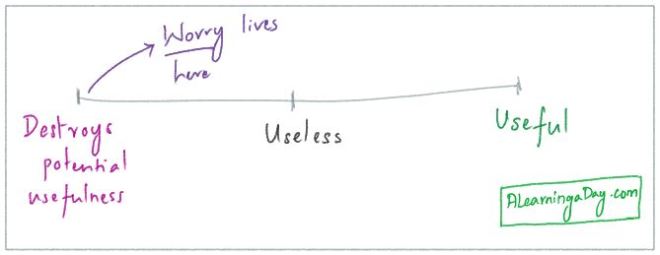
Worry is the opposite of useful. It destroys any potential usefulness. You’d think I’m referring to the word “useless.”

But, I’m not.

Wasting time watching more than 10 minutes of today’s news is useless. Spending more time than you need surfing others’ vacation photos is useless.

Worry, however, is much worse than useless. It is un-constructive, i.e., it doesn’t just waste your time – it debilitates your ability to get anything productive done for a long time.

I took the time to make the case against worry because it is important to understand the size of a problem before you deal with it.

There is no one-size-fits-all solution to dealing with worry. Most folks have their own custom approach. However, it is impossible to deal with a problem you don’t understand. Acceptance follows understanding. And, it is only with acceptance that you can expect change.

The best way to understanding a problem is to write about it. My new all-time favorite nugget about writing is that the word essay comes from the French word “essayer” – which means “to try.” Writing is our attempt to try and figure things out.

This is why the first and most important step to dealing with worry is to write about it. As we write, we figure out what the nature of the beast is. And, this understanding is the basis of our ability to deal with it.

Questions and intent

Questions are a useful way to demonstrate intent. The way you ask a question in a discussion, for example, can clearly indicate if you want to contradict, challenge or learn.

However, questions are only good replacements for intent if you don’t have enough context.

If you are meeting an acquaintance who reached out for a favor, “how can I help?” is a good question to ask. Most people tend to be reluctant about asking for favors. So, asking “how can I help” sets the tone and demonstrates that you intend to help. Besides, you only have limited time with your acquaintances. So, it also helps center the conversation.

However, I’ve learnt time and again that “how can I help?” is a poor question in a conversation with a close friend, team member or spouse. Instead, it is best to stay engaged and listen – the opportunity to help will reveal itself over the course of a conversation. If time is limited, a question like “what’s top of mind” works better. That’s because you have a great opportunity to demonstrate intent by just showing up and listening. Asking “how can I help” feels like a lazy, insincere, substitute. Asking “will x help,” on the other hand, works much better because it shows you’ve given possible solutions thought.

Questions are powerful ways to show intent. So, it matters that we’re intentional about how we use them.

Maker days and manager days

The Farnam Street blog has a great post on maker days and manager days.

A manager’s job is to, well, manage other people and systems. The point is that their job revolves around organizing other people and making decisions. A manager’s day is, as a rule, sliced up into tiny slots, each with a specific purpose decided in advance. Many of those slots are used for meetings, calls, or emails. Managers don’t necessarily need the capacity for deep focus — they primarily need the ability to make fast, smart decisions.

A maker’s job is to create some form of tangible value. A maker’s schedule is made up of long blocks of time reserved for focusing on particular tasks, or the entire day might be devoted to one activity. Breaking their day up into slots of a few minutes each would be the equivalent of doing nothing.

The post is worth reading in full. To me, it inspires three questions –

  1. What percent of your job is maker versus manager? (University researchers tend to be >80% makers for example – while executives tend to be >80% managers)
  2. Is your schedule aligned percentages above?
  3. If not, how can you align it?

My approach in the past year involved organizing my week into maker days and manager days. I scheduled 2 maker days and expected to average around 1 maker day in reality (thanks to meetings).

But, as I head into the new working year, I’d like to be more thoughtful about this. So, here’s to that.

21 day habits versus 3 year construction projects

Many have been sold an idea that it takes only 21 days to create a new habit. Do something new every day till Jan 22 and you’re set for this year and the next few.

Sadly, it is one of those ideas that does no long term good. It only serves to set you up for disappointment.

I reflected recently on important habit changes I’ve attempted over the past decade and I’ve come to realize that the most valuable of the lot took, on average, 3 years. The first few were infrastructure habits – reading nearly every day, writing every day, sleeping 8 hours, waking up early, and exercising regularly. Over the last few years, they’ve been mindset related habits – defining a purpose and attempting to live in accordance to it and focusing on processes versus outcomes.

I realized this as I reflected on the process I made on the theme for 2017 – engagement. My takeaway was that the progress I made this year involved awareness – or identifying the extent of the mountain I have to climb. I made headway to improving my engagement at work – with a no laptop or leave policy in meetings I chose to attend as an example. But, I realized I’m far from where I’d like to be at home. Similarly, I made significant progress in the specific areas I wanted to focus on – health, information diet and seek to understand and then to be understood. But, then again, I still feel I’ve got a long way to go.

That sounds like a “fail” grade on the report card. But, I realized that this was normal. In each of the previous examples, the first year was all about identification and awareness. The second involved testing solutions and, hopefully, finding a few that work. And, the third involved practicing them.

Habits worth having are 3 year construction projects. They take a lot of patience, many check ins, a lot of re-commitment and kindness – to ourselves. But, there are few things more powerful than being able to look at yourself today and to realize that you have made changes in areas that mattered to you. Even if it takes 3 years, the juice is always worth the squeeze.

I know that isn’t the most exciting or inspiring thought as you think about habits you’d like to work on in the new year. But, it will hopefully set you up for success in the long run.

That would be success in my book.

Thank you

Thank you..

… for your trust and attention over the course of the past year(s).

… for being open to a different and occasionally provocative point of view.

… for writing in every once a while to let me know that a note has resonated.

… for being willing to share your disagreements with me so I can learn from your point-of-view.

… for sharing ways in which you are learning, growing and making a difference in the world.

I am very grateful.

Wishing you a fascinating 2018 filled with challenges, frustrations, love, learning and laughter.

Pressing refresh

The power of the new year lies in the shared belief that this change in date is accompanied by us pressing the refresh button.

With the new year, we can reset anything we choose to – old habits, behaviors, relationships and even the few extra pounds we gained over the past months. It still needs us to put in the work – but, there’s something inspiring about starting with a blank slate. Hitting refresh is a powerful idea. As technology geeks know, hitting the refresh button on your browser only changes things that need to change.

Similarly, if you’ve spent a bit of time reflecting over the past few weeks, you know the areas you’d most like to change. My learning has been to focus on one change (with up to three sub changes if you are feeling ambitious) and find ways to check in with yourself through the course of the year.

The interesting thing is that the idea of pressing the refresh button during the start of the new year is just a construct.

If we wanted to, we just need to build in regular reflection into our schedule and allow ourselves the time to press refresh. For example, We could choose to reinvent ourselves every weekend if we choose to. Or, even every day..

What if we did?

PS: I did a podcast with a friend and a long time ALearningaDay reader yesterday. Our 27 minute conversation involved geeking out on favorite books, a touch of philosophy and even some notes on Bitcoin. In case you are interested, you can find that here.

5 books that might change your mind – 2017 edition

Here are 5 books I read this year that might change how you see the world –

1. Born a Crime by Trevor Noah. “Born a Crime” was, without question, my book of the year. Trevor Noah has an incredible story growing up in poverty in South Africa. There are few on the planet who’ve known what it is to live in a ghetto and then follow it up with a glitzy career. There are fewer still who manage to keep a ton of perspective in the process. Great stand up comedians are excellent observers and chroniclers of life. His book does just that. It takes a rich experience-filled life and shares the story with many powerful insights, humor and class. Here are a few of my favorite quotes from the book.

2. Sapiens by Yuval Noah Harari. The one history book to rule them all. It is unusual for a book to have multiple seminal insights. But, Sapiens manages it. Harari is a phenomenal chronicler of history because he manages to weave together multiple powerful threads and create a compelling narrative. His insights on what makes sapiens so powerful (our ability to cooperate with each other), why (our ability to tell each other myths/stories by creating insititutions like corporations, religions and nation states) and how (through unifiers like money and knowledge) are, in danger of over-using the word, seminal. There’s plenty more in the book. I find myself talking about it all the time. If you haven’t read it yet, this is a must read.

3. Mindset by Carol Dweck. I’d heard of this book a few years back but stayed away from reading it as I’m not a fan of books that just state one idea over and over again. This is especially the case when I write a daily blog post on that one idea – building a growth mindset by focusing on learning. However, “Mindset” is as important a work as it gets simply because it reinforces how critical mindset is in our lives. It is the lens with which we see the world. I’ve been a long time fan of the choice map by Marilee Adams which brings the same idea to light using slightly different labels (learner vs. judger instead of growth vs. fixed). Professor Dweck’s work, however, is much more rigorous and more all encompassing. Very powerful book.

4. Bad Samaritans by Ha-Joon Chang. I’ve been on a “I’d like to understand how we got to now” trip over the past year – since events such as Brexit and the US election. Part of the motivation was to understand what is going on and part of it was to question my own beliefs. A year ago, I never questioned the rationale behind free trade. Thanks to Bad Samaritans, I understand why it is important to. Ha-Joon Chang makes a powerful case against the “unholy trinity” of the IMF, the World Bank and the WTO. He shares economic data that clearly points to a simple idea – these organizations, the bad samaritans, act on developed country interests and push developing countries to adopt policies currently adopted in the developed world against their own interests. This is because there’s clear evidence that these policies were not what made the same developed countries rich. He also argues that it is foolish to link culture to economic development as it is economic development that drives the culture it needs (spoiler: the Japenese were once described as lazy). Again, powerful stuff.

5. The Master Switch by Tim Wu. This was another in my “how we got to now” trip. The Master Switch chronicles the history of information industries – telephone, movies, radio, television and the internet. I learnt a ton from this book and it is one which should be on the “must read” list of anyone who has a passing interest in technology. It drives home the point that nature of speech (free or not) in a nation follows the structure of its information infrastructure. It also helps frame debates like net neutrality and also points to why crypto currencies are likely to be the future. That aside, however, the book often gave me goosebumps as it chronicles the rise of powerful corporations we take for granted today. Somebody should make a movie about this stuff – it is that good.

More book resources:

Happy reading!

Default reactions

The Hogan personality assessment (one of the better ones out there) has eleven traits grouped into three defaults reaction to conflict –

  1. Moving away: Avoid true connection with others; pulling away; seems indifferent; described by others as independent, aloof, and / or detached.
  2. Moving against: Deals with self-doubt by behaving in dominant, intimidating ways; try to build self up and make themselves feel better than others; described by others as overly assertive, argumentative, stubborn, and willing to challenge others; always seem to have “boxing gloves on”; motto seems to be “strike before being struck”.
  3. Moving toward:  Tend to respond to stress by seeking acceptance of others; intense desire to feel well-liked, accepted, involved, and appreciated.

The Hogan thesis is that every one of us tends to have a dominant default reaction amongst the three. Each of these default reactions is thanks to our greatest strengths as well as their corresponding weakness. And, it is in our interest to understand, build awareness and take action so we don’t fall prey to the dark side of these forces. For the psychology geeks out there, the three reactions map nicely with the fight, flight and freeze responses.

My default reaction is moving against. This natural reaction means I’m good in tough situations since it calls for energetic responses. However, it also comes with a propensity to over react to the smallest of stimuli. Not everything is a crisis after all.

One of the ideas I’m meditating on (/thinking about) is – how can I do better with my default reactions?

The best antidote I’ve identified to this default reaction is to keep a sense of humor. This is not something I naturally bring to the table. But, it is one I have endeavored to keep more of over the past two years. There is hope yet.

The steps to make this sort of a change are the same as in any other. I first need to clearly see the problem. Then, I need to commit to solving it. This is followed by  testing various solutions. The process of testing brings increased awareness and points to the one solution that will actually work. And, then, finally, I can change. These changes projects tend to be multi year construction projects.

And, as I move into 2018, I’m hoping to make significant progress on this one.