3 notes on decisions for the week

3 notes on decisions for the week –

1) Being afraid of making decisions is as useless as being afraid of being judged. Both are happening – whether we like it or not. So, we’re better off accepting that fact and dancing with it.

2) Once we commit to rising above the fear and making decisions, it is a certainty that we’ll get a few of them wrong. The only useful habit when faced with these mistakes is a focus on a creative, constructive, and corrective response. Fix issues and avoid repeat mistakes.

3) Nearly every decision we’re worried about right now won’t matter a jot in the long run. The stakes are generally far lower than we think. Worry less, smile more – this will pass.

Reason, season or lifetime

A few years back, I came across a model for relationships that has stayed with me. It said people come to your life for a reason, a season, or a lifetime.

Folks who come in for a reason are like guardian angels who swoop in for a short period of time – right when we need them. Folks who are in for a season are with us for a few years – bringing wonderful memories and moments from those times. And, folks who are in for a lifetime find ways to stay with us all the way through.

It gets harder to maintain close relationships as we grow – especially if physical proximity isn’t a given. We change, others change, contexts change, and so on. A lot of the angst in relationships (as in life) comes from an inability to deal with this impermanence.

The beauty of the reason-season-lifetime model is that it reminds us of that impermanence. In retrospect, I can think back to a couple of relationships that didn’t end well – but which clearly existed for a reason or season. And, I can also think of a couple that fizzled out despite an incredible season. Trying to extend these into relationships that last a lifetime was futile.

Understanding and accepting past relationships for what they were enables us to forgive, forget, and simply savor the special moments.

It also enables us to let go of unnecessary baggage and travel lighter. On long journeys, that’s a great way to travel.

Challenging career switches and vanity metrics

Folks who are attempting challenging career switches (top graduate school or some combination of industry, function, location change) often make a mistake that turns out to be debilitating for their search. They index highly on “conversion rate.”

You know this is happening when the internal dialog is – “I applied to 7 places and no one / only one person got back to me.” They’re implicitly calculating a conversion rate of 0/7 or 1/7. While that may be bad for a standard job search, conversion rate is just a vanity metric in challenging searches.

You could have applied to 100 places for all I care – what matters is finding that ONE place that will give you a shot. A focus on conversion rate is, thus, a recipe for giving up too quickly. Having made this mistake myself, I can’t overstate the importance of avoiding it.

If you are convinced the challenging career switch is right for you, your most important allies are grit – passion and perseverance – and a growth mindset. As long as you are learning from your missteps and improving your approach, one opportunity will eventually show up.

And, all it takes is for one to work out.

Internet speed and monopoly power

My mom used to have a 16 MBPS (mega bytes per second) internet connection a few years ago in India. However, in the past 3-4 years, there’s been a slew of new competitors in the broadband market and her internet speed right now is 75 MBPS. Thanks to the competition, the costs have also gone down every year.

We had a 150 MBPS connection via Comcast at home last year. Comcast recently notified me that the 150 MBPS was actually a “special offer.” And, if I still wanted it, I’d have to pay $15 per month extra. I could keep my current rate – but they’d lower our speed to 60 MBPS.

I called up our apartment’s front office to check what my options were if I didn’t choose Comcast. She explained to me that there were none.

So, I called Comcast back and said I’d take the downgrade.

Now, 60 MBPS is more than sufficient for normal internet use. In addition, this is definitely a first world problem. However, it illustrates the cost of a regulation driven monopoly. When your users have nowhere else to go to, you can do the bare minimum and get away with it.

It doesn’t mean you should. But, the incentives to drive profits and “shareholder value” at the expense of customers with no alternatives is very powerful indeed.

Looking outward

There’s a lot written these days about millennial employees looking to find purpose at work. These discussions are interesting and speak to the challenges executives and HR professionals face as they seek to combine monetization with collaborative and inspiring workplace.

That said, I do find myself wondering how much of this is actually about the desire to find purpose at work versus seeking those powerful and elusive intangibles like happiness, equanimity, and peace of mind.

If it is the latter – and, in many cases, there’s reason to believe it is – seeking fulfillment at the office is just a distraction. Regardless of how wonderful the values might be, workplace cultures are built around incentives like pay, promotions, and performance reviews that encourage us to look outward. The powerful intangibles that we tend to seek, on the other hand, only exist when we look inward.

No amount of effort will help us find them if we spend it looking in the wrong places.

Find them within ourselves, we must.

Triumph of spirit

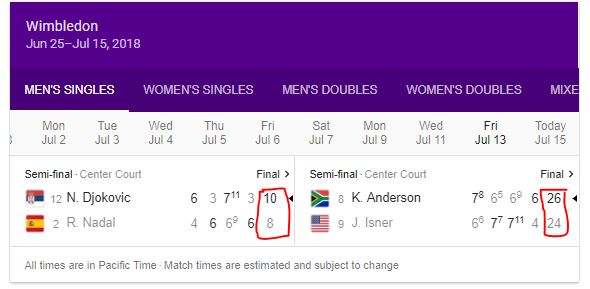
I love mega sporting events. In the space of a few days, they regularly showcase the best of humanity – the warmth of supporters from opposing countries, stunning displays of athleticism, nerves of steel, and spirit from the players. We witnessed all of this in the World Cup and Wimbledon. Since the arrival of 2 kids, I am temporarily just a score + highlights follower. But, my oh my, what scores and highlights they were.

The Wimbledon semi final score line tells the story of the men’s bracket. The athleticism on display from Djokovic and Anderson was something else.

Then again, Serena Williams’ runner up run after giving birth to a baby just 9 months ago takes the gold medal for jaw dropping awesomeness.

And, finally, the world cup had so many wonderful displays of spirit. But, if there was an award for spirit, Croatia would have won it. The Croatian team has faced many trials and tribulations off the court in the past few years with a big corruption scandal. What a way to bounce back. They reached the final following stirring comebacks in every one of their three knock out games – all of which went to extra time. The final, however, was always going to be a mismatch. France’s ridiculously talented side won the world cup despite never really peaking. There’s plenty more to come from this team.

Spirit is a set of qualities that form the key elements of a character of a human. Sporting events such as the World cup and Wimbledon remind us of the power of that spirit. What do such events mean for the rest of us then?

There may be no world cups in our workplaces. But, that doesn’t mean we don’t or can’t showcase spirit. Unlike in the case of such mega sporting events, we are all running the marathon of life. And, the best demonstration of our spirit lies in how we show up everyday – at home and at work.

The world cup is now over. It is on us to take this inspiration and make it count.

Career decisions and partners

A member of our team did a fireside chat with an executive/wise friend who was leaving our organization. One of the questions he asked was about her most important career decision.

After giving it a moments thought, she said – “Marrying my husband.” She went on to share her appreciation for their relationship, for their partnership as parents, and explained that it was key to any success she had enjoyed in her career and also to her happiness.

I think about that answer from time to time.

I grew up in India where marriage is a default decision. Most kids growing up in India don’t think about whether marriage is for them. It is just something you do once you get out of college and get a job. Kids come after that.

Economic development changes the nature of such default decisions. The US in the 1950s wasn’t all that different. You found a job, married young, and had kids. That has changed and we’re seeing that change in the urban centers of India too. We all have our own unique journeys. Marriage is not for everyone. And, having kids is definitely not for everyone.

That said, if you do decide that it ought to be part of your journey, marriage does end up being a critical decision. Once you are past the honeymoon phase, your partner becomes your shrink, best friend, life coach, loyal critic, movie buddy, and romantic partner all in one. By this time, you’ve heard all of each other’s stories and know every one of your crazy quirks. It can be hard to both love and like people you know well – that’s why relationships take work.

In addition, both your personalities, likes, and dislikes influence each other and you find a thermodynamic equilibrium of sorts over time. If you then decide to have kids, you move from testing your partnership in the little leagues to playing in the major leagues. The challenges and stakes get higher as you try and balance being parents and partners while learning to trust each other’s decision making processes.

Successful careers are the result of a large team of contributors. No one does anything of note by themselves. A few succeed despite bad partnerships. But, in most cases, careers are only as successful as the strength of the partnership at the center of it all. That’s because great partnerships in life are like great partnerships in sports and business – both of you push each other and grow together to become the best versions of yourself while complementing each other as a team.

Over the years, I’ve spoken to a lot of friends and colleagues who were thinking about marriage. It is a hard topic to talk about because you don’t have many personal data points to draw from if you have done it well. It is also why I don’t write about it that much. But, if I were to speak from my experience, I’d probably say it is worth being very thoughtful about that choice. And, once we choose, it is on us to commit wholeheartedly and do the work – every day. It definitely is the among the most important decisions we get to make.

In the final analysis, this partnership and this life are completely what we make of it. And, if we want to and are lucky, we have the opportunity to work at making it special and fun – together.

The Queen died. The King died.

Take 1: The Queen died. The King died.

Take 2: The Queen died. And the King died of a broken heart.

Five extra words transformed two boring facts into a story capable of stirring emotion (“Aww”). There’s a lot of talk about storytelling with mental pictures of Steve Jobs floating around. But, if you had to be reductionist, the formula (probably) would be –

Stories = Facts + Context + Emotion

As we move from one meeting to the next pitching our ideas, it is worth remembering that facts and logic only help people reach conclusions. Stories, however, bring emotion to the table.

And, it is emotion that drives action.

(H/T Dan Pink – for such a memorable illustration on the power of stories.)

Open plan offices – counter to the counter point

Cal Newport and David Heinemeier Hansson had strong critiques of open office plans this week (Cal, David). They’re both thought provoking thinkers/writers and I understand where they’re coming from. That said, their arguments are built on the incorrect assumption that the primary purpose of open offices is to foster collaboration.

While that may be the party line, I think the two primary reasons for open offices are cost and culture. Office space is expensive and open offices are much cheaper on a per-employee basis. Cost is a powerful organizational incentive.

Culture is an often overlooked part of the discussions of open offices and is why richer technology firms have embraced open offices. Having executives work at their desks a few meters away from entry level analysts makes leadership feel more approachable and less hierarchical. It signals certain cultural values and changes the dynamic from workplaces where the goal is all about getting to that coveted corner office.

The absence of the culture variable is also the weakness in most studies on open plan offices. The effect of signaling these cultural values is hard to measure in the short term. But, just because something is hard to measure doesn’t mean it is less important.

I still think the commonly cited issues with open offices should be addressed – this critique of open offices based on their propensity to foster predatory behavior against women, for example, is important and needs to be fixed. We need more spaces and cultural norms that make it easy for people to focus. It may also be that companies with strong hierarchical cultures are just not suited for open plan offices.

The issue just isn’t as simple as is often outlined. And, it is hard to move these discussions forward if we don’t understand the trade-offs involved.

Studying and Learning

Doing well in school required us to get good at studying. To study, per the dictionary, is to devote time and attention to acquiring knowledge on (an academic subject), especially by means of books. 

Studying, however, is different from learning. To learn is to gain or acquire knowledge of or skill in something by study, experience, or being taught.

The (albeit subtle) difference lies in the outcome. Studying is focused on the process of acquiring knowledge while learning involves practical application. The real test of learning is what we end up doing with what we learn.

The challenge with teaching learning in schools is that learning is hard to test in a final exams. So, we fall back to testing students’ ability to study. Of course, the obvious downside of this approach is that it is likely we end up completing two decades in schools without a good understanding of how to learn.

The good news is that our education didn’t end with graduation. There is still time to learn how to learn. And, the beauty of learning is that we see the results of what we’ve learnt in our actions every day. To learn and not to do is not to learn. So, if we aren’t actually evolving and improving how we approach our days – every day, it is time to revisit how we learn.

It is the highest leverage thing we can do with our time. After all, studying might have helped us do well in school. But, learning helps us do well in life.