The degree to which a company cares about your call is inversely proportional to the number of times you hear – “your call is important to us.”
As we learn in G R R Martin’s “A Song of Ice and Fire” – words are wind.
The degree to which a company cares about your call is inversely proportional to the number of times you hear – “your call is important to us.”
As we learn in G R R Martin’s “A Song of Ice and Fire” – words are wind.
The common approach to solving problems is to get a team together, brainstorm, and agree on a prioritized approach to get to the solution. Spending time in solution space can be both fun and energizing. This is what we were trained to do as kids in school after all – solve problems.
But, as I look back at the many occasions in which the solution space failed to yield a solution that worked. I realize that it wasn’t because of the intelligence of the team or the effectiveness of time spent in the solution space. It was because of a poorly defined problem.
While good problem solving is undoubtedly important, we get the opportunity to make disproportionate contributions when we hold back these natural impulses to jump to the solution space and, instead, take the time to define the question.
Problem space >>> Solution space.
I recently met someone who collects points as a hobby. He mentioned he currently has more than 2 million points – enough for fully funded airfare and hotel stays for more vacations than he has time for.
But, that doesn’t stop him from collecting points. He does it because it feels like play. The process is far more interesting than the outcome.
This exchange reminded me of the power of combining passion and purpose. Passion asks “what has the world got to offer that fits my interests?” while purpose asks “what have I got to offer the world that has value?”
We’ve seen a lot of good rebuttals to the “follow your passion” advice over the past few years. The central theme is that we don’t often know what our passion is. Instead, we’re better off focusing on purposefully getting good at something that has value as passion often follows expertise.
While it is the pragmatic approach and one that at least ensures we’re not waiting around for the universe to reveal our passion, it has its downsides too. For example, if collecting points was a lucrative profession, I could become an expert at it. But, the process will never feel like play.
Ergo the power of combining passion and purpose.
It is magical when we’re able to get good at something we care deeply about. For most of us, that may mean a long and winding road to understand what this is and a lot of trouble to eventually get there – but, the juice tends to be worth the squeeze.
Activation energy is the minimum quantity of energy required for a reaction. The activation energy idea shows up every day in our lives in the form of the minimum amount of energy required to build momentum toward what we want/need to do.
Activation energy is why its hard to get to the gym on a cold morning. It is why getting started on something important is painful.
But, for those of us who have (at least on occasion) managed to make it to the gym on a cold morning, we have likely experienced that is easier to work out long and hard once we’re there.
Activation energy, thus, regularly stands between us and desired habits. So, it is worth understanding activation energy and how we can work with it.
Overcoming activation energy requires willpower. In the long run, the best use of willpower is to create habits. Habits, in turn, help us reduce the amount of activation energy required to get something. But, it isn’t easy to create good habits. So, here a couple of interesting questions for us to consider in our quest to do so –
1. What are ways to reduce the activation energy until we create a habit? For example, we could start the year with a commitment to go to the gym with a friend for the first 6 months. Or, perhaps, we might pay for a personal trainer.
2. Are there ways to bypass the friction and still reach the end outcome? A consistent home workout for a month may be a great way to get us into the habit. Once we consistently begin to feel the benefits of a good workout, it becomes to lower the activation energy threshold.
Like most things, activation energy is neither good or bad. It just is. And, our experience with it is what we make of it.
Given the sheer competition for attention on the internet, it is a melting pot of extreme opinions. Extreme opinions are great for publicity and entertainment value. They can also be pretty useful to spark debate.
But, by spurning nuance, extreme stands rarely help us get to the truth of the matter.
My approach over time has been to treat extreme opinions like the dissonance between the quotes – “many hands make light work” and “too many cooks spoil the broth.”
Each is useful in stretching our thinking in the right context.
But, the truth, almost always, lies somewhere in the middle.
The advice “be kind to yourself” tends to resonate with a lot of folks (me included) because of our default tendency to be harsh with ourselves. For years, however, I found myself wishing I’d find an easier way to remember it in the moment.
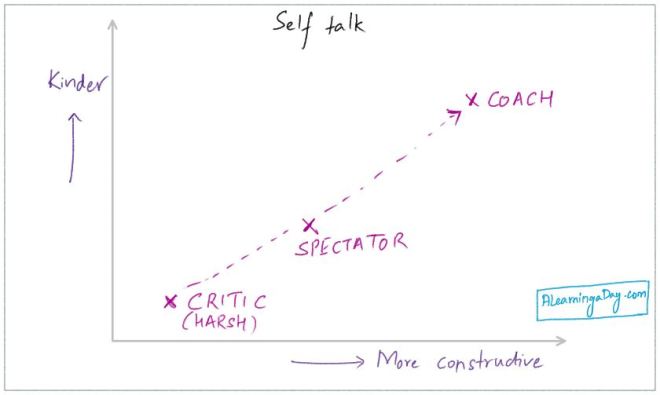
A model I’ve begun using to better translate this powerful idea reframes it around the question – who does your self talk sound like? I’ve picked three characters my self talk tends to sound like depending on the day. It could either be harshest critic (“that was a dumb move”), spectator (“hey, what happened there?”), or coach (“let’s talk about what happened there and what you’ve learned from it”).
You could imagine other characters across the spectrum- mom, close friend, critical friend, etc – depending on your natural tendencies.
Thinking about self talk from the lens of these characters and reminding myself to channel the coach more often has made it easier to implement “be kind to yourself.” Here’s hoping it stays.
If you have ideas/models/habits that work well for you, I’m all ears.
Performance coach Brad Stulberg shared recently – “Don’t aim for consistently heroic efforts. Aim for being heroic at consistency.
Heroic efforts = take a huge toll emotionally, physically, and cognitively. Not a sustainable thing to strive for.
Consistency = compounds over time. Good enough over and over again makes you great.”
It resonated.
In his book, Morten Hansen uses a concept he calls the “learning loop” to apply the principles of deliberate practice at work.
He suggests the following – pick one skill you’d like to get better at, find a coach/create a plan to improve the skill, periodically review progress, and then loop through the process.
The most useful lesson I took away from his approach was to pick one skill – just one. I’ve been guilty of trying to improve three or four things at a time for far too long. The downside of running so many loops is the absence of focus.
This simple idea has changed how I think of improving my ability to “communicate constructively and with clarity” during the workday. I can sense the sharp increase in awareness as I communicate over the course of the day. And, I’m looking forward to experiencing the results of this increase in focus in a few months.
Another timely reminder that more is not better. Better is better.
I received a replacement screen protector recently (warranty). As detail oriented tasks are not my strong suit, I went to an AT&T store to request help with putting it on my phone screen.
A minute into the procedure (for the lack of a better word), the sales associate who kindly helped out was getting visibly frustrated. He had aligned it nicely but was unable to remove four remnant air bubbles. So, I gave it a try and got the number down to two – both of which were below the screen.
As he was steeling himself to try again, I thanked him for his time and explained that I’d be happy to live with this.
I admittedly came home and tinkered with it for another minute – but, I stopped.
For every such decision, I can think of multiple – big and small – where I’ve wasted a lot of time attempting to get to better and then to perfect. No good has come out of that wasted time.
The list of things worth maximizing in this life are very short. The sooner we realize that, the easier and happier our days are.
And, in case you are wondering about screen protector – I haven’t noticed it yet. When I do, I plan to do what I generally do when dealing with damaged objectives – I remind myself that the bubbles exist to remind me that life isn’t perfect.
It isn’t – thanks heavens for that.
We recently received an Echo Dot as a gift. We tend to take a wait-and-see approach with most new technology and this was no different. 3 reflections from the first 3 weeks –
First up, our biggest use case is music – specifically children’s music. While we set the occasional reminder, Alexa and Amazon Music (free with Prime) have been an amazing add to the family. Amazon Music’s collection of children’s songs by the likes of Lisa Loeb and Caspar Babypants (the Taylor Swift and Ed Sheeran equivalents for adults) is fantastic. And, it is much easier to request music by voice than fumble with a phone or an iPad while carrying a kid.
Amazon’s free music collection is also impressive. While we occasionally stumble upon a song that isn’t available, their radio stations / playlists are top notch for English music.
Second, Amazon delivers on value for money at the $30 price point. For most people, the Echo Dot might just replace the need for a speaker. I’ve written plenty about Amazon’s lead in the battle for the home – this experience has been further validation of the strength of their offering.
Third, I find it fascinating that Alexa and Google Home only offer a better manners option as part of parental controls. Why is it that we consider better manners only for the purpose of teaching kids?
From my experience, I have become more polite in the process of requesting our 2 year old to be more polite. I’d argue adults need this as much as kids do.
Perhaps the teams could consider a requirement for all users? At least one “please” for every 3 requests?
Overall, a fascinating device and one that has definitely added value.
PS: There is, of course, the downside of having a device over hear conversations. The party line from Amazon is that Alexa only hears things when she’s summoned. I am reluctant to buy that and have gone in with the assumption that anything within Alexa’s hearing range is sent to Amazon. As things stand with our experiment now, that’s a trade-off we’re willing to live with.

