We kicked this series off with a look at the 4 core skills of an individual contributor Product Manager – problem finding, problem solving, selling, and building effective teams. Then, we defined what a product manager does – a product manager brings a team of cross functional stakeholders together to build a product that is valuable, usable, feasible. Today, we’ll dive into that small matter of career progression and explore the foundation of long term career progress – knowing thyself.
Khe Hy, a blogger at “RadReads,” had a useful illustration on a general career arc.
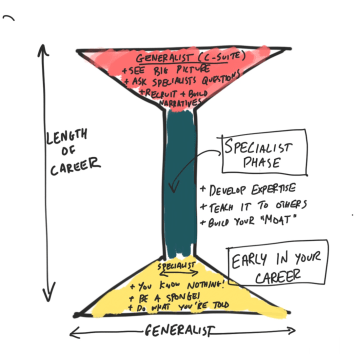
As Khe’s illustration demonstrates, there’s a lot to be gained from exploration early in the career as it helps us figure out what we’d like to be good at. Then, we invest in becoming specialists. And, finally, if we’re interested and able, we get to zoom out again as executives who oversee multiple specialist areas.
While these ideas translate well for product manager careers, my version of the the career arc for product managers would look something like this.
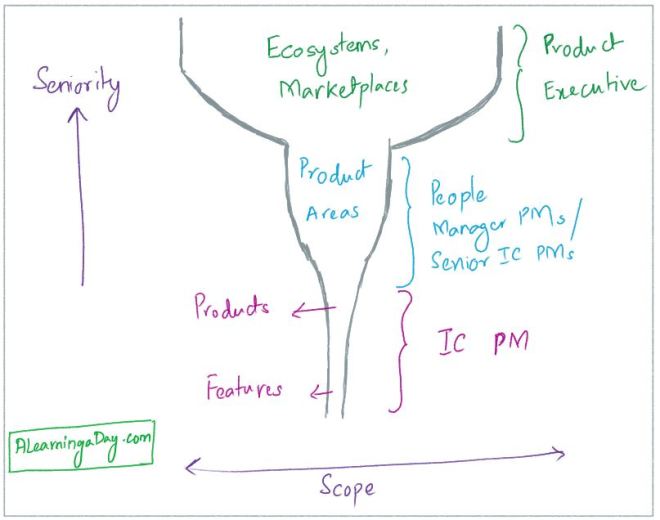
Individual contributor/IC PMs start with a focus on narrow features and small products. Over time, they take on larger products and product areas. Larger product areas are typically led by people managers (“Group”) or senior ICs (“Principal,” “Staff”). And, product executive teams typically oversee entire marketplaces and ecosystems.
Now, if we were to visualize this career trajectory as a building, the foundation would be self awareness. The deeper the foundation, the sturdier the building.
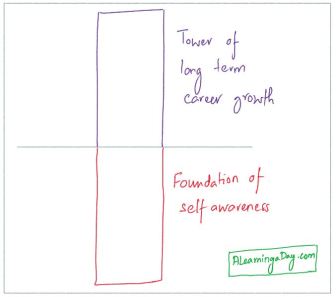
While this holds for careers across industries and roles, it is very pertinent to any role building technology products. Building a technology product takes a village – with team members across functions coming together to ship a finished product. Given the critical nature of teams and people in this process, emotional intelligence is a key asset. And, self-awareness/knowing ourselves is the cornerstone of emotional intelligence.
(Note: There is the alternative approach to building product teams which we can call the Steve Jobs v1.0 approach. This involves “my way is the highway” + some reality distortion + hopefully backed by once-in-a-generation product intuition. This post is for the rest of us.)
What is self-awareness and how can I get more of it?
There are two kinds of self-awareness –
i) Internal: This represents how clearly we see our own motives, values, passions, aspirations, fit with our environment, reactions, and impact on others.
ii) External: This represents our understanding of how others view us.
My observation is that external self awareness is crucial for career progression while internal self awareness is correlated with career fulfillment and happiness.
The challenge with both kinds of self-awareness is figuring out how to get more of it. Approaching this topic can feel very daunting. Ergo, my favorite tool to make this process easier – a “user manual.”
How do I creating my own User Manual?
Step 1 – Create a first draft user manual: Block out 60 minutes of your calendar next week and take a crack at a 1 pager that has some or all of the following –
1) Getting responses and work done: E.g. share your preferred work hours, preferred communication channels, and best times to schedule meetings.
2) My style: 3-4 must know characteristics about your working style
3) What I don’t have patience for: Focus on specific behaviors that drive you nuts.
4) How to best communicate with me: Share how you prefer to consume information – e.g. some prefer written memos or sketching on a whiteboard while others prefer verbal pow wows.
5) What people misunderstand about me: These typically involve flip sides of your signature strengths.
6) Things I’m trying to get better at: 2-3 improvement areas you are focused on.
7) Random Quirks: Something fun. :)
Step 2 – Share with close teammates for feedback: Share with a few folks (/work friends) who know you well and see if this one pager accurately represents you.
Writing the first draft involved drawing on both your internal and external self-awareness. While very few can help you better articulate what you care about, feedback from close colleagues can help give you a measure of your external self-awareness.
Step 3 – Set up 30 mins to review with yourself every month: The power of the first draft of the user manual is that it marks the beginning of the journey. We never “achieve” self-awareness. We just get on the train with our first draft user manual.
As you spend more time with it, you will find yourself tweaking the user manual after every review and crystallizing your random thoughts (at least at first) into themes. For example, I ended up synthesizing the 3 aspects of my personal culture (hungry, thoughtful, learning focused) as I iterated on sharing “my style” as part of this process.
As a bonus step, you might even want to consider reviewing your user manuals jointly as a team. We did this on one of our cross functional teams recently and it turned out to be a very powerful team building exercise.
Conclusion: While short term career progress tends to be a function of good on-the-job skills, long term career (think: decades) progress tends to be correlated to our self awareness. The beauty about self awareness is that it is a skill that is foundational to better relationships – which has implications well beyond our time at the office. And, I’m a fan of using user manuals to aide the development of the skill.
If you find yourself stuck with creating that user manual and would like to see an example, please feel free to check out the Quartz article below for further reading. I’ll also be happy to share mine if that might help – please feel free to send me a note on rohan at rohanrajiv dot com.
Further reading:
i) Tasha Eurich, an organizational psychologist and executive coach, assembled a team to share her findings on both kinds of self-awareness. If you haven’t seen it, I’d recommend reading it here (you can also see my 5 point synthesis here).
ii) This Quartz article on user manuals is a helpful starting point.
iii) If you are curious about more resources to figure out your motives and values – here are a couple of posts (motives, values and mission statement) that might help.


