Much of our ability to be present involves training ourselves to stop staying yes when we want to say a no.
It feels okay in the moment. But, our future selves generally despise us for it.
Much of our ability to be present involves training ourselves to stop staying yes when we want to say a no.
It feels okay in the moment. But, our future selves generally despise us for it.
I walked into a store near our place to buy pens yesterday. As I entered, I realized the shop was rather dimly lit. But, I intended to buy a couple of pens and went about trying to do so. However, the lady at the shop was so unwelcoming that I abandoned the idea just as I was about to pay for them.
As I walked out, I wondered why we ended up in that situation. The obvious initial focus was the unhelpful storekeeper. However, the situation she was in wasn’t great either. The shop dimly lit and didn’t have air conditioning turned on (not ideal in our home city in India). Would a good attitude last in such circumstances?
Then again, why would someone with a desire to do well choose such a circumstance in the first place?
I ended up realizing that the relationship between our circumstances and our mindset are that of a two way loop that reinforce each other. Once we accept our circumstances, we get to shape them.
Then, they shape us.
My mom recently was asked to narrate a story to our two year old daughter ten times in a row. This wasn’t a particularly entertaining story – it was the back story of how a fixture at home got there. But, nevertheless, she wanted to hear the story ten times and was an enthusiastic listener every time.
Such repetition isn’t out of place in a two year old’s life. As they take in new sights, sounds, and language, familiar stories help them find a balance of “explore-exploit” that they’re comfortable with.
The incident did get me thinking about repetition however.
Are there many other ingredients that are more important to a life well lived than repetition? And, if the repetition is smart – i.e. if it incorporated learning from the previous round – so much the better.
The act of loving those we care about contains a lot of repetition – giving many hugs and kisses, appreciating them for the little things they do, and consistently doing the little things that matter to them ourselves.
Building expertise in any skill involves a lot of smart repetition – deliberate practice, consistent routine, and a daily willingness to progress beyond physical and mental pain.
Love, wealth, happiness, and everything else that makes this life worth living is borne out of smart repetition.Take action -> learn from it -> do it better. Rinse. Repeat. Watch your efforts compound over time.
Every student of this journey comes to that point when he/she realizes that this life isn’t about doing big things. Instead, it is about doing those small things with extraordinary care – with plenty of smart repetition.
Nick wrote in wondering if I could publish the fiction recommendations I collected during the holiday season thanks to recommendations from those of you who wrote in. Thank you so much for sharing again… and here goes –
Armada by Ernest Cline
Ender’s Game by Orson Scott Card
Unbroken by Laura Hillenbrand
The Hitchhiker’s Guide to the Galaxy by Douglas Adams
All the light we cannot see by Anthony Doerr
Children of Time by Adrian Tchaikovsky
Sisters Brothers by Patrick deWitt
Avogadro Corp by William Hertling
Mr. Pennubra’s 24-hour bookstore by Robin Sloan
The Books of Babel by Josiah Bancroft
The Long Way to a Small Angry Planet by Becky Chamber
The Rosie Project by Don Tillman
The Master and Margarita by Mikhail Bulgakov
The Poisonwood Bible by Barbara Kingsolver
Cixin Liu’s trilogy starting with the Three-Body Problem
The Punch Escrow by Tal M Klein
Ancillary Justice by Ann Leckie
Annihilation by Jeff VanderMeer
The Emperor’s Blades by Brian Staveley
Neverwhere by Neil Gaiman
Druss the Legend by David Gemmell
Rainbows End by Vernor Vinge
Foundation by Isaac Asimov
The Sisters Brothers by Patrick DeWitt
Lamb by Christopher Moore
Snow Crash by Neal Stephenson
The library at Mount Char by Scott Hawkins
Seveneves by Neal Stephenson
Sundiver trilogy by David Brin
The Sympathizer by Viet Thanh Nguyen
Lincoln in the Bardo by George Saunders
Extinction Point series by Paul Anthony Jones
Blasphemy and Tyrannosaur Canyon by Douglas Preston.
Watership Down by Richard Adams
Replay by Ken Grimwood
I began working my way through “The Science of Why” yesterday and was reminded of Daniel Kahneman’s equations for success from “Thinking Fast and Slow” –
Success = talent + luck
Great Success = a little more talent + a lot of luck
As someone who loves this topic, his equations made me chuckle. I tend to break up talent into a mix of privilege and mindset. But, that aside, it is nice that he omits hard work altogether.
The importance of luck – specifically in being in the right place at the right time – in our extrinsic success can’t be overstated. If you are swimming in an area where the tide is in, you don’t have to paddle.
Most of us know a friend who can pick up skills at will. They say they want to learn the guitar today, watch videos on YouTube for the next 3 months, practice, and emerge as a good guitar player. Or, they actually act on their new years resolution and go to the gym.
We know we can summon up the will necessary to do that for something that’s urgently needed at work. But, we’re generally unable to prioritize stuff that’s longer term/important.
My working theory is that this ability to do self-driven skill building is a function of two things – 1) how driven you are by achievement (vs. other motives) and 2) where you lie on the spectrum between obsessive compulsive and attention deficit. That combination results in a place in the skill building spectrum
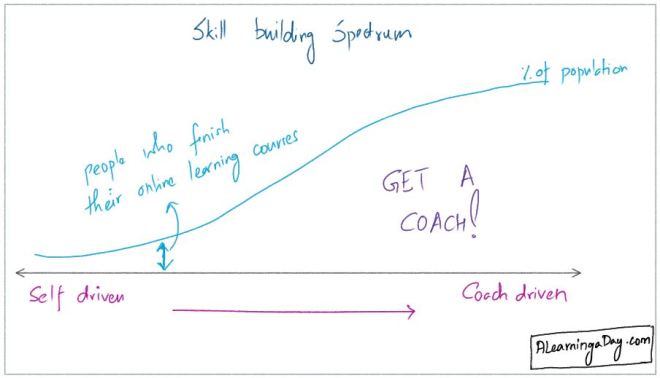
For most of us, skill building isn’t easy because we either need a peer group or, in most cases, a coach.
All this gets us to the key takeaway – the solution to accelerating our ability to learn and get better is not to kick ourselves for not being able to finish that course or go to the gym. It is to simply understand our preferences and get help from a professional.
PS: For what its worth, I think this is the greatest challenge for online learning. Only 3-6% of folks finish an online course they start. Imagine what we’d enable if we provided the support that many of the others needed.
Attacks to online security and password breaches are getting larger and more frequent.
While 2 Factor Authentication (2FA) will help prevent an “Account Take Over” following a breach, we’re in a better place to deal with potential problems when we know something happened. For example, “Account Take Over” aside, spammers might target you with emails claiming to be able to access your account because they have a password from a few years ago.
SpyCloud does exactly that. SpyCloud’s free service notifies you of any breach that involves your email address. It is becoming a must-have along with 2FA in our cyber crime defense toolkit.
It is interesting how often new year resolutions involving non-fiction books focus on breadth (e.g. targeting x books to read per month) and how few, if any at all, focus on depth.
As I’ve come to realize, breadth targets with non-fiction books are the equivalent of vanity metrics. If the goal is learning and growth, there is often more to be gained by picking ONE great book on a topic that matters to us and seeking to simply master the concepts of that book over the course of the year.
That’s because the act of reading alone doesn’t result in learning. It is the synthesis, reflection, and action that follows that results in learning.
In books as in many other things, choosing depth points to wisdom and potential transformation.
As I’ve belatedly been learning in the past week, the right way to lift something heavy is not to bend down to lift it. Instead, it is to do a squat.

Image Source: Healthwise
The reason to do the squat is because it enables us to keep our back straight and ensures our back muscles are supported by our leg muscles.
If this sounds obvious to you, good for you.
For me, on the other hand, learning this was a reminder that doing something in a certain way for a long time doesn’t make it right. That holds true for habits that seem to come “naturally” as well.
A note for new subscribers: This post is part of a monthly Sunday series on my notes on technology product management (this is what I do for a living). You might notice that these posts often link to older posts in the series on LinkedIn even though they are all available on this blog. That is intended for folks who only want to follow future product management related posts. Finally, for all those of you who don’t build tech products for a living, I believe many of these notes have broader applicability. And, I hope you find that to be the case as well…
We’ve covered the following topics so far in this series –
Why is writing for executive audiences a core piece of the sales and marketing toolkit? As IC product managers, many of our opportunities to persuade tend to come from sharing our thought process in writing with internal stakeholders (typically executives in the product management org)- via strategy documents, issue investigations, product specs, and email exchanges.
I’ve intentionally picked an internal audience as the focus because that’s where the biggest challenges tend to lie. When the organization is aligned on the problem that is being solved, it is much easier to build and sell a cohesive solution to users/customers.
For the purpose of today’s post, I’m going to assume most of the longer form writing happens in long form memo-style documents versus PowerPoint presentations. I’m also not going to focus on product specs as that will form the core piece of skill #3 – Problem Solving – and will be covered in our next post.
So, today’s note will be focused on strategy documents, issue investigations, and email exchanges for executive audiences.
The 3 step process. My suggested approach to writing (and speaking) experiences is to work through the 3 parts of the process – 1) Content – start early and write down everything you want to convey, 2) Structure – rewrite your content and make it easy to consume with a logical flow, and 3) Delivery – tailor the final delivery to your audience.
1) Content – start early and write down everything you want to convey. Block 2 hours on your calendar as soon as you know you have a document to prepare and write down everything you want to convey. Don’t worry about logic or structure – simply put all your ideas down in one place.
As simple as this sounds, there is a common pitfall in this process that I’ve seen myself and others fall prey to – postponing the act of generating content because of a desire for the perfectly structured first draft.
If you are most people, your first draft is going to suck. That’s expected. Procrastinating at this stage ends up becoming very expensive because most docs require multiple revisions. Great documents are rarely written in a day. They are also rarely written by blocking out 2 days prior to your review. Instead, the optimal creation process looks something like this.

2) Structure – rewrite your content and make it easy to consume with a logical flow.
“For the average business or professional writer, producing more literate memos and reports does not mean writing shorter sentences or choosing better words. Rather, it means formally separating the thinking process from the writing process, so that you can complete your thinking before you begin to write.” | Barbara Minto, The Pyramid Principle
Now that we have followed Barbara Minto’s advice and completed our thinking in step 1, we are ready to begin to write. The key at this stage is to pick a logical structure that will help convey your ideas. There should be plenty of examples of good structure around you – just look to prior strategy docs or issue investigation docs that have been well received.
Figuring out a structure should not be rocket science. For example, a good issue investigation doc follows a version of – 1. What is the problem?, 2. Where does it lie?, 3. Why does it exist?, 4. What could we do about it?, 5. What should we do about it?
Similarly, most good product strategy docs follow a version of – 1. Problem statement (user/customer need), 2. Size of opportunity if the problem is solved, 3. Our hypothesis and key assumptions, 4. Principles, 5. Strategy (where do we play?, how do we win?), 6. Roadmap / Tests to validate key assumptions, 7. Open questions/Areas we need help.
The challenge in this step (at least in my experience) isn’t finding a good structure – instead, it is in building the discipline to keep iterating on our original draft. Again, Barbara Minto puts it nicely –
“Once you put ideas in writing, they take on an incredible beauty in the author’s eyes. They seem to glow with a fine patina that you will be quite reluctant to disturb.”
The first draft is simply the act of laying down our thought process. The act of structuring involves breaking up with that first draft and rewriting to make it easy to consume.
3) Delivery – tailor the final delivery to your audience. All the work we put into writing and speaking is to persuade our audience. So, this 3 step process involves moving from “what do I want to say?” to “how can I best make my case to the audience?”

Great sales and marketers understand that their success is dependent on their understanding of their audience. When they understand their audience, they can create the sort of resonance in their messaging that leads to action. So, as product managers, this means doing the work to get to know our audience and asking ourselves – Do you understand how to build an argument that will resonate with your key stakeholders?
If the answer is no, we need take the time to meet with our stakeholders and understand them better.
This content-structure-delivery process applies to presentations and emails as well. While we’ve focused on the creation of a document, this process works just as well for preparing a presentation, answering an email, or taking questions at the end of the presentation.
I had shared an illustration recently with a few folks on “good, better, best” for answering exec questions (in Star Wars lingo of course :-)).

As you’ll see, the same process holds. If you are responding to an email, write down your thoughts, rewrite in a logical structure that focuses on clarity over completeness, and seek to deliver the message in a way that anticipates any obvious follow up questions.
You have less time to work through this process in a live Q&A – but, the same idea holds -> understand your audience’s intent when you answer questions. And, if it is unclear, clarify.
While the purpose of the structure stage is to build a logical argument, the purpose of the delivery stage is to transcend logic and create emotional resonance.

While logic will help lead our audience to the conclusions we derive, it is emotions that will help us persuade our audience to take action to support us in our quest to build better experiences for our users/customers.
A career and life sidebar: As you’ve probably noticed by now, this approach is applicable well beyond exec communication. This post could just as easily have been called “Writing clearly” or “Communicating with clarity.” But, in the spirit of focusing on emotional resonance, I have come to realize that the term “Exec Communication” resonates better. :-)

