Speaking about referees

“We’ve lost a game, I don’t think we should be speaking about referees, I can just compliment France and wish them good luck. They’re a fantastic team. They’ve got some brilliant players and Didier (Deschamps) has done a fantastic job. So congratulations to them.” | Gareth Southgate, Manager of the English football team, after their loss to France in the quarter final of the World Cup.

I thought this was a remarkably classy response to a question about decisions by the referee. Many managers would have taken the bait and said something unsavory.

But there’s nothing good that would have come off it. It wouldn’t have helped him or the team accept the defeat and move on.

Things rarely go according to our well laid plans. Complaining isn’t good strategy.

Learning from our experiences and continuing to move forward is.
Successful days and missteps

Most successful days/events tend to include some missteps and some unhappiness.

There’s no point being overly reactive to the inevitable misses. It is hard to get everything right and it is near impossible to make everyone happy. Perfect days/events don’t exist. Our memories just omit the imperfect details over time.

So, even on a good day/after a successful event, expect the good to be 70% of the story.

Then, acknowledge the unhappiness, learn from the missteps, and move on.

Back bencher or front bencher?

I had the opportunity to speak with high school students at one of the schools I graduated from recently. After the conversation, a high schooler asked – “Were you a back bencher or a front bencher?”

I explained to him that I was both. There were periods when I was happy to sit in the back bench. And there was a time in my final year of study when I decided it was important to sit in the front bench. So, the 4 of us who were known for being very chatty at the back of the class the previous year all moved to the front.

In retrospect, it was one of those decisions that changed the trajectory of my life. Sitting in front of the teacher and engaging with them helped me focus. Perhaps more importantly, it changed our implicit norms and culture – the same 4 kids who were okay with getting distracted in the past year committed to focus and engagement.

I then became a back bencher in my undergraduate years again. I chose not to engage and focus. I clearly hadn’t learnt my lesson then. But, as I graduated with a sub-par educational experienced, I resolved to never be a back bencher again.

It remains one of the better choices I’ve made.

We can choose our identity.

You’re right

I switched on my laptop today working through 3 possible ideas from today that I wanted to write about. I then read Seth’s post, shelved all those ideas for the coming days, and decided to just share it in full.

“If a customer, a colleague or a friend is generous enough to share their feelings, those feelings are what they are.

We might disagree with the assumptions that led to those feelings. But acknowledging that the feelings are real is a great place to begin a conversation.

“You feel this way” is not the same as “Everyone who experienced what you experienced would feel the same way.”

It spoke to a mistake I’ve made many a time in the past – not being able to separate the feelings from my disagreement about the assumptions.

I hope to do better.

Thank you, Seth.

Inconvenience today

The Metro rail project in Chennai is building new stations all over the city. At every one of these construction sites, the temporary walls have the tag line – “Inconvenience today for a better tomorrow.”

It is an idea that is applicable to every aspect of our life.

Our long term well-being is a function of our ability to consistently embrace inconvenience.

Socially obligated

A friend was reflecting on COVID-19 and the impact it had on the many social events he felt socially obligated to attend.

In his words – “One of the most amazing things about the past 2 years is that we managed to get through so many life events – births, deaths, marriages, puberty, and so on – without needing to make a big deal about all of them.”

He shared that the biggest thing he took away from all of this was that he’d be better off optimizing for quality in terms of the relationships and events he prioritized over quantity.

It resonated. Opting for quality and focus always feels counter intuitive.

Income and experienced well-being

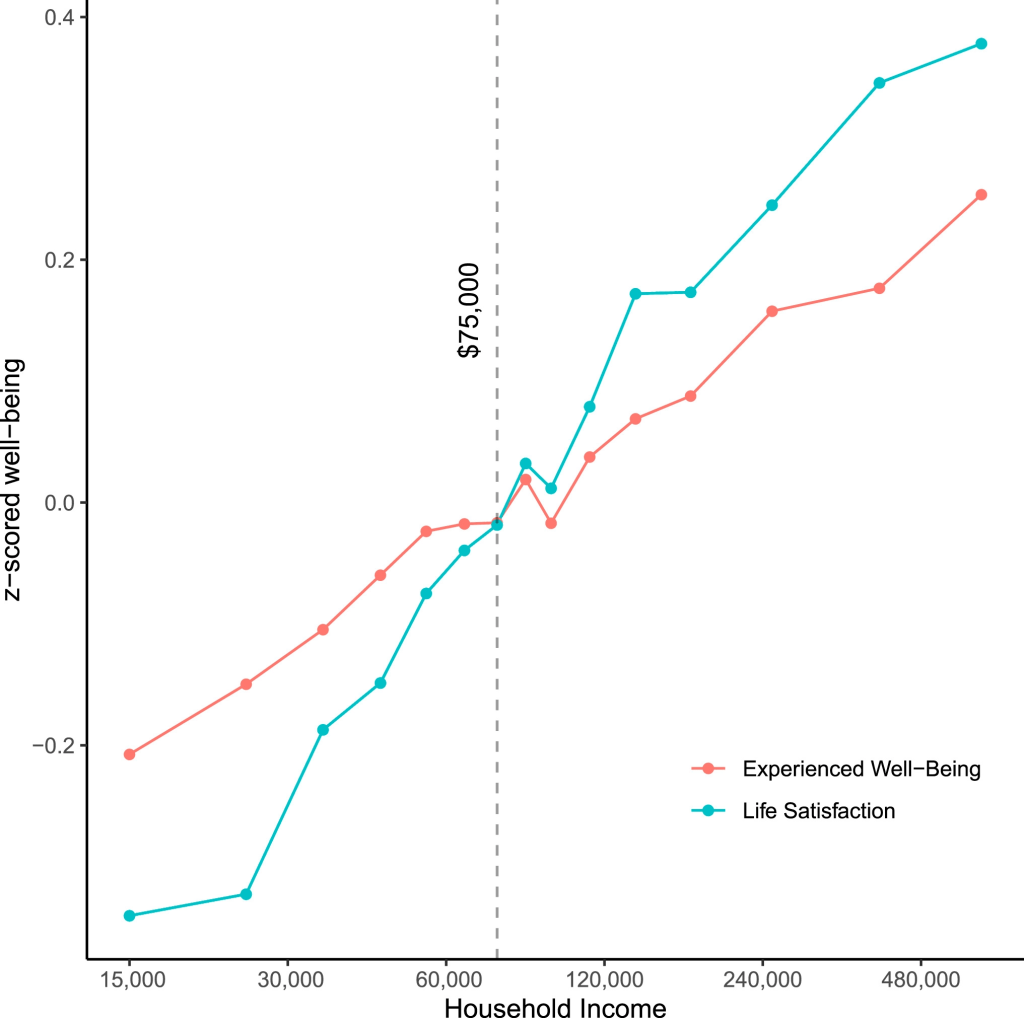
A popular study attempting to understand the relationship between money and happiness posited that there was a plateau in happiness once income reached $75,000. A recent study by Wharton professor Matthew Killingsworth – drawing on reports from over 30,000 professionals in the US – that used a continuous scale to measure well-being instead of the binary scale in the past studies found no evidence of this $75,000 plateau.

Instead, experienced well-being and life satisfaction rose with income.

So did positive feelings (confident, good, inspired, interested, and proud) relative to negative feelings (afraid, angry, bad, bored, sad, stressed, and upset).  


The relationship was logarithmic instead of linear. This means the difference in well-being in families that earned $20,000 vs. $60,000 would be similar to the difference between those earning $60,000 vs. $180,000. This means marginal dollars matter less the more one earns – i.e., you see much larger jumps in well-being when you grow income from $20,000 to $60,000 vs. $60,000 to $100,000.

In short, money contributes to quality of our life in a big way. The more money the better. And we do hit diminishing returns – however, that point is likely well above $75,000 and likely varies a lot based on where you live.

The freemium coconut water strategy

We were waiting outside a building to get an immigration item done. There was a friendly lady selling coconut water.

Unlike other coconut water sellers, however, she didn’t ask us to buy coconut water. Instead, she gestured toward a few plastic stools she had around her stand.

Many took her up on the offer. She was friendly and approachable and conversed with anyone who was willing. A few minutes in, she’d ask if they wanted coconut water. After enjoying her hospitality, it was much harder to say no. And given the strength of the sun in Chennai, it isn’t a very hard sell in the first place.

We asked her about her business and she shared that she sold 100-150 coconuts on most days nowadays (with higher expected revenues in the summer). Some quick math brought us to a conservative estimate of 50,000 INR per month in profits – a solid business.

That got us reflecting on her business fundamentals/strategy. She had a good product that was conducive to the environment. She then had a fantastic location with strong top-of-the-funnel awareness.

Building on these strong fundamentals, she then had a differentiated freemium strategy. Her free offering was the seating in front of her cart. She then maintained a strong upsell rate – optimized further by her approachability.

Well played.

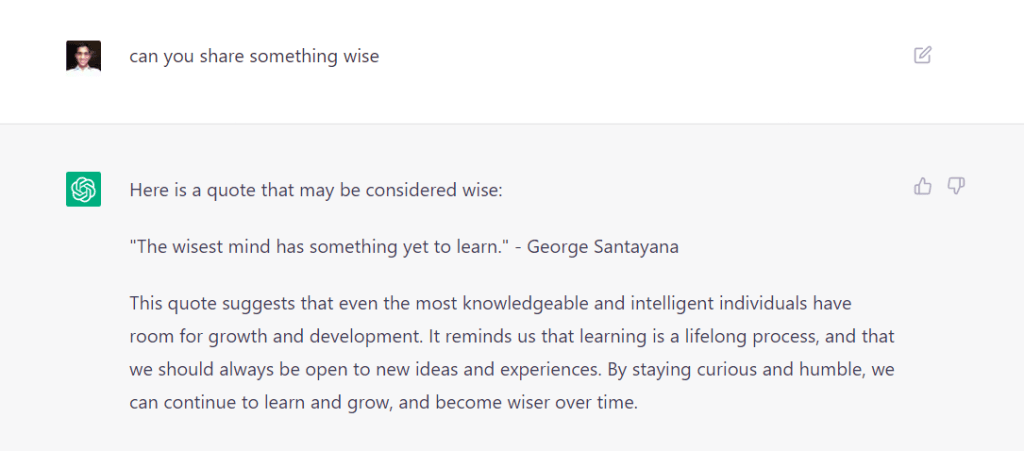
The wisest mind (with a catch)

“The wisest mind has something yet to learn.” – George Santayana

This quote suggests that even the most knowledgeable and intelligent individuals have room for growth and development. It reminds us that learning is a lifelong process, and that we should always be open to new ideas and experiences. By staying curious and humble, we can continue to learn and grow, and become wiser over time.


The catch? This post was written by Artificial Intelligence.

I’ve been sharing a learning/observation every day for over 14 years on my blog. Even so, there are days when I find myself scraping the bottom of the barrel thinking of something useful to write.

After the mind-blowing experience of playing with Open AI’s Chat GPT however, I’m beginning to wonder if those days are history. Getting a new quote every time I asked “can you share something wise?” made for an incredible product experience.


Goodbye writer’s block? (and welcome all sorts of unintended consequences)