COVID-19 #3: Mar 13 notes

First up, I have to acknowledge that I didn’t plan for my blog to become a COVID-19 update blog. But, this blog reflects what I’m learning and thinking about. And, this pandemic is definitely taking more mindshare than ever. So, I’d expect a few more posts in the coming weeks.

I had 5 notes about the virus today.

1. The White House’s overdue emergency declaration is a critical step forward. The White House At long last, the White House has declared an emergency. I am hugely grateful to the millions of traders/financiers who collectively moved the markets and spurred a response. We can finally do away from the nonsense about this being similar to the flu and move on to the work that needs to get done.

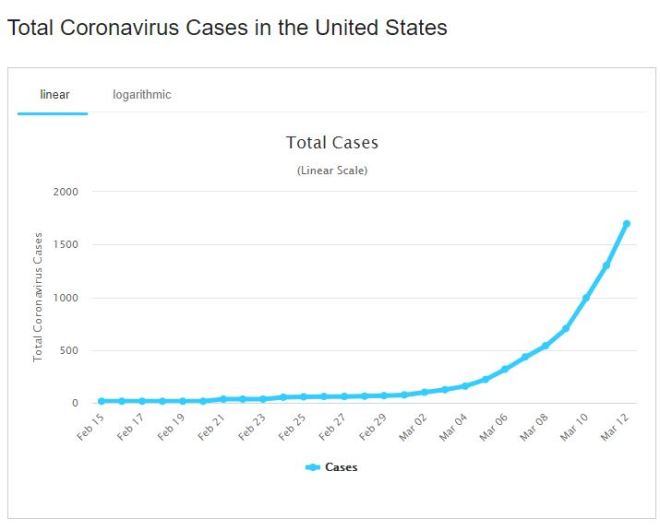
As the graph below shows, we are well into exponential growth territory in the US. The key question right now is – how quickly can we flatten this curve?
2. When this passes, I am hopeful Representative Katie Porter is celebrated as the heroine she is. If you haven’t see the video yet, you should.

She gets at the root of the biggest problem – the cost, without isolation, for a single individual without insurance to get tested are $1331. For a family, that can go up to $3000-$5000. A lot of front-line workers would be worried about these costs. And, yet, staying at home would only make things worse for the community.

To top it all, it takes five days for symptoms to show. So, who knows what’s happening already?

This is why she pushed the CDC to make testing free. This is also why the state of emergency is critical – it unlocks immediate funds for widespread testing. Until we test, we won’t know what the reality is. And, it is key to understand reality to then deal with it.

3. We moved into lock down where we are in Santa Clara County. The inevitability of exponential growth means this should ideally have happened a week ago.

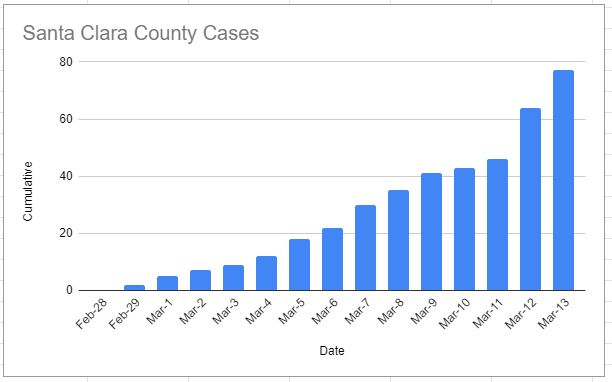
But, as things stand, we’re currently looking at this familiar looking graph. The key, again, will be how the lock down + increased testing shapes this graph. We’ll have a better sense in 3 weeks.
4. Lock down measures are important because people can be daft. If you haven’t heard about the genius who took a flight from New York to Miami knowing he might have the COVID-19 virus, it is worth a read for a simple reminder of how dangerous daft behavior can be.

The result of such behavior is that we have several others who are likely to be carrying the virus without symptoms over the next 5 days to different parts of the country/world.

5. If early drastic measures work, they look overly cautious. It’s been fascinating having a few conversations with family members in India. The initial reactions have been one of relative indifference. The challenge, of course, is the case curve in India isn’t all that different from the one I shared above for Santa Clara (in reality, a few days behind).

So, it doesn’t feel serious. But, from what we know about this virus, this is exactly the time to act. But, how do you act when it doesn’t feel serious?

This has been a fascinating insight into human behavior and gets to exactly why every climate crisis advocate has found it hard to make meaningful progress in the past year.


End note: Needless to say – avoid crowds and common areas, forget travel, wash your hands, avoid touching your face, etc. I’m having particular difficulty with the “don’t touch your face” part after getting a 3 year old’s elbow (accidentally) jam into my eye two days ago. So, maybe the message is – do the best you can. :-)

Also, while we’re at it, if someone can explain the rationale of stocking up on toilet paper, I’d appreciate that.
Posts: #1, #2

You only need one to work out

During a time when I was simultaneously in need of a break and losing hope that any of my shots would work, a friend pulled me aside and said – “Keep working the process and don’t lose hope. You only need one to work out.”

Every once a while, you hear a timely piece of perspective that changes everything for you.

That line did it for me. It completely shifted my perspective.

Over time, I’ve come to appreciate the importance of this perspective through the lens of many a friend and acquaintance’s job seeking journeys. That one thing rarely works out on schedule. But, given time, space, irrational optimism, iterative learning, and some dumb luck, it does.

For those seeking opportunities right now, those timelines have likely been lengthened given the pandemic. Hope you’re able to keep working the process.

All it takes is for one to work out.


PS: Closing the loop on the Premium subscriptions – if you filled that form, you should have heard back from me by Sunday night PT/Monday morning in Asia (and some time in between elsewhere). If you haven’t, please just send me a note on rohan at rohanrajiv dot com. Thanks!

7 notes on COVID-19

I shared a Coronavirus PSA a few days back. A lot more data has been gathered since and I thought I’d share 7 things I’ve taken away from what I’ve read.

1. COVID-19 is a pandemic – do not compare it with the flu. The World Health Organization has declared COVID as a pandemic. A pandemic is a world wide spread of a new disease whose impact tends to be higher due to the lack of pre-existing immunity.

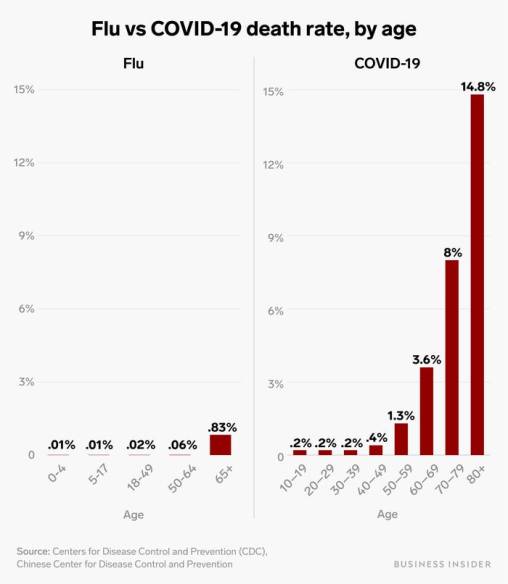
Here’s a simple chart comparing the death rates of both from a week ago. While new data is coming in every day, we are looking at an illness that is ~20x more likely to cause death.

2. It is growing exponentially. Every person who contracts with the virus passes it to more than 2 on average. This means it is spreading more rapidly than most folks can comprehend. The main question to ask is – how long is it taking for the number of cases in your area to double?

In most places, the answer is 3. Let’s imagine a country has 500 cases today. In 1 month, these 500 cases will become  1 million. And, within the next month, it would hit a billion people (assuming there are a billion to infect). (More on Our World in Data)

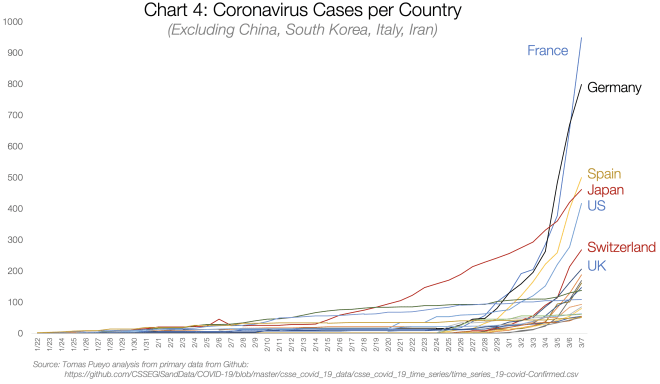
Tomas Pueyo shared an excellent post compiling data we have so far. Here’s a chart of what exponential growth looks like outside the 4 most affected countries.

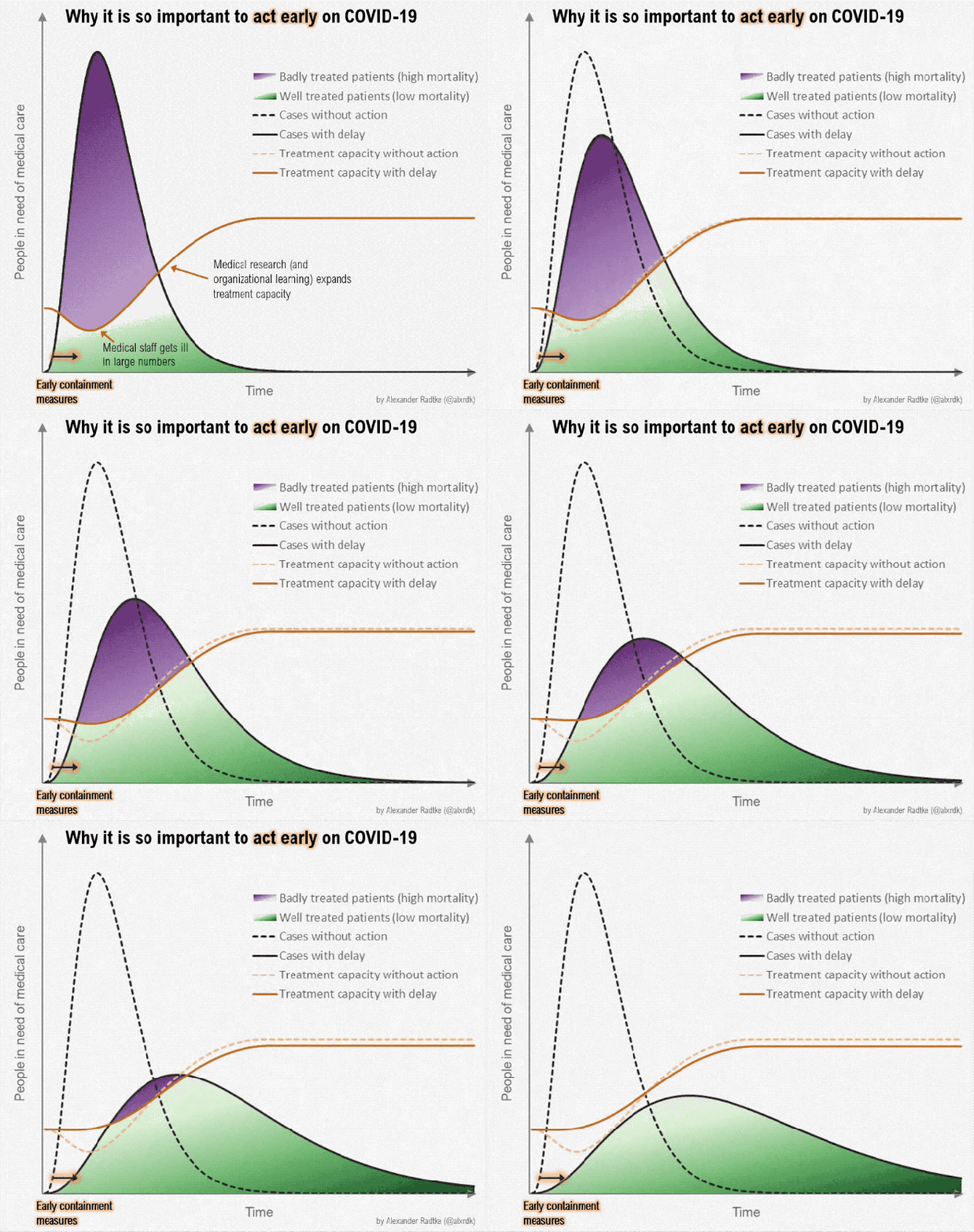
3. The only reasonable strategy we have is to flatten the growth curve. As is the case with viral infections, we will all get it in time. 80% of us will only experience non critical symptoms. But, 20% will need medical care.

If this spread happens too quickly and before we have a cure (as is the case right now), the numbers will overwhelm any healthcare system – only worsening the situation in the absence of a vaccine/cure. So, it becomes critical to act early.

The earlier we take drastic action – effectively shutting down the country (workplaces, schools, etc.), the better the long term situation. The short term trade-offs are very real – specifically, a hit to the economy – but the long term effects make this the best strategy by a distance.

4. Japan, Hong Kong, and Singapore did just that. Learning from the SARS epidemic, all 3 countries acted really early and their growth curves look very different from the rest.

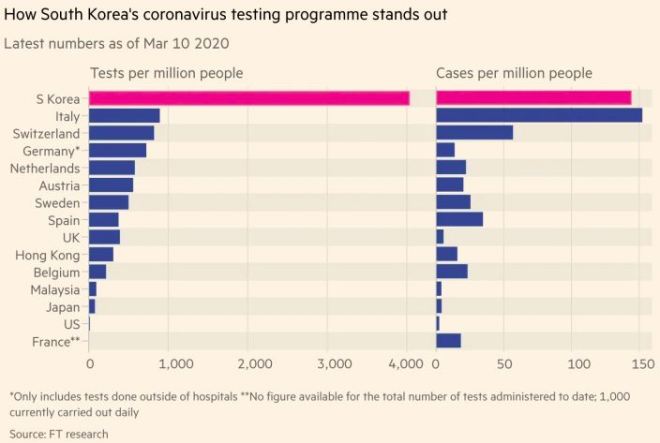
5. Countries that didn’t act quickly have had to take drastic measures to ramp up testing. South Korea has been at the forefront of this. The relative length of the bar on the left vs. the right is a leading indicator of the amount of trouble that lies ahead.

This is particularly important in the case of the Coronavirus because it takes a 5 days for symptoms to show. So, making tests easily available and, thus, enabling testing early and often is the best way to prevent further infection. Just as acting late makes it exponentially worse, acting early is exponentially better.

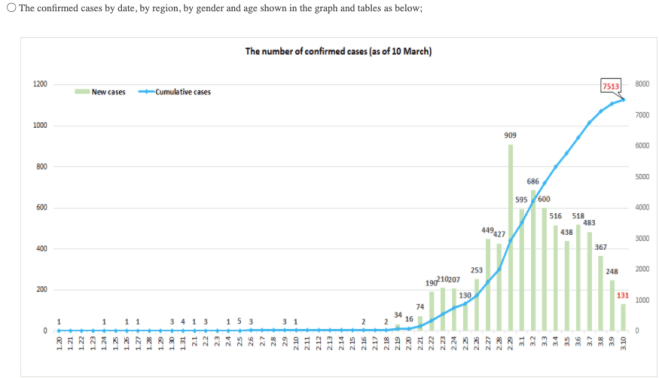
Thanks to a combination of rapid testing and widespread lock down, South Korea bent the epidemic curve – see the decline in new cases as of March 10.

6. The most dangerous places with COVID-19 on the planet today – particularly if you are over 50 years – are places which are neither acting early nor ramping up on testing. Sadly for those of us here, the United States squarely falls in that bucket. There are many good pieces of coverage that outline just how poorly the administration and the CDC have handled this situation.

Instead of focusing on that, I’d like to call attention to an incredible thread on Twitter from Trevor Bedford of the (excellent) Seattle Flu Study team on March 1. The 3 bullet version of this story is –

    • The Seattle Flu study team attempted to begin testing for the Coronavirus in the end of January. But, they were blocked by the CDC. As they grasped the seriousness of the situation given the events in Wuhan, they ran the tests anyway and informed the health officials. The response from the CDC, FDA, and the Federal Government was to cease and desist.
    • As a result of this, we are grossly under-testing in the United States and the flu study team estimates we are underestimating the actual number of cases by an order of magnitude. Tomas’ model suggests the real number of cases is at least 5x more.
    • When the CDC finally decided to act, it attempted to create its own test – however, these tests didn’t work.

As a result, we are left with these sorts of numbers as of 3 days ago.

And, the story emerging from clinics all around is identical – there aren’t enough test kits.

7. We can do our part. Trevor Bedford’s thread and revelations alone led to a chain of events that sparked a response across Washington and California – including companies working from home, canceled conferences/sports events, and so on.

We may soon look back at this thread and the Seattle Flu Study team’s bravery as a defining moment toward dealing with the Coronavirus in the US. Ben Thompson of Stratechery had an excellent article outlining why this thread matters in the broader context of technology and bureaucratic gatekeepers.

Over to what we can do – Flatten the curve is an excellent resource for the things we can do during this time – wash your hands, don’t touch your face, cancel travel, work remotely if you can, avoid large groups, and so on.

A final note: Reading and synthesizing this information reminded me of the final notes from the excellent HBO series – Chernobyl.

“To be a scientist is to be naive. We are so focused on our search for truth, we fail to consider how few actually want us to find it. But it is always there, whether we see it or not, whether we choose to or not. The truth doesn’t care about our needs or wants. It doesn’t care about our governments, our ideologies, our religions. It will lie in wait for all time. And this, at last, is the gift of Chernobyl. Where I once would fear the cost of truth, now I only ask: “What is the cost of lies?”

When I first heard these lines, I thought it was very applicable to the dialog on climate change. Sadly, it is just as applicable in the face of a pandemic.

In times like this, we come to realize the true cost of a lack of science/fact based and dynamic (i.e. open to learning from others/new data) leadership. Whether it is repeatedly comparing COVID-19 to the flu or attempting to downplay its risks, the effects of denial and delayed response have been, are, and will continue to be lethal.

Purging the list

I maintain a One Note page with ideas for future blog posts. I don’t always write about what’s on that list. But, more than half of my posts originate as musings on this page.

Toward the end of last year, I noticed that I was subconsciously avoiding any notes written on this page. So, for a few days, I made a conscious effort to go down the list of ideas. Still, no change.

That was frustrating – I had a long list of ideas going back almost 18 months and, yet, they weren’t being put to any practical use.

So, as part of my end of year reset, I just purged the list.

In the three months since, this page has gone back to being as useful as ever.

Every once a while, even the most dependable systems in our life stop working for us. The worst possible response in such situations is to beat ourselves up. Our systems exist to serve us and not the other way around.

It may just be time for a purge and reset.

Violence and suffering

“Violence is what we do when we don’t know what to do with our suffering.” | Parker J Palmer

I was reflecting on three separate incidents – my reaction to an incident, an exchange I had with someone, and a situation I read about.

In each of these cases, the violence (verbal/emotional in any case) was a direct consequence of an inability to deal with suffering in Parker J Palmer’s words.

As you can imagine, the quote really hit home.

Remote work and doing it right

As the experiment with remote work has begun, I’ve found it tempting to fall into the high pressure optimization trap by asking questions along the vein of – “how do I do this right?”

But, of course, like most things – there isn’t any “right” way and there’s no formula. What works for some will not work for others. And, we tend to be better served when we replace questions about “being good” with questions about becoming better.

Viewed from that lens, I see lots of interesting ideas pop up – virtual hang outs, slack amas, the occasional in-person team working session for folks feeling lonely, etc.

So, my biggest reflection has been to give myself (and folks I work with) some time to make all the wrong moves, test hypotheses, and keep iterating till we find the right set up.

With patience and a willingness to learn, we’ll experiment our way to the right set up and find that all the steps we took along the way were purposeful after all.

Much like building good products.

And much like life.

The Coronavirus aided remote work experiment

As California has declared a state of emergency as of a few hours ago due to the Coronavirus, companies all over are beginning to mandate that everyone works from home for the foreseeable future (~4 weeks at minimum).

As I get ready for an extended period of working from home, I’m curious about 3 questions –

1. How productive is remote work going to be – especially for those working on projects/in roles that involve coordinating large teams?

2. Is there going to be a visible difference in the productivity of folks with kids vs. those without? (How will this even work for folks with kids at home?)

3. What tools are going to be most useful?

I’m certain I’m going to miss many things about our offices (whiteboards, for example). It promises to be a fascinating few week period.

Here’s hoping that these measures help control the spread of the virus.