Losing and being outscored

Legendary coach John Wooden was famous for reminding his players – You can lose when you outscore somebody in a game, and you can win when you’re outscored.

The difference between losing and being outscored lies in the effort you put in. If you’ve given it your very best shot, you can never lose.

You may still be outscored – but that’s very different from losing.

Rigid on principles, flexible on process and vice versa

En-route to success, organizations, teams and people tend to be rigid on principles and flexible on process. You find resourceful people and teams who work with a first principles approach to solve problems. Once they align on the principles, they experiment with various approaches to get things done and, generally, find a way against all odds.

Disruptors are great at this. They don’t get caught up in the process that incumbents are constrained by. The focus on first principles such as an obsession with what the customer needs and work through approaches that helps them address them – usually at lower cost. The only principle that defines their process is experimentation.

But, once success arrives, something often changes. The same organizations and people become fixated on the processes that led to their success. Suddenly, they become rigid on process and flexible on principles.

Hiring and customer service tend to be the first to take the hit. When organizations are small, they focus on a few key principles and focus on a scrappy approach to hiring. But, once they’re successful, the executives involved often convince themselves that a certain archetype (that looks a lot like them) works best for their teams. Similarly, customer service employees are asked to focus on their manual versus actually attempting to solve the customer’s problem and care for them.

This may also be why most successful players make poor coaches and why ultra-successful folks struggle with being parents.

If we had to bring this all down to mindset, the simplest way to describe this would be that successful organizations and people start with a growth mindset. But, over time, they drink their own kool aid and begin managing themselves and others around them with a fixed mindset. They become more focused with keeping and expanding territory and convincing themselves that they’re right over actually testing and experimenting with a willingness to fail.

Of course, in the long run, the moment they become flexible on the principles that made them successful is the moment that marks the beginning of the end of their success.

I can change

There comes a moment when you trust your mindset and your ability to follow through enough to be able to look at yourself in the mirror, say to yourself “I can change myself to fix this”… and actually believe it.

Things are never the same again.

If you’re unable to do that right now, you just need to pick a smaller change.

Over time, the small changes give way to the big ones.

Fear will find you again

There’s an interesting exchange in “The Dark Knight” movie rises about fear.


Doctor: ‘You do not fear death. You think this makes you strong. It makes you weak.’

Bruce: ‘Why?’

Doctor: ‘How can you move faster then possible, fight longer then possible, without the most powerful impulse of the spirit? The fear of death.’

Bruce:’I do fear death. I fear dying in here while my city burns. And there’s no one there to save it.’

Doctor: ‘Then make the climb.’

Bruce: ‘How?’

Doctor: ‘As the child did – without the rope. Then fear will find you again.’


I often think about the role fear plays in our lives. Too many of us fear things that really don’t matter in the long run – e.g., the fear of how others might perceive us if we did something. On the other hand, too few fear things that might actually matter in the final analysis – e.g., the fear of not making the most of the privilege we’ve been granted.

My learning, as a result, has been to question my irrational fears and understand their nature so I can distinguish between fear that matters and fear that doesn’t.

As long as we have insecurity within us (and every one of us does), we will always deal with fear. That’s a good thing. For courage is not the absence of fear; it is learning to act because we realize there are things more important than fear.

Proximity, excellence and opportunity

When we picture Isaac Newton, we picture him making mental breakthroughs with the apple falling on his head. That it likely never happened matters less at this point. Most great stories involve geniuses find opportunity out of nothing.

Except that’s rarely how opportunity shows up.

Instead, the best link I’ve found to opportunity is a combination of proximity and excellence. Get close to people or companies doing what you’d like to do, then get good, and the chances are high that you’ll find opportunity. Intel didn’t just spring up to create the Silicon Valley in the 1970s. Intel’s co-founders worked for Bill Shockley, one of the inventors of the semi-conductor, and then broke off to build their own companies.

Most of the famous management consulting firms, for example, grew out of each other. McKinsey & Co. split from the company that came to be known as A.T.Kearney. BCG was born out of Arthur D Little. And, Bain & Co. was born out of BCG.

Early PayPal employees founded a ridiculous number of great internet companies. And, most leading internet executives today likely learned their trade at an HP, a Netscape or a Yahoo.

Adidas and Puma, owned by brothers from the same village in Germany, dominated the global shoe industry for the longest time. And Nike, the upstart, was created thanks to a plucky track-and-field athlete and the influence of Bill Bowerman – one of the most innovative track coaches who ever lived.

All this is not to say that you couldn’t be someone who popped up with the idea for Nike having no interest in athletics. But, the chances are incredibly low that you’d do something about it even if it crossed your mind.

My learning from connecting these dots translates to simple career advice. First, set expectations – don’t expect opportunity to strike you on your couch. You’ll have to be out on the field getting good at something. Second, if you have a hypothesis for the kind of work you want to do, go to places where the best in the world train and perform. Third, get really good – it helps to recognize what is really opportunity and what isn’t.

And, then, if you’re both lucky and intentional, opportunity will show up dressed in overalls and looking like work.

Solving for Carbon Dioxide

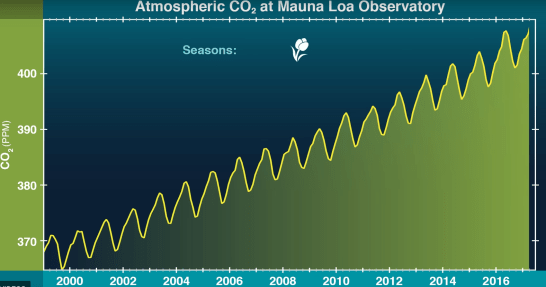
This graph is a record of Carbon Dioxide in the earth’s atmosphere from Nasa’s Mauna Loa observatory in Hawaii.

Carbon Dioxide warms the planet. The most problem of a warmer planet is the melting of ice caps and an increase in water levels.

But, the other emerging story around Carbon Dioxide is the effect it has on nutrients in plants. Politico recently wrote about the work of Irakli Loladze on how Carbon Dioxide reduces minerals in plants and replaces it with carbohydrates. The article concludes with the following 2 paragraphs.

What he found is that his 2002 theory — or, rather, the strong suspicion he had articulated back then — appeared to be borne out. Across nearly 130 varieties of plants and more than 15,000 samples collected from experiments over the past three decades, the overall concentration of minerals like calcium, magnesium, potassium, zinc and iron had dropped by 8 percent on average. The ratio of carbohydrates to minerals was going up. The plants, like the algae, were becoming junk food.

What that means for humans — whose main food intake is plants — is only just starting to be investigated. 

Researchers who dive into it will have to surmount obstacles like its low profile and slow pace, and a political environment where the word “climate” is enough to derail a funding conversation. It will also require entirely new bridges to be built in the world of science―a problem that Loladze himself wryly acknowledges in his own research. When his paper was finally published in 2014, Loladze listed his grant rejections in the acknowledgements.

The whole article is fascinating. And, so is the discussion around Loladze’s original paper. His central thesis is that excess Carbon Dioxide for plants is like junk food.

(That’s Lozadle tossing sugar on vegetables to illustrate his point)

So, what are we doing about the Carbon Dioxide problem? The most promising piece of technology is a concept called the artificial leaf – a ground breaking invention by two Harvard researchers. More on that on my Notes by Ada note on Medium or LinkedIn.

Just to be clear, though, this isn’t about saving the planet. Solving for Carbon Dioxide will be critical if we are going to find a way to survive on this planet. We don’t read about this stuff in the news because climate change is a dirty word these days.

Maybe we’d have a higher success rate if we stopped referring to all of this as efforts to “save the planet.” Maybe we should call it “save human beings from extinction” instead?

It giveth and it taketh

My response to the “how has it been going as a parent” question these days is – “It giveth and it taketh.” 

There are these moments of sheer awesomeness interspersed with moments of “Oh god – there goes another one of my well laid plans.”

That’s the interesting thing about what “it taketh” – it says a lot about me and my expectations of the process. The more I plan and I expect, the more I feel “it taketh” and the more I find myself needing to learn to let go and grow.

In that sense, parenting is a lot like other great journeys (school, challenging projects, engaging jobs, marriage, etc.)  – it is what you make of it. The more you give, the more it takes out of you and the more you grow in the process.

Becoming and being

I used to always aspire to “be the best version of myself.” But, I’ve been switching that verbiage to “becoming the best version of myself” instead – thanks to Carol Dweck’s book on Mindset.

The exercise of reading books on topics like human psychology has changed a lot for me over the years. A few years back, I used to take many notes and share all the interesting experiments I came across on this blog. Doing so helped me grasp ideas better.

But, over time, I’ve found these concepts to come together and to build on each other in interesting ways. Reading a book now is about reinforcing these mental models with small, and powerful, tweaks every once a while.

As a result, I find myself reading fewer and fewer psychology books over time. They all resonate deeply now. Maybe that’s a sign that I need to find other, more challenging things, to learn. Nevertheless, I made an exception recently for “Grit” and “Mindset.” I’d put away reading these books for a long time as I’d come across their chief findings in many others. But, perhaps thanks to my circumstances, I felt I needed a reminder of these ideas.

And, my conclusion from these books is a reinforcement that mindset comes first. It precedes every other trait and quality. Grit is a combination of passion and perseverance. And, I don’t think it is possible to persevere if you don’t cultivate a growth mindset, i.e., focus on becoming something over being something.

As Carol Dweck – “Becoming is better than being.” Commit to the process of becoming and the rest will follow.

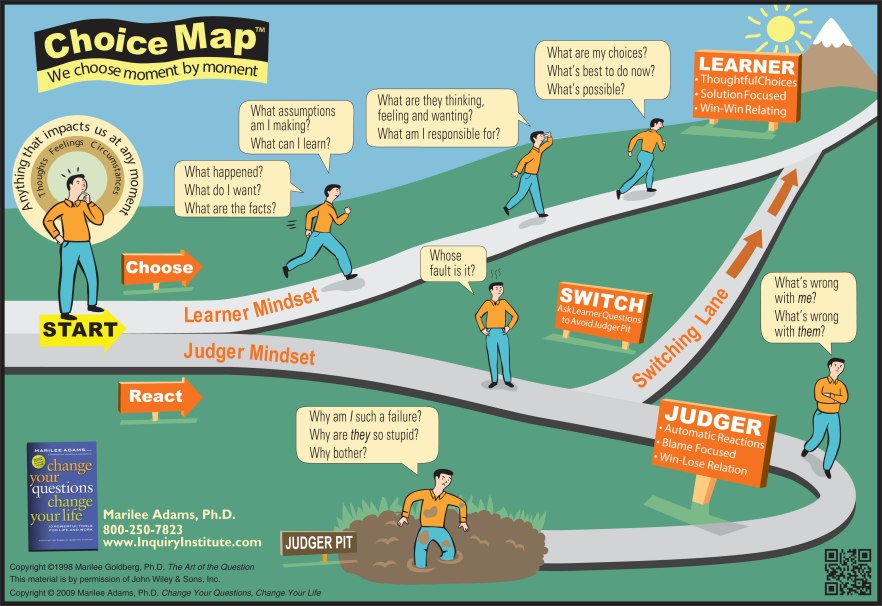
PS: If you’re wondering how you should cultivate a growth mindset, I always go back to a concept called “The Choice Map.” We always choose between asking 2 kinds of questions – learner questions and judger questions. As we choose which questions to ask, so we choose our mindset.

The Invisalign change model

I’ve been wearing Invisalign braces over the past few months. Now that I am ~25% of the way, I was reflecting on the Invisalign change process. Its tenets are as follows –

  1. Have a clear long term goal for change. In this case, aligned teeth in 12-14 months.
  2. Aim to drive change with constant pressure over a sustained period of time. We get to aligned teeth by wearing braces ~22 hours a day for about 12-14 months.
  3. Focus on small, measurable changes, every 2 weeks. Braces are changed every 2 weeks and every new brace focuses on making progress on a few teeth at a time
  4. Check in on progress regularly. There’s a clear plan for the progress to be made bi-weekly and the sensors on the braces enable tracking to ensure this progress is being made. Every 3-4 months, we do a full mapping of the teeth to make sure every detail is monitored and on track.

It’ll be another 10 or so months before I can report on the outcome of the process. But, the process sure seems to be one that we can all learn a ton from in our own change projects.

3 recommendations – Unsplash, Exponential view and Recommendo

3 recommendations –

  1. If you’re ever trying to find a beautiful free image, check out Unsplash. These are photos gifted by “the world’s most generous community of photographers.” They are gorgeous. I use these images as I share daily blog posts and I’m thankful for them everyday.N
  2. Azeem Azhar sends The Exponential View to around 20,000 readers every week. He curates interesting links about the future – on topics like artificial intelligence, the blockchain, electric vehicles, etc. He is a wonderful curator.
  3. If you’re in the market for a great wireless mouse, this ~$10 buy from “VicTsing” has been excellent so far. If you like small recommendations like this that might improve your life, Kevin Kelly and team send a newsletter called Recommendo with 6 recommendations every Sunday. It is worth a 45 second skim – you might just find something useful. For instance, I heard about Unsplash from Recommendo.

Thank you to all these folks for their effort and generosity. It makes a difference.

Happy mid-week!