How should I feel about this?

Our daughter has been attempting to alternate between turning, crawling and sitting over the past few weeks. That means she often loses control and, occasionally, “falls” – i.e. hits her head on the floor with more force than she might expect.

While it likely hurts a bit, we’ve noticed that her first reaction is not to cry. Instead, it is to look at us. She generally has a shocked look that seems to say – “Something weird just happened. How am I supposed to feel about this?”

On our part, we’ve made it a point to smile, cheer and clap every time she falls.

So, when this happened a few days back, we did the same even though we muttered to each other – “Man, that must have hurt her.” But, voila, she saw our smiles and claps and had a thrilled look on her face too.

It was a powerful moment for me as two important lessons hit me. First, so much of early parenting is about the interaction effect between the parents and the child. It is like an improv act with very little dialog as we all play off each other.

Of course, this principle doesn’t just apply to parents but to the teams we work in as well.

And, second, so much of how we react to situations is based on subconscious assumptions of how we’re supposed to feel. The moment we let go of that and give ourselves the time to respond, magic happens.

Much to learn from kids, we have.

Practicing appreciation

There are two steps to practicing appreciation –

  1. Noticing something that deserves appreciation
  2. Appreciating it

We’re not taught how to appreciate things. We generally pick it up from someone around us who does it. It is not that we don’t want to appreciate things. Many of us, at some level, understand that appreciation matters, But, the act of doing so feels awkward. We are stopped by questions like – “Will this make this situation awkward?,” “Will I sound unauthentic?”

Here’s the issue – most people go through their lives feeling little appreciation. We live in an age with a lot of material wealth but little mental well being. It would be foolish to blame it all on a lack of appreciation but a few consistent good words go a long way in lifting people’s minds and spirits. Appreciation is the grease that helps families and teams function better. It has the potential to make days and change life.

The biggest challenge with practicing it is simply doing it. Appreciate something today. Then, do it again tomorrow. As you keep doing it, you’ll notice a lot more that deserves appreciation. And, suddenly, you’ll realize that virtually everything around you deserves a word of genuine appreciation.

The best part about this practice is that there are two beautiful side effects. First, as you learn to genuinely appreciate others, you learn to appreciate yourself. The act of doing so builds our humanity and, somehow, makes us feel better about ourselves.

And, second, the act of doing so fills us with gratitude because it helps us not take things for granted. Trading expectations with appreciation is one of the surest signs of the presence of happiness.

Growth – Getting those users | Thinking Product

It has never been easier to start a company today. This is thanks to the suite of tools that are provided by the likes of AWS/Azure/Google Cloud, Stripe and many other companies who help with getting the basic infrastructure in place.

It has also never been easier to create a product that has the potential to be used by millions of users. Just use the above services to build a mobile app and put it on the iOS or Android app stores. And, in theory, you have a shot at superstardom.

But, it is also harder than ever to generate traction. The top 10 smartphone apps of 2016 were from Google (5), Facebook (3), Apple (1) and Amazon (1).

We often think about this as a recent issue. So, let’s look at the equivalent chart from 2013.


Twitter and Yahoo Stocks were the only “outsiders” that made the list along with Apple Maps. But, the giants were still dominant.

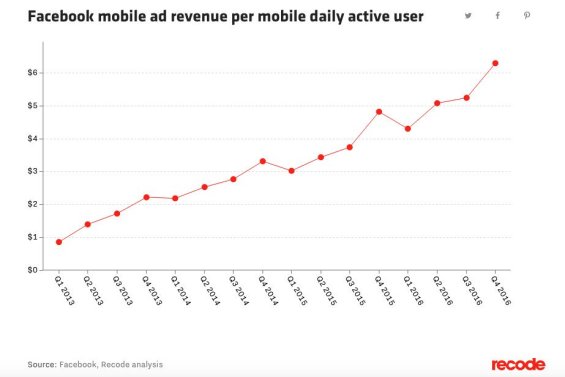
What does all of this mean? If you aren’t an app born out of the family of giant tech firms, user acquisition is going to be hard. This, of course, benefits Facebook since a natural paid acquisition source is Facebook ads.
This all seems rather depressing since it looks like mass market growth isn’t really an option. What does all of this mean for you and me?

Well, if you’re building a mobile app, I think it has become more important than ever before to nail the answers to 3 questions –

  1. Who are my users?
  2. Where can I reach them? (/Where do they spend their time?)
  3. How do I attract their interest?

The good news is that these questions work wonderfully regardless of the nature of your product. And, that’s because they hit at the essence of 3 important pieces of the marketing funnel – segmentation, targeting and positioning.

And, there’s an age old story about dog food (thanks Prof Moran Cerf) that helps explain the magic of the 3 of these in action.


When Paul Iams visited a mink ranch in 1946, he noticed that the dogs at the ranch, who also ate food made for minks, seemed exceptionally healthy and beautiful. So, he developed Iams 999, a superior quality high-protein variety of dog food. But, he didn’t have a good distribution system in place to sell these and, soon, sales stagnated after the first 100,000 dollars. Iams looked in trouble.

Enter Clay Mathile, a new manager, who asked the question – what is a segment that would love what is great about Iams (superior quality => shiny coats, healthy dogs) and not mind what isn’t great about Iams (high cost, limited distribution)?

The answer? Show dog owners!

So, he went on to focus all his advertising on his segment – show dog owners. For example, this meant advertising in magazines that show dog owners read. These show dog owners, in turn, were more than happy to buy premium dog food and go through the difficult sourcing process so they had a competitive advantage.

Iams nailed the market.

Soon, they were ready to expand again and their prices were beginning to come down thanks to their scale. Next, they focused on breeders who cared about having healthy, shiny dogs to sell to future owners. Breeders also didn’t mind the extra expense. Given their excellent product, they won over breeders over time, too.

This new segment had a positive effect because breeders naturally recommended that the new dog owners continue feeding their dogs Iams.

By 1999, Iams had 900 million dollars in sales and was acquired by P&G. Iams now had a place in supermarket stores all over.


This is a classic story because it is applicable to every product. And, as far as building technology products goes, this story almost feels custom built for app builders all over.
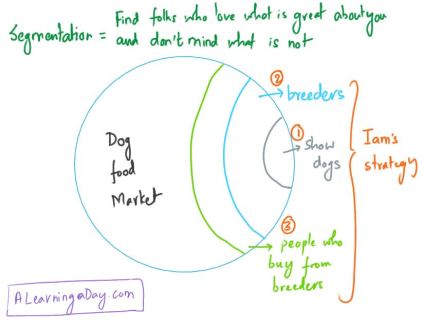
Don’t worry about attacking that large market. Focus on a niche and nail that segment. Then, build from there.

(PS: HT Andrew Chen for shaping my perspective on growth)

Differentiating measurement errors and management issues

Corporations report measurement errors to their customers all the time. Here’s a simple two step test to determine the difference between measurement errors and management issues –

  1. If the number of times you’ve unearthed measurement errors in your business is <=2, they are likely just errors.
  2. If you’ve found more than 2 errors and if the errors repeatedly favor you over the customer, then they aren’t measurement errors. We are looking at management issues that are likely manifesting themselves in everything you do.

For example, I’ve been a Comcast subscriber for 13 months now. I’ve called or live chatted with customer service to report measurement errors 9 times in 6 of the 13 months. And, each time, the error involved Comcast charging me more than they should have. Hence, not a measurement error but a management issue.

As a customer, keep a lookout for repeated measurement errors that count against you. Such businesses have management issues that are going to pop up in the future as well.

And, as a builder of products and services, if you find yourself dealing with repeated measurement errors, take a long, hard look at the incentives and culture you’ve created.

When do you feel owed

One way to live your life is to always feel owed.

How does that work? Well, you likely did something for somebody and they never returned paid you back. But, to add insult to injury, they don’t even acknowledge it much these days.

That ungrateful wretch. You’ll show them when you get a chance.

Of course, you probably way overestimated the impact of what you did.

But, that’s not even point.

Expectations are toxic. And, carrying these expectations with you just increases the amount of toxic material in your brain. It doesn’t just mess with how you think, it also messes with every other thought in your system.

Nobody owes you anything. You do things because they either make you feel better or because they appeal to some inner sense of purpose. So, if you’re walking around feeling owed, you’re inviting unhappiness.

Every once a while, it’s worth asking – “When do you feel owed? What does it take for me to feel owed?” And, find ways to take the time to shed all those expectations you are carrying around. Life feels lighter and better.

Intellectual middlemen

Being creative often involves being intellectual middlemen.

In an interesting study,  Kellogg school of Management Professors Jones, Mukherjee, Stringer and Uzzi analyzed 17.9 million research papers for novelty by assessing how much they’d been cited and what combination of sources they’d cited. They found that – the highest-impact science is primarily grounded in exceptionally conventional combinations of prior work yet simultaneously features an intrusion of unusual combinations.

Charles Duhigg interviewed Brian Uzzi for his book “Smarter, Faster, Better” and Uzzi said – “A lot of the people we think of as exceptionally creative are essentially intellectual middlemen.” That is, “They’ve learned how to transfer knowledge between different industries or groups. They’ve seen a lot of different people attack the same problems in different settings, and so they know which kinds of ideas are more likely to work.”

So, how do we become better at being intellectual middlemen? The abstract of the paper offers a clue – Novel combinations of prior work are rare, yet teams are 37.7% more likely than solo authors to insert novel combinations into familiar knowledge domains.

Quitting that iPad game

Successful iPad games these days are things of beauty. They are beautifully designed and engineered for one purpose – to get you addicted.

It makes sense, of course. That’s how game developers make money. You either get addicted enough to watch ads for other games or you make purchases within the app.

If you’ve ever tried one of these games, you learn very quickly that promising yourself to limit game time isn’t a winning strategy. You might be logical. But, the game developers don’t speak to your logical brain. Instead, they speak to your lizard brain. And, generally, the lizard brain wins.

It turns out that the easiest strategy to limit game time is to delete the game.

Just as the easiest strategy to eat healthy is to remove unhealthy food. Or, just as the better strategy to watch less Netflix is to cancel your subscription.

As a general rule, if you’re going into battle, choose conditions that suit you.

CPG giants and the new e-commerce formula

In May 1913, five San Francisco entrepreneurs (a banker, a wood and coal dealer, a bookkeeper, a lawyer and a miner) invested $100 each to set up the first commercial-scale liquid bleach factory in the United States, on the east side of the San Francisco Bay. The firm was first called the Electro-Alkaline Company and ran into difficult times during the first 3 years.

So, investor William Murray took over the company as General Manager. His wife, Annie Murray, saw the potential in a less-concentrated liquid bleach for home use. She built customer demand by giving away 15-ounce sample bottles at the family’s grocery store in downtown Oakland. The product was called Clorox and the rest, as they say, is history.

The birth of Clorox marked a century of dominance by consumer packaged goods companies. They made their way into our houses by selling us their soaps, tissues and the like, and sponsoring serials in our living room (“soap” operas). Their formula was –

  1. Invest heavily in advertising to build the product’s brand and make customers want to buy it
  2. Invest in retailer relationships so customers can find the product easily when they go shopping

In last week’s “Notes by Ada” note (/essay?), I argue, that we’re reaching the point where these giants are beginning to unravel. The signs are out there – multiple reports about their struggles, disappointing earnings and attempts to buy each other and consolidate. It is no surprise. The formula, if there was one, for succeeding in e-commerce is –

  1. Sell direct to consumers online and cut out all middle-people and costs
  2. Choose to either build a brand using smart digital advertising or build a subscription based relationship

This is another example of “old world” companies facing the chasm and finding the gap between them and technology firms (they’re stuck trying to figure out the cloud while tech firms are implementing machine learning) harder and harder to bridge.

If this piques your interest, the longer version is on Medium or LinkedIn.

Discomfort and commitment

When you first touch the water as you’re starting a swim, it generally feels cold. The first time it touches your back typically sends a shiver down your spine. Ah – the discomfort.

Do you take the plunge? Or not?

The plunge alone won’t suffice, of course. You’ll still feel cold.

Instead, the best approach is to jump in and swim. A few strokes later, the water feels good and you feel comfortable. If it still feels cold, a few more strokes will do the trick.

This is the point when you wonder why you spent time wondering if you did take the plunge. It feels comfortable. And, as you swim more, it begins to feel great.

Of course, this is analogous to every great growth experience.

Getting stickiness right | Thinking Product

My hypothesis is that great products have 3 characteristics.

1. Nail job-to-be-done: They are a great solution to a problem users care about

2. Delight to use: They are well designed

3. Sticky: Makes the customer/user want to come back

I wrote about nailing the job-to-be-done and delight to use characteristics in the last 2 weeks. Today, we’ll explore stickiness.

When I think of stickiness, the question I ask is – “Why will the user want to use the product again?” I’ve generally seen 3 ways apps do this –

  1. Feeds – Come back to see what is new. This works well with apps with network effects. E.g. Facebook or LinkedIn
  2. Notifications – If the notifications are high value (e.g. reminders that the user wants), the user will come back. E.g. Calendar or Mail
  3. A niche high value use case – Providing a use case that core users absolutely love. E.g. Waze

While examples of apps that use feeds and notifications are common, let’s spend a couple of minutes discussing Waze. Waze is a mapping app owned by Google. It was founded in Israel and acquired for over a billion dollars in 2013. Waze isn’t perfect (which product is?). I find its user interface occasionally confusing and it’s GPS capabilities aren’t the best. Google Maps does a better job with both.

But, there are a couple of things about Waze that make it special. First, Waze has built a reputation to help you find the best route using its data on which routes have more traffic. As an added bonus, Waze will also tell you if a store or restaurant is closed as you plan to head over. Both of this means you’d like to start your journey with Waze just to see what the app recommends.

Second, the use case that made Waze really popular among its users is the fact that the community notifies you if a police car or speed radar detector is coming up. As you might imagine, the police community hate this feature but the users love it. Not everyone cares about this feature but, for the ones who do, this feature is invaluable.

Venture Capitalist Fred Wilson has a post about building peer-to-peer apps with niche, high value use cases and he spoke about this feature as a great example of that. From the post –

“If you want to bootstrap a peer to peer network, you can’t start with the mainstream use case. You need to start with the highest value use case, even if it is a much smaller niche. Not everyone likes to drive 80mph in a 65mph zone. But the ones who do will take extra measures to avoid getting pulled over. They report the speed traps to everyone else in real time. Which is what the first users of Waze did.”

Oh, and the police notification works only if you are actively using the app (you need to type a destination). Switching the app on alone doesn’t help. Smart.

Waze example aside, it is really hard to build sticky products – especially mobile apps. The first version of most products aren’t generally good enough to ensure users come back every day. The most reliable way to ensure stickiness is to build a network driven feed. But, there are only so many network driven products that can thrive in the age of Facebook, Twitter, Snap, Pinterest and LinkedIn.

Building stickiness via notifications is easier said than done as notifications blindness can set in and play havoc with your plans.

That’s why going the niche, high value use case route matters for the rest of us. It is our dominant strategy on our journey to stickiness.


Over the past 3 weeks, I’ve written about the 3 aspects of great products – nailing job-to-be-done (Why does the user buy? What does the user fire/replace?), great design (Does the user know what it takes to win? How easy is it?), and stickiness (do you rely on network effects, notifications or a niche high value use case?). Most good products have one of these, great ones typically combine two and the rare exceptional product combines all three.

The next step will be to talk about how all this gets operationalized into a strategy for growth, onboarding and ongoing usage. More to follow.