The simple things

I am listening to “Wonderwall” by Oasis as I’m typing these words out. This was among the first songs I fell in love with and has so many great memories attached to it as it has stayed on every music playlist I’ve had since my early teens.

It is 8:07am on Wednesday – I am looking ahead at a packed day with a new project commencing, a project wrapping up, two assignment meetings and a couple of other notes. It is going to be back-to-back and I’m looking forward to that.

It is at such moments that I realize that it is in these moments that we actually live our lives. Too often, we think of the weekend / the next big break as our only respite. But, this moment is where we live have our day-to-day struggles and challenges. And, it is such moments that add up to a life where we’ve hopefully explored the length and breadth of the road we traveled.

Sure, it isn’t perfect and there are a few things that would be nice if fixed. But, I’m thankful for this moment. It is said that it isn’t happy people who are thankful but it is thankful people who are happy. I believe that. Remembering to give thanks takes work..

But, in the final analysis, I can think of very few other things that will matter as much as being grateful for all we’re blessed with and savoring the simple things that make up the bulk of our experience. Let’s live today.

“Jennifer, relax.”

As an old gentleman walked into a super market, he noticed a small girl crying loudly. She was no older than 2 and was trying to persuade her mom to buy her something she wanted. Her mom just said calmly – “Jennifer, relax.”

The girl immediately started crying even louder. Again, her mom said – “Jennifer, relax.”

By now, the girl had started screaming and was attracting a lot of attention. This time, her mom said calmly – “Jennifer, you don’t want to create a scene in the supermarket. So, relax.”

The man walked to the mom and said – “I am amazed at how calm you are. But, surely, she can’t understand what you’re saying, can she?”

“What makes you think I was talking to her?” – the mom replied.

(I can’t find the source for this story. All I know that it is an excerpt from a talk that was passed on, via a Whatsapp message, by a Mr.Rajan – so, thank you Mr Rajan – wherever you are.)

I thought the takeaway from this talk is brilliant – the quality of your communication with the world determines your impact, but it is the quality of your communication with yourself that determines your happiness.

And, I’d argue that impact made without happiness is akin to an artificial flower – looks good from a distance but lacks the substance and aroma that makes a flower special.

So, let’s communicate better with ourselves this week and remember to treat ourselves with infinite patience and kindness. And, of course, the next time you find yourself in a situation that tests your patience, remember.. “Jennifer, relax.”

Searching for the good life – MBA Learnings

“Think about the metric by which your life will be judged, and make a resolution to live every day so that in the end, your life will be judged a success.” | Clay Christensen

“Productivity is the act of bringing a system closer to its goal.”  | Dr. Eliyahu Goldratt

“The most important thing about the good life is that you get to decide what good is. If you are living someone else’s good life, you’re making a huge mistake.” | Seth Godin

These 3 quotes have given me plenty of food for thought over the past 2 years. They touch on 2 big questions –
1. What is the yardstick with which you will measure your life?
2. Assuming the goal is “the good life,” what is the good life as I define it?

These questions are so incredibly heavy that it feels easier to give up before I even get started. These 2 questions get at more questions – Who am I? What matters most to me and why? Ah. So much easier to just get on our to do lists and do the next thing.

And, yet, is there anything more important than asking these questions? There is no productivity if we’re not working towards the goal, after all..

This afternoon, a close friend and I, at school, are launching the first edition of a 3 part workshop series we’re calling “The Good Life sessions.” The idea is to break the idea of the good life down by asking 3 questions –
1. What do I value?
2. How do I find my personal mission?
3. How do I create an action plan to live a life consistent with this mission?

We’ve been fortunate to receive support from a collection of inspiring professors who’ve walked this path and continue to struggle with these questions. As anyone who reads this blog knows, I have definitely been struggling with these questions for a long while and, after 18 months of wrestling with these questions, have begun to find direction. So, we were really excited to test this idea with the student community and see if we’d find a small group of people who care.

It turned out there was actually a huge group of people who care. We received 70 registrations in the first 120 seconds of our registration opening up and had to close at close to 300 registrations (~25% of the student body) in the first 4 hours. We have a main lecture room and 2 overflow rooms booked today. It helped a lot that the Professors who’re helping us have great follower-ship within the school but (and I am based here) it feels like we’ve hit on a topic that many would like to explore. And, that’s great to see.

I’m not sure this has ever been done before. So, we’re definitely working hard to create structure and tackle these big questions in bite-sized chunks. Of course, this might not work. But, I guess, that’s what makes it really exciting.

More to follow on the good life sessions. For now, I’ll end with a big thank you to Clay Christensen, Dr. Eliyahu Goldratt and the wonderful Seth for those 3 big ideas.the good

The weight of those who are gone

I thought I’d interrupt normal programming today (i.e. the 200 words project) to write about something that is top of mind and personal. I try very hard to abstract from events and focus on the essence of what I’ve learnt. This will not be easy to do in this case but I’ll try.

When I introduce myself to people I work with, one of the ideas I share to help communicate who I am is – I have been shaped a lot by death. Our family lost my uncle to an accident and my father to himself in a space of 3 years. Now, the typical reaction to this for the opposite person to say – I’m sorry. And, if we’re having a really upfront conversation, I generally explain more. You see, the hard part wasn’t that we lost 2 members of our family. The hard part is that my grandmother has, over the 17 years that have gone by, held those who’ve gone dearer to her than those who’re still here. I’m going to leave the details out here and instead just say that very few conversations with my grandmom in 17 years have gone by without us feeling the weight of our absent family members.

I wish this was a unique problem. Given my general comfort with topics that are generally perceived taboo or morbid, I’ve been fortunate to be trusted with information about so many families who have similar dynamics internally. The data I’ve collected over the years has led me to one important conclusion –  we need death education more than we do sex education.

In an average lifetime, we see at least ten births and ten deaths of people who are close to us. And, yet, very few hardly ever get comfortable with the idea of death. That’s a funny situation to be in as death is one among the few certainties of our life on this planet. So, that results in whole families torn apart, relationships broken, and many many unhappy years following a single event. There’s a wonderful Buddhist parable in which a woman goes weeping to the Buddha and asks him to bring her young son back from the dead. He asks her to bring a mustard seed from a house that has never seen death. So, she goes on a long search and comes back empty handed – every house she went to had seen death…

I wanted to write about this today as today was another day when I felt the weight of those who are gone. Today is actually my grandparents 50th anniversary. I’d have loved to interrupt normal programming to wish them a happy anniversary. But, as has been a trend in the past 17 years, there’s always an excuse to mar happy occasions. I’ve made peace with this fact after an “aha” moment 5 years ago. But, my mother hasn’t, for instance. And, that’s tough.

So, I thought I’ll do what I always do and share a few of my biggest learnings from these experiences.

1. Every person is responsible for their own happiness. This has two powerful implications. First, it is that you ought to worry most about your own happiness and not sacrifice that at the expense of others. That’s because, over time, you cannot help anyone else if you can’t help yourself. So, to be useful in the long run, take care of yourself first. Second, you can attempt to help others for a short while. But, after a certain point, it is their life and their responsibility. Don’t try to play god.

2. Really appreciate the people around you. If your mind is always stuck on the past, you’re never going to be able to enjoy the present or the future. All we have in this life is a collection of memories. Yes, there were great memories in the past with great people. But, there are equally great moments waiting in the future. For that, you have to really appreciate and be thankful for those who are with you now. Be great to the people you are with. Collect memories.

3. Express your love and gratitude. Once you learnt to appreciate the people around you, express you love and gratitude. Be generous with hugs, kisses, compliments, affection and love. We sometimes treat our heart as one that has space only for a few. It couldn’t be less true. My experience is that it only expands with time.

4. The world is your family. I’ve come to realize that there is so much family out there in the world. I count myself as a person rich in relationships as I’ve found an abundance of parents and siblings out in the world who’ve taken incredible care of me. I guess you just have to open your eyes to the possibility.

5. Take death education seriously. A couple of weeks ago, I wrote about design firm IDEO’s efforts to “design death” and have those difficult conversations. I think we all have a duty to understand this certainty. If you’ve experienced in some form with a relative or family member, then I hope you’ll take the time to reflect, think, and have conversations about it. Death and the fear of it shapes more lives than you and I can even imagine. And, a lack of an understanding of this concept probably destroys more people’s happiness than diseases like cancer.

For my part, I’ll do my best to add more to conversation here. Death, depression and all such taboo topics are only taboo because we don’t spend enough time thinking about them and really understanding them. And, understanding them is strangely liberating.

One thing that does happen when you do think about these things is you realize how fleeting these moments are. The days feel long, but the years are really short. And, while life may be the longest thing we do, it is still really short in the big scheme of things. It is up to us to do something worthwhile with the time we have and spread as much love and joy as we possibly can instead of being caught in vicious cycles of unhappiness.

As I type these words, there are people who’re dying in various places. Many of these folk likely wish they could live a bit longer and tell the people they loved how much they cared about them – that’s the biggest regret of them all. Some others likely wish they’d lived a life with more meaning.

Happiness is not one of those things that comes assured on our birth certificate. Happiness is hard because it requires us to live a life close to our purpose and have real impact on the people on this planet. But, hard doesn’t make it impossible, of course. To make this life meaningful, to make it count – that’s entirely our responsibility.

And, what a great responsibility it is.

Pressure, quirks and chopping wood

A close friend shared that his plans for today involved a quiet day at work. He also mentioned that he was getting screamed at by everyone he shared the plan with. Today is new year’s eve after all and there’s a certain pressure to do something memorable.

I was reminded of an evening a bunch of us spent together as teenagers. I think it was new years eve. After some time spent gaming in the afternoon, we spent about 3 hours in the side walk discussing our plans for the evening. Ironically, it was well into the evening by the time we ended our discussion. And, this wasn’t a one-time occurrence. We enjoyed talking about what to do. That meant everyone shared their preference and pretty much got berated for suggesting what always seemed like a dumb idea. Planning what to do typically meant lots of laughter and, I think, as a result, we spent a significant portion of those years planning.

Planning was the excuse, of course. It was just a blast to spend time together.

When I look back to my childhood, some of the best moments my friends and I spent together were spent on the most unspectacular things. An evening hanging out at my place, “planning,” a sleep over with a movie or two, riding to the beach (It was 1 hour away. So, it wasn’t the hanging out at the beach as much as it was about the ride), playing, eating panipuri at a roadside chaat shop, and just cracking up at each other’s expense – none of these cost much. But, they all made for really cool memories.

One of the funny consequences of the digital age and social media is that, somehow, they’ve added a certain pressure of expectation to moments of fun. Suddenly, it is not enough to be on vacation, it matters that it is a really cool vacation. Similarly, it is not clear if a fun evening with friends counts without a tagged status update or photo. As a result, fun occasions like new years days and valentines day have become high pressure days where we compete for likes and social status. Maybe some find it fun. I sure hope they do. This is for all those who don’t.

As you think about your fun events either to celebrate this new year’s day or an upcoming vacation, I really hope you think about what makes it fun for YOU. If that means, spending a week by yourself, so be it. In doing this, you will have to embrace your quirks. I realized a year or so ago that I don’t mind working on “stuff” when I’m on a break. What does matter to me is waking up without an alarm. You see, I sleep 10-11 hours on average most vacations and, as long as I do that, I’m happy.

It is up to us to design a life that will embrace that quirkiness. There is no shortcut to looking inward.

Finally, I came across this Zen quote – “Before enlightenment, chop wood, carry water. After enlightenment, chop wood, carry water.”

It is a fantastic quote. Applying it to this context, it doesn’t matter how rich/successful/enlightened we are – at the end of the day, we are still human beings who crave love, attention, engagement, good food, good times and sleep. Here’s to that and more – on this new year’s eve and beyond.

Feelings and States

“How do you feel” is a question you’ve probably heard of a fair bit. I would be willing to bet that “How are you being,” on the other hand,  is a question you’ve never heard asked.

I think we waste too much time thinking about our feelings. Feelings are transitory. In the grand scheme of things, I’d argue that they hardly matter. Our mental states, however, can make or break this life experience.

Let’s begin by understanding the difference between the two. The mental state sets the overall mood. If we are in a depressive state, we might have the occasional happy feeling when a friend cracks a really funny joke. But, over the course of the week, we’ll spend large amounts of time in the dumps. If we are in a happy state, on the other hand, we might experience sadness during the course of a week but we’ll still not lose perspective. A happy state looks different from that transitory feeling of happiness. The high isn’t that high when you “are” a happy person – it is normal service after all.

To “be” happy requires you to do two things at once – to match your actions to what drives you in a manner consistent with an approach that suits you – i.e., to align your why, how, and what – and to keep perspective while experiencing the inevitable ups and downs. A happy state is like a healthy ECG – the highs are not too high and the lows are not too low. There’s just a lot of small fluctuation around that state.

Barney Stinson touches on states in his now iconic dialog “When I’m sad, I stop being sad and be awesome instead.”  He’s probably right – if you focus on “being” happy, you’ll figure a way around negative feelings. If you’re caught up around feelings, it can be a vicious cycle that drags you down. When we “are” (again – are, not feel) happy, we’re simply better versions of ourselves.

A focus on the state matters. I’d go as far as to say – it is probably among the few things that does.

“You may not like us..and that’s okay. “

Every great brand takes a stand for what it believes in. When it does that, it says – “You may not like us.. and that’s okay.” Apple and Harley Davidson aren’t mass market products but they sure are authentic. There is a certain consistent beauty present across their products that comes from that authenticity.

It isn’t too different for us as individuals. When we stand for what we believe in, we also say “You may not like me.. and that’s okay.”

Until we do that, it is impossible to be authentic.

And, without authenticity, it is impossible to be happy.

Confidence is..

Confidence is not knowing that you’ll sail through with no difficulties. It is knowing that when difficulty inevitably arises, you will be able to deal with it.

Confidence, hence, is a state of being. Yes, you can “feel” confident – invincible, even.  But, it is in being confident where happiness lies.


(I am in a place with intermittent connection this week. So, please forgive me if I miss a day. It won’t be for lack of content. :))

7% better – The 200 words project

Here’s this week’s 200 word idea from our RealLeaders.tv interview with Professor Mihaly Csikszentmihalyi..

Social scientist and author of the now legendary book on happiness – “Flow,” Mihaly Csikszentmihalyi and team spent a week collecting data from a group of internet chess players who played over 1000 games.

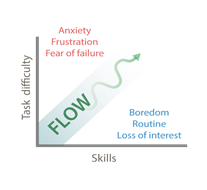
They had the players fill out how much “flow” they felt in the game afterwards. All previous psychological theories spoke about play as a way of boosting self esteem by winning. But, Prof Mihaly and team’s hypothesis was that greatest enjoyment doesn’t come from winning but from playing opponents who are equally matched – so skill levels and challenges are equal (i.e. in “flow” territory).

Flow
Source and thanks to: 
www.EBSketchin.com

Interestingly, the results showed that the optimal challenge was when the opponent was about 7% better. Playing against better players meant the curve of enjoyment went down very slowly while playing against really bad players meant enjoyment went down precipitously. The point is clearly not to just win because, when we play against someone better, we win only 30% of the time but when we do win, we feel much better.

Are we regularly giving ourselves challenges that are 7% harder than our current skill level?

“Happiness is not something that is guaranteed, or that comes with our birth certificates. Happiness is to do things that are harmonious with who we are, with what we can do, with what we like, and with what we think is right.” | Mihaly Csikszentmihalyi 

What should I do if I’m really struggling at work and feel incredibly down because of it?

Someone (anonymous) prompted me to answer a question on Quora. I thought I’d share the question and my response below. The tough part about such a question is that no one can answer it. The best (I believe) you can do is provide a frame that will hopefully help. The response has many of elements I write about here on this blog and all of what is recommended has been tried and tested. So, here’s hoping this helps the person who asked the question and anyone else who might be having a difficult time.


What should I do if I’m really struggling at work and feel incredibly down because of it?

I changed job about a year ago, and really haven’t been doing well in my new job, definitely not as well as I did in my old. Some things are solvable, or at least I can see how to solve them, e.g. project management. However, my job is very technical and requires a deep understanding of material that is complex. I cannot seem to get my head around it, my learning on it is very slow. For that I just do not know what to do, and feel hopeless. It is strange for me because my technical grasp in my old job was good, I don’t know why I am struggling so much here. I feel so demotivated and I do not know who to talk to, as people who do not work in the industry do not understand. I really want some constructive feedback and something concrete to work on, but my colleagues and management say “understanding technical issues should be a given” which makes me wish I could just quit and do something else, although I can’t actually afford to do that financially.


Dear friend,

Congratulations! This is an opportunity that can make you and really change your life.

What you describe is the essence of the toughest struggle we face as humans – it is part external, part internal and part existential. It is when the resistance seems to just overpower you and suddenly everything that you seem to touch seems to have failure written all over it. There is nothing harder. I have experienced losing both my father and uncle between ages 9 and 11 and then facing many difficulties as a consequence of that. And, yet, when I look back at a time when I went through something like this, I found death and it’s consequences easier to deal with. This sort of experience will teach you to be human and, in many ways, I think it’s those that learn to be human are those that learn how to be happy.

The toughest part about this sort of situation is that it comes with a seeming lack of options. You seem stuck in an endless spiral and rebuilding your confidence and your sense of self feel like a lot of hard work.

So, given the situation, it is great that you are asking the question. It is sometimes hard to step out of ourselves when we are having tough times. And, this is definitely a good first step. Well done.

Here’s how I would approach it.

Step 1. Examine your options and make a conscious decision.

It seems to me that there are 4 options –
1. Quit now (which you can’t seem to afford financially)
2. Search for a job now
3. Stay and continue status quo
4. Stay and change things

Out of these 4 options, I think searching for a job now could be an escape. However, given your current mental state, it is unlikely that is going to be fruitful. Since option 3 is not one I would recommend, let’s focus on the decision you have in front of you – To fix it or not to  try.

If you decide to fix it, then we proceed to step 2.

Step 2. Rebuild with a 1 month short term plan.

Give yourself a clear short term process goal, e.g., “I’m going to work hard on “being happy” and I’m going to measure my efforts on it.”

This will take 3 steps – 

1. Get the basics – eating, sleeping, exercising, and reading – right. Eat healthy food every 4 hours, kill alcohol and cigarettes for a month, sleep 8 hours every day, exercise 6 days a week (aerobic for 20 minutes) and spend 30 mins every day reading/listening to a book (perhaps start with your commute). When you start,  start with “Man’s Search for Meaning” by Viktor E Frankl.

Create a simple tracker and measure yourself on these.

2. Journal your daily learnings. You are learning something every day. Reflect on it and write about it. Every challenge is learning and every day, we get better at dealing with them.

3. Recharge emotionally – via good times and volunteering. Spend at least a day a week with loved ones and get over yourself when you do (no moping / complaining). And, make 3 hours to volunteer at a place with underprivileged kids.

Notes
– This may not immediately change anything. You’re in a spiral, and as you face the inevitable frustration once you start trying, you’ll probably spiral further down. Allow yourself to hit rock bottom. It’s a liberating place to be when you realize you can’t sink any lower.
– Don’t take it personally – great footballing stars have gone on to become massive failures when they switched clubs. It isn’t just about you – it is also about the environment.
– As you might have gathered, this isn’t about the technical skills. Our first step is to work on your confidence and motivation. • Be willing to iterate and change approaches. This will help you with stage 1 – getting started and building your confidence. You’ll need to keep tailoring your approach as  some things will work and some won’t. That’s okay. It’s a long way up and there is no easy way out of it.

And, this is not going to be easy or quick. You will feel stuck and annoyed many many times as you work your way through the process. If that happens, welcome to the club. This is how we get made.

PS: I’d love to help beyond this Quora thread. If this thought process helps, that’s great. Even if it doesn’t, please feel free to write me on rohan@rohanrajiv.com if I can be of help in thinking through this. Good luck and good skill!