For them or for us

Stakeholder update meetings are necessary in any project. If you’re running an event for a school, the administration would love to understand what you are up to. In companies, it is a mix of senior management, steering committees and clients.

One way to approach these meetings is for teams to take the “for them” approach. The default reasoning here is that these update meetings are for senior management/clients to see what we’re doing, poke holes, demand better results, and perhaps even put more work on our plates.

The “for us” approach deals with the same reality with a different lens. The reason for stakeholder meetings in the “for us” approach is for the team to reflect, take stock and learn. We do this by sharing our progress so far with senior management/clients, discuss roadblocks and look for opportunities to course correct as necessary. We aren’t doing this meeting “for them.” We’re doing it because we care about our work and it is wonderful to have them as we can learn from their experiences. Yes, they can be painful. But, that’s part of the learning process.

The former is normally used. The latter inspires better work.

As always, we choose.

A letter to an incoming student – MBA Learnings

Around this time last year, once the realization that I was going back to school sunk in, the immediate question that followed was – how do I get prepared? I was, after all, going to be spending in excess of $200,000 without accounting for the loss of income in the next 2 years. This had better be worth it.

My plan of action was to do 3 things – read books on the topic, check out the blogosphere, and speak to as many people as possible. So, I did just that. I found 3 resources useful – the “Case Studies and Cocktails” was pretty hands-on, the famous Stanford letter to incoming students was reassuring and the 108 tips on the MBA Excel blog was very useful from a logistical point of view. I did, however, feel a few things were sorely missing. And, on top of that list was a way to “frame” the MBA experience. Great frames help us cut through the noise and understand what matters. And, given we likely have a hundred thousand capable folk jumping into expensive MBA programs all over the world, I found myself wondering if we could do a bit better in preparing them for the journey.

Luckily, I stumbled upon a first version of the “frame” I craved in my first 3 weeks thanks to 2 wonderful people – an insightful professor who taught us business analytics and a dear friend. Their insights made all the difference to my experience in the past 8 months. And, I’d like to share them with you. As with my essay on internship recruiting, I’d like this to be comprehensive. So, I expect this to be long. I hope it’ll be worth it.

Before we begin, a note on bias. As writing is a direct reflection of thought, every piece of writing has inherent biases. While I’ve done my best to use frames over specific advice, this is hard to do. My priorities in life are around people that matter, learning from life’s experiences, and having a positive impact on the world. And, these priorities shape how I see the world and choose to experience it. As a result, my idea of fun revolves around these priorities (I guess writing a daily learning blog is a bit of a giveaway :-)). So, I trust you’ll put these notes in context and take them with healthy pinches of salt.

Framing the MBA journey. The MBA journey is the first step to the next phase of your life journey. The lessons from this post aren’t just about doing well in graduate school. I think the principles apply for life after school. Most people come to the MBA after a few intense years in their 20s where they’ve largely focused on themselves and their growth. Yes, there are those with kids, wives, and spouses – but, most of the folks in these programs have worked really hard to get in and are now looking for that next step. And, these programs exist to prepare them for that next step in a safe and relatively risk-free environment. To understand how they do that, you have to understand the 3 underlying principles that govern this experience. Let’s start with principle #1.

Principle #1 – The MBA is a 2 year course in decision making and trade-offs.
There are 6 priorities you will need to think about during your time in graduate school. I will go through each of these and will also make a case for the idea that juggling these 6 priorities is a warm-up act for life beyond school. The 6 priorities are –

1. Academics. You are paying for the experience. Education is one part of the experience. Unlike in your undergraduate experience, very few people really care about your grades. In fact, many programs don’t even provide employer’s access to your academic performance. So, do grades matter? Well, they matter as much as they matter to you. There will be many at school who won’t care. And, then again, there will be many who will. There is no right or wrong answer here. It depends on whether academics lies in your priority list. I will, however, offer a few thoughts for you to consider –

– Nearly every class I have taken so far has had lessons that have been either been immediately applicable in my own life or have helped greatly in my understanding of the world. This stuff is useful. I think neglecting it isn’t smart.
– That said, I don’t think it is worth spending every spare moment studying. I think what really matters is an overall grasp of the fundamentals. Ten years down the line, you aren’t going to remember ABC reading or DEF assignment, but, you will remember how to think about network externalities or structuring your company’s debt.
– If the MBA provides this broad based education, it is critical you spend time developing mental models that will help you remember the stuff that matters. As your understanding develops, you’ll find that almost everything is connected. The better your understanding, the more the connectivity.
– It helps greatly to show up to class and participate. Every once in a while, you’ll find your attention drifting or find you have no clue what is being said. Stop the Professor and ask questions. Don’t pride yourself of knowing stuff. Pride yourself on being able to get smarter.. quickly. Nobel prize winners do that.
– We don’t learn best when we take notes during class. We learn best when we take a bit of time after class to summarize the key points of the lecture. I’d definitely consider taking that time to reflect and to create those summaries.
– If you follow a thorough learning process, you’ll find that there is no need for last minute cramming. Good results typically follow good processes.

Academics in your life after school. At school, you will get to create a learning path that suits your interest (in most schools at least). You will likely find your interest in some subjects increase in your time at school. It won’t be possible for you to learn everything. One of the best outcomes of this journey would be a renewed commitment to making use of every moment of time available in your life after school to further your learning. This could be by reading great books on your commute, by taking a course every 3 months, or just connecting with a smart peer group interested in similar subjects. Knowledge -> understanding -> wisdom. It is hard to shortcut that process.

2. Recruiting. What you will really learn in business school is how to lead yourself through a job search. I can’t think of a more useful skill. Here’s why – the days of long tenures at a single company are long gone. This means that the chances that you’ll be looking for a job in the next 48 months and then again in 48 months after that are incredibly high. Learn to do it.

I’ve written about lessons I learnt from internship recruiting. So, I’ll aim to leave you with a few high level thoughts –
– Over the summer, really think about what you want to do in the long term. Consider paths that will help lead you to that goal. Either way, it’ll become really tempting to shun those paths and go after prestigious positions and firms. If that happens, let it be for the right reasons.. or, at the very least, reasons that make sense to you.
– Recruiting hits you much quicker than you’d expect. All schools care a lot about recruiting because these stats feed into their rankings. So, expect to be bombarded with messages about information sessions about every company you can think of. You can’t do them all.
– You’ll find very quickly that the difference between those who recruit successfully and those who don’t can’t be accounted for by a different in their IQ. It comes down to a combination of EQ, preparation and focus.
– Recruiting isn’t easy. Don’t expect it to be. Instead, get ahead of the preparation by taking time to really think about how you’d like to approach it over the summer. Be prepared. That’ll help you be focused.
– Make sure you enlist plenty of support through the process. Find a group of friends looking for the same kind of opportunities and prepare with them, engage 2nd years and seek their advice and support, use the career center and professional club resources. You’re going to need it.
– Keep in mind that there is a lot of luck and chance involved. Focus on your process and approach. The results typically work out in the long run..
– Finally, use the recruiting period to build real relationships with people in the industry of your interest. Don’t just find a job. Get to know people.. it’ll pay off in the long run.

(Of course, all this doesn’t apply if you’ve decided to start-up during or after school yourself)

Recruiting in your life after school. You never really stop being a job/project-seeker. My only hope is that you’ll be a great employer, too, since you know what it feels like to be on the other side.

3. Social. I tend to think of friends as education’s greatest gifts to us. And, it is highly likely you want to make a friends through this experience. Relationships are very personal and everyone tends to have different approaches to social life at school. So, while the rest of the post is pretty colored by my biases, this one is very colored.

– Social life can be pretty stressful. There’s often a funny high school meets 20 somethings dynamic at school. This is just something you should know and expect.
– There are a couple of approaches to making friends – making many friends or making a close small group of friends. I am a fan of marrying both approaches. Success, to me, is having a small group of friends at the end of 2 years who I’d trust with my life and a collection of other friends across various social groups.
– I’d consider creating a diversity check on your calendar every 6 months – just ask yourself if your close circle of friends all look exactly like you (e.g. same country/language/profession). If so, it is worth asking yourself if you are learning anything from the diversity around you.
– Attempting universal popularity is a fool’s errand in my point of view. If that’s what you are after, good luck!
– Instead of attempting to get people to like you, I’d consider working hard to earn their respect through your work ethic and track record. I tend to find that going for respect often ends up resulting in you being liked by people who share similar values.
– Attempting to “network” through school is also a fool’s errand. Your network at every stage will be directly proportional to your net worth – both in terms of wealth and character. But, again, if that’s your plan, I hope you find a way to make it work.
– If you are an introvert, don’t worry. There are enough of us out there. The hard part will be saying no to the many low quality social interactions where 40 people will show up at a noisy bar and barely manage to hear each other speak. Hopefully, all this reading will help you make conscious choices. There’s limited time available to hang out and build relationships.. use it well.
–  I am a big believer in the idea that you attract people by virtue of who you are. And, a big part of showcasing who you are is by what you do. That brings us to priority 4.

Social in your life after school. I don’t have to make a case here, do I? :-)

4. Extra curriculars. There are extra-curricular activities of every kind in school via professional clubs, hobby clubs, fun clubs, etc. My view is that extra curriculars are the single best way to get to know your classmates and build real relationships. Here’s how I think about them –

– Leadership roles in most extra curriculars in school can be big time commitments. I find it hard to think of other opportunities during the experience where you get to spend so much time with your classmates working on interesting stuff (hopefully!).
– Do consider using extra-curriculars as an opportunity to hone your own skills – both hard and soft skills. Through them, you can learn how to work with smart peers, how to attract and hire people you want, how to select the right people for the job and team you’re looking to build, how to inspire them to be as committed as you to your cause, etc. Take your pick.
– My final thought would be to consider using these opportunities to learn how to build great teams. History is made my great teams. And, learning how to build great teams could be the most valuable skill you learn. It is an incredible opportunity to do so..
– Make sure you create your own path. This is a no-risk safe environment. If you aren’t trying things, failing and learning, I’d consider that a real shame.

Extra curriculars in your life after school. I am a big fan of side projects – whether it is your own soccer team or your not-for-profit. This stuff helps improve your productivity and also teaches many a valuable lesson. Successful entrepreneurs and executives always find time for these side projects. We should too.

5. Your friends and family from your “past life.” Graduate school sucks you into a bubble of sorts and it can lead to feelings of guilt when past friends and family are mentioned. That’s just because it is really easy to neglect them as you work through your weekends on assignments due on Monday and a whole host of other deadlines across these priorities. A few thoughts –

– Consider carving out 3 hours every week for your past life. I had Saturday mornings always kept free for catch up calls. It helped a lot.
– Call your mom at least once every week. This one is for the men. Women do this much better.
– Make the effort to stay in touch with your friends. Your roots matter.
– Every once in a while, as you experience wonderful moments, send thank you notes to all those who made this experience possible. There is no way you’d be in school if it wasn’t for all those wonderful people who supported you through the application process – your recommenders, bosses, colleagues, family, friends, teachers, etc. Thank them all from time to time.

Your “past life” after school. It is very possible that your graduate school experience will change you as a person. It is also very likely that it’ll change your career trajectory. There’s a lovely story about a boy who was frustrated with his kite’s string as he felt it was holding his kite back. His father suggested he cut the string. When he did, he noticed that the kite went up for a little while and then went on to crash. His father explained that our roots and values work the same way. It is tempting to cut people off as we soar higher. But, it is really those roots and values that provide the support system for our growth.
I guess there’s a lesson in there for all of us.

6. You. If you’re going in with your spouse/partner and/or your kids, this includes them. For this priority, I will err on the side of giving specific advice as I think this is the most important priority of them all. If you can’t keep your personal life together, you will have a miserable experience. So, really, I’d encourage you to make this your number 1 priority. What does that mean?

It means taking great care of yourself and the people who live with you. Prioritize sleep. Prioritize good food. Prioritize exercise. There have been enough studies over the past few years that have shown that this stuff greatly affects your decision making. And, here we go back to principle #1 – this is a course in decision making and trade-offs. The good news? Better decisions = better life. And, that’s what we really want, isn’t it?

Easier said than done, of course. So, how do you do this? Here’s what I suggest –

1. Decide what is important to you. The latin root of the word “decision” translates to “to cut off/to kill.” A big part of decision making is deciding what doesn’t matter (and, in the process, deciding what does). Decide which of the 6 priorities matter most to you and in which order. The order might (and likely will) change every week. That’s okay. Go in with a plan. A general once said – in war, plans fail but the planning is essential. That’s a great idea.

2. Spend 30 minutes at the start of every day reflecting on the day before and getting organized. There is no use moving from one day to the next without really learning anything substantial. 30 minutes every morning will help a LOT. If you want to make this actionable, consider writing in a journal or writing your own blog (I warned you about my biases!).

Also, a little bit of time getting yourself organized will pay off in a big way. The busier you are, the more organization will help you. For example, an hour spent at the beginning of the quarter putting all important deadlines and reminders for them in your calendar will save you a ton of heartache.

3. Color code your calendar based on these 6 priorities. You will use your calendar a lot. There’s no way around it. Start color-coding your appointments around these priorities. If you had a 3 hour block of free time and spent 2 hours studying, put in a 2 hour “academics” block. This will come of use in your weekly reflection hour.

4. Set aside 1 hour every weekend to reflect on where you spent your time. Make no mistake – your priorities are not what you decided. It is what your schedule shows. If you spent all your time on social activities this week, then that was your top priority. The way to do this is to add up the number of hours spent on each priority every week. It doesn’t have to be perfect. Even broad strokes math will help. The important thing is to understand where you spend your time relative to where you want to spend your time.
(I don’t add up the hours on family time + time spent on me. For good or for bad, I felt tracking them would be too troublesome. Instead, I just check in with myself to see if I feel “in sync.” It also helps I have a slightly more comprehensive measurement system in place – see here if this stuff gets piques your interest or just email me – happy to help with more detail.)

Use this weekly reflection hour to think about the week and figure out your priorities for the next week. On some weeks, you’ll prioritize one thing over the other. That’s part of the process – prioritizing is a not a fixed/one-time thing. It’ll happen every week. The point is to own the process.

If you don’t prioritize your life, someone else will.

5. Try to spend quality time with those who live with you. I say “try” because this’ll be incredibly hard. My experience has taught me that the person who suffers the most from my prioritization missteps is my wife. I’m working hard to do better here. Many relationships suffer during the graduate school experience because it simply isn’t easy on partners and spouses. Some schools integrate partners better than others. But, none of that stuff helps if you do a lousy job of this. And, don’t just talk about prioritizing it. Show me your schedule and I’ll show you your priorities.

Prioritization is incredibly hard. But, it is the single most important life lesson that graduate school can help you learn. The quality of your life will be directly proportional to your ability to prioritize. There will be many mis-steps. But, if you take the time to reflect and learn, you might just really give yourself a shot at that elusive idea that most people seek – the good life.

Principle #2 – The experience is entirely what you make of it. Congratulations on your admission to a great program. If I haven’t made it clear as yet, I’ll say it explicitly – this isn’t a magic bullet. It isn’t guaranteed that you’ll have a great experience. In fact, you’ll find likely find yourself in an environment that is more competitive than any you’d been in before. Suddenly, you’ll be in a pool of talented peers from across various programs vying for the same jobs. You’ll even have to compete for opportunities to volunteer your time for extra curriculars (!).

But, the competition isn’t what this is about. This is about you investing 2 years in your own learning. You can really own this experience and make it exactly as you’d like it to be. In graduate school as in life, the people who do well aren’t those who’re much smarter than you and me. It is people who maintain a laser-like focus on what matters to them.

In the final analysis, just like there is no universal popularity (there are as many Angelina Jolie haters as there are fans), there is no such thing as universal success. The most important thing about the good life is that you get to define what good is.

I hope that, in school as well as in life, you’ll take the time to do that. School just happens to be a wonderful training ground for the real thing.

Principle #3 – Foolishness is believing your value 10x-ed just because you spent 2 years running around a university campus. Depending on the press’ mood, you’ll either find articles telling you that graduate business programs are awesome/are a complete waste of time and money. Regardless of the press’ mood, you’ve typically gone in expecting higher salaries and a better life.

My suggestion here would be to worry about that stuff less. Money matters and you’ll be compensated fine. Sure, your neighbor may get a better sign on bonus but I hope you won’t sweat this stuff. What I would really worry about is whether you’re making the most of the opportunity to get better. Just running to classes for two years in a university campus doesn’t automatically increase your value. Learning something does. And, even if it improves your understanding of the world, we’ve said nothing about your ability to get stuff done and really have an impact. Rather than labor the point, I’ll point, as I have done many a time before, to Hunter Walk’s fantastic post – “It’s fine to get an MBA, don’t be an MBA.”


The “MBA: good or shitty for entrepreneurs” debate flares up regularly here in Silicon Valley. Having attended business school at Stanford, I certainly have a horse in the race, but I’m also not one to insist it’s (a) the best choice for everyone or (b) required for success. At the same time, let’s dismiss the notion that any legitimate entrepreneur would never go to business school – ie that the act of even thinking an MBA is worthwhile proves you’re not a real hacker or hustler.

Key to all this talk is a more fundamental issue which most people gloss over — the notion of letting an experience define you versus it becoming part of who you are. And thus my take is that it’s fine to get an MBA, but not cool under any circumstances to be an MBA.

Getting an MBA means you’re curious to learn broadly about theories and explore how these techniques can be applied to various businesses. Being an MBA means you think you’re getting taught the one right answer to problems – to a hammer everything is a nail – and that only MBAs know these dark arts.

Getting an MBA means offering your perspectives and experiences to your classmates. Being an MBA means looking at your peers as networking targets.

Getting an MBA means thinking about your degree as just another attribute of who you are – I have brown hair, a wife, work at Google, enjoy citrus fruits and possess a Stanford degree. Being an MBA means you are “Hunter Walk, Stanford MBA,” elevating the matriculation to a level of undeserving primacy.

Getting an MBA means you shoot out of school wanting to prove yourself and see what you can contribute to others. Being an MBA means thinking the world owes you something and that your value 10x’ed just from spending two years on a campus.

At the end of the day, just be who you are, which is a collection of skills, abilities, successes, failures, fears, dreams and hopes. The most important degree you possess is Human University.

By the way, the “get, don’t be” applies not just to business school but any accomplishment that causes one to define their identity vis a vis an entity or action. This just as easily could have been titled “fine to go to MIT, don’t be an MIT” or “fine to work at Facebook, don’t be a Facebook.”


Wrapping up. I’m sorry if this post burst the fantasy of a 2 year vacation. I am a big believer in setting expectations right. This experience isn’t designed to be a 2 year joy ride. That’s not to say it can’t be. The easy thing to do is to waltz in and try to find the path of least effort and resistance. Or, you can do the right thing for yourself and for the world by seeking out the difficult stuff and really making the most of the experience.

The choice is yours.  Either way, I wish you well and hope this helps. :-)

And, of course, if I can be of any help at all in helping you get prepared, send me an email on rohan [at] rohanrajiv [dot] com.

PS: I’m sure there are quite a few typos. I am actually on a rare break at home. So, please just let me know of the typos and I’ll fix them as soon as I can. It is also likely I’ll add a few updates as I think about it more.
Noise and prayer

I was at a cultural heritage museum showcasing South Indian culture yesterday that had an interesting sign next to a collection of preserved musical instruments. It explained that it was common for temples in Tamil Nadu to have loud (live) background music during prayer to drown out noises of people talking.

I thought this was fascinating. In most other parts of the world, you’d probably experience a few angry stares or murmurs if you made noise at a place where people need to focus. But, here, someone decided that the better approach was to just drown people’s voices out. As a result, it makes for a unique prayer experience – instead of the customary silence, you have loud music throughout.

Nuances like this make the idea of diversity so fascinating. As I wrote in my essay on diversity and inclusion, getting diversity right in organizations is incredibly hard. Diversity goes beyond the idea of diversity on the surface, e.g. gender and race. When cultural norms differ, it can make understanding the opposite person’s point of view rather difficult. And, if understanding doesn’t come about, trust will be non existent.

The best guideline I’ve come across in dealing with difference and diversity is Stephen Covey’s ‘seek first to understand, then to be understood.’ This isn’t easy. But, it is the only way you can get past the noise to understand why people behave the way they do.

A final note – I’m not of the belief that getting past basic cultural barriers will make everyone a great co-worker. But, that said, if we find compatibility on core beliefs and then learn to build on different perspectives, the research has repeatedly shown that the results are likely to be outstanding.

Lee Kuan Yew

There’s one word that comes to mind when I think of the Singapore government – smart. There aren’t many governments that anyone would describe as smart.

The person who made that possible, former Prime Minister Lee Kuan Yew, passed away today. He was the architect of the modern day Singapore.

Lee Kuan Yew’s regime was what many termed a benevolent dictatorship. He believed that democracy wasn’t conducive to the growth of a third world nation. So, he took it upon himself to develop a vision for Singapore in the 21st century. His vision was of a nation that became a trading hub, that compensated for its lack of natural resources with human capital, and where people could enjoy a standard of living comparable to the west. Unlike other politicians, he actually made sure all of this was achieved.

Some critics will point to the fact that Singapore’s size alone enabled such impact. Others will say his authoritarian policies rein in free will and free speech. There’s no end to these debates and I definitely don’t plan to add my point of view to the mix.

I was a beneficiary of smart policy making as a recipient of a scholarship from the Singapore government that attracted many ambitious students from across south east Asia. I enjoyed many wonderful years in Singapore and I was one of the many millions touched by Lee Kuan Yew’s extraordinary work. He approached nation building as a savvy CEO would approach building a Fortune 500 company. And, he was wildly successful in the process. He would also be the first to admit that his approach to nation building wouldn’t work for the modern day Singapore. He understood the importance of change and adaptation better than most.

In transforming Singapore – a task which many thought would be impossible when he took over – Lee Kuan Yew demonstrated to the world that great feats are possible with a vision, guts and a will to succeed and make things happen. He also reminded us that everything great we see around us was made possible by people just like us.

And, for that, I am grateful. Thank you PM Lee.

Find your Herbie – The 200 words project

Here’s this week’s 200 word idea thanks to The Goal by Eliyahu M Goldratt

Alex Rogo was taking a long hike with his son’s boy scout group. He noticed that, while everyone seemed to be moving as fast as they could, they weren’t really making progress as a group. He was reminded of his Operations mentor’s advice – “find the constraint.” Constraints are obstacles that hold the whole system back – e.g, in a manufacturing plant, it is the machine with the biggest queue of materials behind it.

Alex soon realized that one boy, Herbie, was the slowest of them all. So, he moved Herbie in front of the group and forbid the others to pass him. This completely changed the dynamic – the group soon realized that any improvement with Herbie, however small, would improve the group’s pace. So, they divided everything in Herbie’s backpack between the boys and Herbie moved faster. The group made it to the camp in good time and Alex learnt a key lesson in improving productivity – take the time to identify and remove constraints. Every other improvement we make is non-essential.

HerbieSource and thanks to: www.EBSketchin.com

‘There is no one Herbie and finding one will create others.  The point is not to find him, but always look for him. So, clear your mind, find your Herbies and make them faster.’ | Sean Low on his blog

Getting mission statements right – MBA Learnings

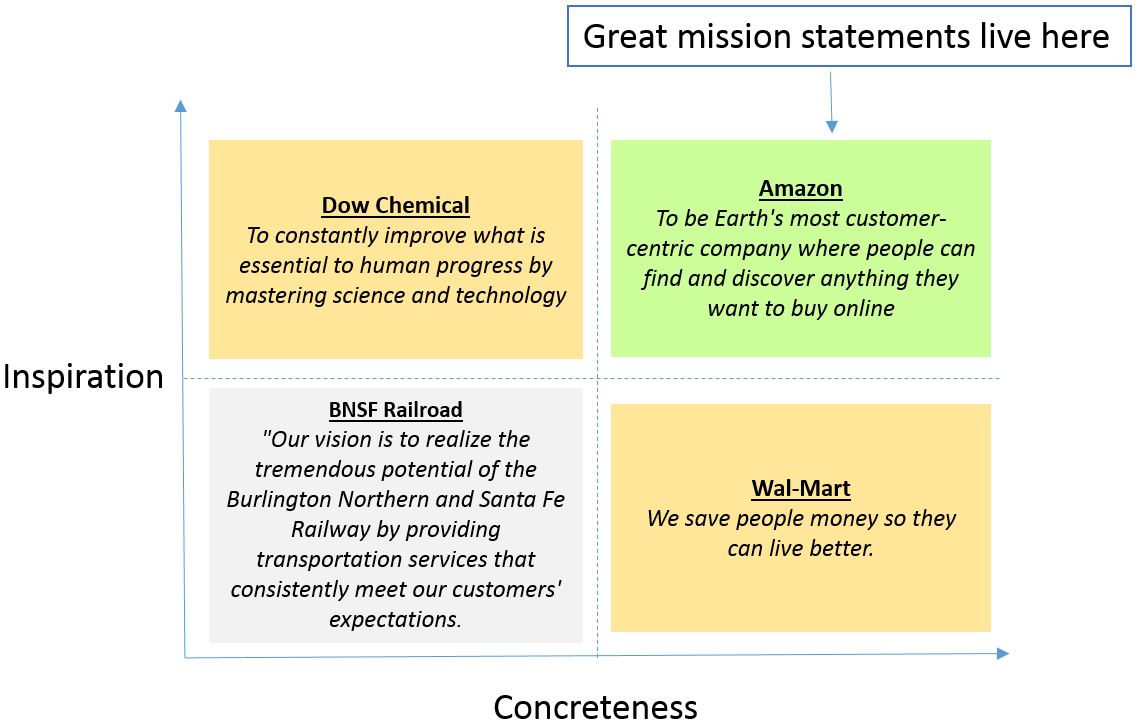
We looked at a few mission statements in our Values Based Leadership class –

Wal-Mart: We save people money so they can live better.
Burlington Northern and Santa Fe Railroad: Our vision is to realize the tremendous potential of the Burlington Northern and Santa Fe Railway by providing transportation services that consistently meet our customers’ expectations.
Dow Chemical: To constantly improve what is essential to human progress by mastering science and technology

As we went through these statements, the comments that followed were around the following lines –
– The Wal-Mart mission is really concrete. It is the sort of statement that can be used whenever Wal-Mart faces a tough decision. Any product or personnel decision could be brought back to the fact that Wal-Mart exists to save people money.
– The Burlington Northern and Santa Fe Railroad mission felt like a non-mission statement. You could easily replace their name and industry with a different company and industry and it could still “work.” That’s a problem.
– Dow Chemical did very well on inspiration. But, how concrete is it? Can the mission statement actually be used in daily decision making?

Bringing it all together, we realized that great mission statements have 2 characteristics –
1. Inspiration. Some inspire with a transcendent purpose and others inspire with a bold goal. Regardless, the inspiration factor gives people a reason to come to work everyday.
2. Concreteness. Concreteness makes the vision easy to understand and apply to daily decisions.

Mission statements, as a result, are an important and, yet, often neglected resource for building culture, improving employee motivation and decision making. What is an example of a great mission statement? I love Amazon’s statement – “To be Earth’s most customer-centric company where people can find and discover anything they want to buy online.” Really inspiring and, yet, very concrete. If there was ever a decision to be made, it is clear that the customer would be first priority.

(Note: I’ve used mission and vision statements interchangeably to convey the larger point)

Mission statements

This learning had immediate applicability for me. I thought of 3 teams I am working with and thought about the various levels of clarity in our purposes. And, voila, it turned out that the team where I felt most stuck was the one with the least clarity around the mission statement.

It is a relatively simple fix. And, it is one we ought to get right.

Staying with problems

Spend time with a problem long enough and you’ll find a way to solve it. You’ll learn to look at the problem differently, find every resource that can help you solve it or perhaps learn from people who’ve solved similar problems.

The sort of problems that experts aim to solve are not those that are weathered by raw intelligence. Every expert knows of at least a hundred others who are smarter than him/her. Those sorts of problems are weathered by persistence.

Great problem solvers possess majors in persistence with minors in patience and grit.

Living the good life requires us to be great problem solvers too. They questions asked of us are – “what is the good life in your definition? what will make you happy? how will you measure your life?” You don’t need a high IQ to solve these. You need high persistence (PQ?).

It is doable and within reach. We just have to be willing to stay with these questions.

What to be vs. what not to be

It is fairly easy to come up with a list of things you don’t want to be. It feels like you have done the hard work of attempting to define who you would like to be in the process. But, really, you haven’t.

“I don’t want to be a flake” is fundamentally different from “I will always keep my commitments.” The former has enough fudge built in for you to keep 7 out of every 10 promises and still be able to rationalize your behavior. The latter, on the other hand, is a commitment to integrity. It swears by the idea of 100% or none. There are no excuses and no easy way outs – you are forced to make real trade-offs.

As a result, there are only so many things you can be. The chances that you’ll pull off research that wins a Nobel prize while being a party animal who paints the city red 3 days every week are minimal. If you want to be a Nobel prize winner, you will need to make some very real sacrifices. Prioritization is essential.

That is precisely why very few choose to take a stand. It is just much easier not to.

But, of course, there is a real trade-off there too – character isn’t built that way.

26

3 things I’m thinking about as I complete my 26th year –

1. Self confidence and the unwillingness to compromise on what matters. The primary reason for starting this blog was to learn to get over my own insecurities and build self confidence. I’ve learnt a few things about confidence over these past few years and a key part of this learning has been the understanding that confidence doesn’t come from dots, it comes from lines. So, a consistent set of small wins does more good for your confidence than an out-of-the-blue big achievement. It is that realization that’s led to an intense, obsessive, sometimes pedantic, focus on process over the past few years. This focus on process has resulted in better results, more happiness and, over time, more confidence.

I’ve begun to observe that this increase in confidence has had an interesting side effect – an unwillingness to compromise on what matters to me.  I think that’s because confidence brings with it a sense of comfort in your skin. And, a mix of this comfort combined with a sense of purpose that’s been a result of all the thinking on the topic for the past 2 years has led to more clarity on why I do things. This, in turn, has helped with making all those little decisions that make up our days. And, as we live our days, so we live our lives.

It is a fascinating evolution though. And, I’m enjoying the change.

2. History lauds the individual but it is teams that make history. Hat tip to Walter Isaacson and “The Innovators” for this one. I’ve really been struck by how every great innovation in the past 150 years was brought forth by teams. I always considered myself reasonably well acquainted with the history of technology and I associated many technology shifts with lone geek genius. I’ve been blown away by the recurrence of this very simple idea – history is made by great teams. That, in turn means, if you want to really make a positive difference, you want to hone your ability to build great teams. (Note: build doesn’t necessarily mean lead)

I have 3-4 interesting team projects in progress and, in the remaining year or so of being a student, I am really interested in digging deep and understanding how great teams are built. It is nice to be able to experiment with no serious consequences. :-)

3. Learning to “see” and learning to make the most of an inch by going a mile deep. A close friend recently said he thought I was very observant. I found this to be an interesting observation as I have always thought of myself as someone with really bad observation skills. And, in some senses, that is very true. I am lost in my own thoughts and world far too often. But, observation in his eyes was to be able to view a situation and take insight from it. And, I think what he described as observant is what the wonderful Seth Godin describes in his post about “learning to see.” 7 years of looking for interesting ideas to blog about has inadvertently taught me to scratch beneath the surface a lot more. Allow me to digress for a moment here – it never ceases to amaze me as to how often people around you can point out things you never knew. I’ve learnt nearly everything about myself, especially about my strengths, thanks to insightful notes from people around me. I do my best to do the same to others around me. These observations around strengths are very valuable – we focus on weaknesses far too much.

His comment, however, led me to think about the idea observation some more. And, the more I think of it, the more I realize that observation is as powerful an idea as it gets. Great learners don’t need too many experiences to learn powerful lessons. They make the most of experiences by extracting an unimaginable amount of insight. I’d like to be able to do that more. And, perhaps that’ll be a great theme to take forward into this 26th year – to be able to make the most of the experiences I choose to immerse myself into by learning to make the most an inch… by going a mile deep.

Thank you to you for reading these notes, liking, sharing, and sending in your thoughts and comments. It is always lovely hearing from you. You make this blog a blog. And, for that, I am very grateful. Thank you for all you do.

(Past birthday notes: 25, 24, 23)

Lessons learnt from internship recruiting – MBA Learnings

I hated looking for a job in my final year at university. It is one of those profoundly painful processes that I really wouldn’t wish on anyone. It seemed to bring to surface all my insecurities and really made me question if I had done anything of note in the past 20 odd years of my life.

So, when I decided to study again, one of my objectives was to understand how best to approach looking for a job. We’re in an age where we’re constant job seekers. Whether it is seeking an internal transfer within a company we work for or whether we’re looking for a role in a different company, it is clear that our age is one of many jobs, roles, careers and companies. In that sense, looking for an internship at school felt like a perfect laboratory to test how this process ought to be approached. I’ve decided to break the whole process down into three main steps, cataloged my process and then shared what I learnt. I’ve attempted to bring it all together in one post. So, it’ll be long. I hope it is worth it.

Stage 1- Figuring out what I want to do. This has to be the first step of any job or project search. There are always options you don’t want. And, it helps to really understand what you want to do rather than follow the crowd. A simple point to remember – for every job or role you don’t feel all that passionate about, there are a hundred who do.

My process.
i) Speak to as many smart people as possible. I liken this stage to market research. Take time to just get some perspective from people you like and respect. Just engage with them on general advice on careers, paths, and how you ought to approach them. It helps a GREAT deal if you already have a sense of the direction you’d like to take. For example, it is much easier to have conversations focused on careers in pharmaceuticals than just careers in general. Ideally, speak to people who’ve done what you’re about to do or something similar. These perspectives should give you data points and perspective to reflect. After every such conversation, take a few minutes to take short notes of what you took away.

ii) Take the time to reflect. Now, take the time and think about what you think you’d be interested in and what you’d like to explore. Write down what you learn. The ideal outcome of this process is a shortlist of roles and companies that you’d be interested in working at.

iii) Explore ways you can meet people in these target roles or companies. There are 2 ways to approach this. The intentional approach is very targeted and focused on getting a job. This involves looking into your LinkedIn connections and figuring out who you know in a certain industry. If you’re looking for connections in Pharma near New York, it makes your search straight forward. Once you find a few people who know people you’d like to meet, you reach out and set up some informational meetings.

The other way to approach this is to do this with less intention (my preferred approach). Reach out to people you know within the industry you’d like to work with and just ask to meet with interesting people. As long as your interest is genuine, this can lead to some really cool serendipitous connections. Take the time to visit these people in person (if at all possible) and just meet. No big agenda aside from a willingness to get to know them and list. In the long run, this approach makes a huge difference and is how good “networking” is done.

Lessons I took away.
i) Get started as early as possible. I was told to get started on this process well before I got to school. It is one of the better pieces of advice I have received. The principle here is straightforward – some things just take time. And, it is best to do so when you don’t have a burning deadline in sight.

ii) Approach this part of the process with the intention to learn as much as you can. Relationships are not built when by seeking specific favors. Relationships are built when you have a genuine interest in getting to know the person at the other end of the table. At this stage, it is critical to really get to know people as the perspective you’ll receive from an expert / someone who has gone through the same process as you is one that you’ll be hard pressed to find in a book.

iii) Think long term. This isn’t about getting what you think you want now. If it is, then you’re approaching it all wrong.

Stage 2 – Attempting to get your foot-in-the-door via an interview.

My process.
i) Finalize that target company and roles list to the extent possible. It helps having a pre-final list. Of course, it’ll change but it helps having an idea of the direction you’re heading.

ii) Work hard on that resume. I think my resume went through at least 20 iterations. It is really important you get as many external points of view as possible, filter out the feedback that suits your style and trust a few people to help finalize on a document that you are happy with. It isn’t over till you are happy with it.

iii) Find ways to signal strong interest. In school, this means showing up to company events and speaking to recruiters. Outside of schools, this means speaking to people within the company/within teams of your interest and making sure people within the company know of your interest.

iv) Work hard on that cover letter. There are a few companies out there who just expressly forbid cover letters. Aside from those, take the time to work on that cover letter. This is a wonderful way to signal interest and explain why you are a fit for the role you’re applying to. This is especially important if you are switching roles or careers. Make sure you run your company-specific cover letter with at least one person from each company you are applying to. The goal isn’t to use every piece of feedback you get. The goal is to filter it for what works for you, trusting a few people whose style suits yours and getting to a version that you are happy with.

v) Send your applications in early. Seriously. Don’t wait for the last minute.

Lessons
i) Narrow or broad? Find an approach that suits you. There are many many ways to go about this process. But, the biggest difference tends to be whether you prefer casting a broad net of target roles and companies or whether you prefer a much targeted and narrow approach. I honestly don’t think there is a right or wrong here as I’ve seen both work exceptionally well. The important thing is to pick an approach that works for you. I’ve come to prefer a narrow approach that is very focused. But, that’s just preference. It has its downsides as you put your eggs in fewer baskets. But, the upside is that you only work on roles that really interest you.

ii) Don’t do things to check-the-box – do it because you care. This is a general life lesson but really applies here. Don’t reach out to recruiters to check the box. Do it because you have a question. This is not everyone’s approach. But, I’d find it hugely frustrating if I found myself on a call that was motivated by a desire to check the “I spoke to someone within the company” box rather than out of genuine desire to learn.

iii) Seek and get comfortable with hard feedback. Better to have hard feedback early on your resume and cover letter than just receive rejections when you apply. Seek hard feedback and celebrate when you do receive it.

iv) Personal contacts matter. If you’ve taken the time to build relationships at the places you want to work, interview calls come much easier. They know you, they like you, they’d like to give you a shot, and your resume submission is just a formality. Makes it easy for them and yourself. I know it is cliche – but, who you know does actually matter a lot.

Stage 3 – Be the best you can be in those interviews. It is easy to imagine the process of attempting to get an interview as a game where you notch up points. Once you have received that interview call, however, your score gets reset to zero. Now, you walk into territory where your previous contacts and relationships matter a lot less (if at all) and where your competence gets a shot at shining through.

Process –
i) Master the basic pieces – behavioral, the 4 why questions and strengths and weaknesses. There is a tried-and-tested approach to doing well at behavioral interviews. I’ve written about that and added my enhancements to the approach in my previous post on the topic. They key here is to just put in the time, write down all your key stories, take time to understand your own thought process as you approach different kinds of problems and work on communicating it.

With the 4 why questions – why industry?, why company?, why role?, and why you?, it matters that it feels passionate and genuine. Boring prepared answers fail this test almost immediately. If you’re not able to find enough passion to explain these in your practice, I’d really question if you’re interviewing for the right role.

Finally, with strengths and weakness questions (especially weaknesses), speak to people who know you well and practice your responses. This needs to feel genuine.

ii) Use the “Tell me about yourself / Walk me through your resume” question to set the tone. This is an important question. Once you’ve taken the time to write down all your key stories and answered the “why’ questions, a clear pattern on your main themes should emerge. I am a big fan of thinking about the one thing you’d want the interviewer to remember about you. Then, think about three things. Structure your “Tell me about yourself” around these 3 things rather than a chronological order. This question is important because you can already lead in to the why company/role questions if done well. Really take the time to get this right – the final product needs to be succinct and it definitely needs to reflect YOU. Practice and feedback goes a long way with this question.

iii) Work hard on technical/case interviews. My interviews required me to get really good on case-style interviews very quickly. For the roles I was looking at, these were either technology product cases (easier) or broad strategy cases (harder). In some ways, I was a bit late into this realization for broad strategy cases and had to work really hard over a 3 week period to catch up. I ended up looking back at 3 weeks where I read 2 books, worked out around 30 cases by myself, 20 with my wife, and 15 mock cases with friends and ex-colleagues. Work with people who’ve mastered the process and aim to find your own path.

4 books helped me greatly in the process.
Product cases: Cracking the PM interview (Gayle Laakmann, Jackie Bavaro) and Decode and Conquer (Lewis Lin)
Strategy cases: Case in Point (Marc Cosentino), Case Interview Secrets (Victor Cheng)

All thus reading and interviewing led to 2 synthesized approaches that I could apply across these 2 kinds of cases –
– For product cases, I had 5 step process – what is the problem the product exists to solve?, who are the users/buyers?, how does it perform?, what changes would I recommend?, and how would I prioritize these changes?
– For strategy cases, I think the crux is identifying whether the case is an estimation (estimate top down, bottom up and do a gut check), a profitability case (break it down into its drivers – revenue, costs, etc.) or a decision case (go/no go with qualitative and quantitative costs and benefits).

I’m staying away from any more specific advice on technical/case interviews as it is important you do all the reading required and develop a style that works for you.

iv) Customize your preparation for each company. Consider developing “snapshots” of your research of the company you’re interviewing for. Here’s an example of a page full of publicly available information on LinkedIn. This stuff takes time but my belief is that this sort of preparation just comes through in the interview.

iv) Develop a pre-interview routine. Confidence matters a lot in the interview game. Develop a routine that helps you feel good. I used to generally wake up early, scribble a few notes of my approach to case interviews, read through my snapshot + behavioral interview notes. Just before the interview, I’d listen to the same collection of songs. I’ve heard of others who did a few “power poses” before their interviews. This is very personal – so experiment with a few different routines and then settle on what works for you.

Lessons
i) There is no substitute for practice and preparation. The only way is through.

ii) Try and do 3 interviews over 2 weeks with 1 person whose opinion you trust. While it is important to get as many mock interviews under your belt, I’d highly recommend doing 2-3 interviews over a 2 week period with 1 person whose opinion you trust. This way, you’ll be able to monitor your progress better than just doing 5 mock interviews with 5 different people.

iii) Pace your preparation. It is hard to sustain intensity over a long period of time. So, pace your interview preparation as far as possible. You will have peaks and troughs. If you pace yourself well, your peaks will come on your most important interview days.

Bringing it all together. If I had to look back at the past few months and give myself advice for the next time I did this, I would tell myself three things.

First, it is a team effort. So, take the time to build and nurture this team. Any successful process has a team of people who worked on it, e.g., your applications to school  were successful because of recommenders, parents and mentors. Similarly, it helps to have a support system of folk who want you to succeed. Ask for help when you need it (and you will). And, remember those who help, say thank you often, keep them informed of your progress (or lack of it in case of people who’re very close to you), be nice and commit to helping them in any way possible and/or paying it forward.

Second, allow luck to find you. In all of these processes, there is always a certain amount of dumb luck involved. Just remember – chance favors the prepared mind. So, be prepared.

Finally, aim to be the best version of yourself. We often attach ourselves to outcomes we don’t control. I’ve written about how admissions and hiring is largely a crap shoot after a certain point. Neither of these are easy processes. That said, they can be very educational. Just aim to learn and celebrate the fact that you’ve given it your best shot. In the long run, the habit of being prepared, showing up and giving it your best tend to matter more than most other things. And, besides, it is my belief that good processes lead to good results.

All the best. I hope it helps.