
The hard part isn’t making the commitment. That’s just a one time thing.
The hard part is the 56,000,638 times you have to re-commit after making the commitment.
So, commit. But, really, commit to re-commit.
The hard part isn’t making the commitment. That’s just a one time thing.
The hard part is the 56,000,638 times you have to re-commit after making the commitment.
So, commit. But, really, commit to re-commit.
Rene Redzepi, the chef and founder of Noma – the restaurant that has been consistently ranked the best restaurant in the world, conversed with Jiro Ono at Ono’s legendary sushi restaurant Sukiyabashi Jiro. I am a huge fan of the movie on Ono – Jiro Dreams of Sushi. So, I enjoyed every minute of the short 12 minute summary video.
My favorite part of the conversation was (paraphrased) –
“How long did it take for you to feel like you became a master?”
“Till when I was 50 years old.”
“Between when you started as a teenager to when you were 50, did you every think of quitting?”
“No. The only question I asked was – how can I get better?”
Powerful. Thank you, Rene and Jiro-san. And, hat tip to Matt Mullenweg for sharing this.
(Before I begin, I apologize to all of you who read this on RSS for going MIA on you over the past 4 days. The RSS feed was broken and I didn’t notice there was an issue. I got that fixed this morning so you should receive 4 days worth of posts today. It is an annoying problem that I run into every months – the encoding system seems to take issue with the occasional apostrophe / single quote as it is interpreted as code and that, in turn, ends up breaking down the system. Thanks to those of you who let me know. Apologies for the trouble.)
A team I am a part of organized a meeting yesterday for our “extended” project team. I was planning to sit in the back and get some work done. But, I noticed the attendees were joining me in the back instead of sitting near the presenter (also a team mate) right up front. So, the presenter asked asked everyone to move forward. I urged them to do so, too.
To that, one of them just said – “I’m just following your example.”
I realized I was the problem, not them. So, I moved ahead, shut my laptop down and got ready to engage. Things got much better.
One of the funny / difficult things about leadership is that we often forget that our behavior is always noticed. That’s just the nature of the job.
And, it is a reminder that the most powerful way for us to lead the way is to simply role model the behavior we expect.
I am listening to “Wonderwall” by Oasis as I’m typing these words out. This was among the first songs I fell in love with and has so many great memories attached to it as it has stayed on every music playlist I’ve had since my early teens.
It is 8:07am on Wednesday – I am looking ahead at a packed day with a new project commencing, a project wrapping up, two assignment meetings and a couple of other notes. It is going to be back-to-back and I’m looking forward to that.
It is at such moments that I realize that it is in these moments that we actually live our lives. Too often, we think of the weekend / the next big break as our only respite. But, this moment is where we live have our day-to-day struggles and challenges. And, it is such moments that add up to a life where we’ve hopefully explored the length and breadth of the road we traveled.
Sure, it isn’t perfect and there are a few things that would be nice if fixed. But, I’m thankful for this moment. It is said that it isn’t happy people who are thankful but it is thankful people who are happy. I believe that. Remembering to give thanks takes work..
But, in the final analysis, I can think of very few other things that will matter as much as being grateful for all we’re blessed with and savoring the simple things that make up the bulk of our experience. Let’s live today.
The theory of constraints views any system as being limited by a small number of constraints. This is easiest to imagine in a manufacturing process – there is typically one machine that limits the production capacity of the plant.
It is no different in our lives. 24 hours, for example, is a constraint that limits us. In fact, the smarter way to think about it might be to view 12 hours as the real constraint. It is hard to sustain 12 hour days over a lifetime even if you might work harder than that for certain periods. And, even then, we’re discussing quantity of work and not quality. So, a really smart way to think about it might be to think in terms of the 3-5 hours of productive time we have in a day. On the one hand, it can be less of a constraint if you can drive that number up. On the other, it is important that we begin by just being aware of that limiting constraint.
Once you understand your constraints, the theory of constraints recommends that you design your system around that constraint. So, in our daily lives, that would mean ensuring we free up bandwidth to ensure we get the most out of the productive hours. It would also mean we sleep well, eat healthy and exercise regularly so we’re consistently pushing up the quality of our thinking during those productive hours.
Understand constraints is critical to understanding reality. And, understanding reality is critical to doing great work.
If you want to be calm under pressure, just start describing yourself (to yourself) as someone who is incredibly calm under pressure.
This transformation won’t take place over night. But, the next time things go wrong (and, don’t worry, they will), you might catch yourself reacting to the mishap. When you do, write down what you learn about yourself. After a few such experiences, you will feel the psychological trigger coming and start learning to take control of your response. And, a few more such incidents later, you will actually feel very calm under pressure. After all, you are one of those people who is calm under pressure.
As human beings, we care about being consistent with who we think we are. This makes labels incredibly powerful. Some of the smartest coaches of sports teams are very quick to label their players as the “best in the world.” It doesn’t matter if they are. It just matters that they begin behaving like they are the best in the world. Sir Alex Ferguson was famous to label Manchester United players as those who had the strength of character to snatch a victory in the last minute of a game. It didn’t matter if a player showed up at United yesterday. He’d suddenly find himself capable of doing exactly that. It was a self fulfilling prophecy.
A big part of being a great leader is bringing out the best in people. For that, we have to learn to see people, not just as they are, but as they could be. And, we’re best served if we begin doing that with ourselves.
Here’s this weeks 200 word idea thanks to To Sell is Human by Dan Pink.
How do you get people to save for retirement? Hal Hershfield from NYU conducted a series of studies which had two groups of participants allocate money between various buckets – a big expense now, other household expenses, and their retirement fund. Before doing so, group 1 was shown a picture of themselves now while group 2 was shown aged picture of their 70 year old self.
The 70 year old selves group allocated more than twice the amount for their retirement than the others ($170 vs $80). To test if this was a reaction to seeing older people, the researchers tried replacing photos of their aged selves with that of other older folk. This had no effect.
It turns out that our biggest barrier to saving for the future is forgetting that we will grow old someday. If we’re having difficulty making long term decisions like saving for retirement, perhaps we should experiment consider sticking a “photoshopped” picture of our older self on our wallets and internet banking dongles?
 Source and thanks to: www.EBSketchin.com
‘Do something today that your future self will thank you for.’ | Jeanine Jacob
We gravitate to things we’re good at. Doing something we’re good at feels great – we’re in our element, we feel good about ourselves and we’re appreciated for what we do.
If success builds careers and failures build character, it makes sense that we gravitate to areas we can be great at in our careers. Notching successes matters. However, in our personal lives, I think it is critical we become beginners from time to time. We can do this by attempting a new difficult side project, learning a new skill or simply doing something we haven’t done.
I am experiencing this in a small project where I am, by far, the beginner. It has been a fun experience attempting to do the basics, feeling very grateful to the experts around me for having me around and encouraging me, and just experiencing the joy when I occasionally do a couple of things right. Being a beginner is a very humbling experience.
Someone I met said she would regularly ask people – “when was the last time you did something for the first time?”
That’s a question worth asking every once a while.
Carlsmith, Wilson and Gilbert of Harvard University published a study about the effects of revenge.
Individuals encountered a free-rider and were given the option to punish, not punish or forecast feelings about punishing the free-rider. Their positive mood was then monitored and measured. The results of the study are nicely summed up in 1 image.
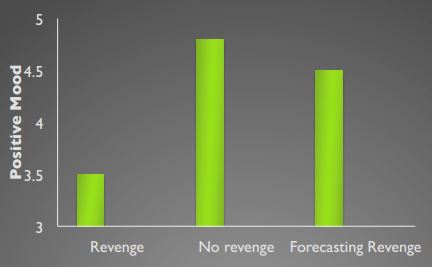
People who punished others felt significantly less positive because they continued to ruminate about their offenders while those who forgave moved on.
I think this idea applies beyond revenge. The more we give space to negative feelings like anger, ego and revenge, the more they take over our lives. As The Buddha summed up beautifully in a quote on anger – “Holding on to anger is like grasping a hot coal with the intent of throwing it at someone else; you are the one who gets burned.”
There’s a lot that can go wrong. Forgive. Move on. And, when communicating with yourself, remember “Jennifer, relax!”
There are 3 ways to view discomfort. The most popular way to view it is as something transitory to keep away from. This view involves working hardest to avoid it. It isn’t comfortable. Why bother?
The second is to view it as a necessary nuisance. Learning doesn’t come without discomfort after all. So, this view focuses on tolerating it as a means to an end.
However, the most enlightened approach is to not just live with it, but to love it. In this view, we don’t just tolerate discomfort but we treat it like we’d treat a close friend. We welcome it and dance with it.
And, why shouldn’t we? Nothing great has been done without discomfort. Our happiness doesn’t lie in strolling about life with a balanced and careful gait. The wonderful Viktor Frankl spoke of the idea of the pursuit of happiness. What words come to mind when you think of pursuit? Does it comfortable? Heck, no. Does it sound tough and tiring? Yes! But, does it sound adventurous, exciting and exhilarating? Absolutely.
It is great to pursue happiness, success, and all those things we associate with the idea of the good life. But, as Frankl wisely pointed out, the good things in life can’t be pursued. They ensue. And, all we can do is make sure we listen to our conscience and do as much as we can to impact as many people as possible in causes we care about. Success and happiness follow precise because we forget to think about it.
All of this requires us to not just tolerate discomfort but to invite it. It is our adventure, our party and discomfort is a huge part of the narrative.. it is time we learnt how to dance with it.
 A Learning a Day