Weirdness and the Empty Chair – The 200 words project

Many entrepreneurs who were attempting to create the next big telecommunication startup in the past decade brought out ideas to simplify international calling. But, as technology analyst Ben Evans points out, we tend to over-estimate how many people know enough people (or any people) in another country – outside very specific groups such as immigrants. That violates the first rule of marketing – you are weird. Don’t assume your customers are like you.

Once we get that, how do we make sure we really understand our customer and keep them top of mind? Jeff Bezos offers an interesting approach.

Even during the fledgling days of Amazon, Jeff Bezos worked hard to establish the philosophy of a company that obsesses over their customers.  An overwhelming figure that used to always set the tone of his meetings was “the empty chair.” Bezos brought an empty chair into meetings and informed his top executives that they should consider that seat occupied by their customer, “the most important person in the room.” Throughout these meetings, a different weight was held on all decisions as the invisible but clear presence of the customer was always accounted for.

“We’ve had three big ideas at Amazon that we’ve stuck with for 18 years, and they’re the reason we’re successful: Put the customer first. Invent. And be patient.” | Jeff Bezos

Source


Source and thanks to: The Everything Store by Brad Stone, Ben Evans’ blog, Prof Moran Cerf @ Kellogg

How you build culture

You don’t build culture within a team/organization by talking about it.

You build culture in three ways –

1. The results you achieve. Results go a long way in creating culture. Consistent high quality work generally comes from a high quality culture. And, on the flip side, if you consistently ship bad work, it doesn’t matter if you have a good culture.

2. How you achieve results. Process comes next. Do you achieve those high quality results by burning people? Or, do you achieve them by stretching and challenging them just the right amount? Is the decision making process dictatorial or is it consensus-driven? All of these processes create culture.

3. Who you fire, reprimand and promote. The final key culture creators or destroyers are the decisions you make around people. When you fire, reprimand or promote people, you send clear signals about what you value. And, if these decisions are aligned with your team’s core values, then you will have created that magical place – a place where the culture is the manifestation of its desired values.

As a wiser friend pointed out, companies and leaders fail most often in getting #3 right. #3 requires you to consistently have the difficult conversations, not tolerate any violation of values, and promote people who perform while being culture ambassadors. This is hard to do.

But, do this right and you build a team/organization that actually does what it says – one of those rare places that can actually claim to have that elusive trait – integrity.

Source

What confidence is and where it comes from

Confidence is not knowing that things will be fantastic the moment you put in effort. Instead, confidence is accepting that things might inevitably go wrong even after you put in your best efforts and knowing that you will cope with it just fine.

So, where does this come from? I think it comes from committing to be a student of life, for life. Once you commit to being a student, you commit to viewing every situation you encounter as a learning. You understand that there would be no learning without experiments and that there would be no experiments without failures. You also choose to keep away the arrogance and stagnation that come with successes because they kill curiosity – the trait that makes a student. Armed with consistent curiosity, you ask questions to understand and relentlessly attempt to understand how things, including life, work.  And, part of being relentless is putting away all desire to create an image or “position” yourself in a certain way to the world.

After all, all you’re trying to do is to learn – that means cutting through the noise and doing whats necessary to further your learning journey. When you do that, you realize that the only way to do that is by simply being comfortable with yourself and your learning style. And that, in turn, requires you to believe that “you are enough.”

And, you are. You are a worthy student of life. That’s why you are here.

Now, let’s get on with it – with confidence.

Making it a habit to tell it as it is

For most people, “telling things as it is” or being direct is a hard thing. That’s why there’s so much politicking and disingenuous behavior in large corporations. Our needs to be popular and to be liked are very powerful and make it very difficult to be direct.

However, when building teams and organizations, building cultures of candor where people feel comfortable with directness is critical to survival. The amount of politicking and gossiping is inversely proportional to the amount of trust there is. And, if ever the word “Team” was an anagram for something, I’m pretty sure T would stand for trust.

I’ve worked hard over the years to make it a habit to tell it as it is and have those conversations – especially when building my own teams. I expected them to get easier over time. They did – just not in the way I imagined.

Now, I feel it has become easier for me to discern if a difficult conversation is necessary. It has also become easier for me to identify situations where it is vital to be communicative even if it isn’t pleasant. But, it hasn’t necessarily gotten any easier to have those conversations and deliver the message. This is because the need to be liked is hard wired in all of us. Over time, I’ve learnt that that need is regularly counter productive and that rising above it is both necessary and important. It doesn’t get any easier though.

Ben Horowitz was right in calling his book “The Hard Things about Hard Things.” Most of the stuff that goes into building a great team or a good life isn’t rocket science. However, doing them and then doing them consistently is bloody hard.

Source

Thinking Product: Amazon Kindle Support awesomeness

I kept up a product review series for about 9 weeks over the summer before talking myself out of it. I felt I was putting too much pressure on myself and decided to give it a break. As the weeks have passed, I am ready to get back to it. My passion for discussing products and services hasn’t changed. I am still keen to learn how to build great products. And, that means learning how to “see” greatness in products. A part of what made the old series hard to continue was that the “product review” framework felt constraining. So, I’ve decided to keep it more open. Let’s see how v2.0 goes.

The product experience I’d like to discuss today is one with Amazon Kindle support.

One of my recent learning objectives is to get good at Statistics. I was recommended a Statistics textbook by one of my Professors and purchased it on Kindle. I didn’t get to it until Thanksgiving break. When I did, I soon realized that it wasn’t conducive to reading on the Kindle (app on my iPad) because it inspired me to take notes, try out exercises and flip pages to see the answers. I needed to get a physical copy.

This, book, however, was $94 on the Kindle. And, while I’m normally indifferent to education related spending, I felt guilty about making a bad decision and began researching Kindle returns. It turns out that all you have to do is go to “Manage Your Content and Devices,” click on the book and (here’s the catch), if the book was purchased in the past week, you can return it with a click.
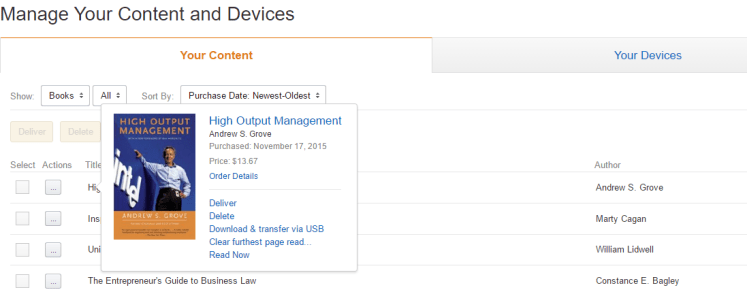
Amazon returns

Mine was 2 months old and I’d also read a bit of it on the Kindle. However, I decided to give Amazon’s Kindle support a shot. Here are the emails.


Hi,

I am a graduate school student who purchased Statistics (Fourth Edition) on my Kindle. However, upon reading it, I’ve found it very hard to “study” this book on the Kindle and purchased a physical copy instead (just purchased a 2nd hand version on Amazon).

I know this is a long shot.. but I was wondering if I would qualify for a return. This would be particularly valuable to me as this is an expensive book ($94!) and I am, after all, a cash starved graduate student.

Thank you for considering this.
Rohan


Their response came through in less than 2 hours.


Hello,

I’ve requested a refund of $93.32 for “Statistics (Fourth Edition).” Refunds are issued to the payment method used to make the original purchase and usually complete within two to three business days.

Once processed, you’ll be able to see the refund request here:

http://www.amazon.com/gp/digital/your-account/order-summary.html?orderID=D01-9350573-87…

Thanks for using Kindle.

We’d appreciate your feedback. Please use the links below to tell us about your experience today.

Best regards,
Shruti S

Did I solve your problem?
Yes No
Your feedback is helping us build Earth’s Most Customer-Centric Company.


3 quick notes –

1. I was blown away by the speed of response. As a friend pointed out, this means they likely have authority at the customer support level to make such decisions. A $94 for a book bought 2 months ago isn’t a small decision by any means.

2. My only improvement suggestion would be to add the name of the customer next to the name. “Hello Rohan” would have been fantastic. Audible support does a fantastic job doing that.

3. “Your feedback is helping us build Earth’s Most Customer-Centric Company.” – In most cases, I would scoff when I see a line like that. It is testament of the consistent awesomeness of all things Amazon that scoffing didn’t even occur to me.

Great product experiences mean making sure your users get supported. Thanks, Amazon, for showing us how its done.

Micro observations and the long, unglamorous road

A few quirks I’ve noticed over the past months –

Focus related
– Listening to music on headphones helps my mind focus a lot more than listening to music on speakers
– A closed door or closed space helps with focus more than an open space
– Spaces with nice views of the outdoors (preferably with a lot of green) improve thinking by a huge degree

Insecurity related
– Lack of sleep is correlated with feeling more insecure/unsure of myself (this likely has a causal relationship – I’m not sure yet)
– On days when I feel insecure/unsure of myself, I literally feel colder and prefer having an extra layer on

Productivity related
– The more hurried I feel in the morning, the less mindful I am through the day – getting the morning right is critical
– The best way to get large projects done is to schedule small bits of thinking time well in advance – it doesn’t matter that I don’t solve any problems, it matters that I begin thinking about it

Reading related
– Audio books, Kindle books and physical books work for different kinds of reading (this is probably a blog post in itself)

I thought I’d share this random collection of micro observations to illustrate two points.

First, it is that the journey to self awareness involves collecting small micro insights such as these. Insights like this go a long way in helping us design a life that works for us. For instance, you will never catch me walking around without headphones. They enable me to focus wherever I want. Similarly, I’ve learnt to be very protective about my sleep schedule and morning routine. I also find leading indicators of days I feel insecure/unsure of myself really useful. These are days when I double down on being mindful, do the simple things right (e.g. exercise, eat well) and work to get back on right mentally.

Second, if it isn’t evident already, the road to self awareness is long and unglamorous. Often, when you reflect on this stuff, you don’t find stuff that delights you. You see behaviors that occasionally make you cringe because you catch yourself acting on some bizarre insecurity or you see random quirks which make very little sense. The point, of course, is awareness. With awareness comes acceptance and action.

long, unglamorous roadSource

And, of course, let’s not confuse a lack of glamour for a lack of happiness. We earn our happiness stripes by working through the lack of glamour.

Water hypocrisy

The other day, I observed a friend doing the dishes with water left running on. A voice in my head screamed in disapproval as I felt a lot of water was being wasted unnecessarily.

Rather than say anything however, I just proceeded to wash my own dishes and regulated the water usage as I normally do. (I did feel self-righteous doing that.)

I thought about that moment a few minutes later and asked myself why I didn’t say anything. And, the answer that came immediately was in the form of a question – “Are you sure you aren’t just being hypocritical?”

A combination of being a student of human irrationality and growing self-awareness over the years had made me fairly conscious about my/our tendency to be hypocritical.

I then reflected on my own water usage. While I’m generally parsimonious, I do tend to indulge when it comes to taking showers. For good or for bad, I love my showers and showers waste a lot more water than an open tap while washing dishes.

Thank god I hadn’t said anything.

Hypocrisy

I took away 3 notes from this moment –

1. If you’re going to give feedback to people, make sure you check your own behavior. There’s a story about a woman who went to Mahatma Gandhi and asked him to advise her son to give up unhealthy sweets. Gandhi asked her to come back in two weeks. After he’d spoken to her son two weeks later, she asked him why he’d delayed the conversation. He said he had to give up unhealthy sweets himself before he felt qualified to give her son advice. While it is likely this story is just that, a story, the moral still holds.

2. The best way to inspire change in people’s behavior is to encourage change to come from within. While some part of that can be achieved by talking to people, most intrinsic desire comes from people observing others around them. We are the average of the five people we choose to be closest to. And, that’s because we generally learn most from these people – whether or not they’re trying to “teach” us.

3. An idea for driving down energy and water wastage would be to have meters that provide data on our usage versus the average in our community. Nothing like a bit of data and peer pressure to make people change behavior.

Bill Campbell style 1:1s

Managers in companies all over the world conduct recurring 1:1 meetings with their direct reports to make sure they’re aligned on key priorities.

Image source

Bill Campbell, executive coach to the top executives at Google, had a suggested approach to the 1:1. Instead of leaving the conversation open, he required both the manager and the team member to bring a list of 5 things to discuss. At the start of the meeting, they would match lists and talk about whatever is on both lists first. After that, they would spend time on 4 topics – performance on job requirements, relationships with peer teams, leadership and innovation.

The first step, however, was key. After all, 1:1s existed to solve problems. If a problem was on both lists, it was clearly top priority. On the other hand, if the lists had no matches, it suggested to Bill that there were much bigger problems at hand.

Here’s to testing Bill Campbell-style 1:1s.

Great management is a discipline, a daily practice of small things like a well-structured 1:1, that when summed across years of collaboration, create dramatic and sweeping change. – Tom Tunguz reflecting on Bill Campbell style 1:1


Source and thanks to: How Google Works by Eric Schmidt and Jonathan Rosenberg

Relax hard

We talk about working hard, partying hard, studying hard, and playing hard. We don’t talk nearly enough about relaxing hard.

One of the best things I’ve learnt to do is to relax hard. This means switching off from anything that sounds remotely productive, sleeping till you’ve paid back any remaining sleep debt from the past few months, lying in bed till you’re actually tired of lying in bed and feeling completely at peace with all of this.

There’s probably a hundred scientific studies out there that tell us why this matters. But, do we really need a scientific study to tell us this?

Growing up with my mom, I learnt that relaxing hard actually doesn’t require much. Certainly no fancy vacation required. You can do it at home with near zero expense – all you need is the right mindset. Fix that and you can have an incredible vacation right at home. That was a valuable lesson – it is all in the mind, after all, and a big part of being happy is simply not wanting to be somewhere else, doing something else. Thanks mom.

So, this weekend, I hope you consider relaxing hard. Forget the task list for a day and enjoy taking time off. The task list will still be there tomorrow. You can get to it, then.

Relax enough and you will re-enter feeling more energized and productive. Re-entry is always powerful.

Teaching without teaching

As I reflect on people I’ve learnt a tremendous amount from, I realize that the common thread is that they’ve taught me an incredible amount… without ever intending to teach me anything.

A dear friend and I have a phrase we use from time to time when we talk about the people dear to us and find ourselves hoping that they’ll just continue to be be their authentic selves. We say – “you do you!”

In that spirit, these teachers/”framily” have lived “you do you.” They just did their thing and, in the process, taught me more than I realize or give credit for.

I guess great lessons can be taught without ever seeking to teach.