Addicted to distraction – The 200 words project

Life coach and author Tony Schwartz’s widely read New York Times article “Addicted to Distraction” began with a realization that he had slipped into a period where he was managing his life very poorly. So, he started on an “irrationally ambitious” plan to cut down on excessive diet soda, alcohol, bad eating habits and web and email distractions during the day.

Through great determination, Schwartz fixed nearly everything he wanted to accomplish, primarily better diet and more exercise, but failed completely in one behavior – cutting back on time on the internet. As Cal Newport notes, there is something serious going on when Schwartz, who has built a career around helping people reach his full potential, finds it easier to kick off sugar, alcohol and sloth than his compulsive internet habit.

There isn’t a prescribed solution here but, it is clear, that it is a call for all of us to examine the nature of our internet behavior and experiment with solutions that suit our style this year. Tony Schwartz shares a few in the article (here) and I, for one, have found enormous value from not allowing my mobile phone in our bedroom after 8pm.

Schwartz recalled a powerful story about a man and his 4 or 5 year old daughter at a family restaurant – “Almost immediately, the man turned this attention to his phone. Meanwhile, his daughter was a whirlwind of energy and restlessness…[attempting many things] to get her father’s attention…she didn’t succeed and after a while, she glumly gave up.

The silence felt deafening.”

addicted, distraction

Source and thanks to: Tony Schwartz’s article, Tony Schwartz’s website for the image, Cal Newport’s analysis

Opportunities – access and utilization

It is one thing having access to opportunities and it is quite another thing to utilize them.

The asymmetrical demand for opportunities that are very sought after means that the process to access them is often very different from the process to utilize them. The US presidential election is a great example – getting elected and doing well as a President require two different skill sets.

While this could easily be a post on whether selection processes are aligned to performance processes, I’d like to focus on our own psychology. Too often, we spend the bulk of our time focusing on access to opportunities. There is always a next opportunity to access and, left to our own devices, life can feel like a race to move from one opportunity to the next faster than our perceived competitors.

The alternative approach is to focus on utilizing the opportunity we have right now and on being worthy of utilizing the next one. Focusing on access inevitably involves figuring out ways to play the system well and, in many cases, market yourself better. There is no way to “game” your own worth, though. This stuff is hard earned and requires focus and grit.

Inevitably, I’ve found that utilizing your current opportunity typically opens doors to the next one. Just focus on being better.. and better things follow.

Or, thinking about it in a different context – relatively, there is more of a dearth of competence than there is of opportunities. And, scarcity is the real opportunity.

opportunities, access, utilization

The cost is not just the cost – MBA Learnings

Let’s take a situation where a firm decides to buy a smaller technology firm for $1 Billion.

Every decision that is made is typically the result of a cost-benefit analysis. In some cases, this analysis is entirely quantitative. In others, it has a huge qualitative element (e.g. fit with strategy). Either way, the costs of the acquisition are not just the cost of acquiring the company. Those are just the financial costs.

The costs that should matter to us are the economic costs of the acquisition – driven by the opportunity cost of using that capital. In this case, the acquiring company had 3 options on how to spend the billion dollars related to that acquisition (there are options beyond this – we’ll assume the acquisition was critical) –

  1. Build the technology
  2. Partner with the technology company to get access to it
  3. Acquire it

When we take these options and their opportunity costs into consideration, the only way we get to option 3 is if we believe that it is the best use of the 1 Billion dollars. Or, put differently, had we invested the billion dollars into options 1 or 2, the long term results would be sub-optimal.

Understanding opportunity costs is fundamental in life just as it is business. At any given time, saying “yes” to a decision just because it provides us some benefit is a really bad way to make decisions. The way to make such decisions is to ask – “Is this the best possible use of my time given all my priorities?”

Great strategy requires us to make choices after understanding trade-offs. And, having a good decision making process that considers opportunity costs is an integral part of great strategy.

cost, opportunity cost

Legacy questions

Some leaders work toward building a legacy where people in their organizations (or families), at some point in the future, would ask – “What would he/she have done?”

A few others, instead,  work toward building a legacy where people ask – “How would he/she have gone about making the decision?”

The first question naturally follows legendary leaders. However, there is an inherent problem with this question – leaders have their own signature style of execution. Asking “what would Steve Jobs do?” isn’t all that instructive because it is near impossible to give a Jobs-ian keynote. Steve’s style of delivery was Steve’s own. You should probably focus on building your own style.

Asking how Steve might have approached a keynote, on the other hand, would likely be very instructive. We would find that he spent hours rehearsing every detail. And, if he, as a master presenter needed do that, we probably would need to invest even more time and energy to deliver a flawless keynote. Asking “what” isn’t that helpful. Asking “how,” on the other hand, is.

And, that’s the challenge for us as leaders – it is always tempting to work toward leaving behind a team asking what we would have done. It is great for our egos and, while it will still leave behind a strong culture, it risks leaving behind people and organizations who will never grow to their fullest potential simply because they are too busy trying to be you.

Leaving behind a team that has a clear understanding of “how things are done here,” on the other hand, is leaving behind a culture that is built on ideas bigger than you. It isn’t easy to do. But, it is work worth doing.

legacy, questionsSource

Observing vs. Judging

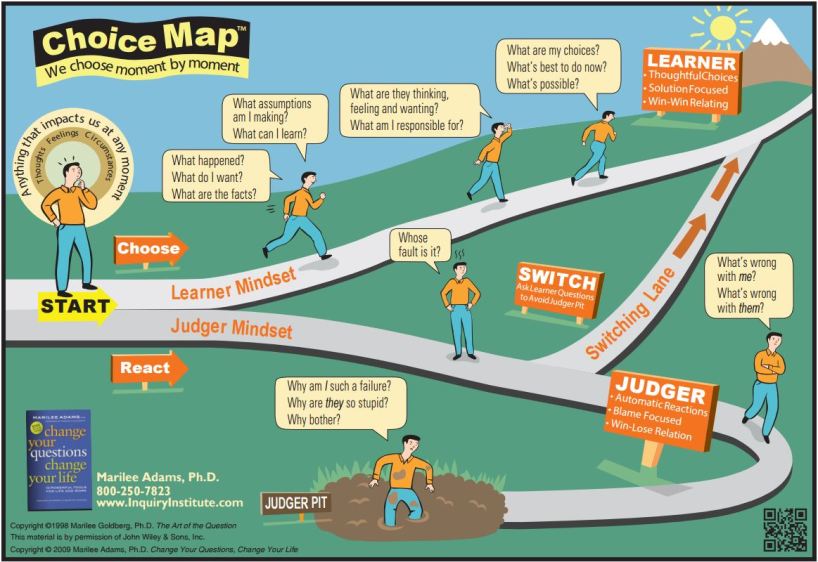
One of the biggest changes in my attempts to change my own behavior in the past 2 years or so has been in the realm of observing vs. judging.

As an example, let me pick on a current trend – I haven’t been meditating in the last week and a half. I generally do so first thing in the morning but, due to a combination of a cold and a couple of disruptions, I’ve been waking up later than usual. In some ways, the core issue is disruption in the morning routine. The usual instinct would be to ask “judging” questions and attempt to use a firm hand – e.g. force myself to get back to routine tomorrow.

However, the approach I take instead is to just observe. In observing, I find myself asking learning questions, e.g, “why is this happening?”, “what are the consequences of this trend?” and even “how long will this continue?” I am my own guinea pig. :-) In addition to this, I also take note of a weekly count of meditation sessions during my week review time on Saturday.

Over time, I’ve built confidence in the fact that observing coupled with the act of measuring consistently tends to bring the changes I want to bring. And, this happens because I take off the pressure that judgment brings.

An example of this approach has been exercise – over 60 weeks that I have data for in the current system (I have some old data too elsewhere), my average exercise sessions in a week has gradually increased with time. It currently stands at 5.2 which means roughly 4 x 25 min sessions and 1.5 days of walking 10,000 steps at least. This is better than it was last year and the improvement has come from the same observe and measure process. Similarly, my average meditation count for 60 weeks is 1.7. However, if I take a 1 year look at this, we’re at 2.7 (3 is the target).

As with all meaningful life learnings, the guiding principles are consistent. In this case, it is playing the long game and focusing on learning questions versus judging questions.

observing, measuring, learning, judging

It is just the applications that are different.

Approaching mock interviews or presentations

Mock interviews or presentations are an opportunity to refine your own judgment of how to approach the real thing well. Too often, they’re viewed as a place to receive feedback you never thought of.

If you have a good mock interviewer or audience, the likelihood you will get good feedback is high. But, that isn’t the point as it is only useful in the short run.

The way to approach practice of any sort is to use your coach’s (in this case, your mock interviewer’s or audience’s) feedback to train your own judgment on when things are done well. This means that the onus is on you to look at your performance critically before the session and walk in with a hypothesis on what needs to get better. All these hypotheses then get tested and validated, or not.

Practice with a coach is both great and important. But, you’re going to need to develop the discipline to coach yourself over time. Besides, game time is an exercise in solitude and listening to your own gut.

It is best to be prepared for that.

mock interviews,presentationsSource

Clubs that don’t accept you

There are many who live by the Groucho Marx quote – “I don’t want to belong to any club that will accept me as a member.” The principle here is that you should always be “reaching” for something better.

This makes sense in some contexts but, like most popular quotes, is horrible advice in many contexts. The principle underlying the execution of the idea is constant comparison. “Is associating with them going to make me look better?” And, the issue with this is that we’re always trying to find the next thing. That, in turn, means we’ll never stop to appreciate what we have.

My counter point to the Groucho Marx quote would be – “Look around, become aware of all the clubs that have accepted you (when they didn’t really need to) and make your acceptance count.”

Life is better when we commit to what we have and stop comparing. Better clubs will open their door for us when we do things of value. I think it is just important to realize that them opening their doors doesn’t just make us better. At that point, it makes them better too.

And, more than ever, it is those who took a chance on you when you got started who deserve all the credit in the world.

clubs that don't accept youSource

Out on a limb

Facts about going out on a limb –

  • You have to wrestle fear and self-doubt before you can do so
  • The feeling of putting yourself out there when you ask for a favor you didn’t need to ask, ship a side project or make a connection you didn’t really need to make can be excruciatingly uncomfortable
  • It is far easier to be comfortable and do absolutely nothing
  • You have to embrace the possibility that it might not work (and for good reason – it doesn’t actually “work” as you intended most of the time)
  • Every once a while, you’ll hear some negative feedback that you will remember for a long time
  • Most of all, it feels unnatural

But, most good things in life come from embracing ideas that don’t feel natural. And, nearly all good things come from doing things that are difficult.

As the wise Scott Peck might say, perhaps all we need to do is to accept that it is difficult. For, once it is accepted, the fact that it is difficult no longer matters.

out on a limb,

Unintended consequences

Most decisions we make have unintended consequences. These unintended consequences are typically caused by the downstream effects of a decision, i.e., your decision results in something (that you likely hoped for), that, in turn, causes something you probably didn’t intend.

There are 2 ways to avoid negative unintended consequences –

1. Experience. If you’ve experienced it before, you know what to expect and how to guard against it. This is how good lawyers earn their keep. They are fantastic at scouring all available legal literature to make sure you are protected from negative consequences of important decisions.

2. Developing the discipline to let it play out in your head. While experience is ideal, if we’re learning and growing, it is likely that we’re exposing ourselves to new situations. And, developing the discipline to let the trickle down effects of our decisions play out in our head is vital to making good decisions. Lazy decision making has bad consequences – a decision whose immediate effects may look good may have bad after-effects. It is only when we make the effort to let decisions play out in our head do we understand the real trade-offs involved. Making decisions by understanding trade-offs to the best extent possible is good strategy.

A simple example of this is letting people schedule times on your calendar for meetings at random. If you have meetings scheduled every 2 hours every day this week, say goodbye to doing work that matters.

The interesting thing about letting the effects of decisions play out in your head is that you often realize that, while the context may be different, you’ve experienced something similar in the past. And, when realize you’ve seen the movie before, you also know exactly how it ends.

unintended consequences, decisions

People who gave you a shot

Today, let’s take a few moments and think about and give thanks to the people who gave us a shot – at a time when we most needed it.

Let us then think about and give thanks to the people who went out on a limb and advocated for us – when they absolutely didn’t need to.

Then, let us also think about and give thanks to the people who believed in us – at a time when we didn’t necessarily believe in ourselves.

And, now that we have given thanks to these wonderful people who’ve shaped our lives, let us go be that person for someone else.