Ineffective Lectures – The 200 words project

(continued from parts 1, 2, 3, 4, 5)
Anders Ericsson’s research on deliberate practice has been extensively in training elite athletes and musicians. But, what about in universities?

Nobel prize winning Physicist Carl Weiman from Stanford university collaborated with a Post Doc and a Graduate student from the University of British Columbia to experiment with redesigning a Physics course. Weiman believed that Professor centered lectures in universities have been ineffective for centuries and he has been on a quest to make things better.

For this course, Weiman and team focused on teaching skills versus disseminating knowledge. So, they redesigned the class to mimic a fast-paced athletic training session centered around the students. They broke a lecture down into various concepts. Each concept had a series of multiple choice questions that students answered in groups using clickers. They got immediate feedback followed by a short instructor led debrief and then moved to the next concept. The results? A 20 point improvement in attendance and a 15 point improvement in scores.

Weiman conducted the experimented both in UBC and the University of Boulder and both universities have begun redesigning courses to offer this format. How can we apply this in how we teach and learn?

Cognitive scientists have found that learning only happens when you have this intense engagement. It’s almost certainly the case that lectures have been ineffective for centuries. But now we’ve figured out a better way to teach” that makes students an active participant in the process. – Prof Carl Weiman


Source and thanks to: Peak by Anders Ericsson, Carl Weiman’s paper on the experiment, ScienceMag’s article
We’ve spent 6 weeks with Prof Ericsson’s work on deliberate practice. Next week will involve a final post providing what might seem like a counter point to his work (but isn’t – spoiler).. And what we might take away from all of this.

What the hell is water

Two fridays ago, a long time reader of this blog shared a speech that she said was her absolute favorite. It was around 4am and I was preparing my introduction for a learning session on values later that morning that I’d helped organize. But, as she said it was her absolute favorite, I searched for a transcript of the video and found it. It was a David Foster Wallace commence speech titled “This is Water.”

I’m glad I did.

The speech is so good that it is impossible to do it justice in one post. So, I thought I’d begin by sharing the short story that he starts with.


There are these two young fish swimming along and they happen to meet an older fish swimming the other way, who nods at them and says
“Morning, boys. How’s the water?” And the two young fish swim on for a bit, and then eventually one of them looks over at the other and goes “What the hell is water?”

The point of the fish story is merely that the most obvious, important realities are often the ones that are hardest to see and talk about. Stated as an English sentence, of course, this is just a banal platitude, but the fact is that in the day to day trenches of adult existence, banal platitudes can have a life or death importance, or so I wish to suggest to you on this dry and lovely morning.


After reading this, I re-wrote my introduction for the session and built it around this story. It is so wonderfully deep and insightful.

Days later, I keep thinking about it from time to time. It is very hard to be 100% conscious and present in this world. When we do manage to do that, we realize that everything we consider normal is nothing short of miraculous. We are all walking miracles. This is incredible. And, it is on us to make it meaningful, to make it count.

This is water.

Values privilege

Values are values only when they costs us money. So, if you care a ton about honesty, you might have to choose to buy all your movies instead of watching them pirated. Watching them pirated might be free. But, we have to trade off whether we care more about honesty or the money.

What happens when we don’t have any extra money then?

Values go out the door.

If you are a family that is struggling to make ends meet, you have no bandwidth to think or care about much else. It is all about survival. And, if it means survival of our group at the cost of another, so be it.

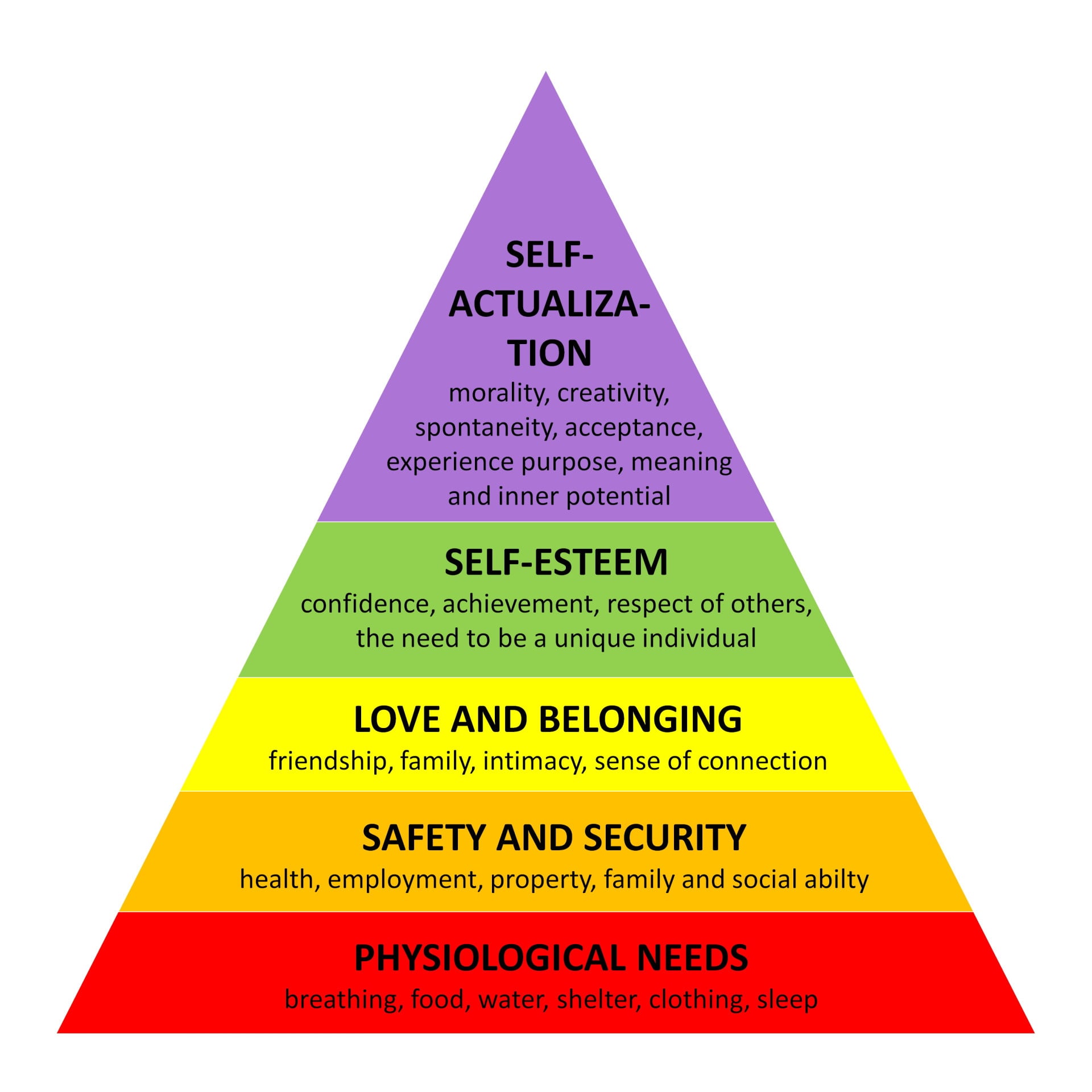
The Maslow’s hierarchy of needs explains this beautifully.

Image Credit: Simply Psychology

If our basic needs aren’t met, then values are a privilege we can’t afford. And, in a world where inequality continues to be on the rise, this will continue to be the case for a growing segment of the population. We will have to find a way to deal with this.

There is no way around it.

Flights to insecurity

We all have insecurities. These insecurities come from wounds at formative times. But, the question remains – are we going to live from a place of wholeness or from our wounds? This isn’t a choice that’s given to us. It is a choice that is earned. To live from wholeness, we need to be able to acknowledge these wounds and choose otherwise. However, even when we do choose to live from wholeness, we will have the occasional flights to insecurity. And, I’d like to make the case that we ought to welcome them.

The other word for wholeness, of course, is confidence. But, confidence is often misunderstood. Seth Godin had a great post a few months ago about widespread confusion around confidence and strength. He called out that we often take loudness, brusqueness, bullying and external unflappability for strength. I clearly remember a time in my life when I have behaved that way. But, I’ve since learnt that real strength lies in the courage to be vulnerable.

And, therein lies the challenge with living from a place of wholeness. We need to be able to summon the courage everyday to care, to put ourselves out there and be vulnerable. Furthermore, it requires us to embrace an approach based entirely on our ability to learn and grow. For, there is no love and care without learning and growth.

Now, even when we do that, every once a while, we’ll find our confidence and wholeness tested. This isn’t just about the times when we get tough feedback about our style. All it might require is a casual question from someone around us that reminds us of our wounds. It’ll be tempting to think nothing of it and move on.

However, I’d urge you (and me) to take a moment, pause and reflect. It isn’t easy to live from wholeness 100% of the time. Every once a while, we drift into living from our wounds. We get ahead of ourselves and lose ourselves. It is only natural. And, these flights to insecurity are gifts – moments that help us save ourselves from ourselves. After we do that, we might conclude that most things are fine and that we have nothing to worry about. But, the chances are that the reflection will prompt some action that will help us massage a few corners that we unknowingly hurt with our edges.

Flights to insecurity are a beautiful thing. They might make us question our wholeness for a little while. But, understanding our wounds and being comfortable spending time with them every once a while is the price we pay to earn our wholeness. And, it is from these questions that thoughtfulness, love and learning emerge.

And, thoughtfulness, love and learning are what we need to make this journey meaningful, to make it count.

Predicting the future

Predicting future events is challenging – yesterday’s result underlined that. It doesn’t matter how much data we have as data alone isn’t a source of truth. Nate Silver and his team at FiveThirtyEight had attempted to caveat their predictions at every stage by calling out the larger-than-usual uncertainty they were seeing. But, in the final analysis, they and many others got the results completely wrong.

Before we get to what happened, it is worth noting that we’re going to hear many step forward and say “See – I predicted it.” That’s normal. It always happens in every exercise that involves predicting the future. In most cases, they just kept believing in an outcome they really wanted. It is easy to just put a contrarian point out there. If it didn’t work, it was contrarian anyway. Now that it did work, it is an opportunity to earn some press. I’d move past that quickly as results aren’t a good approximation for process. And, the lessons are going to be in the process.

Getting back to the issue with prediction, I think a couple of forces made this exercise very challenging. First, fewer people were likely willing to admit that they were voting Republican. Second, it looks like there is a case to be made for serious sampling bias. It doesn’t look like the pollsters were actually reaching a representative sample. Third, the assumption that high turnout would favor the Democrats was completely wrong. And, finally, it seems more than likely that the various polls were influencing each other.

Of course, this analysis is easier in hindsight.

If you work with data on a day-to-day basis, there a couple of takeaways. Firstly, you will never be able to build the perfect model. Treat any exercise aimed at predicting the future as a range of possibilities. Secondly, it doesn’t matter how many of your past models were right. You are only as good as your next one.

Over confidence can be dangerous, often fatal.

When versus how

We are conditioned to think in terms of cohorts or classes. It is a consequence of our industrial system of education. We move from one level to the next when we’re the right age. It matters less how we did.

This system breaks down once we finish our education. Suddenly, we move from a world largely governed by “when” to one governed by “how.” But, it is easy to keep asking ourselves “when” questions.

Personal “when” questions: Is it the right time to get married or have kids?
Professional “when” questions: Am I getting promoted too late? When will I catch up to X person who seems ahead of me despite being in a younger cohort? Did I choose to go to graduate school too late?

It is helpful to internalize two truths. First, there is no right time. Our lives and careers only make sense in retrospect. At this moment, all we can do is focus on doing our absolute best. Most of the good and bad stuff that happens to us is unplanned and, often, based on chance.

Second, how we do things matter a lot more than when we do them. It doesn’t matter if you are older than your cohort if you are the absolute best performer. It is how we do things that opens up opportunities for the next stage. And, whilst “when” implicitly has us focusing on everybody else, focusing on “how” keeps our focus to ourselves – a more productive and much happier place.

Finally, and most importantly, all time wasted on thinking about “when” is time taken away from “how.”

Two sided tools

Humans invented the Axe around eight thousand years ago. It was one of the most powerful tools ever invented. And, its foremost use was cutting wood. While it went a long way in easing early human effort, it also had a dark side.

The Axe also became a powerful weapon when humans fought each other.

Many millennia later, tools and inventions continue to have a two sided nature. Overdosing on life saving medicines, for example, can kill us.

Similarly, technology analyst, Benedict Evans, shared a headline yesterday that likely brought a smile to the face of anyone reading it. Macedonian entrepreneurs have been making money by creating more than a hundred fake pro-Trump sites and sharing them on Facebook. As Ben Evans pointed out, try explaining that headline to someone ten years ago. Yes, we can use social media to connect with each other. But, we can also use it to waste huge amounts of time reading stuff that isn’t real.

All of this is a lovely reminder as we walk into our work desks today. We have an unparalleled array of technology and tools at our disposal. We could use these to learn, ship and make a positive difference. Or, we could be among the millions who only get to experience their other side.

It is on us to choose.

The dangers of innate talent – The 200 words project

(continued from parts 1, 2, 3, 4).
In the many examples mentioned in past weeks, we’ve seen that “talent” is developed by deliberate practice. If you were wondering if it applied to sports, Malcolm Gladwell’s book “Outliers” starts with an interesting insight into how sports talent is picked. Gladwell analyzed data on professional athletes to show that the overwhelming majority are born in the second half of the year. Since this means they fall in the older half of the class, they tend to be physically better developed in their age group when they are young. This gets them selected for intensive practice and the rest is history.

Ericsson’s research supports this – for some sports, one could speculate about some minimum talent requirements – e.g. height and body size. Beyond that, however, practice seems to trump everything else. We also have strong reason to believe that early practice shapes our physical and mental attributes. So, we might be born with a preference for music over sports, for example. But, that counts for little if we don’t practice it.

And, therein lies the dark side of the innate talent hypothesis – believing in innate talent, we tend to write kids off before they have a chance to practice.

Nobody questions that Mozart’s achievements were extraordinary compared with those of his contemporaries. What’s often forgotten, however, is that his development was equally exceptional for his time. His musical tutelage started before he was four years old, and his father, also a skilled composer, was a famous music teacher and had written one of the first books on violin instruction. Like other world-class performers, Mozart was not born an expert—he became one. – Anders Ericsson


Source and thanks to: Peak by Anders Ericsson

Obvious to everyone else

There are times when we do things for reasons that, despite what we might claim, are obvious to everyone else.

We might say we didn’t mean to be mean or selfish. But, everyone else might feel your intentions were obvious. It happens to most competitive people. They act ridiculous in the heat of the moment and find some justification for their behavior. However, their friends always see through it.

This isn’t limited to individuals. Companies do it too.

For example, when Steve Ballmer laughed at the iPhone, it was obvious to everyone outside Microsoft that they were missing the point.

When Slack recently took out a patronizing full page about Windows and told us it was their way of showing they didn’t care, most of us believed otherwise.

Recognizing this dynamic is a useful skill. It is when everyone around you either rolls their eyes or indulges you with a “Suuuure.”

Once you recognize it, fixing it requires us to be courageous enough to evaluate our narrative. The narrative is what convinces us that the story makes sense when it is obvious to everyone else that it doesn’t.

When in doubt, always examine the narrative.

Daring greatly, dude

I just listened to this excerpt from Brene Brown’s book, “Daring Greatly.”


I remembered a conversation that I had just had with a guy in his very early twenties. He told me that his parents sent him link to my TED talks and he really liked the idea of Wholeheartedness and daring greatly. When he told me that the talks inspired him to tell the young woman he’s dating for several months that he loved her, I winced and hoped for a happy ending to the story.

No such luck. She told him that she thought he was “awesome” but that she thought they should date other people. When he got back to his apartment after talking to his girlfriend, he told his roommates what had happened. He said, “They were both hunched over their laptops and without looking up one of them was like, ‘What were you thinking, man?’” One of his roommates told him that girls only like guys who are running the other way. He looked at me and said, “I felt pretty stupid at first. For a second I was mad at myself and even a little pissed at you. But then I thought about it and I remembered why I did it. I told my roommates, ‘I was daring greatly, dude.’”

He smiled when he told me, “They stopped typing, looked at me, nodded their heads, and said, ‘Oh. Right on, dude.’”


Aside from making me smile, this story was a lovely reminder of the power of framing. It moved from “What were you thinking?” to “Right on, dude” the moment he framed it differently.

There is rarely good or bad. It is how we choose to frame it.