
Cause or alchemy

We can regularly default to believing things happen because of some cause or because of a result of some alchemy. There’s merit to both approaches.

When we explain every little thing as the result of a cause, we’re able to understand how to influence the world around us. “Why are you feeling good today? Because I took good care of myself over the past month and slept well last night.” “Why is the business doing well? Because we hired a great team and trained them to do their jobs well.” And so on. The flip side of these explanations is that they’re regularly too simplistic and often boring.

On the other hand, explaining everything as an alchemy makes it all feel like magic. “I don’t quite know how it all works that way. Of course, we brought together a great team and trained them well. But, the way they work together and make our business run is magic.” While a fascinating way to approach life (since it calls out every day miracles), it has its issues when overdone. We can easily bring ourselves to focus on everything we don’t control.

As with most such choices, there’s tremendous wisdom in the middle ground. Make sure we understand the causes while also appreciating the alchemy. There’s definitely plenty we influence. But, once we do our bit, there’s also plenty of magic in our daily lives.

We just have to learn to look for both.
Does it help

As you walk into that meeting today, there’s a narrative inside your head. This narrative is about the meeting and the people in it. It is worth asking – “Does it help?”

There probably was a narrative as you woke up this morning as well. That narrative covered your family, your day and your default frame of mind.

And, there will also be a narrative as you walk into your desk at work today. This one will talk about your perceived role in your organization and your capacity to do things that matter. Did it help you walk in energized?

Narratives are critical. They drive a collection of default behaviors executed in a certain pattern every week. Since it is hard to be conscious 100% of the time, life would be difficult if it weren’t for our these default behaviors. So, we make it easy for ourselves with simplifying narratives.

But, and the but matters, these simplifying narratives aren’t representative of reality. In fact, it is hard for us to identify that reality given our various biases. Besides, we’re capable of manufacturing both intense happiness and sadness inside our heads.

So, a nice way forward is to simply treat the narrative as a tool by asking – “Does it help?”

If it helps us stay inspired and happy, great. On the other hand, if it only brings out the worst in us, change it.

We can.

To know, to learn

To know and not to do is not to know.

To learn and not to apply is not to learn.

There is no difference between a person who doesn’t read and one who can’t.

Sometimes, it helps to get the terminology cleared up. We often claim to know or to learn much more often than we probably should.

I certainly am guilty of that.

Peak – a synthesis – The 200 words project

(continued from parts 1, 2, 3, 4, 5, 6) – This is a synthesis of the series of posts from the book “Peak” by Anders Ericsson.

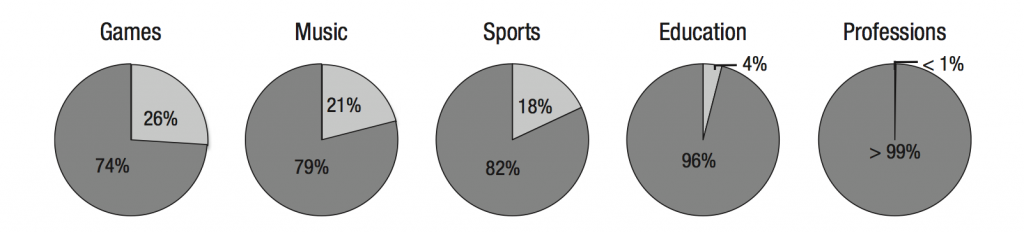
Brooke Macnamara, David Hambrick, and Frederick Oswald reviewed a large number of studies since Anders Ericsson’s seminal 1993 paper. They found that a sheer amount of deliberate practice does not explain all variation in expert performance. They also found that it varies by context – more applicable for more predictable activities like games and sports.

deliberate-practice-variation(light gray = explained variation, dark gray = unexplained)

While this can seem discouraging, it ties into an intuitive idea – deliberate practice alone doesn’t explain all expert performance. There are many other personal and environment factors that interact with each other in making experts. However, “innate talent” is not one such factor.

What does this all mean for us? First, stop using innate talent as an excuse. Second, where possible, actively find ways to integrate the principles of deliberate practice into how we teach and learn – take the help of a coach and push ourselves beyond our comfort zone. For example, we could use regular meetings to try out new ideas and practice taking initiative or test our presentation skills.

At its core, deliberate practice is about learning how to learn and to approach what we do as enthusiastic and committed students. So, here’s to that.

This is not a pie chart (above) of talent vs. practice. All traits, including the ability to deliberately practice, involve a mix of nature and nurture. In fact, there is no such thing as innate talent. That’s a myth that is constantly perpetuated, despite the fact that most psychologists recognize that all skills require practice and support for their development– even though there are certainly genetic influences. – Scott Barry Kaufmann


Source and thanks to: Peak by Anders Ericsson, Practice alone does not make perfect – Scientific American

(The 200 words project involves sharing a story from a book/blog/article I’ve read within 200 words)

One lie

We’ve all likely lied in our lifetime. I certainly lied a ton when I was a kid and then a few times as an adult. Someone dear to me once said – “Just be honest. If you start with one lie, you’ll need a hundred others to cover up.”

It is a line that has proven true time and time again. Lying wraps us in a quagmire as it makes things incredibly complicated. We need to be careful, watch every step, and make sure we never say anything inconsistent. It requires constant focus to keep up a false story.

Clay Christensen, in his wonderful book “How Will You Measure Your Life?,” said there is no such thing as 99% honest. He didn’t allow for any slack. You were either honest or not.

I’ve attempted to take this approach to life to heart. And, it still cracks people who know me well up. I don’t say “yes” to the casual – “We should grab coffee sometime.” I have actually stopped saying that line. If I say “yes,” I make sure I put time on the other person’s calendar for coffee. Here’s why – the next time I see that person, I won’t have to come up with some white lie about why we didn’t catch up. I also wouldn’t have reneged on a verbal commitment. Honesty and integrity win.

I get that saying “yes, absolutely” to social nice-ities and not following up is normal. But, I find that the long run cost of such flimsy commitments is actually very high. We get used to not keeping small promises. And, we get used to small white lies and a few other lies to cover up. At what point does a lie or a promise get big enough to warrant serious attention, then?

Hence my promise to myself – no flimsy promises and no white lies. And, by extension, no bullshit. If I say something, I will do my best to follow up. It’s been a simple, liberating and happy approach to life with a conspicuous absence of baggage. Long may that continue. And, long may we all avoid starting with one lie…

Guilt and Shame

Guilt is when we feel we have done something bad.

Shame is when we feel we are bad.

Every once a while, guilt can be useful as it pushes us to take action and right things we’ve done wrong. Shame, on the other hand, does nothing constructive. First, it paralyzes us. Then, it goes on to mess with our sense of self-worth.

It is a fine line between a scolding that says – “Your actions created a mess” – and – “You are a mess.” But, that fine line is capable of inflicting a large amount of damage. I know someone who was made to wear a sign on their chest and walk around in public for a few days in return for a mistake they made. While the purpose may have been to guilt them, this had shame written all over it.

Good people do bad or mean things every once a while. This is especially true for kids who are still to understand the difference. Making them feel shame, sadly, is a self fulfilling prophecy.

Now that we know the difference, we will hopefully recognize it when we see it around us. Most importantly, we’ll be able to use the difference to make sure we steer clear of shaming in our lifetime.


HT: Brene Brown

And that’s okay

There’s an important line of self talk before you embark on a new project. The first part of it is acknowledging “This might not work.” And, the second part is saying “And that’s okay.”

This might not work is the acknowledgment that what we’re doing is an experiment. And, experiments may or may not work. “Might” is the key word in that phrase. “Might” acknowledges that tension that requires us to have the courage to dare, to go out on a limb.

But, “this might not work” alone is incomplete. “And that’s okay” is a key half of the puzzle. It requires us to have the confidence to look the “might” in the eye and say – “I’ll be fine.” It asks us to accept that troubles, when they appear, will pass – like water under a bridge.

This complete phrase has a liberating effect. It tells us that we are a lot more than what we do. It helps us grasp the difference between states and feelings. We can feel the disappointment of a defeat and, yet, be content, happy even. We might feel the joy of victory but, yet, enjoy the equanimity.

Rudyard Kipling, in his wonderful poem, “If” said –
If you can make one heap of all your winnings
And risk it on one turn of pitch-and-toss,
And lose, and start again at your beginnings
And never breathe a word about your loss;

If, indeed. It is the sort of game changer that makes it worth a try.

This might not work. And that’s okay.


HT: Seth, for introducing me to “This might not work.”

Beavers and rabbits

In 1946, members of the Argentinian navy released 10 beavers to enrich the ecosystem and perhaps kick start the fur trade. Now, beavers have wrecked havoc in Argentina for decades. Unlike trees in North America, trees in South America die when beavers sink their teeth into them. Without a natural predator, they are now a hundred thousand strong. And, Argentina has declared a war on beavers

Australia faced a similar problem when 6 rabbits were introduced for hunting. Rabbits turned out to be an invasive species in Australia.

The obvious lesson here is to beware messing with the delicate balance in nature. There are two other less obvious ones.

First, small things have the ability to mess with the balance in an ecosystem. Nice organizational cultures have been destroyed by a few bad hires. Introduce one person who enjoys politicking more than doing the work and you might not notice much change. However, bring a few and it’ll soon affect the ecosystem.

On the flip side, you might also find yourself in environments where you are the invasive species. In an environment that thrives on the fact nobody asks questions, asking questions might result in the environment rejecting you.

Pay attention to the environment. Some adapt, others don’t. And, while some will work well for you, others won’t. Make sure you choose. And, once you make your choice, pay attention to the changes it undergoes. A change in your environment is sure to have an impact on your life and happiness.

Long held assumptions

We all have long held assumptions.

In my case, from when I was a child, I was told that I must have a fast metabolism. I think it is common to tell folks who remains thin while having a good appetite that that must be the reason. And, I never questioned it.

Over time, it morphed into a fact in my mind. It was no longer just an assumption. This is classic availability bias – you hear it so many times that you start believing it is the true.

A few weeks back, I had the opportunity to take a test to figure out my resting metabolism rate (or RMR). And, my report after the test told me that I was on the lower end of average for my comparison group. Not just average. Below average.

That test reinforced a bunch of powerful lessons. First, it reminded me of the dangers of confusing long held assumptions and facts. Second, testing this long held assumption with a $50 investment was particularly useful. It will help me manage my diet and my weight over time so much better. So, do test your long held assumptions when possible.

Finally, it also beautifully illustrated a fact that we all probably know somewhere deep inside. When it comes to burning calories, exercise isn’t anywhere as effective as leading an active, healthy life. While exercise helps us build muscle and improve our ability to burn calories and be active, there is no substitute to activity through the day. Small decisions like standing during meetings, taking the stairs, walking more often make a bigger difference over the long run than exercise.

Seek out those long held assumptions. They make up our default setting.

Outcome goals versus direction and process goals

Setting outcome based goals isn’t smart. “I will lose 10 pounds” or “I will achieve the highest performance ratings” are the sorts of goals that present more downside than upside in the long term. There’s a lot of great resources that talk about replacing goals with systems. While I think most of that thinking is good, it misses an important point. It isn’t enough, in my experience, to replace outcome goals with process goals. I find that it helps combining a process goal with a directional goal.

As an example, let’s take a weight loss related outcome goal – “I want to lose 10 pounds within 10 months.” The systems/process goal answer to this would be to replace this with some variant of – “I am going to eat healthy and exercise 3 times every week.”

This is a pretty drastic shift and is hard for most people. That’s because we’re replacing the idea of achievement in 10 months to no achievement. Ever. While it makes sense that we must trust in the process, it helps to have markers along the way.

And, as far as markers go, directional goals work great. There are 2 criteria for directional goals –
1. They need to be a range and shouldn’t be super specific. We always tend to over estimate how we’ll achieve in a year while greatly underestimating how much we achieve in a decade.
2. Their time period needs to be longer than the typical outcome goal you might set.

So, an example directional goal for our weight loss example would be – “I’d like to move toward a fitter body with toned muscles and 3-6 pounds lost within the next 12 months.

The idea is to ease the pressure while still giving you something to celebrate. The other benefit of laying down markers is that you can use them to check in on your process. If you’ve made absolutely no progress in 12 months, it is a sign that you need to fix your process.

The principle here is straightforward – any advice that asks you to ditch goals forever and replace them with process isn’t entirely right. It is helpful to over index on process as we all tend to swing too strong the other way. However, the best test of a process is if it is generating good results without you having to think about them. And, directional goals tend to be a great way to bridge that gap.

PS: Doing things well and right takes time.