Calm

Calm, as a quality, is one I’ve been attracted to for the longest time. We tend to be attracted to qualities we don’t possess ourselves. And, calm is no exception in my case.

Looking back at the past 3 years, however, I’ve observed growth in my ability to be calm. Even if I have a long way to go before it shows up in every aspects of my life, I found myself reflecting on what drove this growth.

I think learning of any kind typically comes from 3 sources – from reflecting on your own experiences, from books / synthesized information that you read and from people you meet. And, I think this growth in my ability to summon calm has come from each of these three. But, I think there have been 2 important drivers that have reinforced each other.

The first is confidence. Confidence has been an important overarching theme over the years on this blog. I started writing here because I believed I was becoming too insecure for my own good. My hypothesis was that writing everyday and sharing my failures would help me put things in perspective. And, it undoubtedly did. Confidence, I’ve come to realize, is about consistently acting from wholeness and not from our wounds. Practicing it requires acceptance of your insecurities, self awareness and thoughtfulness. It doesn’t come easy. In my case, for example, I needed to disengage from a relationship that seemed to only serve one function – reminding me of my insecurities.

The second driver is perspective. If confidence is about consistently acting from wholeness, perspective makes it easier for us to get in touch with that wholeness. I’d attribute most of the perspective I’ve acquired in the past 3 years as a compound effect of writing every day for nearly a decade. I’ve written through challenging times and good times over the years. And, I’ve finally begun to understand that “you never know if a good day is a good day.” Things have a way of working out, or not. Trying to second guess how life will turn out is a waste of our time. We’re better off plugging away.

I’ve shared a note from Seth’s “The Icarus Deception” in the past.

“One of the things the professional artist gives up is the thrill of the manic high. I used to be manic, about twenty years ago, when there was a sliver of something working. Things were really brutal at work, with rejections and near-business-death experiences coming daily, and I grabbed hold of any positive feedback really tightly.

Now, I’m delighted to say. not so much. Which means the highs aren’t as high. The successes are about the privilege of doing more work, not about winning. When my Kickstarter project for this book met its funding goal in less than three hours. I didn’t do the line-kicking dance reserved for TV celebrations. Instead. I took out my laptop and got to work. That is the greatest privilege I can imagine.”

I vividly remember reading this note on a flight 5 years ago and wondering – “Wow, what must that feel like?”

I have a better idea now. I’ve not read too much stoic philosophy but have read enough to understand that this is what it is about. And, from my limited experience of this in the recent past, I can attest to the fact that it feels great.

We spend most of our lives in the process of doing stuff. Success is when we enjoy that process. Wins and losses just exist tell us if our process is right. They are signal – nothing more, nothing less. Confidence involves being our best self and acting from wholeness whether we’re on an up or a down. It comes from understanding that even this will pass. Perspective involves reminding ourselves that we never know if a good day is a good day. The combination of the two helps us keep a level head, roll up our sleeves and get back to work on building a life we consider worth living.

There is really no greater privilege than that.
Food and technology

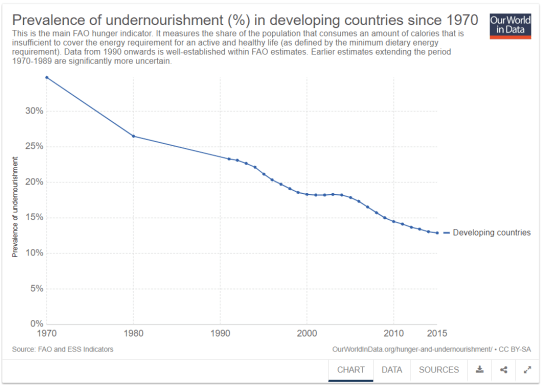
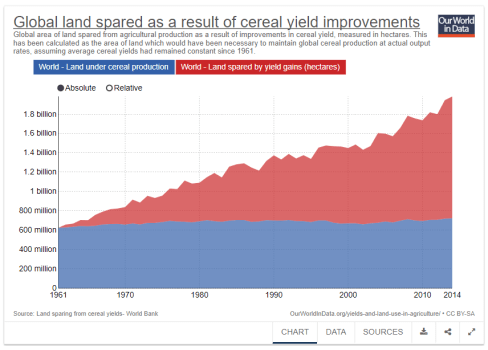
We’ve made a lot of progress in meeting the world’s food needs.

We’ve done this by using more technology to increase the yield of our lands.

While the benefits have not been as evenly spread as we’d have liked, things are getting better.

But, we’ve done a poor job in some areas – especially in our treatment of animals.

I think we’re going to see tremendous progress in food in the coming decades. We’re going to see more Soylent inspired alternatives to unhealthy food. Drones and artificial intelligence are going to help us further improve land yield. But, I’m most excited about two other innovations.

The first is large scale vertical farming that start ups like Plenty and InFarm are working hard on. Vertical farming can greatly improve yield, can be done indoors and uses sensors to optimize the growth of plants.

And, the second is lab grown meats from the likes of Memphis Meats. Once we figure out how to produce this on a large scale, it won’t just be a more humane method of meat production. It will also be significantly better for the environment. Studies show that clean meat could potentially be produced with 96 percent less greenhouse gas emissions, 45 percent less energy, 99 percent less land use and 96 percent less water use than meat made through animal agriculture.

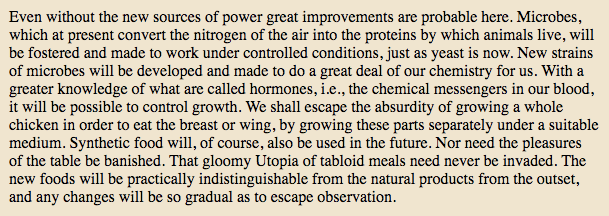
In a remarkably prescient note, Winston Churchill had predicted this 80+ years ago.

It has taken us a while. But, I’m optimistic we’ll get there soon.

(A longer, more detailed version of this note is on Medium or LinkedIn as part of “The Notes by Ada” project)

Mesh Wi-Fi systems

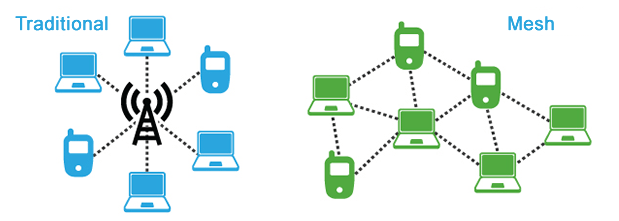
Traditional Wi-Fi set ups don’t scale well with multiple devices. You lose a lot of speed for each step you take away from the router and have to install extenders if your home happens to be longer than it is wide.

And, let’s face it – extenders really suck. You need to create a new Wi-Fi network and only get pitiful speeds even after doing so. You’re likely reminded of this every day – especially if you live far away from family and use video calls to stay in touch.

Mesh Wi-Fi technology gets rid of all these traditional set up limitations by replacing the hub and spoke router model with a mesh that blankets your home with the high speeds that you’d get using a LAN cable.

This video does a great job explaining why mesh Wi-Fi is great.

We live in times when having good internet access is way more important than having cellular access. And, a mesh Wi-Fi system is a game changer. We pay for a 100 MBPS connection and I couldn’t believe my eyes when I saw a 110 MBPS speed outside our home (!) – where we’d never have been able to connect to our extender even.

A real game changer. I couldn’t recommend it strongly enough.

Things we can count on to always be present

There are a few things we can count on to always be present in our workplace –

  • Obstacles – Unexpected obstacles that throw our well laid plans off
  • Feedback – Room for improvement in how we do things
  • Admin – Admin work we’d rather not do
  • Politics – People issues or politicking (as long as there are more than 2 people working on something)

Despite their ever present nature, we still regularly react to obstacles, feedback, admin and politics with annoyance. We often act surprised, astonished even and let these things get us down.

Perhaps we should save the surprise for things that are actually surprising. These are ever present in our lives and make things interesting (up to a point).

So, we might as well love them for what they teach us and get on with it.

Length of a feedback survey – 2 principles

When you create a feedback survey, you make an important decision on its length. The length decision is a trade off between survey completions and useful information. 

If the survey is too long, customers won’t complete it. If it is too short (e.g. 1 question), you may not get the information you need.

I’d suggest 2 principles as you think of the length of a survey –

  1. The length should be proportional to the time spent with the experience
  2. The length should always be a few questions shorter than what you think you need

A simple example to illustrate these points. I had an email exchange with the support team of the company that manages US embassy appointments to change the location of my appointment in their system. It took me a minute to write the email. They sent me a response and asked for feedback. However, the moment I clicked the survey, I decided to close it. That’s because I saw what felt like 30 radio buttons. If I spent 2 minutes (at most) on an exchange, I’d like the survey to be a simple “Happy” or “Not happy” with an optional text box. I’d be more inclined to spend 5 minutes on a survey if it was for a 1 day boot camp that I attended.

As a general rule, we tend to over complicate surveys. My sense is that most feedback surveys would be far better if they just stuck to 3 questions –

  1. How likely is it that you’d recommend our ___ to your friends?
  2. What did we do well?
  3. What could we do better?

All of this is subject to what you are trying to achieve of course. But, I would hazard a guess that some feedback is better than none. Uber, for example, does a great job with this trade off by leading with the rating. You can add comments if you want to but you don’t have to. They’ve taken these principles to heart.

And, their results (a thriving feedback community) follow what is an excellent process.

ALearningaDay email

On most days, I open up my inbox to see what I call “ALearningaDay email.” That’s typically a note from someone in this community about a recent post. It is either a note sharing their experiences, feedback or interpretation. There have been times when these notes have brought a tear to my eye.

I love these notes and they continue to be my favorite kind of emails. They’ve been a wonderful way to get to know many of you – some of whom I’ve even had the pleasure of meeting in person.

I’ve heard from a few of you over the last weeks about missing the comments section. I’m sorry I shut down a channel for conversation. Over time, having another channel to communicate (for just a comment or two on average per post) was causing overhead. And, when I lost the ability to use Disqus as I moved to WordPress managed hosting (which has been excellent so far), I thought it was a perfect time to close the channel.

That said, the point of the move was not to shut down the conversations. I am still reachable as ever via email – rohan at rohanrajiv dot com. So, for those of you who’d like to carry on the conversation and share your notes, I’d love to hear from you. For those who get the daily email, please feel free to just hit reply.

Looking forward to continuing the conversation.

Is it really a serious problem?

There are 3 kinds of problems that deserve to be called serious problems in my book –

  1. Matters of life and death
  2. Anything that causes tremendous pain or illness
  3. Anything that affects the ability to get access to food or find shelter

Given the quality of modern, urban life, many of us rarely encounter serious problems. So, we get lax about our definitions. Suddenly, a deadline that’s slipping, a tough conversation or a setback on a project can be labelled  a serious problem.

Every one of us faces challenges and obstacles. But, most of these aren’t serious (thank the force for that). The moment we label such challenges as “serious problems,” we give them far too much importance and reduce our ability to channel our limited bandwidth on tackling problems that actually make a difference in the long run.

Perspective is the biggest gift we can give ourselves.

Retention – feat the tragedy of the commons | Thinking Product

There are two questions to ask when we think of retaining users  –

  1. Are we continuing to drive value for our users via continuous improvement or better surfacing of value?
  2. Are we reminding users of the value they can drive?

Both these questions are important but drive contrasting approaches. The first question focuses on improvements within the product while the second is essentially a notifications/reminders driven strategy.

1. Are we continuing to drive value for our users via continuous improvement or better surfacing of value? 

As mentioned above, there are two ways we drive value here. First, we keep making improvements within the product. For most enterprise products, this continual part of the roadmap is typically driven by customer feedback. For consumer products, it is generally driven by rapid experimentation and copying successful features from other consumer products. And, while consumer product management is arguably more gut driven than enterprise product management, great consumer products are often molded by their users. A seminal example of this is the story behind Twitter’s hashtag.

The first hashtag appeared thanks to Chris Messina, a user who suggested using # for groups. Interestingly, he got inspiration for this from another social network (perfect illustration of my point above) – Jaiku- and from tags on Flickr. In time, Messina’s idea spread and Twitter, after a period of resisting it, came around to it.

Second, most products generally do a poor job surfacing value to users. That’s because our assumptions about the most valuable aspects of our products are rarely what our users value. This is where analysis of usage data goes a long way in improving the product.

Overall, however, this question is all about continuously improving our products to drive value for our users and is the surest proxy for long term product success.

2. Are we reminding users of the value they can drive?

Any savvy mobile product manager today has a sophisticated notifications strategy. She has a point of view on when to surface a push notification versus a badge and when to use email to drive users back to the product. This isn’t limited to small companies trying to get traction. We see the largest companies use notifications a fair bit to drive usage as well. For example, Facebook gets very aggressive with email notifications if you don’t visit your profile or feed. I use Facebook primarily for my blog’s Facebook page. But, that engagement clearly doesn’t count for Facebook – so, I receive an email reminding me of what’s going on on Facebook every day.

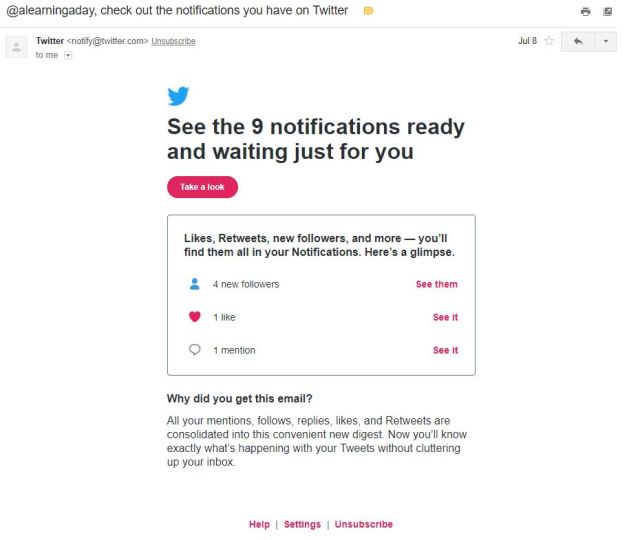
Twitter, recently, shifted its notification strategy pretty drastically as well. This was what a notification email from Twitter looked like until the first week of July.

And, this is what happened once they shifted strategy.

Now, I have to click on “Take a look,” head to Twitter to see what happened. Twitter has been having difficulties with user growth and this is clearly a metric mover. The big question with such changes, of course, is whether it will continue to be a metric mover in the long run.

Notifications are important. When done right, they are good reminders of the value a product can drive for the user. However, too often, they are used as short term metric movers that only end up annoying users. The problem with notifications is classic “tragedy of the commons.” If a company has 5 teams who all want to drive up their numbers, how long before they all surface frequent notifications and compel the user to turn off notifications?

The bottom line – a retention strategy that is driven by notifications is a poor retention strategy. I think retention strategies work best when 80% of the effort goes into driving real value and the remaining 20% (and not any more) focuses on reminding users via notifications.

If our users aren’t listening to our many reminders of how great we are, maybe we ought to revisit our assumptions.

Don’t wait for inspiration

This is my third attempt at writing a post today. The previous two didn’t work. After 9+ years of attempting to ship something every day, such days are not new. Some days are just slow days and I know when I feel stuck.

The good news is that I don’t waste time reveling in feeling stuck. If I’m unable to think of something to write for five minutes, I walk away and come back later.

My biggest learning from these days is to not use terms like “waiting for inspiration.” Inspiration is intrinsic and comes from a clarity of purpose. Waiting for something we control is not a great use of our time.

Instead, it is on us to seek it. If we look hard enough, we’re sure to find it.

At least that’s one of those things this 3,400 day journey has taught me.

Check and do what?

The next time you pick up your phone to check a feed or email, ask – “Check and do what?”

Take note of the reasons you hear.

I’ve found 2 types of reasons –
1. The first kind (20% of the time) involved a clear reason for checking, e.g., clearing out email backlog as I hadn’t checked in a while or connecting with someone
2. The second kind (80% of the time) revolved around boredom and instant gratification. I knew there was no need but I still wanted to do it – just because.

Eliminating that second kind of checking is an easy shortcut to a more fulfilled life.

PS: It is hard to stop the second kind of checking cold. So, find a replacement. Every time you find yourself wanting to check for boredom or instant gratification, pick up a book or just take a walk around the house.