
Sending audios and optimizing flows | Thinking Product

I wanted to send a friend an audio message on iOS. The flow started straight forward. First, I pressed the mic button on the side of the message.

Next, I record the message.

I liked the user experience (Ux) here as it clearly separates finishing an audio, playing it and sending it. Whatsapp, for example, auto sends an audio message the moment you take your finger off. So, I can see the benefits of adding an extra step. But, however, I ran into an issue. The phone reminded me that I was low on battery (20%) and it just stopped the recording abruptly. I just lost a 5 minute audio message.

So, I recorded this again and sent it.

I realized then that I wanted to add an extra message. So, as I worked through the second message (2 minutes), I noticed that the first message had disappeared.

What the hell was going on?

So, I recorded the first message all over again. That’s when I noticed a small option to”Keep” in blue.
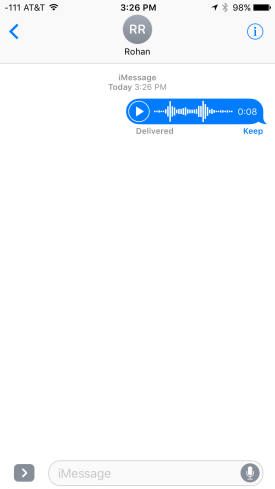
It turns out that the blue “Keep” is a button. And, if you don’t click it within 2 minutes, the audio message will disappear.

This can be changed in your settings. But, for some reason, this is the default experience. And, it extends to the receiver of the message as well. This friend explained that she was thoroughly confused when the memo just disappeared. As the memo included some notes that required a repeat listen, this led to a few issues at her end too.

So, what can we learn from this? The first lesson is the obvious one- we have to be thoughtful about the defaults we use. Smart defaults are critical to help users along the way. It is tiring if a user has to make every little decision and check every checkbox. But, in this case, for some reason, the product and design team decided that audio memos need to be removed by default. It is a decision that has likely caused a lot of confusion among users. And, the keep button doesn’t help matters much.

Second, and most importantly, optimizing flows is at the center of great Ux design. 

Many equate design with pretty appearances. But, users use products to get a job done – not to admire how the beauty of the product. And, when they get their job done, they win. To win, users need to flow from one action to the next.

And, great Ux design is all about optimizing these flows.

When boiled potatoes were delicious

This was day 4 of a trek in the Himalayas. We had 21 kilometers to cover and after 13 or so mostly uphill kilometers, we finally stopped for lunch. Lunch was boiled potatoes and boiled eggs. I think I had 2 or 3 of each.

It remains one of the most delicious meals I’ve ever eaten. I can still remember how eating those boiled potatoes felt. We were so grateful for them that day.

I remembered that meal yesterday with a friend who was with me during that trek. We had a late dinner and, this, ate when we were really hungry. And, of course, the very ordinary food tasted wonderful.

The now legendary boiled potato experience taught me how much our feelings are driven by circumstance. When you are hungry, edible food is delicious. When you have little, most things are great.

Often, as we go through life with good fortune by our side, we leave behind a piece of ourselves that used to enjoy those small things. It takes fancier experiences and bigger things to impress us. Thats why eating when really hungry never fails to remind me the importance of savoring all the wonderful small things around me.

The small things, almost always, are the big things.

Angst at the airport

Go to any boarding queue at the airport and you’re likely to find someone in angst.

“This boarding line seems to be too long.”

“Why are they taking forever?”

“This airline is so incompetent.”

The angst is useless, of course. Everybody in that area is going to the same place and will get there at the same time. If a delay is meant to happen, it’ll happen anyway. Complaining about it isn’t going to do anyone any favors.

But, this post could just as easily been about angst at the DMV or angst at the office.

Angst is hardly ever useful and nearly always unhelpful. If you are that unusual person for whom angst spurs constructive action, please ignore this post.

But, for the rest of us, any time we find ourselves feeling angst, let’s ask ourselves – “Is this moment going to matter in 5 years?” Assuming it isn’t (and it generally isn’t), let’s just put some music on our headphones or open up a book and let it pass. If it is going to matter, let’s just put some music on or open up a book anyway. Angst isn’t going to help with constructive action. Some calm is.

The world will be better for it. And, we will be happier too.

Hemingway Editor

Of late, I’ve added an extra step to my daily writing process. After I write my post, I copy it over to http://www.hemingwayapp.com/. The Hemingway editor gives me a score and targeted feedback on how I can write better (e.g. omit this word).
 
The feedback isn’t always useful. But, it does help fine tune my writing. I generally get tripped up using passive voice and unnecessary words. I used to use a plugin called “Yoast SEO” to do the job when I was on a free version of WordPress and was happy to discover the Hemingway editor after the switch.
 
So, for those of you who’re looking to practice and improve your writing, I hope you find it useful.

Centralization and Decentralization — blockchain and Kindleberger

We’ve seen a change in sentiment in the mainstream media around the centralization of power amongst the big tech firms. In response, a lot of the discussion in the hacker communities has been about the power of the blockchain and Bitcoin to shake up the current establishment and decentralize everything.

In this week’s Notes by Ada note, I share my skepticism of the purist utopian vision for the blockchain. I think the technology is without doubt ground breaking. Here’s an example of why I’m bullish about the technology –

  • Imagine you are a refugee in a new country. You have no official ID or financial history in the country — so, banks aren’t exactly queuing up to give you an account.
  • But, as a refugee, the government would like to give you some aid to get you started. However, they’d also like to keep tabs on that money to make sure you are spending it responsibly.
  • Without easy access to money, you could be stuck in bureaucratic hell for a long time.
  • Enter Moni — a prepaid mastercard service that links your mastercard to the blockchain.
  • Your prepaid card doesn’t need any bank. The government directly adds credit and knows they can track any issues in your spending via an incorruptible database on the blockchain.
  • Assuming you have good intentions, you use this money to get your life started, get a job and are hopefully on your way to building a better life.

This is not fiction. The Finnish government is already testing this with asylum seekers and the United Nations is exploring using this technology for one billion people worldwide who have no legal identification. Powerful stuff.

But, we often confuse the technology breakthrough with its potential second order implications.

Technology breakthrough: A blockchain is a decentralized network with information. The breakthrough in the blockchain is in the ability to have a decentralized database that is not owned by anyone. This was not possible before and means we can now have shared incorruptible databases.

First order implication of the technology breakthrough: Databases controlled by middle people (e.g. banks) were sources of trust for various transactions in the economy. Now, you don’t need to have these middle people. Instead, you could, for example, execute a pre-agreed contract via the Ethereum blockchain. As long as certain conditions are met (e.g. money is transferred to account B), ownership can be transferred too.

Example question about its second order socio-economic implication: Blockchains could render important pillars of our financial system obsolete. Maybe this will remove the need for banks, central banks and governments?

In the many discussions about blockchains, I see people mixing the technology breakthrough and its potential second order implications. Here’s the deal — the breakthrough and its first order implications are here to stay. But, all of the implications being dreamed up right now are not necessarily going to pan out the way many of the purists imagine it.

More on Medium or LinkedIn. Medium says it is a 13 minute read – so you have fair warning. :-)

Small improvements in productivity

When we begin training for a new skill, we start by making large improvements for every small change. Fix your stance and swing, for example, and your strokes become much better.

But, the plateau arrives sooner rather than later. Suddenly, every small improvement takes a lot more effort. And, if you become an elite performer, these tiny improvements in your speed or accuracy can be the difference between being the best in the world and an also ran.

While this is easy to imagine this curve for an athlete, it is easy to forget that it applies just as nicely to the rest of us. Instead of producing athletic performances, our success is often measured by the value we produce, i.e., our productivity.

When we get started on the productivity curve, we make a ton of progress by just learning to focus on the right things. But, once we learn to do that, it is the tiny changes that make a difference. If we halve the amount of time we spend mindlessly surfing television or checking our notifications in a day, we give ourselves an extra few minutes every hour. And, the effect of those extra few minutes adds up and compounds over time to give us time and energy to spend on things that matter to us.

Over time, these small improvements have the same effect on our lives as they do in the legacy of elite athletes. They can make the difference between a life with regrets about time wasted and a life well lived.

Kaizen

Kaizen is the Japanese word for continuous improvement. The two Japanese words Kai and Zen translate to “change” and “good.” Put together, they mean – “change good” or change for better.

It’s a simple and powerful motto for two reasons. First, whether you’re frustrated or elated, you can always choose to change for the better. And, second, it underscores the need for us to change – continuously.

And, needless to say, it comes with a 100% “it will change your life” guarantee.

The question for us, then – are we going to hear the word “kaizen,” nod and walk away?

Or, are we going to adopt Kaizen and all that it entails in our lives?

Reflections after a broken pipe

 One of the pipes below our apartment broke yesterday. As it’ll be Monday before it is fixed, all our access to water is temporarily restricted to one tap and one shower. I had two reflections from the experience.
 
First, as is generally the case, we only realize the value of something when it is taken away. And, we’re definitely finding how inconvenient it can be to clean, cook, and do things we’d not have given much thought to. It is so important that we look around and remember to be grateful for what we have. Every one of us has more things to be grateful for than we know.
 
Second, we are fortunate that our inconvenience is temporary. This made me think about the millions of people on the planet who don’t have easy access to water. And, in many of these cases, despite the lengths they go to, they don’t get to access clean water. For the many of us who live in places where we take both the access and purity of our water for granted, it is hard to even imagine the worlds of pain they go through.
 
Luckily, there are ways you and I can help. I started a recurring monthly donation to Charity : Water a few months back thanks to a wise friend who is a big fan. I love their model – 100% of what you donate goes straight to helping provide people access to clean water. Their operations and costs are funded by a few large donors. So, a small monthly amount from you can go a long way.
 
It is hard to focus on education and productivity if you don’t have access to the basics. Access to water is definitely one of those. Here’s to organizations like Charity : Water who’re working toward that mission.

The monks and the woman

A senior monk and a junior monk were traveling together. At one point, they came to a river with a strong current. As the monks were preparing to cross the river, they saw a very young and beautiful woman also attempting to cross. The young woman asked if they could help her cross to the other side.

The two monks glanced at one another because they had taken vows not to touch a woman.

Then, without a word, the older monk picked up the woman, carried her across the river, placed her gently on the other side, and carried on his 
journey.

The younger monk couldn’t believe what had just happened. After rejoining his companion, he was speechless, and an hour passed without a word between them.

Two more hours passed, then three, finally the younger monk could contain himself any longer, and blurted out “As monks, we are not permitted a woman, how could you then carry that woman on your shoulders?”

The older monk looked at him and replied, “Brother, I set her down on the other side of the river, why are you still carrying her?”


I think about this story from time to time when I find myself carrying hurt or annoyance of any sort. It doesn’t mean I always manage to overcome it. But, this story definitely goes a long way in reminding me that the only person we hurt by carrying past hurts is ourselves.

Now is all we ever have. And, how we treat now is the best way to ensure we feel better tomorrow.

Working through plans A-Z

I recently spoke to someone I met thanks to this blog about his hopes of making a career transition to a company in a different location. He had his thought process nicely laid out. I think my only value add to his process was asking him what plans B, C and D were.

I think of nearly everything I do in terms of projects. Some projects last a long time while others are shorter. And, over the past few years, I’ve had various career related projects involving attempted switches of companies, functions and locations. Some of these involved nested projects – e.g. going to graduate school to make the location change process easier or involved sorting immigration issues. Some of these projects worked. Some didn’t.

Every time I reflect on this journey (and speaking to him definitely made me reflect on it) and find myself thinking about the journey ahead, I am reminded of the quote – “If plan A doesn’t work, remember there are 26 letters in the alphabet.”

That quote has been very representative of how my journey has unfolded. Plan A has rarely worked. But, I’ve done my best to work through plans B, C, D and so on.

Just this morning, I learnt that a project I’d been working on for a while didn’t work out. It is, without question, a bummer. But, going through the process taught me a lot. I was grateful for the incredible support I received from many wonderful folks through the process and felt I’d given it my best shot. It is a reminder that there’s a lot outside our control and that that good processes don’t always lead to good results in the short run.

But, as I look back to the past decade, I feel confident about the long run effect giving processes you commit to your best shot. And, I’ve also learnt that a key part of running a good process is making sure you are preparing for and working through plans A-Z.

On days like this, I feel grateful for having the privilege to write here. There are the days when the tag line of this blog – “Never failure, only learning” – comes to life. It reminds me that we never know if a good day is a good day. All we can do is keep plugging away.

And, I definitely intend to do that.