
Filing tax returns

As we get to wrapping up filing our tax returns for the year, I am left with one checkpoint and one reflection.

The checkpoint is the annual exercise of making the final update on the box on our accounts sheet that calculates savings for the year from Income – Expenses – Taxes. It is helpful to reinforce where we landed for 2018 and how each of these is trending from one year to the next.

The reflection revolves around everything these taxes pay for – including the infrastructure that I often take for granted. The quality of a society’s infrastructure determines the overall productivity. And, I’m grateful for the opportunity to contribute – in a small way – toward making the baseline a bit better for everyone.
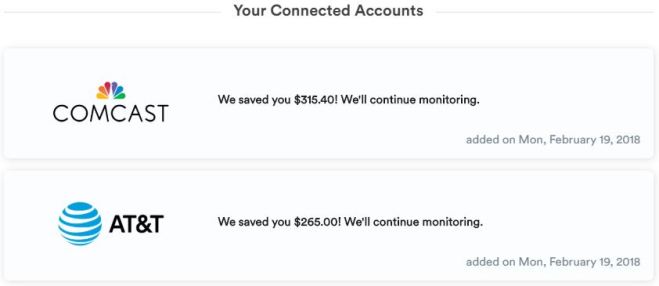
The trim dashboard

One of my favorite product experiences as a user in the past year has been with Trim. Their value prop is simple – you connect your cell phone and cable accounts – and they negotiate a better rate every few months.

As they serve thousands of customers, they have the data at hand to negotiate effectively on your behalf. So, I find myself smiling every time I receive a heads up text from them that says “we’re negotiating on your behalf.” Their latest negotiation (not yet added to the dashboard) seems to have saved me another $180 for the year on my Comcast bill.

And, that’s on top of the ~$600 in savings they’ve negotiated in the past year. I’m happy for them to take 33% of this as revenue as it still means $400 in savings.

Their dashboard, thus, is a weekly reminder of the value they’ve added to my life.

As someone who attempts to build valuable products for a living, the Trim dashboard is a great example of this gold standard user experience – the ability of a product to clearly demonstrate the value it delivers.

Spending money where we spend our time

One of the better pieces of advice I’ve received when it comes to spending money was – “Money well spent is generally spent either on experiences or where you spend your time.”

The second half of the advice has been particularly helpful over the years as we’ve made purchase decisions. Investments in a nice mattress, comfortable daily wear clothes and shoes, nutritious food, and ergonomic work equipment tend to have a high return-on-investment.

The uhm ah project – unconscious popularity

A quick update on my quest to remove filler words like “uhm,” “ah,” and “like.

As I’ve been attempting to dial up my awareness for when I (and others) do it, I’ve noticed something interesting – I’ve been in a few conversations where these words were among the most frequently used words.

Isn’t it amazing that a collection of words which are used unconsciously can be the most dominant words used in a conversation?

The default setting is powerful.

Awareness of base assumptions

As time passes, I am learning to be more aware of my base assumptions.

By default, I wouldn’t notice a few things in my day – a peaceful night of sleep, functioning limbs, food when I’m hungry, a bathroom when I need it, water, and fresh air.

And, yet, if any of these were in doubt, my whole world would crumble.

It may not be realistic to be constantly aware of these base assumptions. But, I’m learning to remind myself to be more aware.

That means starting with taking a few seconds to be thankful for a peaceful night of sleep on a comfortable bed. It continues with a few more seconds feeling aware of my (mostly) functioning limbs. And, it means continuing to take a few seconds at different points of the day to appreciate the small things more.

The impact that a few seconds of such awareness has on me is amazing.

I’m hopeful I’ll be able to do more of this.

Work hard now so you can have it easy later

“Work hard now so you can have it easy later.”

The problem with that idea is that it places overdue importance on some arbitrary milestone – a certain promotion or some net worth number.

As long as we’re focused on solving problems that matter, we are never set. We don’t ever get to rest easy.

But, with some luck and accumulated privilege, putting in the work now does make it easier to create the sort of optionality that enables us to direct that hard work onto areas that feel less like work and more like play.

Puzzles, not problems

Tom Tunguz shared a note on his blog from a survivor of the class of 1943 in the alumni magazine –

“Imagine-75 years ago-our Commencement date was listed as January 1, 1943. Our “last supper” date was December 12, 1942. It was in the main dining room. President Hopkins and Arthur Hayes Sulzberger, president and publisher of the New York Times, were the keynote speakers. No pomp, no valedictorian, no honorary degrees, no cap and gown, no family. The dinner ended with hugs and tears eyes. We scattered in different directions the next morning. We were facing World War II in its darkest moments…91% of the class was headed for the armed forces.”

He went on to share the poignant experience of reading his grandfather’s diary from WWII and his gratitude at waking up every day to solve puzzles, not problems.

Puzzles, not problems.

It is easy to forget that as we roll from one day to the next.

I share that gratitude.

Ambiguity and over-communication

Leverage, the verb – using something to maximum advantage, is key to operating with effectiveness. A useful way to generate leverage is to invest energy in activities that produce disproportionate return. And, a reliable way to do that is to find causes and effects with exponential relationships. For example, one such relationship is that between a project’s level of ambiguity and the degree of communication required.

ambiguity-communication

Highly ambiguous projects benefit disproportionately from over-communication. If there’s inherent uncertainty and a lack of clarity in how you are trying to solve a problem, the team benefits greatly from regular check ins, status updates, and forums in which they can communicate. In such projects, we would do well to encourage the stupid question or redundant comment as they often help us understand sentiment, concerns, and may even show us the way forward.

At the other end of the curve is the reason why most folks complain about weekly status meetings. Most projects don’t have the level of ambiguity required to justify a weekly status meeting. The early stages may have justified a regular check in – but, the costs far exceed the benefits as time passes.

All this leads to the question this curve inspires – on the projects you are working on, does the intensity and frequency of communication match the level of ambiguity?

Replacing guys with folks

My go-to greeting to address a group of people has been “guys” for the past decade. It isn’t gender neutral and it definitely isn’t the most inclusive.

I conducted an informal poll among a few colleagues looking for potential replacements. We concluded that the two best candidates were “y’all” and “folks.” As saying “y’all” was not going to work for me, I decided to get to work on changing my default greeting to “folks.”

A few weeks in, I’m pleased to report some progress. I’ve probably replaced “guys” with “folks” 50% of the time. The rest is a mixed bag between catching myself after the fact and not.

I’m shooting for a 100% replacement by June.

Here’s to that.