10x, not 10% – The 200 words project

The Eastman Kodak company in its heyday was like the modern day Google. As the chart below shows, its success was thanks to the dominance of film cameras – at one point, Kodak captured 90% of the film and 85% of the camera sales markets in the US. Then, digital cameras entered.

Kodak, 10x, not 10%

Were digital cameras a surprise to Kodak, then? Absolutely not. The digital camera was invented in 1975 by Steve Sasson – a Kodak engineer. However, when Sasson showed his invention to executives, management squashed the idea. While it is easy to criticize Kodak executives given hindsight, they did the rational thing and protected their highly profitable business line. Kodak, like many companies, was more focused on growing at 10% than by 10x.

While this note could be one about companies learning to disrupt themselves, this idea can be applied just as easily to personal productivity as well. Very often, we focus on 10% improvements over changing the way we approach things – simply because the small change feels easier. If we can’t bring about massive changes to our own habits, how can we point fingers at Kodak?

If Kodak executives had asked what it would take for the world to snap one trillion photos a year, a new understanding would have emerged. Clearly, you wouldn’t get there by selling film. – Ken Norton


Source and thanks to: Ken Norton’s essay – 10x, not 10%

Fiber Optics and Selfies – The 200 words project

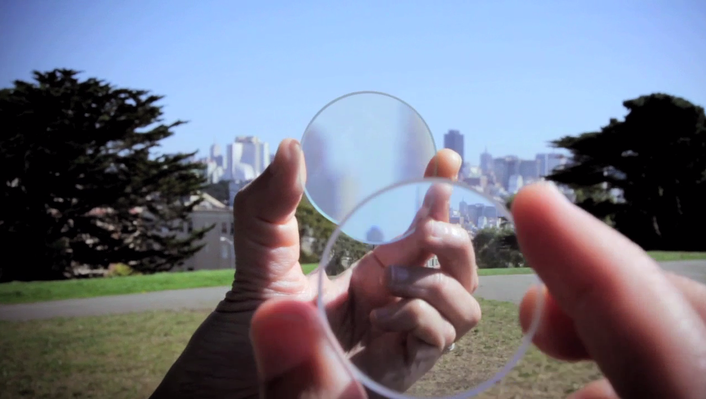
Thanks to its unique properties and ability to manipulate light, glass (continued from last week) lenses led to cameras and, thus, photography, videography, television and movies.

However, glass’ next biggest impact came from fiber glass. Fiber glass’ properties made it extremely useful for materials ranging from jet engines to computer chips. In time, scientists found ways to send signals via fiber glass and that, in turn, resulted in fiber optic cables which were much more efficient than copper wires. Thus, a string of fiber optic cables transports all information (cue: hundreds of selfies) between North America and Europe. Amazing!

All these advances have led to never ending jokes about the selfie epidemic. However, selfies aren’t a new thing. Drawing self-portrait was an obsession among artists. However, self-portraits didn’t exist till the 14th century – until our band of Murano glass wizards coated the back of glass with an alloy of tin and created the first mirror. Until the fourteenth century, it was impossible for people to see a clear image of themselves.

As with many things in modern life, it begins and ends with glass.

(Note: While glass making changed so much after it became mainstream, the reason the invention of glass took so long was because of the high temperatures required to make it. So, we ought to tip our hats to the inventors of the furnace who made the magic of glass possible. :))

The World Wide Web is woven together out of threads of glass. – Steven Johnson

fiber optics, selfiesImage Source 


Source and thanks to: How We Got To Now by Steven Johnson

The Power of Glass – The 200 words project

How often do we think about the impact glass has on our lives?

Glass making became mainstream as part of the Roman Empire. However, innovation occurred when glass makers from Constantinople relocated to Venice (the world’s top trading hub) after its fall. Since making glass involved high temperatures, accidents resulted in Venetian buildings being burnt down. So, all glass makers were exiled to the Venetian island of Murano. This led to an era of innovation among glass makers thanks to experimentation and sharing of ideas.

While the invention of the printing press has been lauded for its role in spreading radical ideas, it led to an important realization amongst now-literate common folk – they couldn’t see! The inventors from Murano rose to the challenge and churned out 3 massive innovations – spectacles, the microscope and the telescope. Within 20 years, Galileo had made the telescope famous. While it took longer for the microscope to have mainstream impact, Robert Hook’s study of insects and corks in the 1600s resulted in the naming of a fundamental building block – the cell. Discovery of microorganisms and vaccines followed.

In terms of impact, however, glass was just getting started. More next week.

A world without glass would strike at the foundation of modern progress: the extended lifespans that come from understanding the cell, the virus, and the bacterium; the genetic knowledge of what makes us human; the astronomer’s knowledge of our place in the universe. No material on Earth mattered more to those conceptual breakthroughs than glass. – Steven Johnson


Image Source


Source and thanks to: How We Got To Now by Steven Johnson

Good relationships and the good life – The 200 words project

The Harvard study of adult development, one of the longest studies ever done, studied the life of 724 men over 75 years. The men were from 2 groups – a group that attended Harvard college in 1938 and another from Boston’s poorest neighborhoods. Every year, they were interviewed about their work, their home lives, their health, and were also tested medically with blood tests and brain scans. Over the last decade, the study also expanded to wives and children.

So, what did they learn? 3 common sense lessons about relationships –
1. Loneliness kills. People who were more isolated were less happy and had worse health.
2. It isn’t about the number of social connections but the quality of your close social connections. Living in the midst of conflict was found to be really bad for health.
3. Good relationships don’t just protect our bodies, but our brains. The memories of people with high quality relationships stayed sharper, longer. Good relationships were simply those where, despite disagreements, both people felt they could count on each other.

The good life, they found, is built on good relationships.

Many of the inner city Boston men ask us, “Why do you keep wanting to study me? My life just isn’t that interesting.” The Harvard men never ask that question. – Robert Waldinger :D

Image Source


Source and thanks to: TED talk by Robert Waldinger, the 4th Director of the study

Paying the smartphone tax – The 200 words project

Building on last weekend’s note on Attention residue and shallow work, here’s this week’s 200 word idea –

Seth Godin shared the costs of using the smartphone –

1. Urgent vs. important. The phone has been optimize to buzz and highlight the urgent. A day on the phone = a day when we buried the important.

2. Losing the moment. Since the world is in our pocket, it is harder for us to be here, right now.

3. Brevity over density. Since everything is done in a hurry, it makes sense to consume and produce “byte-sized” content (GTG, LOL). Is brevity the goal in how we spend our lives?

4. The Filter bubble. The closed gardens of the smart phone world mean we’re most likely to consume ideas that we already understand, from people we already agree with – echo chambers.

5. Easily off the hook. Because it is so easy to hit send or share, we can relieve the tension of creation with a click.

Like most things that are taxed, smart phones are often worth it, creating connections and giving us information when we need it. Perhaps, though, turning our phones off for six hours a day would be a useful way to cornering us into creating work we can’t live without.

“I don’t read work e-mails after 7 pm or on weekends, and if you work for me, may I suggest you put down your phone?” | Grey’s Anatomy TV Producer Shonda Rhimes’ email signature

Source and thanks to: Seth Godin’s wonderful blog – as is the case with Seth’s posts, the original is far better than my edited 200 word version. :)

PS: A fun and insightful add on the topic- a 5 min video of Louis C.K. on mobile phones, kids, solitude and happiness

smartphone tax,Image source

Attention residue and shallow work – The 200 words project

As last week’s 200 word idea on “Addicted to Distraction” touched on a very specific problem of our age, I thought it might be useful to continue digging deeper into the problem and potential solutions in a “deep work” series inspired by Cal Newport’s latest book on the topic.

In a popular paper on multitasking, researcher Sophie Leroy studied the effect of multi-tasking on performance by forcing task switches in the laboratory (e.g. asking people who were solving word puzzles to switch to review resumes). The results from this and her similar experiments led her to coin the term “attention residue.” When you switch your attention from Task A to another Task B, your attention doesn’t immediately follow – a residue of your attention remains stuck thinking about the original task.
And, people experiencing attention residue were likely to demonstrate poor performance on that next task. The more intense the residue, the worse the performance.

In our work lives, there are 2 sources of attention residue – back-to-back meetings on different topics and smartphone distractions. The more the attention residue, the more we find ourselves in a state of “shallow work” – time when we don’t push our cognitive limits.

How do we fix this if multiple projects is a reality? A simple idea to get us started is to plan weeks in a way where we spend large chunks of time (e.g. an afternoon) on specific projects.

More such ideas and ways to think about the problem and its solutions in later editions..

“High-Quality Work Produced = (Time Spent) x (Intensity of Focus)” | Cal Newport


Source and thanks to: Sophie Leroy – Why is it so hard to do my work?, Deep Work by Cal Newport

Addicted to distraction – The 200 words project

Life coach and author Tony Schwartz’s widely read New York Times article “Addicted to Distraction” began with a realization that he had slipped into a period where he was managing his life very poorly. So, he started on an “irrationally ambitious” plan to cut down on excessive diet soda, alcohol, bad eating habits and web and email distractions during the day.

Through great determination, Schwartz fixed nearly everything he wanted to accomplish, primarily better diet and more exercise, but failed completely in one behavior – cutting back on time on the internet. As Cal Newport notes, there is something serious going on when Schwartz, who has built a career around helping people reach his full potential, finds it easier to kick off sugar, alcohol and sloth than his compulsive internet habit.

There isn’t a prescribed solution here but, it is clear, that it is a call for all of us to examine the nature of our internet behavior and experiment with solutions that suit our style this year. Tony Schwartz shares a few in the article (here) and I, for one, have found enormous value from not allowing my mobile phone in our bedroom after 8pm.

Schwartz recalled a powerful story about a man and his 4 or 5 year old daughter at a family restaurant – “Almost immediately, the man turned this attention to his phone. Meanwhile, his daughter was a whirlwind of energy and restlessness…[attempting many things] to get her father’s attention…she didn’t succeed and after a while, she glumly gave up.

The silence felt deafening.”

addicted, distraction

Source and thanks to: Tony Schwartz’s article, Tony Schwartz’s website for the image, Cal Newport’s analysis

Saying yes, saying no – The 200 words project

Cynthia once recalled an incident from when she was 12 years old. Her father promised to take her with him on a business trip to San Francisco. For months, they talked about the trip. “After his meetings, we planned to take a taxi to Chinatown, have our favorite food, see a movie, ride the cable car, and have a hot-fudge sundae. I was bursting with anticipation,” she recalled.

When the day finally arrived, Cynthia waited eagerly for her father to finish work. At 6:30pm, he arrived, but with an influential business client who offered to take them out for dinner. She felt her heart sink.

In a never-to-be-forgotten moment, her father simply said to his client: “I’d love to see you. But, my girl and I have planned a special evening to the minute.” So, together, father and daughter did everything according to their plans. “That was just about the happiest time of my life. I don’t think any young girl ever loved her father as much as I loved mine that night,” she says.

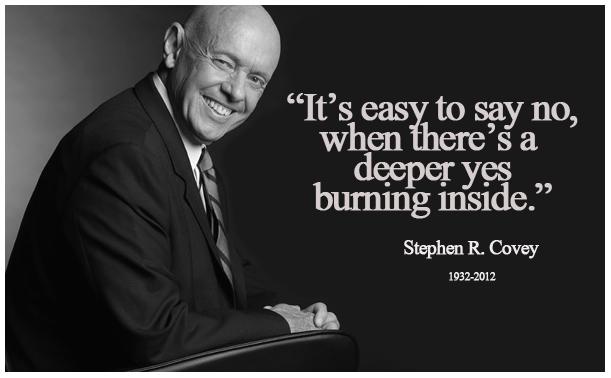
Cynthia’s father was none other than Stephen R Covey. Covey did put “first things first.” Here’s to all of us doing so over the holidays…

no, yes, stephen covey, prioritiesSource

Every time we say yes to something that doesn’t matter, we implicitly say no to something else that does. And, conversely, every time we say no to something that is lower priority, we implicitly say yes to something that matters. – Anonymous


Source and thanks to: Essentialism by Greg McKeown

2 year social proof – The 200 words project

After acquiring several small grocery stores in 1934, Sylvan Goldman noticed that his customers would stop buying items when their hand-held shopping baskets became too heavy. This led him to develop the shopping cart. In its earliest form, the invention was a folding chair equipped with wheels and a pair of heavy metal baskets. However, despite keeping them in prominent places and with huge signs, his customers didn’t use it – men thought it ‘effeminate,’ and women felt it demeaned their ability to carry a shopping basket.

social proof, sylvan goldman, shopping cartSource

Frustrated to the point of giving up, Goldman tried one more tactic – he hired shoppers to wheel the carts through the store while accumulating the items they wanted to purchase. Encouraged by some initial success, he continued paying people to push his shopping cart for two straight years(!).

Over time, his customers adopted.. and the rest, as they say, is history. Even if his shopping cart was a superior product, it required Goldman to use the principle of social proof to transform it into a success story.

Nothing draws a crowd… like a crowd. – PT Barnum


Source and thanks to: Griskevicius, Cialdini, and Goldstein – Applying and Resisting Peer influence

Discuss the flaws – The 200 words project

Imagine someone marches in to your office to tell you that your recent decision to try out plan A sucks and that plan Z is better. The usual instinct is to listen and then repeat the argument for why your decision is the right one.

Dave Hitz, founder of NetApp, handles opposition on decisions differently. He focuses the conversation on all the flaws of a decision. So, in this case,  he’d explain that Plan Z is reasonable – not only because of the reasons outlined but also because of two additional reasons. And, plan A not only has the issues you pointed out but three others.

He found that people found this openness very relieving. It made them understand that a good process was followed in making the decision (Dave saw to that) and that was typically the main reason for their concerns. Dave and his team understood that, while individual decisions may be occasionally wrong, the right process would be the best possible long term ally in their decision making.

Don’t confuse bad results with bad decisions. Worry about a bad decision process. Don’t worry about a bad result. Good decisions lead to good results in the long run. – Ken Crouse


Source and thanks to: Decisive by Chip Heath and Dan Heath