
Why science is hard – Part II – The 200 words project

(Continued from Part I)

Why do we see headlines about coffee being good for us one day and bad the next? It is possible that the original study was flawed- career incentives around paper publication have created bogus journals. But, it is gradually becoming harder to fake it on the internet with online forums and comments on all journal websites. Self-correction is a critical part of science and retractions are on the rise.

science is hard

The main issue is in such studies is that isolating how coffee affects health requires lots of studies and lots of evidence, and only over the course of many, many studies does the evidence start to narrow to a conclusion that’s defensible. The variation in findings is not a threat – it just means that scientists are working on a hard problem.

This uncertainty doesn’t mean that we can’t use findings to make important decisions. We should make the best decisions we can with the current evidence but take care not to lose sight of its strength and degree of certainty AND stay open to new data. It’s no accident that every good paper includes the phrase “more study is needed” — there is always more to learn.
(More on how failure is actually moving science forward in the last piece of this series next week..)

Science is great, but it’s low-yield. Most experiments fail. That doesn’t mean the challenge isn’t worth it, but we can’t expect every dollar to turn a positive result. Most of the things you try don’t work out — that’s just the nature of the process. Rather than merely avoiding failure, we need to court truth. – FiveThirtyEight


Source and thanks to: The FiveThirtyEight Blog – Science isn’t broken
Why science is hard – Part I – The 200 words project

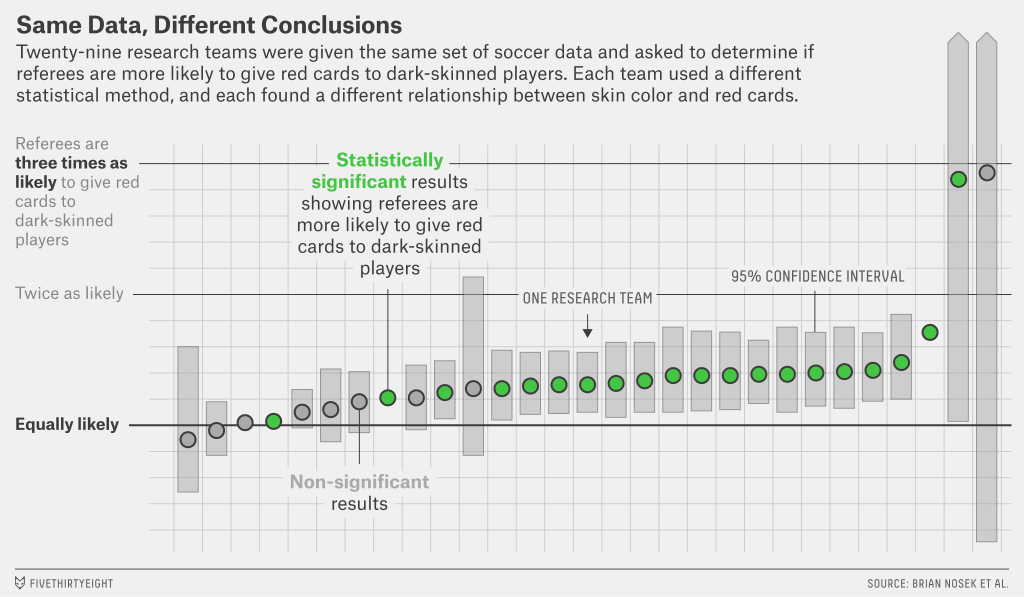
A recent project spearheaded by Brian Nosek, a founder of the nonprofit Center for Open Science, invited researchers to analyze the same data around a prompt: Do soccer referees give more red cards to dark-skinned players than light-skinned ones? Twenty-nine teams, 61 expert analysts, and wide variety of methods were used.

The results? 20 teams concluded the answer was yes (with widely varying magnitudes), 9 teams found no significant relationship.

science is hard

The variability in results wasn’t due to fraud or sloppy work. Even the most skilled researchers must make subjective choices that have a huge impact on the result they find.

All is not lost, however. These disparate results don’t mean that studies can’t inch us toward truth. For instance, it is hard to look at the results and say there’s no bias against dark-skinned players.

The important lesson here is that a single analysis is not sufficient to find a definitive answer. Every scientific result is a temporary truth, one that’s subject to change when someone else comes along to build, test and analyze anew.

But, if this is the case, how do we make sense of news clippings that claim A causes B? More on that next week.

Science isn’t broken. It’s just a hell of a lot harder than we give it credit for. – Christie Aschwanden


Source and thanks to: The FiveThirtyEight Blog – Science isn’t broken

The Popeye spinach myth – The 200 words project

Popeye the sailorman was a major evangelist for spinach in the 1930s and is said to have increased green consumption in the US by one-third. He loved spinach because the iron content helped him attain super strength.

The only problem was that the “fact”  about the iron content in 100 grams of spinach – 35 milligrams – was off by a factor of 10. That’s because a German chemist named Erich von Wolff misplaced a decimal in his notebook in 1870 and that goof created one of the cartoon characters of the century. The story of the decimal point goof has since been retold multiple times, most famously in a book called “Follies and Fallacies in Medicine,” a classic work of evidence-based skepticism first published in 1989.

All these re-tellings miss another important fact – the decimal point explanation is a myth. The mistake arose from faulty measurement methods. Subsequent analyses just improved measurement closer to the currently estimated real value of 2.71 milligrams per 100 grams (roughly 1/10th the believed 35mg).

So, what’s with these myths that get presented to us as facts? And, why is “science” so problematic? More next week..

It’s a lot easier to spread the first thing you find, or the fact that sounds correct, than to delve deeply into the literature in search of the correct fact. – Samuel Arbesman

popeye, spinach, myth


Source and thanks to: The FiveThirtyEight Blog – Who Will Debunk the Debunkers?

The supermarket willpower test – The 200 words project

The local supermarket is one of the best places to understand what we know about willpower.

A well-functioning super market will begin by having free food samples in the bakery section near the entrance. As a group of Stanford researchers showed, eating sweets increases people’s propensity to buy more and makes them over-sensitive to dopamine triggering “for sale” signs.

Somewhere close, you’ll also see green and healthy food. It makes a lot more sense to have vegetables near the checkout line so your tomatoes don’t get crushed by other stuff you buy. But, vegetables help you stock up on good karma (“moral licensing”). You can then proceed to spend the karma you earned on unhealthy stuff.

Milk, bread and eggs are all the way at the back – if you came for a quick run, you still need to pass all the tempting stuff en-route – twice.

Finally, even if you managed to make it to the checkout counter resisting everything, you have candy and gossip magazines waiting for you while you wait. After all those vegetables, tossing one of these wouldn’t hurt, right?

The test isn’t over till you are out of the examination hall.

“he odds of going to the store for a loaf of bread and coming out with only a loaf of bread are three billion to one. – Erma Bombeck

supermarketImage Source


Source and thanks to: The Willpower Instinct by Kelly McGonigal, The Power of Habit by Charles Duhigg

The baldness game – The 200 words project

Six year old Emma had been undergoing therapy for cancer. The day after her head was shaved, she walked into class to find her classmates making fun of her. Emma dreaded going to school the next day.

When their teacher walked in the next day and greeted the kids in her usual cheerful way, she took off her scarf and showed off her bald head. The kids were all taken aback and, that evening, every one of them asked their parents to shave their heads bald.
The teacher saw opportunity in the little girl’s first day of suffering. She wore her bald head like a fashion statement and saw it as an opportunity to increase bonds, create solidarity, and most importantly, have fun. So, she created a game and everyone wanted to play.

Whenever we face a situation that creates winners and losers, it is probably worth reminding ourselves that we always have a choice to create a win-win game. The possibilities always exist.

Many circumstances that seem to block us in our daily lives may only appear to do so based on a framework of assumptions we carry with us. Draw a different frame around the same set of circumstances and new pathways come into view. – Ben and Roz Zander, The Art of Possibility

baldnessImage Source


Source and thanks to: The Art of Possibility by Ben and Roz Zander

Rule number 6 – The 200 words project

Two prime ministers were sitting in a room discussing affairs of state. Suddenly, one of the aides walked in and began furiously explaining something that had gone wrong.
The resident prime minister admonished him gently – “Peter,” he said, “kindly remember Rule Number 6.” On hearing this, Peter calmed down, apologized, and withdrew.

The politicians returned to their conversation but found themselves interrupted by another hysterical staffer. Again the prime minister said – “Marie, please remember Rule Number 6.” Complete calm descended once more and she, too, withdrew with an apology.

When this scene repeated again, the visiting prime minister said: “My dear friend, I’ve seen many things in my life, but never anything as remarkable as this. Would you be willing to share with me the secret of this Rule Number 6?”

“Very simple,” replied the resident prime minister. “Rule Number 6 is ‘Don’t take yourself so damn seriously.'”

“Ah! That is a fine rule.” After a moment of pondering, he inquired, “And what, may I ask, are the other rules?”

“There aren’t any.”

When we follow Rule number 6 and lighten up over our childish demands and entitlements, we are instantly transported into a remarkable universe. The new universe is cooperative in nature, and pulls for the realization of all our cooperative desires. – Ben and Roz Zander


Source and thanks to: The Art of Possibility by Ben and Roz Zander

rule number 6

Coronary by-pass surgery success – The 200 words project

Cardiologists who performed Coronary by-pass surgery were studied in hospitals across the US. The normal fatality rate is 3% and researchers wanted to find out if some doctors were safer than others.

It was found that it wasn’t so much the doctor as much as it was the doctor’s familiarity with the hospital. The more the doctor operated with a certain team and thus understood their strengths and weaknesses, the safer he became. And these abilities were not portable. The moment the doctor moved hospitals and teams, he became as un-safe as any other.

Wall street analysts also exhibited similar teething troubles. When top analysts were hired by new firms, it turned out to be a lose-lose if they didn’t bring their team with them – the firm never got the “star” they wanted while the analyst never ended up giving a star performance.

So, when we set out hiring stars, let’s keep an eye out for their team members. And, of course, when going for important surgeries, look for doctors who are familiar with the hospital’s set up.

Surgeons didn’t get better with practice. They only got better at the specific hospital where they practiced.

surgeryImage of a Coronary Bypass Surgery team – Source

Source and thanks to: Give and Take by Adam Grant

Any special requests? – The 200 words project

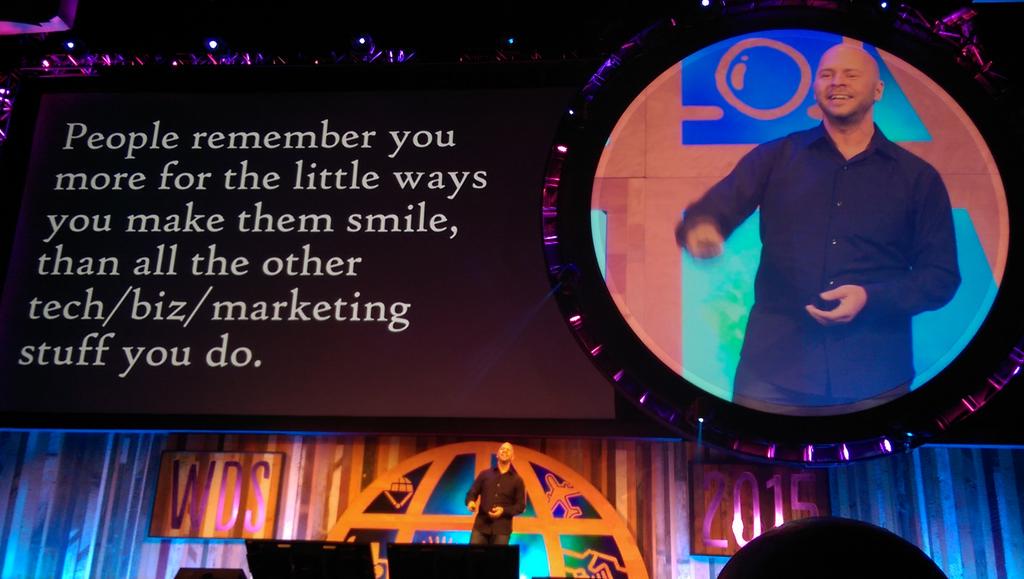
When Derek Sivers ran CDBaby.com, one of the first places to buy music by independent artists on the internet, he intentionally built a reputation for delighting customers by just being human and authentic. For example, one of CDBaby’s biggest sources of PR was artists who exclaimed – “Somebody actually answers the phone! In 2 rings!”

Every CDBaby order form had a “Any special requests?” question. So, when one customer asked for cinnamon gum, the team sent cinnamon gum with the order and delighted the customer. Thousands of people heard about it.

Then, another customer who bought a CD with a squid on the cover asked, as a joke, for a plastic squid. It was somewhat fateful that an East Asian artist had actually sent the CDBaby team a plastic squid as a thank you. So, the team sent that to the customer.
The delighted customer created a video of the experience (http://sivers.org/squid) and shared his experience far and wide.

Organizations are collections of people, after all. Reminding customers of that fact can create remarkable experiences.

People remember you more for all of the little ways you make them smile over all the cool marketing you do.  – Derek Sivers

special requests, squid


Source and thanks to: Derek Sivers’ talk at WDS

The Curry workout – The 200 words project

Stephen Curry, considered one of the greatest NBA shooters of all time, owes a lot of this success to a unique practice regimen devised by his trainer, Brandon Payne.

Payne’s philosophy is focused on improving “neuromuscular” efficiency – training the connection between mind and body. One such novel workout requires Curry to wear a pair of military-grade strobe glasses that strobe at different speeds, impairing vision, while Curry dribbles a basketball with one hand and catches a tennis ball with the other. Take away that stressor on the senses during the game and Curry’s reaction times are faster.
Overloading the brain and body during practice and then contrasting it in order to get immediate feelings of improvement are what Payne does in his skill work with Curry.

As Diamond Leung, a journalist, wrote about Curry’s regime, he realized that there was a lesson in all this for him and us. Thanks to all the stimulation from our devices, we are already wearing strobe glasses and are in the midst of a struggle to focus on any single activity long enough to carry it out with imagination, verve and precision.

The Curry workout is perhaps the ultimate call for mindfulness.

curry workout

When I’ve got something intricate to work on, I now tend to visit coffee shops with bad Wi-Fi. That forces me to keep working on the task at hand, even if I’m stuck for a little while. It also gives me a chance to peel back the project to first principles every now and then, and to do some sustained, free-form thinking about what I’m trying to accomplish… it’s hard to know when breakthroughs will happen. Getting rid of sensory overload doesn’t instantly guarantee success. But it improves the odds. – Diamond Leung


Source and thanks to: Mercury News article on Stephen Curry and Brandon Payne

Bothered by limitations – 10x thinking – The 200 words project

Continuing last week’s thread on 10x, not 10% – 10x thinkers, Ken Norton observes, don’t surrender to limitations – they get bothered by them. They look for ways around them, or things they can do to blow through them.

Google’s “Project Loon” is an example of 10x thinking. Project Loon is attempting to use weather balloons to bring reliable internet connectivity to underserved populations around the world. Whether Project Loon succeeds or not remains to be seen, but they’re trying.

A wonderful example of blowing through limitations comes from the 1960s when faster cargo ships and containerization revolutionized international shipping. However, when freighters from Hawaii reached San Francisco harbor in days instead of weeks, they were still forced to wait for many days since their documents needed to clear customs after arriving via postal service. Adrian Dalsey, Larry Hillblom and Robert Lynn saw this as an opportunity – while ships were still being loaded in Hawaii, they drove from dock to dock picking paperwork. They, then, put them in their luggage, got on a flight to San Francisco and got the papers ready by the time the ships arrived.

Dalsey, Hillblom, Lynn => DHL.

It’s often easier to make something 10x better than it is to make it 10% better. – Astro Teller, Google[x]

10x


Source and thanks to: Ken Norton’s essay – 10x, not 10%