Amazon-style narratives – The 200 words project

Here’s this week’s 200 word idea from The Everything Store by Brad Stone..

A few years into building Amazon, Jeff Bezos wanted meetings to be more productive. So, he decided to ban PowerPoint presentations since he felt they communicate very little real information. Instead, meetings at Amazon were to be structured around memos (with a maximum of 6 pages), called narratives. Bezos believed writing necessitated rigorous preparation from meeting organizers, forced a deeper clarity of thought, and ensured they went beyond the numeric facts to the story.

So, to this day, meetings of Bezos’ team of senior executives begins with participants quietly absorbing the memo. They spend as long as 30 minutes reading and scribbling notes in the margins. Bezos says the act of communal reading guarantees the group’s undivided attention.

The Amazon meeting idea is being adopted by many companies. Here’s to giving it a shot.

Amazon style narratives
Source and thanks to: www.EBSketchin.com

 Full sentences are harder to write, they have verbs. The paragraphs have topic sentences. There is no way to write a six-page, narratively structured memo and not have clear thinking.” | Jeff Bezos

But, and, possibility – The 200 words project

Here’s this week’s 200 word idea from The Art of Possibility by Benjamin and Rosamund Zander..

Rosamund Zander says – “Imagine you are in Florida for summer vacation and find it raining heavily. You hate it because you went to Florida for the sun and many rounds of golf. But, what can you do? You can choose to reject it with a ‘but’ and sulk – “I wanted to have fun but it is raining.”

Or you can choose to accept it with an ‘and’. “I wanted to have fun and it is raining.”

This opens up to the next question – what can you do about it? You have many options – get lots of rest, play board games, watch movies, eat great food, or take a flight to a sunny place.

So, as the Zanders point out, if you are short sighted, don’t complain about not being able to see. Pick up your glasses and explore the possibilities.” Only with acceptance do we have possibility. And, we can get started by replacing the “but” with an “and.”

Acceptance-possibility

Source and thanks to: www.EBSketchin.com

‘The capacity to be present to everything that is happening, without resistance, creates possibility.’ | Ben and Roz Zander

Big picture and close up – The 200 words project

Here’s this week’s 200 word idea from Decisive by Chip Heath and Dan Heath..

American President Franklin D Roosevelt always worried about the quality of information that reached him. So, he had a strong network of people outside the federal government who gave him feedback. He would even have his wife, Eleanor Roosevelt, visit projects unannounced and send him reports. He also maintained relationships with lower members of staff to ensure he always had the right information.

But, his most important tool was the ‘big picture and close up.’ He used polling heavily to figure out what the people thought. During his time, the White House would receive 5000-8000 letters every day. If it dipped, he would complain. He would make sure they were analyzed in terms of the problems they found and made sure they were then categorized (e.g. 3,000 on tax, 2,000 on healthcare, etc.).

Then, he would review specific letters to understand the “temperature” of the issue (e.g. specific complaints on a change to the tax code). This way, he got a big picture view and dived in to understand the nuance.

How can we apply the “big picture and close up” approach to make decisions in our lives?

 Big picture close up

Source and thanks to: www.EBSketchin.com

“The country demands bold, persistent experimentation. It is common sense to take a method and try it: If it fails, admit it frankly and try another. But above all, try something… We need enthusiasm, imagination and the ability to face facts, even unpleasant ones, bravely.” | Franklin D Roosevelt

7% better – The 200 words project

Here’s this week’s 200 word idea from our RealLeaders.tv interview with Professor Mihaly Csikszentmihalyi..

Social scientist and author of the now legendary book on happiness – “Flow,” Mihaly Csikszentmihalyi and team spent a week collecting data from a group of internet chess players who played over 1000 games.

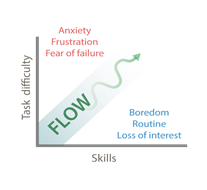
They had the players fill out how much “flow” they felt in the game afterwards. All previous psychological theories spoke about play as a way of boosting self esteem by winning. But, Prof Mihaly and team’s hypothesis was that greatest enjoyment doesn’t come from winning but from playing opponents who are equally matched – so skill levels and challenges are equal (i.e. in “flow” territory).

Flow
Source and thanks to: 
www.EBSketchin.com

Interestingly, the results showed that the optimal challenge was when the opponent was about 7% better. Playing against better players meant the curve of enjoyment went down very slowly while playing against really bad players meant enjoyment went down precipitously. The point is clearly not to just win because, when we play against someone better, we win only 30% of the time but when we do win, we feel much better.

Are we regularly giving ourselves challenges that are 7% harder than our current skill level?

“Happiness is not something that is guaranteed, or that comes with our birth certificates. Happiness is to do things that are harmonious with who we are, with what we can do, with what we like, and with what we think is right.” | Mihaly Csikszentmihalyi 

What if we stopped going outside? – The 200 words project

Here’s this week’s 200 word idea thanks to ASAP Science’s video on what if we stopped going outside and the excellent Lifehacker.com.

We are told to spend more time outdoors so we get Vitamin D. But, what does that really mean?

Well, some of the cholestrol we consume is altered and stored in our skin. When sunlight hits our skin, it modifies this cholestrol into Vitamin D3 which eventually gets activated into vitamin D. This activated Vitamin D absorbs calcium from our food ultimately leading to bone growth and strength. A lack of Vitamin D, aside from weakening bones, results in a decrease in immunity. There’s also evidence to suggest that indicates vitamin D prevents cancer, heart disease and depression. This may explain why people in much colder climates often experience “the winter blues.”

Additionally, brain imaging has shown that brains in nature show more activity in regions associated with stability, empathy and love while those in man-made environments (like high rise buildings) showed more fear and stress.

Finally, sitting (our primary indoor posture) results in more type 2 diabetes and cardiovascular disease. A study of more than 200,000 people showed a link between mortality and increased sitting time.

Time for us to switch off our laptops and head out when we take breaks at work this week..

What if we stopped going outside

Source and thanks to: www.EBSketchin.com

‘When you wander into untamed landscapes it calms your nerves and restores your brain power. Just three days in nature lead to a 50% increase in performances on creativity tests.’ | A study by University of Kansas researchers

The full decision making LearnoGraphic – The 200 words project

This is a re-post of sorts. I’m hopeful it falls under the category of “so good that I have to post it twice.” However, I understand that this does sound very self-flattering. I am sorry about that. After the sort of effort it took to make it (hat tip to our talented illustrator, EB, who deserved the lion share of the credit), I must admit I feel less guilty about sharing ‘it again again as a part of the 200 words project. :-)

As some of the regular readers might know, we call this a “LearnoGraphic” (you heard it here first!) as it is a summary of one of our favorite books.  This is inspired by “Decisive” by Chip Heath and Dan Heath.

At the LearnoGraphics project, we believe that our progress as a species occurs when we find, build and share great ideas. Books are a big source of learning and ideas and we’ve embarked on a mission to spread ideas from our favorite books. We are hoping to share one LearnoGraphic every quarter – it is an ambitious goal as these take a lot of work in synthesis and illustration. This quarter’s LearnoGraphic is on “Decision Making” and a few of these ideas will hopefully sound familiar from previous 200 words project notes. We will explore other ideas in depth too in the coming weeks.

<Please click the image to open – for some reason, I’m unable to display it in full size>

Decision Making Learnographic

Andrew Hallam’s car buying technique – The 200 words project

Here’s this week’s 200 word idea from The Millionaire Teacher by Andrew Hallam and Decisive by Chip Heath and Dan Heath.

Andrew Hallam, a school teacher and self-made millionaire, became wealthy with careful control over his spending (and consistent investing in index funds). One of his decision making strategies is to attain distance before making big spending decisions.

For example, in 2002, when he was ready to buy a car, Andrew refused to let himself be hoodwinked by fast talking car salesmen at the store. So, first, he decided exactly what he wanted in a used car: namely, a Japanese car with a stick shift, original paint, fewer than 80,000 miles, and a walk-out price of less than $3,000. He didn’t want a new paint job because he worried that it might hide rust spots or damage from accidents and he didn’t care about the age or model of the car.

He then called up second hand car sellers and told him what he wanted. Many baulked at his request. But, a few days later, one of the showroom offered a second hand Japanese model that had just arrived at their store for $3000. Andrew went to the store, inspected the car and walked out with the car.

As Andrew attests, attaining distance is a great way to make good decisions.

AndrewHallam car buying

Source and thanks to: www.EBSketchin.com

“Imagine wandering onto a car lot…. A sharply dressed salesperson will soon be courting you through a variety of makes and models… a minnow like me needs an effective strategy against big, hungry, experienced fish.” | Andrew Hallam

The ladder of control – The 200 words project

Here’s this week’s 200 word idea thanks to 99u.com.

David Marquet, Captain of the USS Santa Fe, followed a leadership principle – push authority to as low a level as possible. Under normal practice, officers would “request permission to” perform operations such as submerge the ship. The captain would approve and the officer would carry out the task.

David insisted his officers move up the ladder of control (below), stop asking permission, and instead state “Captain, I intend to submerge the ship” to which he would respond, “very well.” Initially, he had a lot of questions for the officers about whether it was safe, whether the preconditions were met, whether the team was ready, and whether it was the right thing to do. With time, he asked fewer and fewer questions as the officers learned to provide that necessary information at the same time they stated their intent.

The immediate and obvious benefit was that with this small shift in language, just a few words really, the officers became the driving force behind the submarine’s operations.

Perhaps we ought to consider moving our teams up the ladder of control as well..

Ladder of control

Source and thanks to: http://www.EBSketchin.com

‘Moving people from “request permission” to “I intend to…” raised them one rung on the ladder of control, from passive followers doing what they were told at the bottom to proactive engaged leaders, crafting the future, at the top. ‘ | David Marquet

Sampson’s inability to say no – The 200 words project

Here’s this week’s 200 word idea from Give and Take by Adam Grant..

Sampson’s inability to say no. After Sampson failed in his first senate election, he competed in his second with a rival from his party who was doing equally well. So, Sampson gave up his seat and asked all his followers to vote for his rival as they had similar goals. His fellow member won – Sampson cared much more about the people than his own victory.

Sampson won many friends with his focus on giving and finally won the senate seat on his third attempt. When Sampson took office, he went against tradition to hire rivals who were all either much smarter or much better known than him. He believed he owed it to the people to have the best to govern them. One of his rivals, who had previously called him an ape, ended up describing Samson as the greatest ruler of men.

Sampson showed that it is possible to succeed as a “giver” in politics. His task was made more challenging when we take into consideration that reputation and relationships were much harder to build in the 1800s when social media didn’t exist.

And if you’ve never heard of Sampson, not to worry. Sampson was the pen name of Abraham Lincoln.

Sampson no
Source and thanks to: www.EBSketchin.com

‘Character is like a tree and reputation like a shadow. The shadow is what we think of it; the tree is the real thing.’ | Abraham Lincoln

 Pricing Amazon Web Services – The 200 words project

Here’s this week’s 200 word idea from The Everything Store by Brad Stone.

Amazon Web Services (AWS) allows entrepreneurs to plug into Amazons Servers and use it’s computing infrastructure. The AWS team wanted to price it with a traditional monthly/yearly rental system.

 But, CEO Jeff Bezos shifted the focus completely –

1. He decided to create an electric grid model where you pay 10c/hour of use. This was ridiculously cheap but he knew companies like Microsoft and Google wouldn’t want to play this game as it would constrict their generally high profit margins

2. He thus played to Amazon’s greatest strength – building large scale low margin businesses that attracted customers. He actively avoided what he considered Steve Jobs’ biggest mistake – making the iPhone so fantastically profitable that it attracted so much competition that ended up eating its market share. He believed high margins attracted competition while low margins attracted customers.

 When moving into a new territory/project, let’s channel Bezos and remember to play to our strengths.

 PS: The graph below illustrates this beautifully. Despite increasing revenues, Amazon.com has almost never made a profit – intentionally.

(If you look very closely, you can see that in 2010 the company accidentally made a profit. )
Source and thanks to: Benedict Evans’ blog

 ‘One thing is easy to agree on, though: competing directly with a company like this is very hard. ‘ | Benedict Evans on Amazon’s profit graph