Searching for the good life – MBA Learnings

“Think about the metric by which your life will be judged, and make a resolution to live every day so that in the end, your life will be judged a success.” | Clay Christensen

“Productivity is the act of bringing a system closer to its goal.”  | Dr. Eliyahu Goldratt

“The most important thing about the good life is that you get to decide what good is. If you are living someone else’s good life, you’re making a huge mistake.” | Seth Godin

These 3 quotes have given me plenty of food for thought over the past 2 years. They touch on 2 big questions –
1. What is the yardstick with which you will measure your life?
2. Assuming the goal is “the good life,” what is the good life as I define it?

These questions are so incredibly heavy that it feels easier to give up before I even get started. These 2 questions get at more questions – Who am I? What matters most to me and why? Ah. So much easier to just get on our to do lists and do the next thing.

And, yet, is there anything more important than asking these questions? There is no productivity if we’re not working towards the goal, after all..

This afternoon, a close friend and I, at school, are launching the first edition of a 3 part workshop series we’re calling “The Good Life sessions.” The idea is to break the idea of the good life down by asking 3 questions –
1. What do I value?
2. How do I find my personal mission?
3. How do I create an action plan to live a life consistent with this mission?

We’ve been fortunate to receive support from a collection of inspiring professors who’ve walked this path and continue to struggle with these questions. As anyone who reads this blog knows, I have definitely been struggling with these questions for a long while and, after 18 months of wrestling with these questions, have begun to find direction. So, we were really excited to test this idea with the student community and see if we’d find a small group of people who care.

It turned out there was actually a huge group of people who care. We received 70 registrations in the first 120 seconds of our registration opening up and had to close at close to 300 registrations (~25% of the student body) in the first 4 hours. We have a main lecture room and 2 overflow rooms booked today. It helped a lot that the Professors who’re helping us have great follower-ship within the school but (and I am based here) it feels like we’ve hit on a topic that many would like to explore. And, that’s great to see.

I’m not sure this has ever been done before. So, we’re definitely working hard to create structure and tackle these big questions in bite-sized chunks. Of course, this might not work. But, I guess, that’s what makes it really exciting.

More to follow on the good life sessions. For now, I’ll end with a big thank you to Clay Christensen, Dr. Eliyahu Goldratt and the wonderful Seth for those 3 big ideas.the good

A letter to an incoming student – MBA Learnings

Around this time last year, once the realization that I was going back to school sunk in, the immediate question that followed was – how do I get prepared? I was, after all, going to be spending in excess of $200,000 without accounting for the loss of income in the next 2 years. This had better be worth it.

My plan of action was to do 3 things – read books on the topic, check out the blogosphere, and speak to as many people as possible. So, I did just that. I found 3 resources useful – the “Case Studies and Cocktails” was pretty hands-on, the famous Stanford letter to incoming students was reassuring and the 108 tips on the MBA Excel blog was very useful from a logistical point of view. I did, however, feel a few things were sorely missing. And, on top of that list was a way to “frame” the MBA experience. Great frames help us cut through the noise and understand what matters. And, given we likely have a hundred thousand capable folk jumping into expensive MBA programs all over the world, I found myself wondering if we could do a bit better in preparing them for the journey.

Luckily, I stumbled upon a first version of the “frame” I craved in my first 3 weeks thanks to 2 wonderful people – an insightful professor who taught us business analytics and a dear friend. Their insights made all the difference to my experience in the past 8 months. And, I’d like to share them with you. As with my essay on internship recruiting, I’d like this to be comprehensive. So, I expect this to be long. I hope it’ll be worth it.

Before we begin, a note on bias. As writing is a direct reflection of thought, every piece of writing has inherent biases. While I’ve done my best to use frames over specific advice, this is hard to do. My priorities in life are around people that matter, learning from life’s experiences, and having a positive impact on the world. And, these priorities shape how I see the world and choose to experience it. As a result, my idea of fun revolves around these priorities (I guess writing a daily learning blog is a bit of a giveaway :-)). So, I trust you’ll put these notes in context and take them with healthy pinches of salt.

Framing the MBA journey. The MBA journey is the first step to the next phase of your life journey. The lessons from this post aren’t just about doing well in graduate school. I think the principles apply for life after school. Most people come to the MBA after a few intense years in their 20s where they’ve largely focused on themselves and their growth. Yes, there are those with kids, wives, and spouses – but, most of the folks in these programs have worked really hard to get in and are now looking for that next step. And, these programs exist to prepare them for that next step in a safe and relatively risk-free environment. To understand how they do that, you have to understand the 3 underlying principles that govern this experience. Let’s start with principle #1.

Principle #1 – The MBA is a 2 year course in decision making and trade-offs.
There are 6 priorities you will need to think about during your time in graduate school. I will go through each of these and will also make a case for the idea that juggling these 6 priorities is a warm-up act for life beyond school. The 6 priorities are –

1. Academics. You are paying for the experience. Education is one part of the experience. Unlike in your undergraduate experience, very few people really care about your grades. In fact, many programs don’t even provide employer’s access to your academic performance. So, do grades matter? Well, they matter as much as they matter to you. There will be many at school who won’t care. And, then again, there will be many who will. There is no right or wrong answer here. It depends on whether academics lies in your priority list. I will, however, offer a few thoughts for you to consider –

– Nearly every class I have taken so far has had lessons that have been either been immediately applicable in my own life or have helped greatly in my understanding of the world. This stuff is useful. I think neglecting it isn’t smart.
– That said, I don’t think it is worth spending every spare moment studying. I think what really matters is an overall grasp of the fundamentals. Ten years down the line, you aren’t going to remember ABC reading or DEF assignment, but, you will remember how to think about network externalities or structuring your company’s debt.
– If the MBA provides this broad based education, it is critical you spend time developing mental models that will help you remember the stuff that matters. As your understanding develops, you’ll find that almost everything is connected. The better your understanding, the more the connectivity.
– It helps greatly to show up to class and participate. Every once in a while, you’ll find your attention drifting or find you have no clue what is being said. Stop the Professor and ask questions. Don’t pride yourself of knowing stuff. Pride yourself on being able to get smarter.. quickly. Nobel prize winners do that.
– We don’t learn best when we take notes during class. We learn best when we take a bit of time after class to summarize the key points of the lecture. I’d definitely consider taking that time to reflect and to create those summaries.
– If you follow a thorough learning process, you’ll find that there is no need for last minute cramming. Good results typically follow good processes.

Academics in your life after school. At school, you will get to create a learning path that suits your interest (in most schools at least). You will likely find your interest in some subjects increase in your time at school. It won’t be possible for you to learn everything. One of the best outcomes of this journey would be a renewed commitment to making use of every moment of time available in your life after school to further your learning. This could be by reading great books on your commute, by taking a course every 3 months, or just connecting with a smart peer group interested in similar subjects. Knowledge -> understanding -> wisdom. It is hard to shortcut that process.

2. Recruiting. What you will really learn in business school is how to lead yourself through a job search. I can’t think of a more useful skill. Here’s why – the days of long tenures at a single company are long gone. This means that the chances that you’ll be looking for a job in the next 48 months and then again in 48 months after that are incredibly high. Learn to do it.

I’ve written about lessons I learnt from internship recruiting. So, I’ll aim to leave you with a few high level thoughts –
– Over the summer, really think about what you want to do in the long term. Consider paths that will help lead you to that goal. Either way, it’ll become really tempting to shun those paths and go after prestigious positions and firms. If that happens, let it be for the right reasons.. or, at the very least, reasons that make sense to you.
– Recruiting hits you much quicker than you’d expect. All schools care a lot about recruiting because these stats feed into their rankings. So, expect to be bombarded with messages about information sessions about every company you can think of. You can’t do them all.
– You’ll find very quickly that the difference between those who recruit successfully and those who don’t can’t be accounted for by a different in their IQ. It comes down to a combination of EQ, preparation and focus.
– Recruiting isn’t easy. Don’t expect it to be. Instead, get ahead of the preparation by taking time to really think about how you’d like to approach it over the summer. Be prepared. That’ll help you be focused.
– Make sure you enlist plenty of support through the process. Find a group of friends looking for the same kind of opportunities and prepare with them, engage 2nd years and seek their advice and support, use the career center and professional club resources. You’re going to need it.
– Keep in mind that there is a lot of luck and chance involved. Focus on your process and approach. The results typically work out in the long run..
– Finally, use the recruiting period to build real relationships with people in the industry of your interest. Don’t just find a job. Get to know people.. it’ll pay off in the long run.

(Of course, all this doesn’t apply if you’ve decided to start-up during or after school yourself)

Recruiting in your life after school. You never really stop being a job/project-seeker. My only hope is that you’ll be a great employer, too, since you know what it feels like to be on the other side.

3. Social. I tend to think of friends as education’s greatest gifts to us. And, it is highly likely you want to make a friends through this experience. Relationships are very personal and everyone tends to have different approaches to social life at school. So, while the rest of the post is pretty colored by my biases, this one is very colored.

– Social life can be pretty stressful. There’s often a funny high school meets 20 somethings dynamic at school. This is just something you should know and expect.
– There are a couple of approaches to making friends – making many friends or making a close small group of friends. I am a fan of marrying both approaches. Success, to me, is having a small group of friends at the end of 2 years who I’d trust with my life and a collection of other friends across various social groups.
– I’d consider creating a diversity check on your calendar every 6 months – just ask yourself if your close circle of friends all look exactly like you (e.g. same country/language/profession). If so, it is worth asking yourself if you are learning anything from the diversity around you.
– Attempting universal popularity is a fool’s errand in my point of view. If that’s what you are after, good luck!
– Instead of attempting to get people to like you, I’d consider working hard to earn their respect through your work ethic and track record. I tend to find that going for respect often ends up resulting in you being liked by people who share similar values.
– Attempting to “network” through school is also a fool’s errand. Your network at every stage will be directly proportional to your net worth – both in terms of wealth and character. But, again, if that’s your plan, I hope you find a way to make it work.
– If you are an introvert, don’t worry. There are enough of us out there. The hard part will be saying no to the many low quality social interactions where 40 people will show up at a noisy bar and barely manage to hear each other speak. Hopefully, all this reading will help you make conscious choices. There’s limited time available to hang out and build relationships.. use it well.
–  I am a big believer in the idea that you attract people by virtue of who you are. And, a big part of showcasing who you are is by what you do. That brings us to priority 4.

Social in your life after school. I don’t have to make a case here, do I? :-)

4. Extra curriculars. There are extra-curricular activities of every kind in school via professional clubs, hobby clubs, fun clubs, etc. My view is that extra curriculars are the single best way to get to know your classmates and build real relationships. Here’s how I think about them –

– Leadership roles in most extra curriculars in school can be big time commitments. I find it hard to think of other opportunities during the experience where you get to spend so much time with your classmates working on interesting stuff (hopefully!).
– Do consider using extra-curriculars as an opportunity to hone your own skills – both hard and soft skills. Through them, you can learn how to work with smart peers, how to attract and hire people you want, how to select the right people for the job and team you’re looking to build, how to inspire them to be as committed as you to your cause, etc. Take your pick.
– My final thought would be to consider using these opportunities to learn how to build great teams. History is made my great teams. And, learning how to build great teams could be the most valuable skill you learn. It is an incredible opportunity to do so..
– Make sure you create your own path. This is a no-risk safe environment. If you aren’t trying things, failing and learning, I’d consider that a real shame.

Extra curriculars in your life after school. I am a big fan of side projects – whether it is your own soccer team or your not-for-profit. This stuff helps improve your productivity and also teaches many a valuable lesson. Successful entrepreneurs and executives always find time for these side projects. We should too.

5. Your friends and family from your “past life.” Graduate school sucks you into a bubble of sorts and it can lead to feelings of guilt when past friends and family are mentioned. That’s just because it is really easy to neglect them as you work through your weekends on assignments due on Monday and a whole host of other deadlines across these priorities. A few thoughts –

– Consider carving out 3 hours every week for your past life. I had Saturday mornings always kept free for catch up calls. It helped a lot.
– Call your mom at least once every week. This one is for the men. Women do this much better.
– Make the effort to stay in touch with your friends. Your roots matter.
– Every once in a while, as you experience wonderful moments, send thank you notes to all those who made this experience possible. There is no way you’d be in school if it wasn’t for all those wonderful people who supported you through the application process – your recommenders, bosses, colleagues, family, friends, teachers, etc. Thank them all from time to time.

Your “past life” after school. It is very possible that your graduate school experience will change you as a person. It is also very likely that it’ll change your career trajectory. There’s a lovely story about a boy who was frustrated with his kite’s string as he felt it was holding his kite back. His father suggested he cut the string. When he did, he noticed that the kite went up for a little while and then went on to crash. His father explained that our roots and values work the same way. It is tempting to cut people off as we soar higher. But, it is really those roots and values that provide the support system for our growth.
I guess there’s a lesson in there for all of us.

6. You. If you’re going in with your spouse/partner and/or your kids, this includes them. For this priority, I will err on the side of giving specific advice as I think this is the most important priority of them all. If you can’t keep your personal life together, you will have a miserable experience. So, really, I’d encourage you to make this your number 1 priority. What does that mean?

It means taking great care of yourself and the people who live with you. Prioritize sleep. Prioritize good food. Prioritize exercise. There have been enough studies over the past few years that have shown that this stuff greatly affects your decision making. And, here we go back to principle #1 – this is a course in decision making and trade-offs. The good news? Better decisions = better life. And, that’s what we really want, isn’t it?

Easier said than done, of course. So, how do you do this? Here’s what I suggest –

1. Decide what is important to you. The latin root of the word “decision” translates to “to cut off/to kill.” A big part of decision making is deciding what doesn’t matter (and, in the process, deciding what does). Decide which of the 6 priorities matter most to you and in which order. The order might (and likely will) change every week. That’s okay. Go in with a plan. A general once said – in war, plans fail but the planning is essential. That’s a great idea.

2. Spend 30 minutes at the start of every day reflecting on the day before and getting organized. There is no use moving from one day to the next without really learning anything substantial. 30 minutes every morning will help a LOT. If you want to make this actionable, consider writing in a journal or writing your own blog (I warned you about my biases!).

Also, a little bit of time getting yourself organized will pay off in a big way. The busier you are, the more organization will help you. For example, an hour spent at the beginning of the quarter putting all important deadlines and reminders for them in your calendar will save you a ton of heartache.

3. Color code your calendar based on these 6 priorities. You will use your calendar a lot. There’s no way around it. Start color-coding your appointments around these priorities. If you had a 3 hour block of free time and spent 2 hours studying, put in a 2 hour “academics” block. This will come of use in your weekly reflection hour.

4. Set aside 1 hour every weekend to reflect on where you spent your time. Make no mistake – your priorities are not what you decided. It is what your schedule shows. If you spent all your time on social activities this week, then that was your top priority. The way to do this is to add up the number of hours spent on each priority every week. It doesn’t have to be perfect. Even broad strokes math will help. The important thing is to understand where you spend your time relative to where you want to spend your time.
(I don’t add up the hours on family time + time spent on me. For good or for bad, I felt tracking them would be too troublesome. Instead, I just check in with myself to see if I feel “in sync.” It also helps I have a slightly more comprehensive measurement system in place – see here if this stuff gets piques your interest or just email me – happy to help with more detail.)

Use this weekly reflection hour to think about the week and figure out your priorities for the next week. On some weeks, you’ll prioritize one thing over the other. That’s part of the process – prioritizing is a not a fixed/one-time thing. It’ll happen every week. The point is to own the process.

If you don’t prioritize your life, someone else will.

5. Try to spend quality time with those who live with you. I say “try” because this’ll be incredibly hard. My experience has taught me that the person who suffers the most from my prioritization missteps is my wife. I’m working hard to do better here. Many relationships suffer during the graduate school experience because it simply isn’t easy on partners and spouses. Some schools integrate partners better than others. But, none of that stuff helps if you do a lousy job of this. And, don’t just talk about prioritizing it. Show me your schedule and I’ll show you your priorities.

Prioritization is incredibly hard. But, it is the single most important life lesson that graduate school can help you learn. The quality of your life will be directly proportional to your ability to prioritize. There will be many mis-steps. But, if you take the time to reflect and learn, you might just really give yourself a shot at that elusive idea that most people seek – the good life.

Principle #2 – The experience is entirely what you make of it. Congratulations on your admission to a great program. If I haven’t made it clear as yet, I’ll say it explicitly – this isn’t a magic bullet. It isn’t guaranteed that you’ll have a great experience. In fact, you’ll find likely find yourself in an environment that is more competitive than any you’d been in before. Suddenly, you’ll be in a pool of talented peers from across various programs vying for the same jobs. You’ll even have to compete for opportunities to volunteer your time for extra curriculars (!).

But, the competition isn’t what this is about. This is about you investing 2 years in your own learning. You can really own this experience and make it exactly as you’d like it to be. In graduate school as in life, the people who do well aren’t those who’re much smarter than you and me. It is people who maintain a laser-like focus on what matters to them.

In the final analysis, just like there is no universal popularity (there are as many Angelina Jolie haters as there are fans), there is no such thing as universal success. The most important thing about the good life is that you get to define what good is.

I hope that, in school as well as in life, you’ll take the time to do that. School just happens to be a wonderful training ground for the real thing.

Principle #3 – Foolishness is believing your value 10x-ed just because you spent 2 years running around a university campus. Depending on the press’ mood, you’ll either find articles telling you that graduate business programs are awesome/are a complete waste of time and money. Regardless of the press’ mood, you’ve typically gone in expecting higher salaries and a better life.

My suggestion here would be to worry about that stuff less. Money matters and you’ll be compensated fine. Sure, your neighbor may get a better sign on bonus but I hope you won’t sweat this stuff. What I would really worry about is whether you’re making the most of the opportunity to get better. Just running to classes for two years in a university campus doesn’t automatically increase your value. Learning something does. And, even if it improves your understanding of the world, we’ve said nothing about your ability to get stuff done and really have an impact. Rather than labor the point, I’ll point, as I have done many a time before, to Hunter Walk’s fantastic post – “It’s fine to get an MBA, don’t be an MBA.”


The “MBA: good or shitty for entrepreneurs” debate flares up regularly here in Silicon Valley. Having attended business school at Stanford, I certainly have a horse in the race, but I’m also not one to insist it’s (a) the best choice for everyone or (b) required for success. At the same time, let’s dismiss the notion that any legitimate entrepreneur would never go to business school – ie that the act of even thinking an MBA is worthwhile proves you’re not a real hacker or hustler.

Key to all this talk is a more fundamental issue which most people gloss over — the notion of letting an experience define you versus it becoming part of who you are. And thus my take is that it’s fine to get an MBA, but not cool under any circumstances to be an MBA.

Getting an MBA means you’re curious to learn broadly about theories and explore how these techniques can be applied to various businesses. Being an MBA means you think you’re getting taught the one right answer to problems – to a hammer everything is a nail – and that only MBAs know these dark arts.

Getting an MBA means offering your perspectives and experiences to your classmates. Being an MBA means looking at your peers as networking targets.

Getting an MBA means thinking about your degree as just another attribute of who you are – I have brown hair, a wife, work at Google, enjoy citrus fruits and possess a Stanford degree. Being an MBA means you are “Hunter Walk, Stanford MBA,” elevating the matriculation to a level of undeserving primacy.

Getting an MBA means you shoot out of school wanting to prove yourself and see what you can contribute to others. Being an MBA means thinking the world owes you something and that your value 10x’ed just from spending two years on a campus.

At the end of the day, just be who you are, which is a collection of skills, abilities, successes, failures, fears, dreams and hopes. The most important degree you possess is Human University.

By the way, the “get, don’t be” applies not just to business school but any accomplishment that causes one to define their identity vis a vis an entity or action. This just as easily could have been titled “fine to go to MIT, don’t be an MIT” or “fine to work at Facebook, don’t be a Facebook.”


Wrapping up. I’m sorry if this post burst the fantasy of a 2 year vacation. I am a big believer in setting expectations right. This experience isn’t designed to be a 2 year joy ride. That’s not to say it can’t be. The easy thing to do is to waltz in and try to find the path of least effort and resistance. Or, you can do the right thing for yourself and for the world by seeking out the difficult stuff and really making the most of the experience.

The choice is yours.  Either way, I wish you well and hope this helps. :-)

And, of course, if I can be of any help at all in helping you get prepared, send me an email on rohan [at] rohanrajiv [dot] com.

PS: I’m sure there are quite a few typos. I am actually on a rare break at home. So, please just let me know of the typos and I’ll fix them as soon as I can. It is also likely I’ll add a few updates as I think about it more.

Getting mission statements right – MBA Learnings

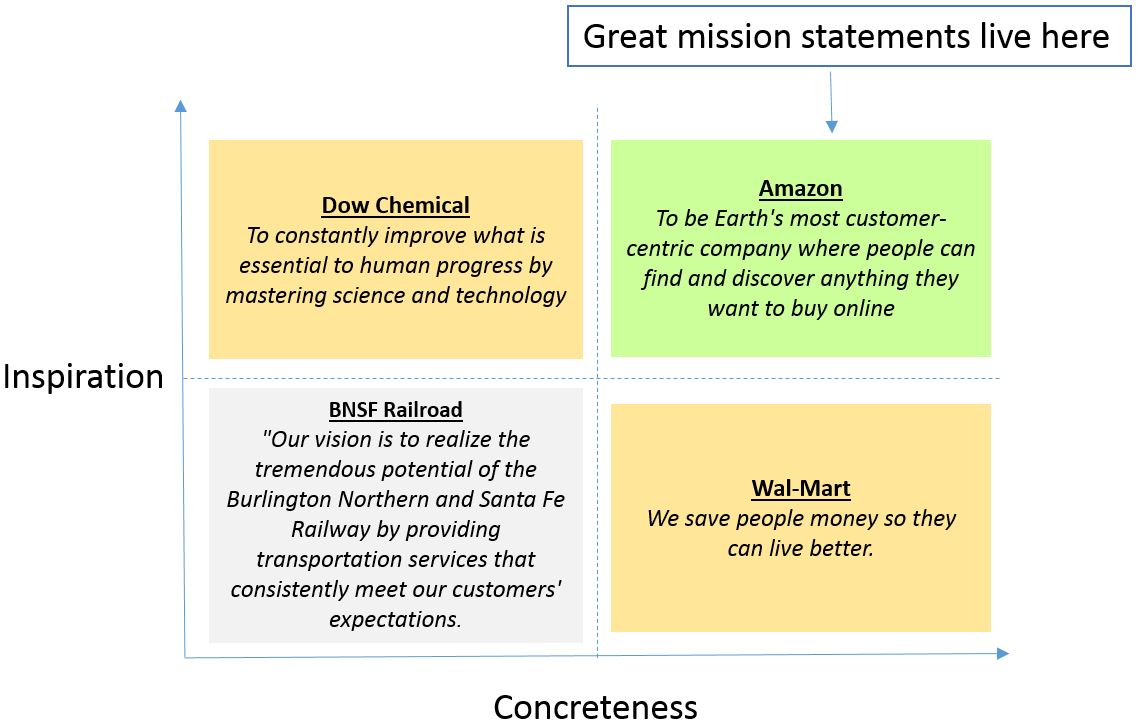
We looked at a few mission statements in our Values Based Leadership class –

Wal-Mart: We save people money so they can live better.
Burlington Northern and Santa Fe Railroad: Our vision is to realize the tremendous potential of the Burlington Northern and Santa Fe Railway by providing transportation services that consistently meet our customers’ expectations.
Dow Chemical: To constantly improve what is essential to human progress by mastering science and technology

As we went through these statements, the comments that followed were around the following lines –
– The Wal-Mart mission is really concrete. It is the sort of statement that can be used whenever Wal-Mart faces a tough decision. Any product or personnel decision could be brought back to the fact that Wal-Mart exists to save people money.
– The Burlington Northern and Santa Fe Railroad mission felt like a non-mission statement. You could easily replace their name and industry with a different company and industry and it could still “work.” That’s a problem.
– Dow Chemical did very well on inspiration. But, how concrete is it? Can the mission statement actually be used in daily decision making?

Bringing it all together, we realized that great mission statements have 2 characteristics –
1. Inspiration. Some inspire with a transcendent purpose and others inspire with a bold goal. Regardless, the inspiration factor gives people a reason to come to work everyday.
2. Concreteness. Concreteness makes the vision easy to understand and apply to daily decisions.

Mission statements, as a result, are an important and, yet, often neglected resource for building culture, improving employee motivation and decision making. What is an example of a great mission statement? I love Amazon’s statement – “To be Earth’s most customer-centric company where people can find and discover anything they want to buy online.” Really inspiring and, yet, very concrete. If there was ever a decision to be made, it is clear that the customer would be first priority.

(Note: I’ve used mission and vision statements interchangeably to convey the larger point)

Mission statements

This learning had immediate applicability for me. I thought of 3 teams I am working with and thought about the various levels of clarity in our purposes. And, voila, it turned out that the team where I felt most stuck was the one with the least clarity around the mission statement.

It is a relatively simple fix. And, it is one we ought to get right.

Lessons learnt from internship recruiting – MBA Learnings

I hated looking for a job in my final year at university. It is one of those profoundly painful processes that I really wouldn’t wish on anyone. It seemed to bring to surface all my insecurities and really made me question if I had done anything of note in the past 20 odd years of my life.

So, when I decided to study again, one of my objectives was to understand how best to approach looking for a job. We’re in an age where we’re constant job seekers. Whether it is seeking an internal transfer within a company we work for or whether we’re looking for a role in a different company, it is clear that our age is one of many jobs, roles, careers and companies. In that sense, looking for an internship at school felt like a perfect laboratory to test how this process ought to be approached. I’ve decided to break the whole process down into three main steps, cataloged my process and then shared what I learnt. I’ve attempted to bring it all together in one post. So, it’ll be long. I hope it is worth it.

Stage 1- Figuring out what I want to do. This has to be the first step of any job or project search. There are always options you don’t want. And, it helps to really understand what you want to do rather than follow the crowd. A simple point to remember – for every job or role you don’t feel all that passionate about, there are a hundred who do.

My process.
i) Speak to as many smart people as possible. I liken this stage to market research. Take time to just get some perspective from people you like and respect. Just engage with them on general advice on careers, paths, and how you ought to approach them. It helps a GREAT deal if you already have a sense of the direction you’d like to take. For example, it is much easier to have conversations focused on careers in pharmaceuticals than just careers in general. Ideally, speak to people who’ve done what you’re about to do or something similar. These perspectives should give you data points and perspective to reflect. After every such conversation, take a few minutes to take short notes of what you took away.

ii) Take the time to reflect. Now, take the time and think about what you think you’d be interested in and what you’d like to explore. Write down what you learn. The ideal outcome of this process is a shortlist of roles and companies that you’d be interested in working at.

iii) Explore ways you can meet people in these target roles or companies. There are 2 ways to approach this. The intentional approach is very targeted and focused on getting a job. This involves looking into your LinkedIn connections and figuring out who you know in a certain industry. If you’re looking for connections in Pharma near New York, it makes your search straight forward. Once you find a few people who know people you’d like to meet, you reach out and set up some informational meetings.

The other way to approach this is to do this with less intention (my preferred approach). Reach out to people you know within the industry you’d like to work with and just ask to meet with interesting people. As long as your interest is genuine, this can lead to some really cool serendipitous connections. Take the time to visit these people in person (if at all possible) and just meet. No big agenda aside from a willingness to get to know them and list. In the long run, this approach makes a huge difference and is how good “networking” is done.

Lessons I took away.
i) Get started as early as possible. I was told to get started on this process well before I got to school. It is one of the better pieces of advice I have received. The principle here is straightforward – some things just take time. And, it is best to do so when you don’t have a burning deadline in sight.

ii) Approach this part of the process with the intention to learn as much as you can. Relationships are not built when by seeking specific favors. Relationships are built when you have a genuine interest in getting to know the person at the other end of the table. At this stage, it is critical to really get to know people as the perspective you’ll receive from an expert / someone who has gone through the same process as you is one that you’ll be hard pressed to find in a book.

iii) Think long term. This isn’t about getting what you think you want now. If it is, then you’re approaching it all wrong.

Stage 2 – Attempting to get your foot-in-the-door via an interview.

My process.
i) Finalize that target company and roles list to the extent possible. It helps having a pre-final list. Of course, it’ll change but it helps having an idea of the direction you’re heading.

ii) Work hard on that resume. I think my resume went through at least 20 iterations. It is really important you get as many external points of view as possible, filter out the feedback that suits your style and trust a few people to help finalize on a document that you are happy with. It isn’t over till you are happy with it.

iii) Find ways to signal strong interest. In school, this means showing up to company events and speaking to recruiters. Outside of schools, this means speaking to people within the company/within teams of your interest and making sure people within the company know of your interest.

iv) Work hard on that cover letter. There are a few companies out there who just expressly forbid cover letters. Aside from those, take the time to work on that cover letter. This is a wonderful way to signal interest and explain why you are a fit for the role you’re applying to. This is especially important if you are switching roles or careers. Make sure you run your company-specific cover letter with at least one person from each company you are applying to. The goal isn’t to use every piece of feedback you get. The goal is to filter it for what works for you, trusting a few people whose style suits yours and getting to a version that you are happy with.

v) Send your applications in early. Seriously. Don’t wait for the last minute.

Lessons
i) Narrow or broad? Find an approach that suits you. There are many many ways to go about this process. But, the biggest difference tends to be whether you prefer casting a broad net of target roles and companies or whether you prefer a much targeted and narrow approach. I honestly don’t think there is a right or wrong here as I’ve seen both work exceptionally well. The important thing is to pick an approach that works for you. I’ve come to prefer a narrow approach that is very focused. But, that’s just preference. It has its downsides as you put your eggs in fewer baskets. But, the upside is that you only work on roles that really interest you.

ii) Don’t do things to check-the-box – do it because you care. This is a general life lesson but really applies here. Don’t reach out to recruiters to check the box. Do it because you have a question. This is not everyone’s approach. But, I’d find it hugely frustrating if I found myself on a call that was motivated by a desire to check the “I spoke to someone within the company” box rather than out of genuine desire to learn.

iii) Seek and get comfortable with hard feedback. Better to have hard feedback early on your resume and cover letter than just receive rejections when you apply. Seek hard feedback and celebrate when you do receive it.

iv) Personal contacts matter. If you’ve taken the time to build relationships at the places you want to work, interview calls come much easier. They know you, they like you, they’d like to give you a shot, and your resume submission is just a formality. Makes it easy for them and yourself. I know it is cliche – but, who you know does actually matter a lot.

Stage 3 – Be the best you can be in those interviews. It is easy to imagine the process of attempting to get an interview as a game where you notch up points. Once you have received that interview call, however, your score gets reset to zero. Now, you walk into territory where your previous contacts and relationships matter a lot less (if at all) and where your competence gets a shot at shining through.

Process –
i) Master the basic pieces – behavioral, the 4 why questions and strengths and weaknesses. There is a tried-and-tested approach to doing well at behavioral interviews. I’ve written about that and added my enhancements to the approach in my previous post on the topic. They key here is to just put in the time, write down all your key stories, take time to understand your own thought process as you approach different kinds of problems and work on communicating it.

With the 4 why questions – why industry?, why company?, why role?, and why you?, it matters that it feels passionate and genuine. Boring prepared answers fail this test almost immediately. If you’re not able to find enough passion to explain these in your practice, I’d really question if you’re interviewing for the right role.

Finally, with strengths and weakness questions (especially weaknesses), speak to people who know you well and practice your responses. This needs to feel genuine.

ii) Use the “Tell me about yourself / Walk me through your resume” question to set the tone. This is an important question. Once you’ve taken the time to write down all your key stories and answered the “why’ questions, a clear pattern on your main themes should emerge. I am a big fan of thinking about the one thing you’d want the interviewer to remember about you. Then, think about three things. Structure your “Tell me about yourself” around these 3 things rather than a chronological order. This question is important because you can already lead in to the why company/role questions if done well. Really take the time to get this right – the final product needs to be succinct and it definitely needs to reflect YOU. Practice and feedback goes a long way with this question.

iii) Work hard on technical/case interviews. My interviews required me to get really good on case-style interviews very quickly. For the roles I was looking at, these were either technology product cases (easier) or broad strategy cases (harder). In some ways, I was a bit late into this realization for broad strategy cases and had to work really hard over a 3 week period to catch up. I ended up looking back at 3 weeks where I read 2 books, worked out around 30 cases by myself, 20 with my wife, and 15 mock cases with friends and ex-colleagues. Work with people who’ve mastered the process and aim to find your own path.

4 books helped me greatly in the process.
Product cases: Cracking the PM interview (Gayle Laakmann, Jackie Bavaro) and Decode and Conquer (Lewis Lin)
Strategy cases: Case in Point (Marc Cosentino), Case Interview Secrets (Victor Cheng)

All thus reading and interviewing led to 2 synthesized approaches that I could apply across these 2 kinds of cases –
– For product cases, I had 5 step process – what is the problem the product exists to solve?, who are the users/buyers?, how does it perform?, what changes would I recommend?, and how would I prioritize these changes?
– For strategy cases, I think the crux is identifying whether the case is an estimation (estimate top down, bottom up and do a gut check), a profitability case (break it down into its drivers – revenue, costs, etc.) or a decision case (go/no go with qualitative and quantitative costs and benefits).

I’m staying away from any more specific advice on technical/case interviews as it is important you do all the reading required and develop a style that works for you.

iv) Customize your preparation for each company. Consider developing “snapshots” of your research of the company you’re interviewing for. Here’s an example of a page full of publicly available information on LinkedIn. This stuff takes time but my belief is that this sort of preparation just comes through in the interview.

iv) Develop a pre-interview routine. Confidence matters a lot in the interview game. Develop a routine that helps you feel good. I used to generally wake up early, scribble a few notes of my approach to case interviews, read through my snapshot + behavioral interview notes. Just before the interview, I’d listen to the same collection of songs. I’ve heard of others who did a few “power poses” before their interviews. This is very personal – so experiment with a few different routines and then settle on what works for you.

Lessons
i) There is no substitute for practice and preparation. The only way is through.

ii) Try and do 3 interviews over 2 weeks with 1 person whose opinion you trust. While it is important to get as many mock interviews under your belt, I’d highly recommend doing 2-3 interviews over a 2 week period with 1 person whose opinion you trust. This way, you’ll be able to monitor your progress better than just doing 5 mock interviews with 5 different people.

iii) Pace your preparation. It is hard to sustain intensity over a long period of time. So, pace your interview preparation as far as possible. You will have peaks and troughs. If you pace yourself well, your peaks will come on your most important interview days.

Bringing it all together. If I had to look back at the past few months and give myself advice for the next time I did this, I would tell myself three things.

First, it is a team effort. So, take the time to build and nurture this team. Any successful process has a team of people who worked on it, e.g., your applications to school  were successful because of recommenders, parents and mentors. Similarly, it helps to have a support system of folk who want you to succeed. Ask for help when you need it (and you will). And, remember those who help, say thank you often, keep them informed of your progress (or lack of it in case of people who’re very close to you), be nice and commit to helping them in any way possible and/or paying it forward.

Second, allow luck to find you. In all of these processes, there is always a certain amount of dumb luck involved. Just remember – chance favors the prepared mind. So, be prepared.

Finally, aim to be the best version of yourself. We often attach ourselves to outcomes we don’t control. I’ve written about how admissions and hiring is largely a crap shoot after a certain point. Neither of these are easy processes. That said, they can be very educational. Just aim to learn and celebrate the fact that you’ve given it your best shot. In the long run, the habit of being prepared, showing up and giving it your best tend to matter more than most other things. And, besides, it is my belief that good processes lead to good results.

All the best. I hope it helps.

Rules vs. Guidelines – MBA Learnings

One of the more powerful ideas I’ve learnt in my ‘Values Based Leadership’ class is understanding the power of using rules vs. guidelines in setting culture.

Culture is by far the most powerful change tool that exists. If you really want to change behavior, it is the culture you should turn to. The culture is the mixture of norms and rituals that act as the default behavior in every group or organization. There are rule-based cultures and guideline-based cultures. There are advantages and disadvantages to both. And, to analyze the difference, I thought I’d examine how I’ve approached designing my own culture.

There are many ways to think about designing culture. I think of culture as a set of habits that we incentivize, one way or another. The basic habits I’ve been working to develop have been as simple as – sleep 8 hours, eat healthy, exercise 5 times a week, and meditate. This journey alone has taken the best part of the last 4 years and I am still not done. The first habit I sought to fix was sleeping 8 hours. And, my first instinct was to design a rule based system. When the 8 hour rule didn’t work, I mandated a 530am compulsory wake up as a way to encourage myself to sleep at 930pm. This didn’t work well either as I ended up sleeping late and going into work sleep deprived. I had a few similar experiences with attempting to exercise and meditate. These experiences taught me a couple of valuable lessons about rule-based systems. There is no doubt they are great when you just get started as they make you feel like you accomplished something. But, they work on the carrot-and-stick idea of motivation. And, as modern research has demonstrated, ideas of autonomy, mastery, and purpose motivate us a lot more than the carrot-and-stick model.

So, my next series of attempts were using guidelines. No punishments involved here. The first guideline was to attempt to sleep 8 hours every day. 1 year into that, I did that most of the time. Eating healthy was much easier and I didn’t have to try hard. Exercise was a real beast and I started in earnest in January 2013. Since then, I have averaged exercising ~5 times a week (typically a mix of 3-4 times in the gym and football in good weather). Meditation was much harder. After a rules based attempt in mid 2013, I gave meditation up. However, when I worked on my “tracking my purpose” last year, meditation was an important part of what I considered my ideal personal culture. But, as I swear by guidelines these days, I didn’t attempt to force it. As I tracked my progress every week, I just resigned myself to putting in a 0 as my meditation count for the week. And, after 6 straight months of putting in zeros, I abruptly decided to start meditating as soon as I woke up on Monday last week. I logged into my Headspace app and got started again. I’ve been meditating every weekday since.

What changed? I think the fact that I expected meditation to be a part of my personal culture meant I had an subconscious reminder every week. Next, the fact that I didn’t force it meant that it happened out of intrinsic motivation. And, now that it is there, I have no intention of letting it slip. And, even if it does, that’s okay. I’m sleeping, eating, exercising and meditating because I want to. That’s just how I like leading my life. (“This is how we do things here” – is the all powerful statement of culture)

It is that realization that makes a guideline-based culture incredibly powerful. In some ways, the guiding principle of a guideline-based culture is – “I trust you to do the right thing in the long term. And, if you don’t, be kind to yourself and come back and fix it tomorrow”

It is as empowering as it gets.

PS: The MBA Learnings series is an example of a guideline. It is 1 per week. I aim to do it on Wednesdays. But, the one per week guideline is much more important than the Wednesday rule idea.

The Dropbox peace-of-mind – MBA Learnings

If I had to summarize my learning on pricing from my Microeconomics classes, it would be -> avoid price competition like the plague. And, to do that – differentiate, differentiate, differentiate.

We discussed Dropbox’s move in August last year to lower prices to compete with Google, Apple, Microsoft and Amazon. The big question was whether this was going to be a race to the bottom in a future where storage would inevitably be free?

Now, Dropbox is one of my favorite products. I have been a user since the early days when they used to be hosted on “getdropbox.com” and their brand has nothing but positive associations. All my working files sit on my Dropbox folder and, ever since I did that 3 years ago, I’ve never had to fret about whether my working files will ever be lost.

So, I thought I’d put together 2 recommendations for Dropbox based on what I’ve learnt in Marketing and Microeconomics in the past few months. These recommendations are based on the principal that differentiation matters. If we make the argument (and we can) that most storage providers inherently offer a similar product, the game-changer will be Dropbox’s ability to horizontally differentiate, i.e., inspire great brand loyalty among its users. That, then, leads us to a marketing question – how can they do that? My line of thinking is to think around the traditional 4 P’s – product, price, promotion and place. And, my 2 recommendations are going to be based on promotion and price –

1. Target the peace-of-mind business. The question is – what can Dropbox do to differentiate? That leads me to – what is the market? The first answer seems to be storage. But, is it really storage? Or, put differently, do we want it to be storage?

When I look at why customers use Dropbox, collaboration is obviously a massive reason and is at the core of why they do what they do. They have understandably worked really hard at making collaboration easy. My recommendation would be to also target the peace-of-mind business. Every user who collaborates via Dropbox likely has many important files on it. Why not just move them all onto Dropbox and make it a full set?

I pay Crashplan a yearly fee to back up my photos. That could easily be Dropbox. I think Crashplan works fine but I don’t love Crashplan the same way and would be more than happy to pay a bit of a premium for that love and trust.

In short, I think the customer problem that Dropbox could look to solve is to remove the worry about files not being backed up. This needs an investment into customer education and a few tweaks into the way it is marketed. But, if done well, I think this could be a huge win.

2. Get creative with pricing. The current “band” approach to pricing from the storage providers is staid. The problem with bands is that it only feels like a good deal if you are near the edge of the next band. Why pay $10 for 1 terabyte if all you have is a 100 GB worth of content to store.

An approach that could be really impactful is Amazon Web Services-style “you-pay-for-what-you-use.” This could work well for 2 reasons –
1. Foot-in-the-door. Even if I’ve not fully made up my mind, I could put in 10 extra GB into my Dropbox folder and try it out for a month. Once I’m in and experience the peace of mind, it’ll be hard to get out.
2. Customer’s use will expand with time. It is much easier to get a customer paying $6 to pay $10 vs. one paying $0. This use expansion is part of the reason behind the fact that Dropbox and Netflix still use AWS for storage.

Dropbox has a strong edge when it comes to differentiation because its brand associations are all linked to storage. Amazon, for example, has begun offering photo back up for free for Amazon Prime members but I still haven’t checked it out because I don’t associate Amazon with photo storage (yet). It’ll be interesting to see how the storage wars play out. Good luck, Dropbox!

3 steps to approaching behavioral interviews

If you’ve interviewed for a professional role in the past few years, you’ve likely faced a “Tell me a time when..” question. There are lots of guides on how to answer these sorts of questions. I’ve found most of them to only be moderately useful. I’d like to share a 3 step process that I’ve come to use for these interviews.

Base line requirements. There are 2 base line requirements –
a) Create a behavioral matrix. Create a table with a few rows that list the various types of questions (typically – Leadership and Influence, Challenges, Failure, Success, Teamwork, and Approaching problems) and let the columns be Professional, Education and Personal. For each combination, list stories that fit the behavioral themes. The key here is not to miss important stories from various aspects of your life. While you are at it, also list the key starter questions – “Tell me about yourself,” “Why industry/company/role/you?” “What are 3 weaknesses?”

b) Really work on the main 5-8 stories. You will probably narrow down to a set of 2-3 super star stories and 3-4 good stories. Work hard on fleshing them out so they feel really concise. Flesh out the rest of the stories in bullet point fashion as well. Once you’ve fleshed them out, make sure you really know them by heart. There is no substitute to practice here.

Once you hit the base line requirements, you are ready for a behavioral interview. The 3 step process that needs to follow is –

1. Think deliberately about your strategy. The way to think about it is to ask yourself 2 questions – what is the one thing I’d like the interviewer to remember about me? And, what are three themes I’d love the interviewer to remember?

If your themes are wicked design skills, creativity and your ability to take initiative with the “wicked design skills” being the 1 thing you’d like the interviewer to remember, that needs to be woven in as a thread through the interview. Your “tell me about yourself” should have all 3 explicitly mentioned, your answers to “why role/why you?” should have them mentioned. Your weakness will probably be something along “think too much about design and not enough about implementation” since most great strengths moonlight as weaknesses.

The important thing is to start with your strategy and work it in through the stories. The best strategies will fit well with the company and role you are interviewing for. So, if you’re interviewing to be an interface designer, I would define what skills the best interface designer should have and see how your skills match. Great interviewees present a story that just makes sense. Deciding on a strategy and weaving it through is how you do that.

2.  Answer the question. The famous “STARL” framework (Situation-Task-Action-Result-Learning) is a good starting point for behavioral interviews. Using the STARL analogy, don’t spend more than 20 seconds on describing the situation. This is very hard to do because it feels like we need to give the other person a real taste for the complexity of the situation. Don’t bother. It doesn’t matter. Just answer the question.

I’d recommend just paraphrasing the question and starting with a crisp situation before you dive into the details. Being succinct when you tell your stories is how you differentiate yourself.

3. Don’t just tell them what you did – explain your thought process. Let’s say you are asked a question – “Tell me about a time when you faced resistance to an idea you proposed.” You can pull off a great interview answer if you answer the question, weave your overall strategy in and talk about a time where you responded to the situation well and generated great results. That would work because that’s what most folks do.

Let’s think about the “why” behind behavioral interviews for a moment. They don’t exist because interviewers want to know what you did. They exist because they want to understand how you approach problems. So, make it easy for them. After succinctly describing the situation, explain how you think about it. An example would be – “Whenever I face resistance to one of my design ideas, I typically do 3 things – first, I speak one-on-one to the dissenter to understand the source of the dissent. Next, I take time to explain what my rationale and thought process was. Finally, if it is a easy fix, I make the change but, if I feel it compromises on the integrity of the design, I work to understand the decision criteria and see if we can bring an objective person to discuss it with us. I followed these steps when I was faced with this situation..”

In 20 seconds, you’ve explained how you think about dissent and then will have given him/her confidence that you’ve walked your talk before. Follow this process for each of your key stories and explain this thought process before you dive into the details – you’ll be golden.

I hope this helps.

Nobel prize winners and stupidity – MBA Learnings

In our first Microeconomics class this quarter, our professor spoke of her experiences presenting research to audiences that included Nobel prize winners. She noticed that the Nobel prize winners were most often the ones who raised their hands and asked questions. Some of these questions might even have been perceived as “stupid” questions as they occasionally sought to clarify some of the most basic concepts of the discussion.

When she observed this pattern repeat over and over again, she realized that it was that willingness to learn and dig deep that made the Nobel prize winners special. You see, they might have been stupid when they started but they saw to it that they didn’t stay stupid for long. And, her message to us was to make sure we asked questions about any concept we didn’t understand in class.

This is my third iteration of being a student and, in my quest to learn how to learn, I feel like I’m finally begin to understand and internalize lessons like this. This is a trait I observed in top executives from my time as a consultant as well. They were very willing to look stupid and ask questions around the underlying assumptions. And, these questions often unearthed real insight.

This lesson reminded me of the Mark Twain quote – ‘ A person who won’t read has no advantage over one who can’t.’

You don’t often control your current level of stupidity. But, staying at your current level of stupidity is entirely your choice. If you find yourself wondering if your question is a stupid question, remember the Nobel prize winners..

(Thanks Professor!)

Are you failing enough? – MBA Learnings

I thought about this morning’s post a few times. I had a learning in queue that I had been thinking about from our Microeconomics class this week. But, I decided to shelve that this week and write about something that is top of mind – failure. That also leads me to the other related thought – when I’d first thought of the “MBA Learnings” series, it wasn’t just to share learnings from class. It was also to really touch upon life in business school and share my thought process as I approached it.

One of the questions I ask myself from time to time is – am I failing enough? I ask myself this question for a few reasons. First, it is because I think there is a strong connection between failure and learning. I have come to realize that the biggest by-product of success is self confidence. Yes, if you are smart, you will sit down and discuss what went well. And, yes, you will learn a lot from it. But, when you fail, you don’t have anything else to hold onto except learning. That’s powerful. Second, it is because failure helps guard against complacency. There is no mechanism that makes you eat humble pie as much as failure. I think that’s incredibly important because humility is what keeps us in touch with reality. And, it is people who really understand reality that are able to drive change and do something with it.

I received a few texts from a friend last night that I saw as I woke up. He shared that a project he’d been working on had failed. He said – “I couldn’t do it. We couldn’t do it.” I could feel his disappointment. But, I also thought that was a great way to think about it. Even if we’re working in a team that has a share in our failures, the best way to think about failure, in my opinion, is to start with the “I.” Sure, you can blame everyone and everything around you. Sure, the circumstances must have been extenuating. But, you played a part. And you have to own it.

I say this because I’ve spent the last two days reflecting on a project I consider very important. And, after a few weeks of intense effort, I feel I’ve made a large enough collection of mistakes to slow down and reflect. We’re in a creative stage of the process and I’ve enjoyed this stage and have experimented heavily. The nature of experimentation is that a few work and most do not. And, every once in a while, the collection of experiments that don’t work threaten to overshadow the ones that do. And, I think I am at one such point – a real learning moment. I woke up at 4 this morning and spent the last hour and a half putting these thoughts together. This isn’t the first such learning moment of course.

It made me remember a moment 5 years ago now when we were in the early stages of putting together a team for what felt like an audacious project as a university student – to put together a new university version of Britain’s Got Talent (inspired by the Susan Boyle moment) and to do so despite not having an assurance that we’d have enough funding to pull it off. We had only secured 30% of the funds required, had no venue, and had just begun putting together a small team. 2 weeks into working with the team, I received an email from one of the team members asking to withdraw. I went back to that this morning and thought I’d share a small part that I still remember –

Also the entire experience of working (together ?) in this student based team has not been completely great either. Yes, you might claim to model this on the real life workplace environment, but once again I fail to see true justifications for certain aspects. While I do understand from our brief interactions, that leadership skills are what are being aimed for by each of you, I have to admit, that I was not really motivated to look up to you as a person who could lead us to work for <> (maybe because I failed to see the part of ‘lead by example’ coming in anywhere).

Following this note, 2 others withdrew.  Oh, it hurt. There’s something to be said for moments when people around you look at you and say (either verbally or not) that you’re not deserving of their trust.

That definitely was a learning moment.

But, I also know now, with the benefit of hindsight, that, the eventual success wouldn’t have occurred without such moments. They’re painful in the short term but meaningful in the long term. And, five years later, I can say with a lot of certainty that I look back at these moments with a smile.

I find myself facing new kinds of challenges today. It has been a challenge finding the time to reflect amidst two packed days. This stuff doesn’t happen when you are sitting idle and looking for things to think about. I guess that’s what is great about waking up early and getting some time to yourself. After two days of thinking about it, I think I’ve finally understood where the problems lie. And, I realize I’m going to approach it as I normally do – own up to my mistakes, be open about my intentions and have a conversation.

That goes back to my original question – Am I failing enough? Before I answer that, I’d just like to say that this is what I’ve loved about the MBA experience. You have a huge number of opportunities to experiment, learn and fail. There’s only so much you can fail at work – there are way too many things at stake (most of all, your own job). But, I’m now in a place where I’m paying a couple of hundred thousand dollars to learn and I intend to make the most of that. The new Kellogg rebranding led to the “inspiring growth” tag-line. That’s easier said than done, of course. Growth can be painful because it requires you to experiment, fail and learn. But, is it worth it? Absolutely.

And, as of this morning, I definitely think I am failing. And, I am fortunate to be in an environment that allows me to fail spectacularly. It is occasionally painful but I’m glad for the opportunity.

Diversity and “inclusion” vs “exclusion” – MBA Learnings

I ordered a burger at a burger joint run by a crew completely who seemed to all be from the Philippines in San Francisco airport. At a time when it is hard for skilled immigrants to even enter the U.S., how did this happen?

Yet, I wasn’t surprised. I have seen this far too often by now. I’ve found a KFC in the English countryside that was run by a crew from mainland China, many McDonalds outlets in Europe run by Bangladeshis and Indians, etc. Why is it that these very distinct cultural groups form?

The reason, very simply put, is inclusion (hat tip to Prof Adam Waytz for sparking this thought in our Values Based Leadership class). As humans who make all these decisions around hiring, etc., we go a long way to bring in people we like. People we like often tend to be people like us. And, when we keep bringing in people like us, we then tend to create safe and inclusive echo chambers.

That’s why you see entire areas in metropolitan cities that are filled with a certain group of immigrants and, to bring in a popular example, you have corporate boards at most of the top 500 companies in the world filled with white males.

We’ve reached a point when there’s no doubt that diversity is great. Researchers have repeatedly demonstrated that teams with women outperform teams with men. If you’ve ever worked on a team with diverse points of view, this finding isn’t surprising. Making sure you have women, or Eskimos for that matter, seems like tackling a problem of such depth on the surface. However, surface diversity is a big first step to real diversity. And, yet, despite knowing this, problems with diversity still exist everywhere.

Why? Because we focus too much in exclusion. And, our solutions tend to either be creating diversity groups or putting in admission quotas. I feel we’re thinking about it wrong. These are quick fixes and presume the problem is an intentional exclusion problem. And, I think they will not work. Yes, you might have a bit of short term success, but, it will be fleeting because the diversity hires you bring in will not be set up to succeed.

My thesis is that the way to solve this is to focus on the people within the existing system and to help them become inclusive. This is a long and challenging process and is definitely not a quick fix. But, it is the only way you fix the real problem.

Now for a personal story – the last time I was in university, I built a 15 member team to work on a university version of Britain’s Got Talent. I intentionally went about putting together a multi-cultural team of 15 people from 6 countries (all from South East Asia as we were in Singapore). The final core team of 5 that became incredibly close, however, were all Indian. It doesn’t stop there – we were not only Indian, we all came from the same city and effectively spoke the same language and enjoyed the same kind of food. Was this a hiring problem? Absolutely not. It was a Rohan/retention problem (depending on your point of view) – I was still overly biased to be inclusive to people like me to create an environment for people different from me to succeed.

This is an interesting contrast to a team I’m working with now which is almost as diverse as it comes. The interesting note here is that I made little effort to ensure it was diverse – I actually began by speaking to my friends. What changed? Well, me. Many things have changed with time – most of all, it’s been the understanding that there are people with similar values all around the world and really embracing the idea that the world is my family. But, the real change is an understanding that while people might have similar value systems around the world, it takes a little longer to really understand where they’ve come from because you don’t quite have the same common knowledge base. And, trust flows from understanding which, in turn, flows from knowledge. So, it takes much longer (and requires more of an investment) to understand someone really different from you. It is, of course, completely worth the investment.

What does this all boil down to?

1. On a personal level, make the effort to really get to know and understand people who are different from you. Look around and check for what your friends look like. If your friends all look exactly like you whilst you are in a diverse environment, that should be a warning sign. This is much much much much more important if you are in a school of some sort as that’s the single best environment to make friends who’re different from you. It is much harder to find diverse friends at work.

2) On an organizational level, create an environment where the norm is to make the effort to really get to know people. This is hard to do and depends a lot on the culture you create. While it definitely relies on you making sure you have enough surface level diversity to start with, you need to work doubly hard to make sure that translates to real inclusion. You also need to make sure that the basic norms when working in teams in your organization involve leaders who build teams that trust each other. More on this in a different post.

There’s no easy solution to this, no secret sauce. Diversity is going to be a tough problem for us to solve because the real solution is difficult and requires a huge investment in the long term. Yet, it is the single biggest step we can take towards peace and understanding in what is an incredibly diverse, yet connected, world. We’re not going to get over differences in religion and caste and creed without wisdom. And, wisdom, like trust, comes from understanding.

The hardest part about thinking about and working on such topics is that, for very long periods of time, it will feel like you’re constantly banging your head on the proverbial brick wall. And, after feeling like you’ve not made progress, you inevitably begin to question whether it is all worth the effort.

That changes when you do break through the barrier, of course, because figuring this out for yourself, your organization, and your community will likely be the most impactful thing you’ll do.