
A habit becomes so when it isn’t just what you do but when it is a part of who you are.
Category: Everything else
The biggest problem solving challenge
The biggest challenge in the process of problem solving is the problem finding.
The problem that first appears is rarely the problem worth solving. It takes a lot of work to check our biases, to resist the urge to make immediate progress, and to stay with it long enough to understand the root causes.
It is why problem solving is a relatively straightforward skill to develop.
Problem finding, on the other hand, is a different matter altogether.
Downward bumps
One of the fascinating things about two-lane highways that mandate trucks to use the slow lane is that the slow lane always has noticeable tire-shaped downward bumps. These downward bumps are a result of the wear and tear from hundreds of thousands of trucks traversing the highway each year.
These bumps aren’t caused by any one truck. That would be impossible.
Instead, they are a result of sustained pressure over years – caused one truck at a time.
Sustained pressure over time – it is how we change the nature of hard things.
Noah highlights – others, doomscrolling, climate, and toward a shallower future
I’ve shared Noah Smith’s work a few times in the past couple of years. His newsletter is one of my favorites. I thought I’d share a few excerpts from a few of his past editions that resonated. The first three are in no particular order – I saved the best one for the end.
(1) Noah shared this cartoon from 1971 that features a huge number of negative stereotypes about the Irish — as terrorists, as drunkards, as criminals, and as seeking to dominate American culture.

Of course, all of this change in time. And the “other” group has shifted over time. His post makes the argument that Hispanics are the new Irish. The meta point was deep – it is a tale as old as time.
(2) Doomscrolling is hazardous to our mental health. In his recent post featuring five interesting things, he shared a powerful study about doomscrolling on Twitter.
“There is no shortage of studies correlating social media use with poor mental health. But this one, by de Mello, Cheung, and Inzlicht, really hits home for me:
In public debate, Twitter (now X) is often said to cause detrimental effects on users and society. Here we address this research question by querying 252 participants from a representative sample of U.S. Twitter users 5 times per day over 7 days (6,218 observations). Results revealed that Twitter use is related to decreases in well-being, and increases in political polarization, outrage, and sense of belonging over the course of the following 30 minutes. Effect sizes were comparable to the effect of social interactions on well-being. These effects remained consistent even when accounting for demographic and personality traits. Different inferred uses of Twitter were linked to different outcomes: passive usage was associated with lower well-being, social usage with a higher sense of belonging, and information-seeking usage with increased outrage and most effects were driven by within-person changes.
In other words, Twitter is exactly the outrage machine people think it is. It’s the Two Minutes Hate from Orwell’s 1984, except it lasts exactly as many minutes as you’re willing to give it. And no matter how fun you think it is to be outraged at stuff, it’s not good for your emotional well-being.
I have to be on Twitter for my job. Hopefully, you don’t.”
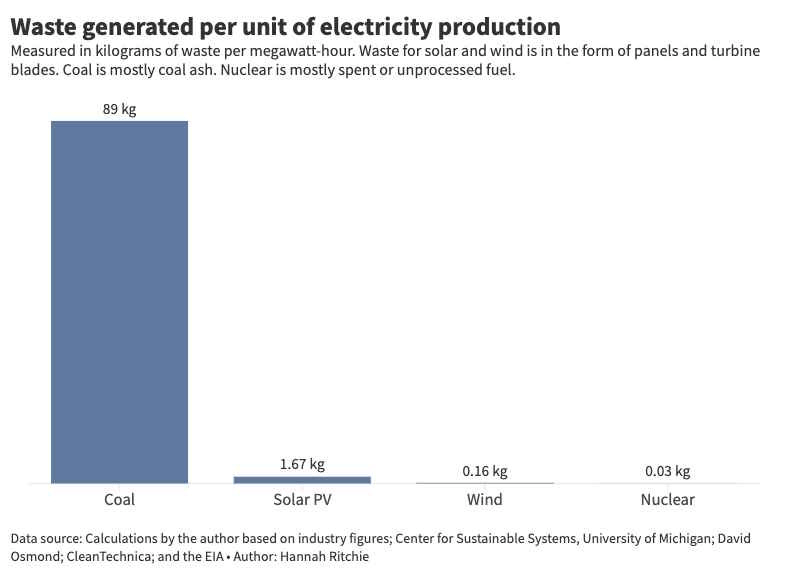
(3) This summary on climate change was both simple and insightful.
The change in climate got a lot more severe in 2023.

This is expensive – the US saw a record number of $1B+ disasters.

Fossil fuel emissions have more or less been constant since 2015.

With most of the Coal power coming from China

China is also a massive contributor to the renewable boom as the leading producer of batteries. Renewable energy trajectory is exponential.

Residential adoption continues to grow all over the world along with growth in electric vehicles.

And all of this is increasingly enabled by solar – which is efficient and cheap.

And just awesome.
(4) My favorite post from the last quarter is titled “Toward a shallower future.” The post is an answer to a question I find myself asking from time to time – how should I think about how much adversity my kids have in their life? They have it so much easier than I did – is that okay?
I know I’m not alone in asking this question.
His grandfather, a bombardier in World War 2, once said to him – “I did that [stuff] so you wouldn’t have to.” Or in the words of John Adams – “I must study politics and war, that our sons may have liberty to study mathematics and philosophy. Our sons ought to study mathematics and philosophy, geography, natural history and naval architecture, navigation, commerce and agriculture in order to give their children a right to study painting, poetry, music, architecture, statuary, tapestry and porcelain.”
Then he goes onto make this point
“And they must at least try to understand that in a more general sense, happiness isn’t truly shallow — it just has a different kind of depth. The passions of people raised in a kinder, gentler world may be alien and incomprehensible to the older generation, but they are no less intense, and the culture around them is no less complex. Adversity forces us to rise to its challenge, but abundance allows us to discover who we might become, and that is a different sort of adventure.
Looking back on my own life so far, I remember the happy child I was, before clinical depression changed me. Depression is horrible, but it added a richness and depth to the person I am today, and I appreciate the value of those changes. But if that happy child had gotten a chance to grow up without depression, I think he would have been changed in different ways, and under the tutelage of gentler teachers, would have become no less worthwhile and interesting of a person.
So it must be with humanity. The modern world of push-button marvels has lost something, but it has gained more than it has lost. By celebrating it, we honor the countless millennia of heroes who worked in some small way to bring it about, even as we dedicate ourselves to continuing their great enterprise. Our legacy is to fill the Universe with children who laugh more than we were allowed to.“
It was a perspective changer. Thanks Noah.
Smart work, hard work
The thing that’s often forgotten about “smart work” is that it generally takes “hard work” to get smarter about what to do.
Quality time, quantity time
The thing that’s often forgotten about “quality time” is that it generally takes “quantity time” to get to the quality.
Learning imprint
I met a wise friend I’d learned a lot from after a decade. It was wonderful to be able to recount a few of the things I’d learnt that have stayed with me a decade later. The biggest lesson of them all was – “Don’t confuse good outcomes with good decisions.” I think about that idea regularly.
It got me thinking about just how special that is. The imprint we leave on people when they learn something of value because of what we do or say is a special one. It can provide perspective that changes many lives.
The path to that isn’t to go around looking to teach. That just makes us annoying.
It is, instead, to simply be a person of value. Like most meaningful things in this life, others learning from interactions with us is just a byproduct of that good product.
Overalls and work
“Opportunity is missed by most people because it is dressed in overalls and looks like work.”
I remember reading this first as a teenager. I think I thought little of it.
The more time passes, the more I appreciate its wisdom.
Hitched to everything else
There was a powerful insight in David Attenborough’s “Life on our Planet” series where he shared the challenges facing coral reefs.
The biggest challenge, by far, is the warming climate. When waters become too warm, reefs whiten and die. Coral reefs both contribute disproportionately to marine diversity and have been dying at accelerated rates due to warming waters.
The next, however, is shark overfishing. Sharks are the apex predator in the coral reef ecosystem. They eat the mid-size fish who, in turn, eat the “grazers” that keep the reef healthy. When the shark population falls, the mid-size fish eat too many of the grazers – throwing the entire ecosystem off balance.
This is a recurring theme in nature. Entire ecosystems can be thrown off balance when you hurt one part. It reminds me of John Muir’s insightful note – “When we try to pick out anything by itself, we find it hitched to everything else in the Universe.”
That idea applies to so many things in this life. We are all – all living beings included – connected in more ways than we realize.
Sideways x priorities
We only learn about how important our priorities are to us on days when everything goes sideways.
It is on those days that priorities become so.

