Learning and digging gold

An inefficient gold digger needs many good mines to extract a good harvest of gold. An effective gold digger, on the other hand, needs only one.

Learning is similar. You don’t need to have 20 years of experience to have sufficient learning. You can extract 20 years worth of learning from 1 year if you set your mind to it. Growing old is not an option but growing up by making the most of the experiences life throws at you definitely is.

So, while “am I learning” is an interesting question to ask in a situation, it isn’t terribly useful. Yes, you are learning something most of the time. But, asking yourself “am I extracting maximum learning out of this?” changes the game.

Just one trait about effective gold diggers – they don’t stop when they get one mine right. They keep working and widen that gulf. Learning is not different. Ask those who take time regularly to read, for example, and they’ll remind you that there is no difference between the ones who don’t read and the ones who can’t. Learning, like any other skill, needs work – perfecting it requires constant deliberate practice.

Understanding management debt

Ben Horowitz, the former CEO of Opsware and now-successful venture capitalist, has a great post on management debt. He offers a slightly deeper explanation in his excellent book – The Hard Thing About Hard Things.

I have been thinking about management debt over the past few months but didn’t have a term for it. I am now able to put the word into context and would like to share some of my lessons.

Management debt is when a leader or manager (I will stick to “leader” for simplicity) takes a call that works better for the short term than for the long term. Any such decision is equivalent to the leader taking a loan for a short term pleasure and will require the leader to pay it back with interest. The rates of interest on certain kinds of management debt are really high. In his blog post, Ben details 3 situations where he’s seen management debt –

1. Putting two in a box – Trying to keep two talented folks in his company during a reorganization by making them co-heads.
2. Over compensating a key employee when she has a better job offer because she is key to a current project.
3. No performance management or feedback process – leading to surprises when things don’t work well.

I haven’t managed a billion dollar company and, while I am sure my experiences don’t compare to those of Ben Horowitz, I have found myself guilty of using management debt multiple times without realizing it on multiple projects. And my lessons are as follows.

I. Define culture early – it is hard to change. Culture is set by a set of principles that defines your approach to work. This needs to be defined really early or things get really messed up down the line. One such example is a project I’ve lead for nearly 3 years – when we started, we took a scrappy approach towards getting things done. I figured that the focus ought to be to just get results and we’d find time later to define how we’d like to do it better. So, we took nearly a year to define our values, ways of working, etc., and just kept the habit going. And, you know what? 1.5 years later, we still haven’t gotten past our scrappiness. Heck, we don’t even know what our values are.

The extent of the damage is evident because another member this team and I are also part of 3 other project teams and we behave differently in those. Culture is powerful and is hard to change once it is set. I am still not clear how to solve the problem with the culture issues in this project – clearly, I’m still paying the interest on my management debt.

2. Create a 6 month feedback process. I’ve worked on projects where there was an attempt at weekly performance management and then run projects with no performance management. I find that a 6 month feedback process is reasonable and important. 1-3 month feedback can work okay on short engagements but feedback systems shorter than that become carrot-and-stick systems in my view and don’t give people enough time to get comfortable. If you think this is hard to do in a busy day job, I can assure this is harder when you are working on a project(s) in addition to your day job on weekends with limited time. That said, it is important. Else, you are just taking on more debt. And, I have learnt that the interest on this one is costly.

3. Create a list of management principles. As I’ve been thinking about 1 and 2, I’ve realized that what I am missing is a list of management principles. I have an implicit list but it’s clearly not been enough to provide clarity. These management principles will help you stay true to your goals and will ensure you are firm and insistent on the right things. Once you have these principles defined, don’t compromise.

I am going to explore this topic in greater depth over the next few months. More to follow on setting culture, designing feedback processes, developing management principles, and the like.

Email and constructive communication

I was once part of a heated email chain a couple of years back. As with most heated email chains, this began with a misunderstanding which was only amplified with time. I was the junior-most member of the team and was more the by-stander who was being called on from time to time to produce one number or another.

At one point, our senior-most team member sent an email to a couple of us on one side of the argument that read something like this – STOP REPLYING TO THE EMAIL CHAIN. WE WILL TAKE THIS OFFLINE AND SORT THIS OUT.

He immediately set up some time with each of us, listened to us, focused on the next steps and  methodically worked his way through the issues. And sort it out we did.

Emails are good for a whole lot of things – sharing status updates, ensuring information is shared, asking questions and engaging in discussions, and setting up real life conversations. They are, however, not good for any communication that isn’t constructive and almost always make things worse. Deprived of context and facial expressions, we always assume the worst.

The learning for me was simple – the moment you sense an email thread going negative, take it offline. And, as my wise colleague would say, STOP.

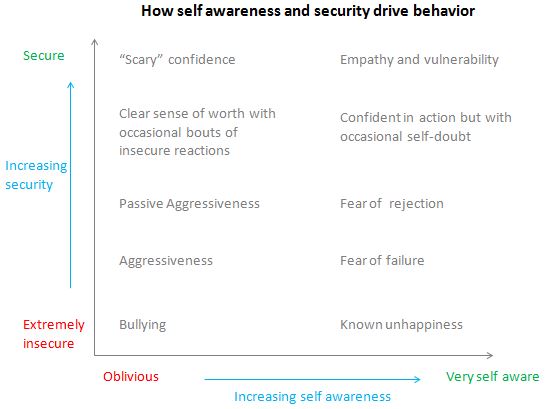
How self awareness and security drive behavior

Below is a 2 x 2 that describes how self awareness and security drive behavior. This isn’t a well researched graph. Instead, it is one that I’ve put together from observing myself and other people.

Before we dive in, I’d like to quickly describe the axes –

X Axis: Self awareness – Oblivious stands for an inability to be self aware.
Y Axis: Security – Secure doesn’t mean the person has no insecurities. Secure just means that, on average, the person is a lot more driven by security than insecurity. Every one of us have our insecurities but some choose not to be driven by them. Another possibility here is that, sometimes, environment plays a role in increasing the insecurity level.

Self awareness and security 2x2

I can’t say I am happy with every data point I’ve described on the graph. I recognize the ones I have experienced well. I have also not marked many interesting points in the middle which is probably where we spend most of our time. However, I think this should work for all practical purposes. Over to the takeaways –

1. Aggressive behavior always arises from insecurity. Vulnerability can only rise from confidence. The causes of these two behaviors are often swapped. Vulnerability, the ability to ask for for help, the ability to be kind, etc., can only come from a place of worthiness.

2. I find it very helpful to think of my behavior within a particular situation on this chart and understand what drives it. For example, I was on a call yesterday when I started out behaving aggressive. The call was a first-of-a-kind discussion in my experience with 10 people via Google Hangout on a topic that would have really benefited from a face-to-face meeting. I had no idea if we’d even be able to facilitate such a discussion via a video call with it’s lags and disconnection. 5 minutes into the call, once I began to realize that there was no need to worry and that I should really calm down, I began to settle. Soon, I was back to normal behavior.

3. My idea of normal behavior has changed a lot over the years. From my limited experience, it is easier to move right before you move upwards. We can all work harder on our self awareness by setting aside more time for reflection and taking stock. It begins there. Insecurities are a harder beast to tackle. They are often so deep rooted that it takes a fair bit of self awareness to even realize that is the case.

4. I’ve deliberately stayed away from the concept of “ego.” I’ve observed large egos when you feel insecure and manageable egos among the more secure folk. That said, I am always left with the feeling that there’s more to that word. So, I’ll come back to it when I feel I’ve understood it enough – maybe 4 years from now. :)

This graph is a culmination of observations over the last 4 years or so and is the first time I’ve been able to put these thoughts and ideas into a frame. These ideas have had a lot of influence in making me a happier and more secure person. And, if there is anything I have learnt, it is that we can all benefit from self reflection. Positive change almost always begins there.

Fun Saturday: Best 20 chick flicks

When my wife and I got together, I didn’t like or watch chick flicks. But, then, since our taste in movies were two non intersecting circles, we both had to make a few compromises. One of them from my end was watching romantic comedies or “chick flicks.”

I am not a regular movie watcher but I think it’s fair to say that I’ve seen my fair share of chick flicks over the past 8 years. And, for all the reluctant boyfriends and husbands, I am happy to share that there are quite a few nice ones out there. When I mentioned this as a bunch of us gathered a couple of weekends a go, one of the group raised his eyebrows in disbelief and sent us a request for a favorites list the next day.

I thought I’d share that list. This is pretty much sorted in the order of priority that my wife and I agreed on. We may have missed a few but hoepfully this is a good starter list –

1. We Bought a Zoo: Matt Damon, Scarlett Johansson with kids and animals. Hard to go wrong but they actually did it pretty well.
2. Penelope: Great great movie. Must watch as it has a lovely message. And, as a bonus, it also has Peter Dinklage.
3. Sweet Home Alabama: Classic chick flick. We like it loads.
4. The Switch: We’re big fans of Jason Bateman.
5. The Proposal: Another classic.
6. Raising Helen: Nice move with a nice message.
7. No Reservations: See above and also has Catherine Zeta Jones
8. Notting hill: The chick flick of chick flicks
9. The Wedding Date: I can’t remember/this was my wife’s pick.
10. Definitely, Maybe: I liked this one.
11. Love happens: Nice message with Jennifer Aniston and Aaron Eckhart.
12. The Wedding Planner: I can’t remember/this was my wife’s pick.
13. How to lose a guy in 10 days: Classic
14. Pride and prejudice: The Keira Knightley version. I thought it was done well.
15. What to expect when you’re expecting: Funny in parts and touching in parts
16. Maid of honor: I can’t remember/this was my wife’s pick.
17. Couple’s retreat: REALLY lame but will inspire you to go to Bora Bora
18. The Change Up: Very lame but with some hilarious moments
19. Forgetting Sarah Marshall: Nice movie
20. The Notebook: This is a sob fest.

PS: If you guys have good recommendations, I’d love to hear them too!

Making the world better

Atrocities happen every day of the week on this planet. This was one of those that had me swearing out loud. A man felt it went against his family’s honor for his pregnant daughter to marry someone against his wishes but felt it was perfectly okay to murder her with his son and a few goons.

There is a lot wrong with the world. There is no doubt about that. There is a lot right too that goes unmentioned. It feels, as a result, that we have two principal duties to help make the world better. Focus on the right in our lives and do more of it. This is the only way to keep our spirits up without getting bogged down by everything that is wrong with the world.

At the same time, we must work hard on changing what is wrong. A lot of what is wrong with our attitude towards other races and women can be made much better. It starts within. We have to pledge to be open to differences ourselves and hopefully change the culture of our families and friends to reflect that. Change occurs in ripples. It begins with changing ourselves or, at the very least, teaching ourselves to think. There is a real dearth of people who can do that. Atrocities like the one above are typically committed by men (yes, it is always men) who are unthinkingly following some norm or order.

The world will never be perfect but it can become better, much better. In making ourselves better, we make it a bit better and I think that’s as worthwhile a cause as any.

Building Help2Grow.org – a series

When a few close friends and I met on a saturday evening last year, our discussion centred for a long time on the best way to give to those less privileged than us. We had all tried multiple methods – volunteering our time, giving to charities, and a fair bit of micro-lending. And, we were still discontented. I think it was because we felt we could do it better but didn’t know how. We were all intent to do this back in India as we had all grown up seeing the challenges the underprivileged face and we wanted to do our bit to make it better.

That conversation in early September last year was when Help2Grow.org was really founded in my opinion. Conversations can be truly momentous in retrospect.

A few weeks later, another friend shared some of the charitable volunteer work he did on a Whatsapp group that we all are part of and we jumped at the opportunity to further the discussion. “Why not start our own charity?” – we thought. And we did.

We had 2 challenges in the pre-formal-founding days that we never expected. The first was picking a name. We put all the pressure on our volunteer friend and shoved what must have been close to 200 possibilities  at him – again, over Whatsapp – technology really is amazing. After being stuck in the “we need a name” phase for a week, a couple of us decided we just had to hammer it down. So, the final name was picked and we were ready. Learning – many teams tell wonderful stories of how they spoke of a name and how it just “clicked.” We didn’t have any such luck. We were mentally and emotionally tired of the naming process and decided it was time to pick and focus our energies on making a difference. And, guess what, we love our name!

The next challenge involved getting the India wing of the team together for the formal registration. We wanted 3 team members to sign the trust deed and, somehow, one thing or the other seemed to come up in the last minute leading to a postponement. Initially, there were whispers of this being the universe’s way of telling us what the “right” time would be (or fate). After a month of dithering, we decided it was probably not fate but the resistance. So, we promptly got it done. Learning: Yes, there are times in life when, no matter what we do, life seems intent on executing other plans. However, that is not always the case. It is also up to us to keep pushing to test the limits.

We then navigated our way through the registration and began working towards our first meeting. We had 14 people interested, had registered a charitable trust, created a bank account, and were all set to go.

But, where?

That’s the story I’d like to share with you. It’s a story that is still being written and, most importantly, it’s a story that might not work. This isn’t a series about how to build a successful charitable trust – this is a series about our attempts at building a charitable trust that will last a 100 years. I’d like to take you through our process, failures, occasional successes and learning through the process. One of our core values is to “be transparent about why we do what we do” – so I’d also like to share our intent, dreams, and plans. Help2Grow.org is about giving to the community and there are many ways to give. We’re hopeful sharing these learnings will help too.


This blog post has also been posted on the Help2Grow.org blog.

Every market/client has problems and every market/client is special

There is a nice consulting truism that serves as a reminder from time to time – every market/client has problems and every market/client is special and, most importantly, no one really understands this (especially not those people sitting in headquarters).

I’ve seen this across clients and across country organizations within the same client. Every country organization says exactly the same thing when starting out on a discussion around change.

What they are really saying is – Take time to listen to and understand us. If we don’t feel listened to, we’re not going to listen to you.

They’re right in part. The listening helps us in understanding the nuances that will enable us to ask the right questions. The basic principles will still work (they are basic principles for a reason) – we just have to customize them to suit the needs of our clients.

But, first, you have to listen to be heard.

Staying in pretentious-stan

Social media has created a new country – Pretentious-stan. Here’s a prospectus –


Rent: Our rents are high – we require large amounts of your time and an unwavering attitude that is focused on serving our cause. Most of your thinking time should be devoted to making the stay of our other residents comfortable. This is not all about you, after all.

Note: Unholy ideas like opportunity cost are not to be considered

The ideal resident. Our ideal residents have 3 endearing qualities to our residents –
1. A constant need for approval
2. A willingness to share normally uninteresting details and/or gossip
3. A willingness to, well, be pretentious. This requires a bit of elaboration – we require our residents to invest in things that fall into our “Like-able list” – all moments they feel awesome and amazing, photographs of a coffee mugs and tea-cups at all stages from all angles (actually, most kinds of photographs), “check in” from every place that might draw likes – new countries, business class lounges at airports, and, in general, we love those who share pictures of themselves sharing into great landscapes.

(Fun fact: Unlike the Foursquare check in which was invented to create a directory that would create an online version of the yellow pages, we are proud to share that the Facebook check in was created purely for Pretentious-stan residents. That it has expanded to mainstream use is a sign of our the validity of our mission.)

Are you worried that you may not fit in? Don’t worry – even if you have none of these qualities but have a desire to fit in, we’ll make it work. We use state-of-the-art tools (Facebook and Instagram being on top of the list) to make sure you feel at home right from day one.

Word of caution:
1. We consider sharing things in our “un-like list” equivalent to treason – interesting ideas, stories about your failures (boo), things that moved you, long and well thought out prose. We share similar ethos with successful public speakers and just focus on making it entertaining. Real content is frowned upon and you can rest assured that NO pretentious-stan member will like or encourage such content by sharing it.

2. We also dislike the use of social media to, well, be social – e.g. stay in touch, create meet ups in real life, etc. We allow for occasional indiscretion but, on the whole, we prefer you spend time on your phones even when interacting with your family and friends. Thank you for your understanding.

We are sure you will like it here.

The ones who are most in need of love..

are often the ones who are hardest to love.

The same is true for most things we tend to long for (for good or for bad) – happiness, money, jobs, recognition, power, success. It always feels like the ones who have a lot of something are the ones who get more of it and vice versa.

I’ve learnt that it’s best to observe those to whom something comes easy and understand what they do or don’t do. For instance, since my interests lie in happiness and success in the form of making a positive difference on this world, two of my observations from people who seem to have it figured out are –

– Happy people have this unending ability to keep perspective, laugh at a situation and say – “C’mon, it could be much worse.”
– People who make a difference don’t do it with one large decisive action overnight. The big actions we see are the sum of a lifetime of consistent small actions.

There’s a lot to learn.

PS: I’ve also learnt that, sadly, there’s not much we can do for someone who refuses to learn these things. We’re better off surrounding ourselves with folks who are happy rather than attempt to turn around an unhappy person. We only go where want to go – others can help but only so much.