Shifting in progress

I wrote about ongoing difficulties with my hosting provider last week. After a few months of considering a switch in providers, I let my frustration guide action and signed up for an account with InMotionHosting. Funnily, while InMotionHosting was recommended to me by a trusted friend, I also received a serendipitous note from one of you recommending them. I’m looking forward to how this all unfolds.

I plan to get to the shifting tomorrow morning. So, please expect a few issues in the coming few days – I hope to get most of the key stuff sorted tomorrow. But, if you have any difficulties getting the email/feeds, you’ll know I’ve likely messed something up. :)

2 small lessons from this experience –

1. I’ve received 5 emails from my soon-to-be previous hosting provider in the last 24 hours alone requesting feedback on last week’s exchange.

Hosting feedback
I
 didn’t get to my product review post this week but this is as good a lesson as any – DON’T do this. It should have been abundantly clear that I was frustrated from my 30+ email exchange. This might just be an automated process but there’s really no excuse for this barrage.

2. Always consult a smart friend before and when you make decisions that matter. It is amazing how much good advice there is around you and how much trouble good advice can avoid. As a general rule, when you make important decisions, seek help from a smart friend or two.

2 characteristics of systems that work in the long run

1. Built-in flexibility. Sometimes, once you plunge into a project, you realize that the original plans don’t work. And, every once in a while, even if the original plans work, they need to be de-prioritized. Openness to change is critical. To take a personal example, a rigid exercise regime that offers no break will fail.

2. Predictable tracking. Predictable tracking is how we ensure if we are taking executing as per plan and, if we are, if our actions are still contributing to progress. No tracking -> no accountability -> no progress. And, going back to the exercise example, whether you make progress or not, check in with yourself every week. What gets measured gets done.

Redirecting focus

I find myself in a near constant battle with my mind to keep it focused on things I control. Granted, I’m probably more attention deficit than the average person. But, my mind’s desire to seek out and dwell on situations, relationships and possible future scenarios over which I have no control and which always take me down an unhappy path never ceases to amaze me.

I have only found one way to solve this – constantly work to redirect focus to myself.

Self centeredness is a dirty word in our time. I understand that. I’m in search for a new term – maybe “self focus” – to describe my workaround. The idea is simple – the more time I spend on thinking about stuff outside myself, the more helpless, discontent and unhappy I become. I see my role as that of a driver steering my mind towards thinking about what my priorities are, what I need to get done and how I can do them better.

My mind control program simply reads – when in doubt, redirect focus to self and spend time visualizing and thinking about things you control. Our actions, then, follow these thoughts.

And, that’s where the good stuff lies.

Or, at least, that’s been my limited experience.

Path-sharers

How many of your kindergarten classmates are currently your colleagues? What about secondary school or high school classmates?

If you are in your 30s, the chances are that the answer is 0.

We are wired to compete. Our schools exacerbate this instinct. The truth, however, is that we’ve got this completely wrong. Just because someone is on the same path as us doesn’t mean they’re heading to the same destination. And, just because someone is further along the path doesn’t mean they’re at the same point in their journey.

We’re always going to have people like us – fellow executives, fellow entrepreneurs, and so on. It is tempting to compare notes – salaries, funding rounds, education, grades, and so on. It is, however, useless.

We’re all on journeys to unknown destinations. Every once a while, we have others join us on that path for a little while. Instead of competing with them, trying to push them out of the path or looking at them with envy, what we must really do is be happy for their presence and continue working on making progress on our path. The more we focus on them, the more we detract from asking the important questions – “am I on the right path in the first place?”, “am I doing the best I can?”

There’s a secret that all incredible companies share – they don’t make decisions based on their competition. They keep doing things that build off their strengths and they always end up doing better than the rest. It is the same idea at play in our lives. We are on our own unique journey. Let’s celebrate and help the occasional “path-sharer” – they make the journey meaningful and fulfilling.

Growing pains

After 5 years or so of not going 24 hours without a post, I missed one yesterday. And, that’s thanks to my blog being down for over a day. I tried to work with my hosting providers to fix it and not call a dear friend of mine who has helped solve most of my problems over the past years. I figured it is time my hosting providers earned their fees. What followed was a bad 24 hour experience during which about 40 emails were exchanged with nothing done.

It all started with a member of this community emailing with a note about some spam links he spotted on a google search. There were links that basically looked like Alearningaday.com/free-cheap-software. My hosting support recommended I removed plugins I don’t use. I did. The site went down. The prognosis was that this was my fault and that it would require them to retrieve files. The retrieval would apparently cost me $60. Since $60 is as much as it would cost for a year of hosting, I was shocked. But, I needed the job done.

24 hours later and 40 emails later, nothing was done. This experience was a perfect illustration of a couple of concepts at work –

1. I’ve been experiencing growing pains on ALearningaDay. Over the past couple of years, the blog has moved from a very very small blog to a very small blog. In the process of losing the “very,” we’ve moved to just over 250-300 regular daily unique visits, ~1000 readers on RSS and just over a 1000 email subscribers. While this is miniscule by most standards, the site became interesting enough for hackers and bots to try and redirect traffic. WordPress also has some known vulnerabilities here and I’d switched over to WordPress a year or so ago. So, after a few trysts with a persistent Russian hacker who tried redirecting all mobile traffic on Android to his/her auction site, I’ve seen an ever increasing number of spammy trackback links . And, despite a clean up by my hosting providers when this happened, it is evident that the clean up job wasn’t very thorough.

Ever since my first growing pain issues, it has become apparent to me that I need to find a hosting provider that is better equipped to deal with this. A big part of the issue is likely that my hosting provider just didn’t have the capability to handle these sorts of problems. While these are good problems to have, they are problems nevertheless. Growth comes with growing pains and this was a good reminder.

2. The second lesson here is that it is vital we keep upgrading our infrastructure. What got us here won’t get us there. I started with my current hosting provider 8 years ago and had a decent experience. However, they got expensive over time, got bought over by another company and changed policies left, right and center. A change has felt overdue. However, being human, I’ve been resisting that change. That’s never a good idea.

And, here’s the amazing part – I finally called my friend and asked for help. He solved the problem in 5 minutes. He explained that he faced the same issue a couple of times on another website and had his web hosts solve it.

I’m a big believer in focusing energy on customers that matter. It is very likely that, post restructuring, I’ve been identified as a customer at my web host that is more trouble than value. Either way, the service experience was disappointing. And, my letting it go unsolved for a day was a statement to myself – time to take my business elsewhere and make those much needed upgrades to my infrastructure.

Here’s to making the shift and here’s to no more downtime.

Predictors of performance

As part of my ongoing experiments with my favorite guinea pig (i.e. myself), I was curious about understanding what factors were the best predictors of my performance in a given day. Now, performance isn’t easy to measure. So, I decided to just check for my mood at the end of the day – the general assumption was that, the better my performance during the day, the better the mood at the end of the day. It isn’t perfect but I thought it was a good enough proxy.

The results of this fairly unscientific experiment to test predictors of performance over the past 6 weeks or so were as follows –

1. Sleep. This didn’t surprise me one bit. But, it became very clear to me that lack of sleep was the single biggest day de-railer. Get 7.5 or 8 hours of sleep and I can literally feel energy through the day. Anything less and the effects begin to show. And, once it gets to the 6 hours territory, I just begin to feel slow.

2. Morning routine. This was a pleasant surprise. I found a huge difference when I got through my morning routine without stress- this includes meditating, blogging, clearing personal email, catching up on feeds/news, freshening up and having breakfast. If I have that 1.5 hours or so in the morning, the day goes much better.

(As you might expect, sleep has a big effect on the morning routine because sleeping late means waking up late and that, in turn, means less time for the morning routine. So, sleep’s top position is well deserved.)

3. A feeling of fitness. I target 6 exercise points in the week. 2 of these points can be 10,000 fitbit steps. 1 point otherwise is either 6 exercises in the gym or 0.5km in the pool (both take ~20 mins). If I feel I’m target for the 6 for the week, I feel great. If not, I feel sluggish. Interestingly, I observed that it is the “feeling” of fitness that matters more than fitness itself. The games our minds play..

I think I have generally been well fed in the past weeks and I didn’t try starving myself to see what the effects of food are. :-) I expect they are substantial too. I still think these 3 would be up top.

As I write this, it strikes me that all of this sounds so basic. That said, I also know that I’ve worked hard for the best part of the last 5 years to just get these basic things in place. And, they’ve played a big role in improving my overall level of happiness.

Common sense, as they say, is not so common. And, as I’ve learnt, getting the basic things consistently right is definitely no simple thing. Either that, or I’m a very slow learner.. and we can’t rule that out as yet. :-)

I am right and you are the prick

Relationships generally break down because of issues at both ends. Especially in the case of bad break ups (and I’m referring to both professional and personal beak ups), the problems are, almost always, both ways.

In such a situation, the best response is to just acknowledge that it didn’t work and walk away.

The worst thing you can do is to adopt the adopt the – “I am right and you are the prick” – worldview. Sure, this can feel justified. After all, the other person just didn’t do things “right.” But, right and wrong are often matters of perception. And, the biggest reasons break ups happen is because the perceptions and beliefs around right and wrong don’t align.

If you find yourself adopting that worldview, stop. From personal experience, it is a worldview born out of ego and it never ends well. And, if you find yourself on the receiving end of someone who adopts that view, walk away immediately. From personal experience again (of being the prick this time), it isn’t fun being repeatedly made to feel like the insensitive prick. There is nothing to be gained there except unpleasantness.

Such break ups are a great reminder of the importance of associating with people who you can work with / live with as we seek to build our teams, companies, and lives. There are many many ways in which this can go wrong. And, what makes human nature amazing is that when it does go right, we often take those precious people for granted.

Don’t.

Take care of and be present with the people that matter. In the final analysis, there are few other things that will actually count.

(As you all might have figured by now, these notes don’t come from a place of – “I am the enlightened master. Let me share my wisdom with you.” They come from a need to remind myself of what I’m learning and what actually matters as I’m generally guilty of making all these mistakes on a daily basis. So, I am always glad to hear from you when these notes resonate. Thank you for joining me on the journey!)

Goals vs. systems and its implications on management

In his book – How to Fail at Almost Everything And Still Win Big – Dilbert creator Scott Adams asserts that ‘goals are for losers while systems are for winners.‘ In his words –

Losing ten pounds is a goal (that most people can’t maintain), whereas learning to eat right is a system that substitutes knowledge for willpower.

The difference between the two, in his mind, is that goals are one-and-done things while systems are enduring and don’t focus on the short term.  So, stay away from goals and focus on systems is his advice.

I thought I’d deconstruct this today and analyze the goals and systems idea in further detail.

First, from a self management perspective, I think Scott is spot on. I think of goals vs. systems as a focus on results vs. a focus on process. Focusing on results means spending large portions of time outside our circle of influence as we don’t generally control outcomes. Additionally, it also means walking down the “judger” path. A focus on process is not just better because it is a happier path (it is that, too). It is better because our circle of influence grows in direct proportion to the amount of time we spend within it.

However, the difficulty with extreme points of view is that there are always exceptions (I think Scott took the extreme point of view just to make a point). And, there is an important exception to the systems/process path. Every once in a while, we need to check if our processes are leading to the outcomes/goals we have in mind. The inherent assumptions with systems is that we design systems that work. So, if we take – I will lose 10 pounds (goal) vs. I will lead an active life (system), it is vital that we check in every once a while to make sure our system is leading to the desired outcome of feeling healthier. In that sense, we need both goals and systems. And, consistent with Scott’s point of view, I think it is better we focus on systems.

When we apply the goals vs. systems idea to management, however, the implications are interesting. When it comes to dealing with others, I think that managing via systems is a bad idea. Managers who try to control their employees’ processes become annoying micro-managers. This is because the nature of systems is that they are personal. What works for the manager will likely not work for his colleague. And, that’s okay. As long as she’s getting her work done in a way that is consistent with the values and culture of the firm, the manager shouldn’t meddle.

So, in this case, it is vital that we, as managers and leaders, focus our energies on setting clear goals for those we manage/lead. And, just like in the self-management case, it is worth checking in with their systems/processes from time to time just to ensure they’re not doing something completely wrong. Trust, but verify.

So, if I had to abstract from all this analysis and arrive at the principle, it would be this – don’t think goals OR systems. Think goals AND systems and tailor based on context. When it comes to managing ourselves, it is best to focus on processes/systems instead of goals/results. And, when it comes to managing others, hold them to outcomes instead of processes. In both cases, don’t abandon the other. Check in with your goals from time-to-time to make sure your processes are taking you where you want to go and vice versa.

As a wise friend once told me when I was grappling with a “this or that” question -“Whenever I am faced with such a dilemma, I ask myself [very deeply] what it would take to replace OR with AND.”

There’s always something

I was preparing for an important meeting and a collection of things seemed to be falling off the rails. And, I found myself wondering what my output might have been if all the conditions had been perfect.

That’s when I thought about some of the other important presentations I’ve had to do in the past – and, you know what, there was always… something. Just looking at the last 3-4 months – I was sick with a bad throat during my final exams in my spring quarter and rushing to travel back home in my finals in the winter quarter (all student examples – sorry :-)).

There’s always something. We can dream about striking that perfect balance all we want. But, for the most part, we spend all our time in the “balancing.” The only trustworthy indicator of our performance level is our performance on a bad day.

So, if you get that opportunity to perform on your best day with perfect conditions, revel in it. It doesn’t happen often. But, when it does, it is magical.

On the other hand, if you feel most things are going wrong as you enter that important presentation, welcome to life. This is how we get made.

3 happiness principles – a synthesis of 50+ books

A wiser friend asked me an intriguing question – based on everything you’ve read, what are some tips you’d suggest for someone to lead a happier life?

I asked him for some time as I wanted to make sure I gave it thought. Any psychology hobbyist understands that you don’t throw around happiness tips lightly. I then asked myself 1 question – if I had to synthesize everything I’ve learnt about happiness from my readings (60+ relevant books) and experiments over these years, what are 3 principles that I would share? I was keen about 3 principles because I don’t think our mind retains more than 3 principles. Additionally, I was keen on principles over tips because tips are akin to specific advice. I prefer frameworks that we can all apply to our individual context.

So, here goes –

1. Optimize your energy over everything else. It is energy we must care about and not time. Spend your time on things and people that give you good energy. The same applies to resources – spend your money either on experiences or in areas where you spend a lot of your time. Great experiences, e.g.  a legendary trek up Kilimanjaro, give us positive energy that last us a long while. Similarly, if you spend a lot of time on your desk, investing in a standing desk might provide a ton of energy on a daily basis.

A key part of this principles is focusing on “your” energy, i.e., taking care of yourself before you attempt to take care of the world. If you’re burning yourself out in your attempts to do good, your energy is not going to last long. Once our own needs are met, most of us naturally begin to focus our energies on giving back.

This principle has far reaching implications – for example, it is impossible to keep good energy if you don’t work in an environment that suits your personality. You can’t hang out with people who just take energy from you and give little back. You can’t work with co-workers who you don’t learn from. All your decisions soon become decisions that either give you better energy or don’t. The only way to do this well in the long run is to treat yourself as a research subject and keep tabs on what it takes for you to have good energy. The better your energy, the happier you’ll be.

There are very few blanket rules that apply to everyone. However, there are a couple of things that generally work – sleeping enough, eating well, exercising regularly and counting your blessings are as close as you get to blanket “good energy” rules. But, to each their own.

2. Use your willpower to build good habits like exercising, reading, keeping a journal/meditating, and building meaningful relationships with people you care about. If you fight yourself every time you try to do something that you think is good for you, it is a losing cause. The best use of willpower is to use it to build habits. Habits are the infrastructure of your life experience. There’s a reason every developing economy focuses heavily on infrastructure. The better the infrastructure, the more good stuff can thrive. If you’re consistently having power outages (e.g. sickness), for example, you can’t do much with your life.

So, the question then becomes, what infrastructure should you build? A more involved, and, in my opinion, better way to build this infrastructure is to really ask yourself that tough question – how will you measure your life? If you are a person who’ll measure yourself by the number of people you’ll mentor, then part of your infrastructure needs to be include creating consistent space for mentorship. If you aren’t sure of where to start, exercise, reading and meditation are a great place to start.

Once you’ve identified this, there are plenty of great resources on how to hack your brain to do this. There are no generic principles, though – if you feel it is helpful, I’m happy to suggest ideas that’ll help make it easier to break the resistance on these habits. But, before anyone dives into brain hacking, I’d suggest getting really clear on why you want to do something. A lack of clarity is a recipe for internal resistance.

Finally, the best resulting outcome of this is the sort of discipline that inspires integrity. Integrity is simply making and keeping commitments. As we use our willpower to build good habits, it brings with it a tremendous level of confidence in our own word. There are few better things in life than the ability to face ourselves in the mirror.

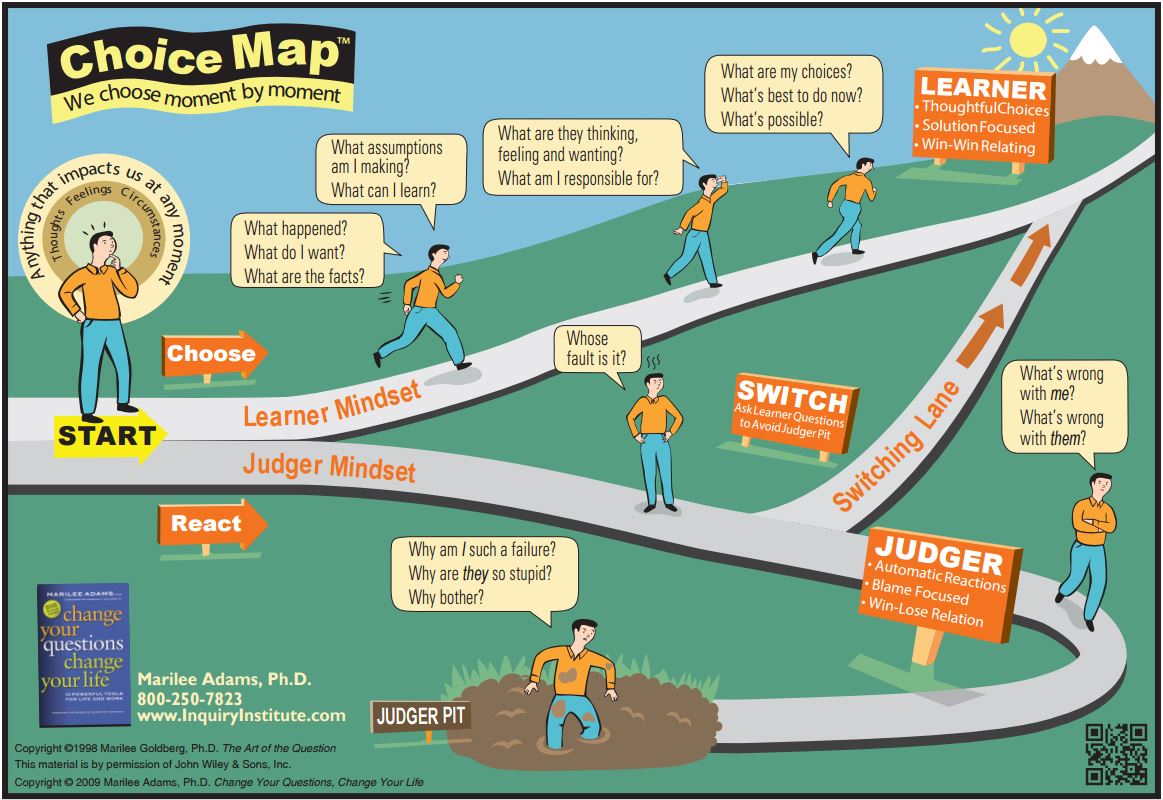
3. Choose learner questions over judger question. At every moment in our life, we ask ourselves questions. Every decision we make is a product of questions we ask ourselves. For example, we probably asked ourselves – what will make me look good today? And, the result of that is the clothes we wear. Over time, many of these questions become subconscious. And, without realizing it, we default to certain kinds of questions that may or may not have a net positive effect on our lives.

There are two kinds of questions – learning questions or judging questions. When you ask learning questions, you spend more time in learning mode and judging questions means time spent in judging mode. There are many psychology terms that illustrate the same idea – fixed vs. growth mindset, “be good” goals vs. “get better” goals. They all say the same thing. The best illustration I’ve seen is a concept called the choice map (thanks to Marilee Adams’ Inquiry Institute).

Choice Map

Here’s why it is incredibly powerful – people who ask learning questions focus on learning (duh) while those who spend time asking judging questions focus on performance. As a result, learning questions force us to focus on process vs. results. And, that, in turn, means we spend most of our time focusing on situations that are in our control. It also means we put in effort without attaching ourselves to the outcomes. Outcomes and results are the judger’s way of life. Interacting with the world with non-attachment is the one of the most tell tale signs of happiness. It enables us to give our heart, mind and soul into the projects we work on without worrying about short term pay offs. It is all about the long game. It is all about the process. In the long run, good results follow good processes.

So, that’s that – energy, habits and learning questions sum up the three principles that I’ve gleaned from all my readings and experiments.

If you’re wondering about common threads among the three (I was), the thread I spotted was that they require us to make our daily decisions based on consistent and constant self awareness. Self awareness drives the production of data that helps us make better decisions (that’s why meditation/journaling are key habits).

So, if there’s a ‘one last thing’ idea here, it is that all this data is useless if we don’t use it to make better decisions. The Latin root of decision translates into ‘to cut’ or ‘to kill’. So, learning to say no, and in the process, deciding what we effectively say ‘yes’ to may be the single most important skill that affects our happiness. The quality of our lives are directly proportional to the quality of our daily decisions.

And, as we live our days, so we live our lives.