The recruiting journey through self doubt – MBA Learnings

The MBA learnings series has two objectives. The first is to develop the discipline to synthesize and share some powerful concepts I’ve learnt while at school. With about four and a half months left at school, I’m hopeful that I’ll continue to do this after I graduate as well. The second has been de-mystify what the journey is really about. I have been surprised at the lack of really good resources on this topic and I hope to have a definitive list of 8-10 posts on the topic that will be helpful to prospective, admitted and current students after I graduate. I’ve listed the 5 posts written so far, below.

Today’s topic is one that aims to de-mystify an important part of the MBA experience – finding a job or, to use a one-word description, “recruiting.” My experiences – both as someone going through the journey myself as well as someone attempting to help others through the experience – have shown that recruiting is hard. It is probably the single hardest piece of the graduate school puzzle.

It is easy to laugh – this is almost as privileged a place to be when it comes to finding a job. Some of the best employers around the world make it a point to invest hours and days on campuses to talk to students about what life at their firm is like. All definitely true. But, I don’t think life gets any easier when you are Bill Gates. Sure, you take away worries around shelter, sustenance, and the like. But, the kind of challenges you face are in no way inferior to everyone else. In fact, it is my belief that challenges of the mind tend to be the hardest to talk about and deal with. As evidence, I have learnt that students from the law school and business schools at most universities are the biggest users of on-campus counseling services.

I think this part of the experience is particularly hard for three reasons. First, every person going through the process has a track record of success that got them into school. It feels natural to expect this to work well with relative ease (and, in a few cases, it does, too). Second, the fact that you’re going through it with so many classmates – some of whom do better than you by balance of probability – increases the pressure. And, finally, most of these folk have received really bad career advice in the past that has led them to believe that there is that one “dream company” out there for them.

In my case, I think the peer pressure involved with the experience definitely made me question my own competence and abilities more than once in those moments. I made a couple of unusual choices and those came back as questions – did you do the right thing? What if you had done things differently?, etc. It also took what seemed like ages for any progress to come through. It was tough and it definitely felt like a journey through self doubt. It all worked out though – as I believe it did for most folk who put in the work. That doesn’t mean it is easy. And, it definitely doesn’t mean it isn’t worth it.

Among the things that helped me in that period, I would pick 3 that were particularly helpful –

1. Focus on the feeling of walking away knowing you did your best. At every point, I just focused on getting to one thing – the feeling of walking away from the interview knowing I gave it my best shot. Since all my energy was focused on that one goal, it made my life a lot easier since I didn’t attach myself to any one outcome. This also took away any possible focus on a “dream job.” Sure, I felt extra pressure on a couple but, as I’d intentionally stayed away from focusing on the outcome, it felt easier. The principle here is to to focus on the process and trust that good processes lead to good outcomes in the long run.

2. Read Harry Potter. I’ve shared this story with many first years. I directed a lot of the pressure into reading Harry Potter. Now, of course, I don’t advocate you do that. But, I do think it is helpful to find something that completely distracts you – so, find your own Harry Potter. I remember my wife offering up my iPad anytime she felt I was feeling the pressure. Thanks JKR! In general, when I wasn’t in class, I made it a point to be home by myself. I preferred solitude to hearing the constant chatter about “the latest and greatest.” I was on a light course load during that quarter and had plenty of time to myself. I spent this time researching about companies, reading Harry Potter and sleeping – my antidote to the pressure.

3. A 2nd year support group. I had a small group of 2nd year friends who I stayed in close touch with during the process. I engaged a couple of them on helping me with most aspects of the interview and another couple who helped me exclusively with cases. I kept this group informed of everything that was going on and vented, on occasion, to them. While I knew I could count on them to never mince words if I was doing something wrong, they were also generous with their time, energy and support. All of this helped give me plenty of perspective and was incredibly helpful.

So, if you are a 1st year going through the process, keep plugging away. The one thing that is worth remembering is that this is one of many job switches in the coming years. Focus on the long term outcome and use the process to learn how to approach finding a job better. This is definitely hard.. but it also definitely helps to keep perspective. There are a a few billion people who’d love to be in your place.

And, if you’re a 2nd year, I hope you’ll remember to balance being direct with your feedback and generous with your hugs.


1. I’m in, Now what? – An attempt at helping you structure your transition to school once you are admitted.
2. Advice to an incoming student – A long “expectation setting” post that breaks life at school into a tension between 6 priorities
3. Designing for introversion – An introvert’s guide to thinking about the MBA experience
4. Lessons learnt from internship recruiting – Lessons + a guide to how to think about the summer before school
5. Digging into my 1st year process – A reflection on how I approached my 1st year and what I learnt

self doubt, recruiting, mba learningSource

To have a shot at change

To have a shot at retaining employees, you have to first accept they will leave.

To have a shot at making the sale, you have to accept that the customer may have no real need for your product.

To have a shot at exercising regularly, you have to first accept that it won’t happen unless you intentionally find place and energy for it in your schedule.

To have a shot at maintaining deep relationships, you have to be willing to let those you love go.

To have a shot at success in your project, you have to be willing to accept that it might not work.

To have a shot at becoming a better person, you have to first accept that your natural instincts will likely not lead there.

It feels easier to hold onto ideas that pre-suppose success and change – as if they were so easy. The keyword in that sentence is to “hold on.” Holding on always feels easier. Letting go is hard. But, to be able to lead change, we need to be able to accept change ourselves.

Again, the counter intuitive shows us the way – the first step in being able to change is accepting things as they really are and not as we want them to be.

change, accept reality

What are you taking a break from?

Is it a break from distractions to do work? Or a break from work to get distracted?

The former is what happens when we just go with the flow. The latter, on the other hand, requires us to be intentional.

A powerful saying by author Malcolm Muggeridge came to mind as I was thinking about this – “Never forget that only dead fish swim with the stream.”

Maybe living without intention is more existing than living.

distractions, intentions, living, existing


HT: Cal’s book on Deep Work. More will follow in the coming weeks on lessons from the book.

Breaking rhythms

Rhythms are defined as a strong, regular, repeated patterns of movement or sound. We regularly get into rhythms in our life – a morning routine, a way of easing our way into focus on a particular topic, among others. Good rhythms, like everything that is meaningful in this life, are hard to create and easy to break.

I wrote last Monday about how I’d broken my morning routine rhythm the previous week. Sure enough, it was disrupted all of last week as well. It is today when I felt myself get back to something that resembled my usual routine. You see this happen all the time in sports – teams who see a winning streak broken suddenly lose many games, teams that never let a goal in for many matches let many in, and strikers start scoring goals every game.. until they don’t and then struggle to get their scoring streak back.

Understanding rhythms requires us to understand Newton’s first law of motion.

An object will remain at rest or in uniform motion in a straight line unless acted upon by an external force.

Momentum of any kind, as a result, is hard to change. This beautiful principle has two important implications. First, we must consider designing our days in ways we can find momentum on various projects. If you’re planning to work on a project, set aside a 3 hour block to do so. It’ll give you time to dig deep.

Second, we must take a step back and consider the various routines and rhythms that we’d love to have in our ideal lives. Once we identify them, we must get to work on making them part of our lives – one at a time.

After all, As Newton wisely identified, things are not likely to change unless acted upon by an external force.

rhythms, routines, newton, motion, external force,

Opportunities – access and utilization

It is one thing having access to opportunities and it is quite another thing to utilize them.

The asymmetrical demand for opportunities that are very sought after means that the process to access them is often very different from the process to utilize them. The US presidential election is a great example – getting elected and doing well as a President require two different skill sets.

While this could easily be a post on whether selection processes are aligned to performance processes, I’d like to focus on our own psychology. Too often, we spend the bulk of our time focusing on access to opportunities. There is always a next opportunity to access and, left to our own devices, life can feel like a race to move from one opportunity to the next faster than our perceived competitors.

The alternative approach is to focus on utilizing the opportunity we have right now and on being worthy of utilizing the next one. Focusing on access inevitably involves figuring out ways to play the system well and, in many cases, market yourself better. There is no way to “game” your own worth, though. This stuff is hard earned and requires focus and grit.

Inevitably, I’ve found that utilizing your current opportunity typically opens doors to the next one. Just focus on being better.. and better things follow.

Or, thinking about it in a different context – relatively, there is more of a dearth of competence than there is of opportunities. And, scarcity is the real opportunity.

opportunities, access, utilization

Legacy questions

Some leaders work toward building a legacy where people in their organizations (or families), at some point in the future, would ask – “What would he/she have done?”

A few others, instead,  work toward building a legacy where people ask – “How would he/she have gone about making the decision?”

The first question naturally follows legendary leaders. However, there is an inherent problem with this question – leaders have their own signature style of execution. Asking “what would Steve Jobs do?” isn’t all that instructive because it is near impossible to give a Jobs-ian keynote. Steve’s style of delivery was Steve’s own. You should probably focus on building your own style.

Asking how Steve might have approached a keynote, on the other hand, would likely be very instructive. We would find that he spent hours rehearsing every detail. And, if he, as a master presenter needed do that, we probably would need to invest even more time and energy to deliver a flawless keynote. Asking “what” isn’t that helpful. Asking “how,” on the other hand, is.

And, that’s the challenge for us as leaders – it is always tempting to work toward leaving behind a team asking what we would have done. It is great for our egos and, while it will still leave behind a strong culture, it risks leaving behind people and organizations who will never grow to their fullest potential simply because they are too busy trying to be you.

Leaving behind a team that has a clear understanding of “how things are done here,” on the other hand, is leaving behind a culture that is built on ideas bigger than you. It isn’t easy to do. But, it is work worth doing.

legacy, questionsSource

Observing vs. Judging

One of the biggest changes in my attempts to change my own behavior in the past 2 years or so has been in the realm of observing vs. judging.

As an example, let me pick on a current trend – I haven’t been meditating in the last week and a half. I generally do so first thing in the morning but, due to a combination of a cold and a couple of disruptions, I’ve been waking up later than usual. In some ways, the core issue is disruption in the morning routine. The usual instinct would be to ask “judging” questions and attempt to use a firm hand – e.g. force myself to get back to routine tomorrow.

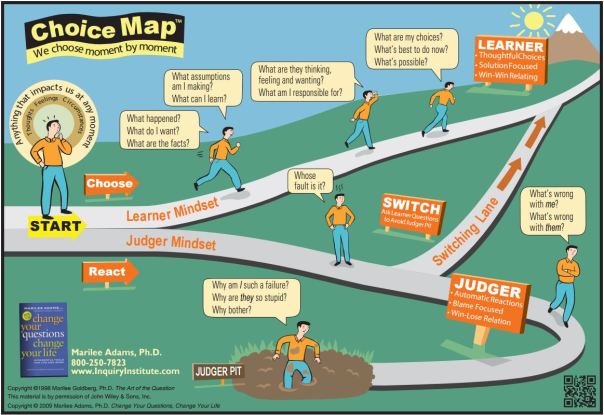
However, the approach I take instead is to just observe. In observing, I find myself asking learning questions, e.g, “why is this happening?”, “what are the consequences of this trend?” and even “how long will this continue?” I am my own guinea pig. :-) In addition to this, I also take note of a weekly count of meditation sessions during my week review time on Saturday.

Over time, I’ve built confidence in the fact that observing coupled with the act of measuring consistently tends to bring the changes I want to bring. And, this happens because I take off the pressure that judgment brings.

An example of this approach has been exercise – over 60 weeks that I have data for in the current system (I have some old data too elsewhere), my average exercise sessions in a week has gradually increased with time. It currently stands at 5.2 which means roughly 4 x 25 min sessions and 1.5 days of walking 10,000 steps at least. This is better than it was last year and the improvement has come from the same observe and measure process. Similarly, my average meditation count for 60 weeks is 1.7. However, if I take a 1 year look at this, we’re at 2.7 (3 is the target).

As with all meaningful life learnings, the guiding principles are consistent. In this case, it is playing the long game and focusing on learning questions versus judging questions.

observing, measuring, learning, judging

It is just the applications that are different.

Approaching mock interviews or presentations

Mock interviews or presentations are an opportunity to refine your own judgment of how to approach the real thing well. Too often, they’re viewed as a place to receive feedback you never thought of.

If you have a good mock interviewer or audience, the likelihood you will get good feedback is high. But, that isn’t the point as it is only useful in the short run.

The way to approach practice of any sort is to use your coach’s (in this case, your mock interviewer’s or audience’s) feedback to train your own judgment on when things are done well. This means that the onus is on you to look at your performance critically before the session and walk in with a hypothesis on what needs to get better. All these hypotheses then get tested and validated, or not.

Practice with a coach is both great and important. But, you’re going to need to develop the discipline to coach yourself over time. Besides, game time is an exercise in solitude and listening to your own gut.

It is best to be prepared for that.

mock interviews,presentationsSource

Clubs that don’t accept you

There are many who live by the Groucho Marx quote – “I don’t want to belong to any club that will accept me as a member.” The principle here is that you should always be “reaching” for something better.

This makes sense in some contexts but, like most popular quotes, is horrible advice in many contexts. The principle underlying the execution of the idea is constant comparison. “Is associating with them going to make me look better?” And, the issue with this is that we’re always trying to find the next thing. That, in turn, means we’ll never stop to appreciate what we have.

My counter point to the Groucho Marx quote would be – “Look around, become aware of all the clubs that have accepted you (when they didn’t really need to) and make your acceptance count.”

Life is better when we commit to what we have and stop comparing. Better clubs will open their door for us when we do things of value. I think it is just important to realize that them opening their doors doesn’t just make us better. At that point, it makes them better too.

And, more than ever, it is those who took a chance on you when you got started who deserve all the credit in the world.

clubs that don't accept youSource

Out on a limb

Facts about going out on a limb –

  • You have to wrestle fear and self-doubt before you can do so
  • The feeling of putting yourself out there when you ask for a favor you didn’t need to ask, ship a side project or make a connection you didn’t really need to make can be excruciatingly uncomfortable
  • It is far easier to be comfortable and do absolutely nothing
  • You have to embrace the possibility that it might not work (and for good reason – it doesn’t actually “work” as you intended most of the time)
  • Every once a while, you’ll hear some negative feedback that you will remember for a long time
  • Most of all, it feels unnatural

But, most good things in life come from embracing ideas that don’t feel natural. And, nearly all good things come from doing things that are difficult.

As the wise Scott Peck might say, perhaps all we need to do is to accept that it is difficult. For, once it is accepted, the fact that it is difficult no longer matters.

out on a limb,