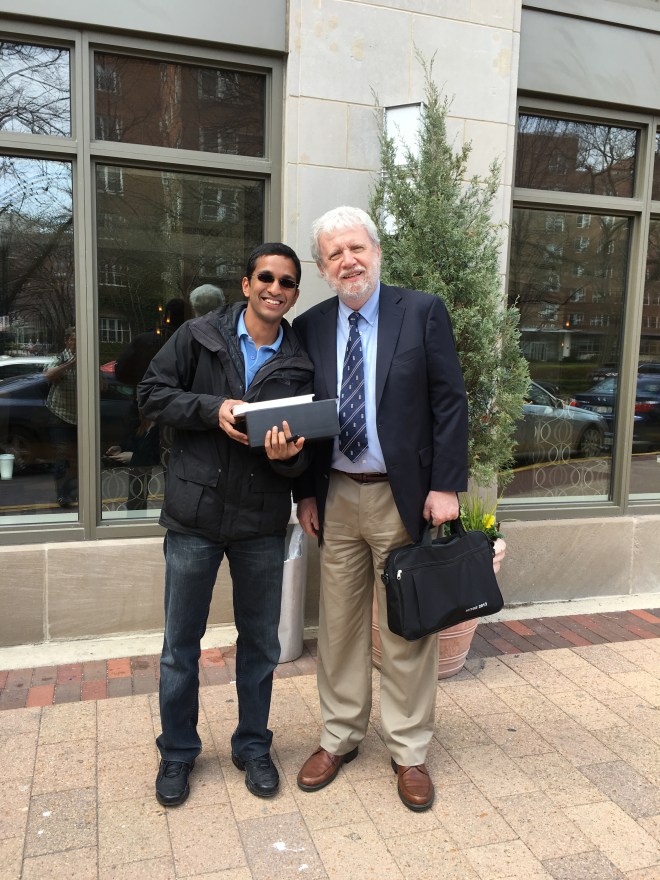
Bob Iger

I read Disney CEO Bob Iger’s autobiography – “The Ride of a Lifetime” recently.

The first and most important thing to say about the book is that it is fantastic. I read an Amazon review where the reviewer described the second half of the book as “business school gold” – I agree.

He is surprisingly candid and thoughtful in describing both his career prior to becoming Disney’s CEO as well as his exceptional ~15 year run as CEO. And, while I can talk about the many great anecdotes in the book, there were two things that stood out to me.

The first was how straightforward Iger was in describing his ambition to become the CEO of Disney (once ABC was acquired) and how stressful he found the selection process. There was no false humility about never having imagined himself as CEO at any point when there could have been. His natural candor and directness really came through.

The second was the patience he exhibited throughout his career. He was 54 when he became the CEO of Disney. And, even after a stellar career, he went through an excruciating process before he was chosen because he was seen as a stalwart of the Michael Eisner regime whose reputation had soured within the company and its board. However, he kept his patience and finally made it to that dream job. And, after doing so, he made his experience count.

Fascinating story and great book.

Thank you, Bob, for sharing your journey with us.

Milarepa and the demons

One day, the Tibetan teacher Milarepa left his cave to gather firewood. When he returned, he found that his cave had been taken over by demons. There were demons everywhere!

His first thought upon seeing them was, “I have got to get rid of them!” He lunges toward them, chasing after them, trying forcefully to get them out of his cave. But the demons are completely unfazed. In fact, the more he chases them, the more comfortable and settled-in they seem to be.

Realizing that his efforts to run them out have failed miserably, Milarepa opts for a new approach and decides to teach them the dharma. If chasing them out won’t work, then maybe hearing the teachings will change their minds and get them to go. So he takes his seat and begins teaching about existence and nonexistence, compassion and kindness, the nature of impermanence.

After a while he looks around and realizes all the demons are still there. They simply stare at him with their huge bulging eyes; not a single one is leaving.

At this point Milarepa lets out a deep breath of surrender, knowing now that these demons will not be manipulated into leaving and that maybe he has something to learn from them. He looks deeply into the eyes of each demon and bows, saying, “It looks like we’re going to be here together. I open myself to whatever you have to teach me.”

In that moment all the demons but one disappear. One huge and especially fierce demon, with flaring nostrils and dripping fangs, is still there.

So Milarepa lets go even further. Stepping over to the largest demon, he offers himself completely, holding nothing back. “Eat me if you wish.” He places his head in the demon’s mouth, and at that moment the largest demon bows low and dissolves into space.


When dealing with the toughest challenges – the kind that involves the demons inside of us – brute force turns out to be a blunt instrument. Acceptance, kindness, and a willingness to open our hearts and minds to the learning ahead of us enable us to make the progress we seek.

(H/T: Reboot by Jerry Colonna)

Daily fluctuations, weekly consistency

A time/priority management observation – the more I embrace and accept daily fluctuations and inconsistency, the more it enables weekly consistency.

Putting too much pressure on getting something done on any given day often doesn’t pan out. We often face unexpected roadblocks, random events that take up our time, and occasional bad luck. But, viewed over the course of a week, there’s plenty of time to recover, re-prioritize, and respond.

Managing our time and priorities is a portfolio game… and weeks are the atomic unit of the portfolio.

Ending legacy admissions at Hopkins

The Dean of Johns Hopkins shared why they ended Legacy Admissions on The Atlantic. While the whole piece is worth reading, here are a couple of powerful paragraphs


Legacy preferences—the admissions advantage given to family of alumni—are generally alien to Canadian (and, indeed, European) universities. And I never became reconciled to the prevalence of this form of hereditary privilege in American higher education, particularly given this country’s deeply ingrained commitment to the ideals of merit and equal opportunity.

In the intensely competitive process of admission to America’s selective universities, the advantage afforded legacy students is no small matter. One study that looked at admissions to elite colleges in 1997 estimated that legacy status afforded applicants an admissions boost equivalent to an added 160 points on the SAT. Another study, which looked at admissions to 30 highly selective institutions in 2007, concluded that legacy applicants were more than three times as likely to be admitted as their non-legacy peers. Because legacy students at these schools are more likely to be wealthy and white than non-legacy students, the very existence of legacy preferences limits access for high-achieving low- and middle-income students, and also for African American, Latino, and Native American students.

—Today, according to the economist Raj Chetty and his colleagues, a child without a college degree from a family in the lowest income quintile has only a 5 percent chance of moving to the highest quintile. But if that child graduates from one of America’s most selective universities, the odds of making that leap rise to 60 percent.

Screaming kids and reactions that never help

When you’re standing opposite a screaming kid (usually caused by some combination of pain, hunger, or tiredness), there are two reactions that never help –

1. Getting angry

2. Taking it personally

I think I’ve made some progress on being more even tempered in the past 3 years. But, as I realized recently, I’ve got ways to go with not taking it personally.

Of course, this isn’t limited to losing patience with a screaming kid. I have work to do with my impatience in general. And, as per usual, parenting has just revealed something I need to work on nevertheless.

The first step, regardless, is consistent awareness.

Working on it…

The answer is probably not on your phone

I experienced a moment of insecurity about a decision I’d made recently. And, I noticed that my instinctive response when I experienced that feeling was to check my phone.

Because that’s what the phone often does – it diffuses some tension with a short term endorphin hit.

At that moment, I heard a wiser part of myself say – “The answer is probably not on your phone.”

Indeed, it isn’t.

The answer tend to lie within us. And, when that isn’t true, it tends to lie with the people we love around us.

Appreciation and psychological safety

It is amazing how much more interesting and productive discussions within a team are when every contributing team member unambiguously feels appreciated.

There’s plenty of evidence that the presence of psychological safety signals a productive team dynamic. And, in my experience, the presence of ample amounts of appreciation in turn is a strong leading indicator of the presence of psychological safety.

Roy Disney and Bob Iger- Ego and Respect

Bob Iger, in his so far excellent book “The Ride of a Lifetime,” shares a story about he went about diffusing an ongoing public outcry from Roy Disney, nephew of Walt Disney, just after he was appointed CEO.

Roy Disney had been public in his unhappiness with former CEO Michael Eisner and eventually resigned from Disney’s Board in protest. And, he wasn’t happy with Bob Iger’s selection as the latter was COO during the last 5 years of Eisner’s rein.

After a conversation with Roy, Bob Iger shared that he realized there were a lot of pent up emotions behind Roy’s behavior. He felt he had been slighted and disrespected by Eisner and the rest of the board. And, most importantly, he was hurting at parting with the legendary company founded by his uncle.

So, Bob Iger went about making a few small changes – he gave Roy Disney the title of Chairman Emeritus and made arrangements for a small consulting fee and an office at Disney headquarters. Roy, for his part, agreed to call off the lawsuit.

The lesson Bob Iger shares is the recognition that most people just want a bit of respect. And, in difficult situations, it is so important to not let our ego get in the way of that happening.

It resonated.

Intermittent Fasting – week 2

I started intermittent fasting in earnest this new year. Tim Spector’s excellent book – The Diet Myth – reminded me of the reasons most cultures/religions recommend fasting.

After testing it over the holiday/reflection season, I’ve decided to experiment with
the 16/8 diet. This means eating between ~12pm-8pm and fasting for the remaining 16 hours. I haven’t been strict about the 16 hours – I have probably averaged between 15 and 16 hours.

So, why IF and why now?

I know a few friends and family members who swear by it. Nearly everyone I know has done it for weight loss. That wasn’t an interesting reason to me.

Instead, the health rationale for fasting, in general, and intermittent fasting made sense to me intuitively. The evidence for the health benefits have been stacking up over the years as well.

While I can’t attest to the health benefits just as yet, my experience over the past week and a half has been very positive. I knew not to expect any serious hunger pangs as I’d been testing it for most of December. However, the biggest positive has been getting an uninterrupted-by-breakfast stretch of deep work at the start of the day.

Looking forward to seeing how this plays out over the course of the year. For now, this change seems to be a keeper.

PS: I’ve mentioned The Diet Myth a bunch over the past months. It was recommended by James in response to a post on the challenges with diet research. Thanks for the recommendation, James – clearly high impact. :-)