
When we compare our lives with those of others we know, we see the things they have that we don’t.
In that process, we miss seeing what they see when they see us and do the same thing.
Everyone has their own unique struggles.
It is how we get made.
When we compare our lives with those of others we know, we see the things they have that we don’t.
In that process, we miss seeing what they see when they see us and do the same thing.
Everyone has their own unique struggles.
It is how we get made.
It is January 2003 and we’re at the Australian Open in Melbourne. Serena Williams is playing Kim Clijsters.
Kim Clijsters is the more established star of the two and takes control of the game in the third set by racing to a 5-1 lead.
Serena holds serve. 5-2.
Kim serves. She has her first matchpoint. Saved.
Then her second matchpoint (advantage following a deuce). At this point, you’re thinking that Serena is done. Kim is enroute to being world number 1 that year and is likely going to take it.
But, Serena saves again.
A few more exchanges later, Serena takes the set.
Kim is still 5-3 up though. You figure that she has another chance to serve and win 6-4.
But, she doesn’t. Instead, she makes two costly double faults that ensure Serena breaks.
And, before you know it, Serena has won the game 7-5.
There have been many great comeback in sports over the years. And, tennis certainly has seen many.
But, you always have a few that stick with you. I vividly recall watching that game in our living room back home blown away at the fight Serena Williams displayed that day.
The memory of that comeback still inspires me. It is a reminder of the fact that being good at something doesn’t mean things get easy.
It never gets easier. You just learn to fight better. And, Serena Williams has certainly done that in her storied career.
6 years ago, someone suggested I respond to a question on Quora – What should I do if I’m really struggling at work and feel incredibly down because of it? I changed jobs about a year ago and really haven’t been doing well in my new job. I just do not know what to do and feel hopeless.
And so I did – with a mini-essay of an answer. I also left my email address for any follow up questions folks may have.
What is fascinating is about this thread is that I still get the occasional email from someone who read this thread. After all these years! The internet is a fascinating place.
Some of the stories folks have shared over the years are very painful – they tell the story of challenging financial constraints, misfortune, abuse, and the like. The conversations that feel most productive go down a familiar path –
(1) The writer lays out the options – I respond with any options they might have missed.
(2) We discuss the trade-offs inherent in these options.
(3) Following this, I ask them what they’d do, ask them to believe in their judgment, and wish them all the best on their journey.
There tends to be an “aha” moment in most conversations when the person writing in realizes I don’t have a magical answer I can share that will solve their problems.
That sounds obvious – but, when we’re desperate, a lot of seemingly obvious truths aren’t so. I’ve been in that situation and can relate.
The best thing that can happen from these situation is internalizing a truth about the hardest situations in this life – there is no easy solution. There are only trade-offs. And, while others can help us surface options we’ve missed or provide more perspective on the trade-offs, no one can help us make the right call.
Only we have that data. And, the best thing we can do is believe in ourselves to make that call.
I do my best to communicate to folks in these exchanges that I believe in their ability to make the right call.
I hope they do too.
Community water fluoridation (CWF) adds a controlled amount of fluoride to the water supply to prevent cavities.
It is a preventative measure that costs roughly $1 per person in a community. The benefits, on the other hand, have been estimated at about 100x the investment.
The Center for Disease Control in the United States declared CWF to be among the ten greatest public health advances of the twentieth century. We may not need it much longer because of the addition of Fluoride now to toothpaste, formula, etc.
But, it seems to have worked well while it lasted.
Water fluoridation reminded me of the impact of the addition of Chlorine into the water supply.
Both are great examples of upstream measures that are both invisible to us and incredible in their contribution to our wellbeing.
A simple way to improve the performance on our mobile devices is to turn off background app refresh.
It occurred to me that this is very applicable to us as well.
Learning to move on from open threads, close out distractions, and focus on one thing at a time helps us improve (often step change) our performance.
It is just not as easy as turning off a toggle.
But, with practice, maybe it could be.
We’ve had a heat wave since Friday with temperatures in the ~40 degree Celsius/100+ degree Fahrenheit range.
As our home doesn’t have air conditioning, we spent most of Saturday huddled near our most effective pedestal fan.
While our attitude was reasonably positive given the circumstances, we certainly didn’t walk around with a feeling of gratitude.
Until this afternoon.
We thought we’d beat the afternoon heat by going to a Target (supermarket/store) nearby. But, we walked into a store without lights or, more importantly, air conditioning. We were told that the electricity was out all day thanks to a few bouts of lightning last night (I know, bizarre combination of experiences).
We soon realized that Target wasn’t alone in the experience – a collection of neighborhoods were out of electricity today.
That new bit of data changed our perspective immediately.
As we came home and huddled around our working fan, we were really grateful the fan worked.
New data -> Awareness -> Shift in perspective.
It is magical when it happens.
PS: I was initially thinking I’d skip my PSA about the climate crisis today – despite the highly relevant post. Then, I came across this excellent visualization of the temperatures in the past 12,000 years shared by Alexander Radtke.

And, see this annotated version for more color.
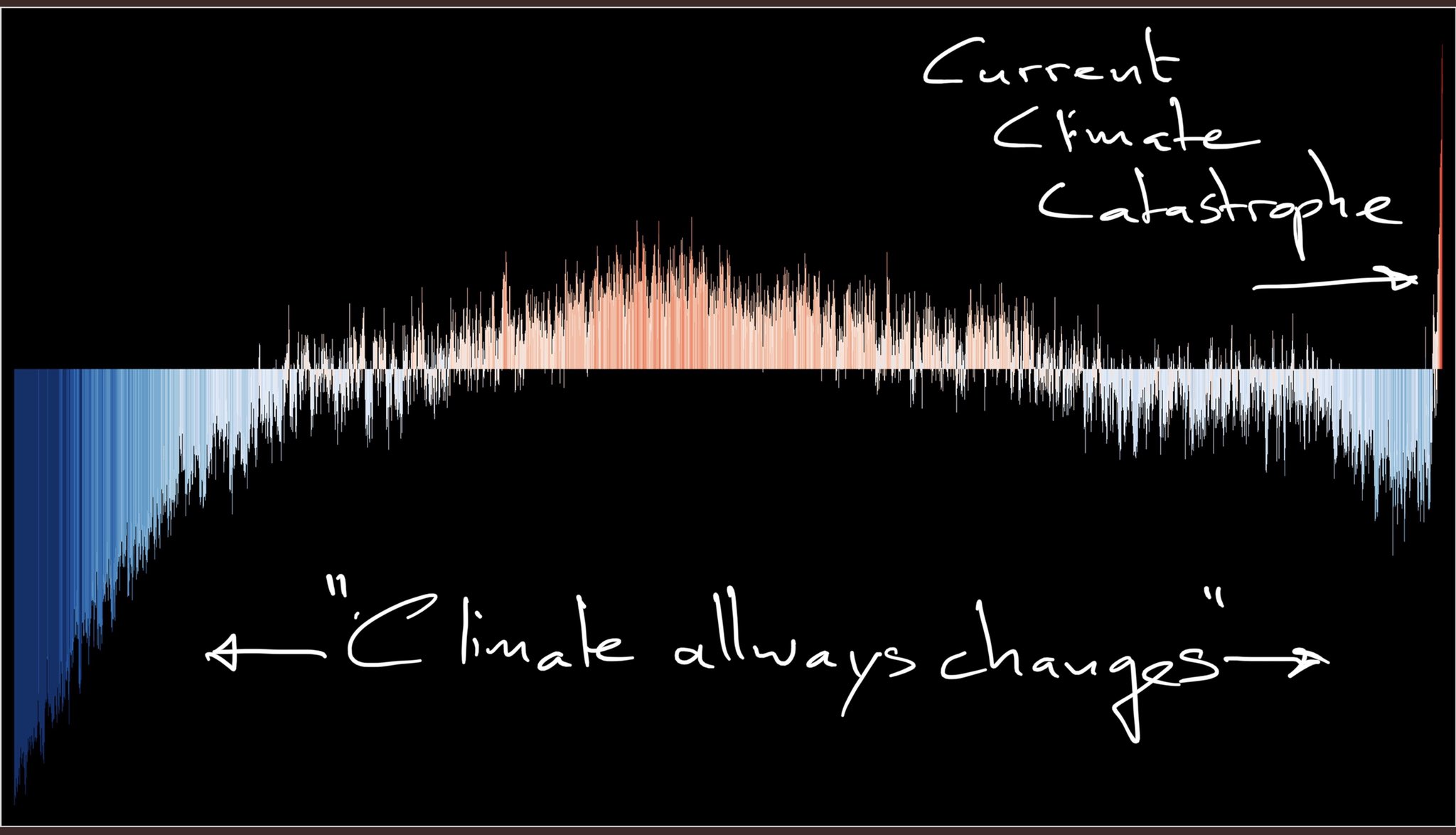
Climate has changed over time – the change, however, has been gradual. The kind of change we’re seeing in the past two hundred years is abnormal. There is no running away from physical realities. It will be on us to see what we can do to minimize the impact in the next two decades.
There’s a quote attributed to Baseball legend Joe DiMaggio – “There is always some kid who may be seeing me for the first or last time, I owe him my best.”
It is an idea that has since been used to describe the passion of many a great athlete to do their best every time they stepped out on to the field.
I’ve been thinking about it since watched the Michael Jordan documentary.
It isn’t an idea I have internalized yet.
But, the thought of doing so alone is very inspiring.
I spoke about and/or read out Brad’s post a few times this week.
It’s Monday. Again.
I have 30 Zoom meetings on my calendar this week (yes – I counted). It’s a light week for Zoom meetings since I have four board meetings this week, which each takes up a big block of time, limiting the total number of Zoom meetings for the week.
Did I say that it’s Monday?
My Whoop recovery score is yellow again. It’s yellow almost every day. I get plenty of sleep, but it’s still yellow. Sometimes it’s red. It’s rarely green these days.
On Sunday, I turned the pages of the New York Times with mild disgust. The only day I look at news is on Sunday, and then it’s only the New York Times in physical format. It now takes about ten minutes and I’m not sure why I’m doing it anymore.
Amy and I made a small change to our life algorithm this week. Instead of having the dishes pile up until one of us does them, we are alternating weeks. I’m on dish duty this week. We use the same plates over and over again.
I did my laundry again on Sunday. Every week I do my laundry on Sunday. I take my running clothes out of the sink in the mudroom bathroom and toss them in the washing machine. I grab my laundry basket from my closet and throw them in also. I set the machine for 1:06, pour in Tide Sport, and press Start. When it beeps, I put them in the dryer for 0:40 and press Start. When it beeps, I take them out, fold them, and put them in my closet. They are the same clothes every week.
I’m either running or swimming at least four days each week. Since my Whoop is always yellow, I keep thinking that taking a few days off will help. When I swim, it’s in the same pool back and forth and back and forth and back and forth. When I run, it’s in the same 0.94-mile loop – sometimes clockwise, sometimes counterclockwise. Over and over again.
It’s Monday. Again.
It struck a deep chord with me.
My guess is that it’ll do the same for you.
The more undesirable the behavior, the faster it becomes a habit. :-)
An upstream thinking question – how many times in the past month did we celebrate a systems solution to prevent problems?
How does this compare with the number of times we celebrated an urgent problem/”crisis” that was overcome?

