
Tony Hsieh and notes on happiness

Tony Hsieh, the co-founder of Zappos.com, passed away a few days ago.

Fittingly, there was a lot of appreciation for all he brought to the world. Hsieh built a very unique customer and people centric culture at Zappos before it was sold to Amazon. He shared his approach in his lovely book – “Delivering Happiness.” And, after the Zappos sale, he also spent a lot of his time and energy attempting to revitalize the Las Vegas downtown.

A few days later, it emerged that he had been on a self destructive loop in the past months with far too much alcohol and drugs. The Forbes article detailing this is a sobering read.

I was reminded of three things at once.

First, COVID-19 has made 2020 a particularly difficult year for our collective mental and emotional wellbeing. In Tony Hsieh’s case, these challenges severely exacerbated existing problems and ultimately proved fatal. But, for those of us who know of friends and family who’re having mental health issues, let’s encourage them to get help and be as supportive as possible.

Second, Tony Hsieh became a hero for many after he wrote “Delivering Happiness.” I loved that book and thought of him as an enlightened leader after reading that book. But, as he wisely noted in the book – “Things are neither as good or as bad as they seem.” So true.

Finally, I was reminded of Dave Winer’s excellent blog post – “Your human-size life.” Below is the post in full – it is one I think about from time to time. And, it is where my mind went after I read this final chapter of Tony Hsieh’s story.


In the early years of this blog I wrote a lot about the personal struggles of people who had attained financial independence only to find out that it revealed that money was not what was standing in the way of happiness. That’s contrary to the message of our society, which is this:

– Until you’re rich, you’re miserable.
– Once you’re rich, it’s all great!

I was fascinated with this topic, because a few years earlier, when the company I founded went public, I had achieved this independence, and found that I wasn’t happy. I felt like I had done all that had been asked of me, and I was promised happiness, and I had been cheated, and wanted to understand why.

Before I hit the mother lode, I was just another gold digger, struggling to make payroll, even though my company had offices on Easy Street (not a joke) in Mountain View. I was actually having as much fun as you could have, but didn’t know it at the time.

One evening, I was walking around the neighborhood of the office when I met a friend of a friend, let’s call him Joe (not his real name) and stopped to chat. I had heard that he was very rich, and asked why he lived in such a modest middle-class neighborhood when he could afford an estate in Los Altos Hills or Portola Valley. He said he preferred to live a modest life, to live within his ability to use his wealth, and just kept the money as a cushion in case something went bad, someone in his family got sick, or some other emergency. 

I thought then this was puzzling, I didn’t get it, but now, with the benefit of almost 30 years of hindsight, I realize he was totally right. One of the biggest mistakes rich people make is to try to live larger than a single human being can. A mathematical impossibility. You can buy a big house, but you can only sleep in one bedroom at a time. You can own twenty fantastic cars, airplanes and yachts, but you can only be in one at a time. You can own an NBA team and a MLB team, and you get to sit in the nicest seat in the house at games, but you still can only sit in one seat. In other words, your humanity doesn’t increase just because your wealth did. You don’t get bigger. 

And it’s even worse than it appears — the struggle to live more than one life will fail, and it will make you feel like a failure, just as you felt before you made the money! So being rich does not mean success if your goal is to achieve immortal super-human-ness.

You can see that horrific struggle in Peter Thiel’s actions and statements. He says he’s going to live forever, and so will today’s college grads. And I assume in the back of his mind he’s also going to solve the problem of just getting one body to use. He will persevere and find a way to sleep in his San Francisco mansion and his New York penthouse at the same time. But here’s the problem — even if he achieves these goals, and of course he won’t — he still won’t be happy. 

I can say this with some certainty because I’ve been down the road he’s on, and I got off. And I just watched. Watched as the super-rich of my generation got old and their arteries hardened. They got used to talking to servants, and having their asses kissed at all times, and never having to listen to anyone tell them they’re full of shit. I’m a few years older than Thiel, and if he had seen what I have seen, he wouldn’t be so happy about living forever. 

I think we all need a struggle, I think that’s where our creativity comes from. We need something that feels unattainable, but actually is not. But the struggle to rise above our humanity, that’s not going to happen for any of us. And the desire to have it robs your very human life of any value. 

Joe had it right. Live a gentle human-size life. Go for a walk in your middle-class neighborhood and run into a friend of a friend and share what you see, and influence their life for the better. That’s the kind of thing a human can do. And it is, imho, where happiness comes from. 
Worrying and failing

I spent some time worrying about something that didn’t happen recently.

I’ve written eight times about worry in the past three years. In these posts, I’ve covered the perils of worry in detail – e.g. it means suffering twice, is a triple whammy, etc. Over the course of the past decade, I’ve probably written about worry over twenty times – each time attempting to teach myself to deal with it better.

Thanks to these posts, I have gotten better at dealing with worry. No question about that.

But, I clearly haven’t learned. At least not learned in the sense of “to learn and not to do is not to learn.” My failure to lose focus for an hour or so anticipating that which never happened was a good reminder of this.

This wasn’t because I was only aware of it after the fact. I remember being aware of it as it happened.

But, instead of reminding myself of the choice, I took the easy path – distraction.

That’s the challenge with learning skills that matter. You take a few steps forward and think you’ve gotten past the difficult part.

That’s about when you find yourself taking a few steps back.

The important thing at this point is to not lose heart. It is normal to move back and forth for long periods of time. Progress isn’t linear. This is especially so with learning skills that matter.

The important thing is to use the experience as a reminder that there’s more work to do.

Then, keep plugging away.

Dr Jim Yong Kim on vaccines and 2021

Dr Jim Yong Kim was the former Head of The World Bank and lead of the HIV/AIDS division. He’s also among few folks on the planet who has helped guide nations through five previous pandemics.

Dan Roth, Editor of LinkedIn News, interviewed Dr Kim to get his perspective on the recent vaccine announcements and what lies ahead in 2021. Below are 4 things I took away:

(1) The 95% efficacy of the Pfizer and Moderna vaccines is very encouraging. And, to think they were created with brand new technology is amazing.

The only downsides are that both these vaccines need cold storage. While the Pfizer vaccine requires -70 degrees Celsius, the Moderna vaccine is better at -20 degree Celcius. So, the latter can survive in a refridgerator for a longer period of time. But, both of these will be challenging to transport and use in developing countries.

The Astrazeneca Oxford vaccine, on the other hand, needs just 2-8 degree Celsius for storage (i.e. refridgeration will do). That makes it likely to be used most widely.

(2) A 90% effective vaccine needs 70% or more of the population to have taken it for herd immunity. And, while it is fantastic that we reduced a decade long process to ten months in producing this vaccine, the downside is that there’s plenty we don’t know. For example, we have no idea how long the protection will last. We still have plenty to learn.

(3) In politics and pandemics, ground game is critical. So, Dr. Kim expects the likes of Australia, New Zealand, Singapore, South Korea, et al, to get back to normalcy quickly. He shared why he didn’t expect the US to be on the list.

“I think the military has been doing a good job in terms of the logistics of delivering the vaccine. And right now, it seems like the number of people who say they’re going to get the vaccine has been going up. Fifty percent said that they were going to get it a few months ago.

But people who are going to be suspicious of a vaccine, whether it’s from one group that still doesn’t think COVID is a big issue or another group — and this is communities of color, people living in much more difficult circumstances — that have their own set of suspicions.

And so the way you get past that is by having a really strong ground game, a public health system that’s doing testing and contact tracing and supported isolation. In other words, putting people in isolation and quarantine, but supporting them if they don’t have enough food, if they don’t have diapers for their children. This kind of system is necessary in every state for us to get the vaccine out. And unfortunately, we don’t have that in place in most of the United States.”

(4) So, when could we expect normalcy? He had a few notes on the response from the business community.

“They’re basically looking at what’s happening with viruses, with the vaccines and treatments and their assumption is that once we have a vaccine it’s over. But the scientist who has developed the Pfizer vaccine has been saying, ‘Look, we’re not going to get this to everybody for a long time. And the first signs of normal life in the hardest hit areas — including the United States — is going to be next winter.’ So at least another year. 

“You want to speed that up? The way to speed that up is to build public health systems that can put out outbreaks, that can deliver vaccines, that can help people stay safe.”


In short, we’ll end the COVID-19 year with reasons to be optimistic. But, for those of us in the US, it is likely we’ll only begin to see the end of this twelve months from now.

Where learning happens

Our learning shows up in our doing.

Put differently, how we do things is our learning in action. If we don’t do it, we haven’t learnt it.

And, while learning and doing have this important relationship, the doing is not where the learning happens. Instead, the learning happens in the spaces between our actions.

In those spaces, we reflect, think, synthesize, and resolve to make the small changes for the next time we take action.

Often, when we design learning experiences, we over-optimize on the doing or the more academic study that we sometimes call learning. Both are important. Theory is important. Practice is also important.

But, to learn effectively, it is equally important to design those spaces in between as part of the learning process.

That’s where the magic of learning happens.

Lemons from life

A friend shared the “when life gives you lemons, make lemonade” quote in a recent conversation.

The quote does a great job speaking to the importance of reframing challenges.

What it doesn’t do, however, is set the right expectations.

Life doesn’t give us those proverbial lemons occasionally.

If we’re seeking to do something meaningful with our time, we’ll get them all the time. The presence of lemons from life is just a sign that we’re headed in the right direction.

The obstacle is the way.

Help with a connection

I’m interrupting normal programming today with a request for help from readers in the US.

Is there any chance you might know someone who might know someone who works at the US Citizenship and Immigration Services (USCIS)?

I ask because we’d really appreciate the opportunity to speak to a human at USCIS about the current timelines for a visa extension for an H4/dependent visa holder. Our hearts sank when we realized the timelines had gone from 3.5-4.5 months when we applied in March this year to 21 months (the extension is for 36 months).

For the uninitiated, this means my wife (and our family in many ways) –
– cannot re-enter the country if she were to travel to visit our parents abroad in case of an emergency
– needs to be at the DMV every 8 weeks to get the next 8 week extension of her driving license
– cannot hold a job (despite the best efforts of a kind boss who tried extending her employment with 3 months of unpaid leave, endless uncertainty on your work authorization makes employment impossible)

We’re hoping to understand if there is any foreseeable end to this limbo state.

We’ve received training from the immigration system in dealing with uncertainty over the years. But, this 8+ month bout of uncertainty with everything else going on in the world has been… challenging.

I know it is probably a long shot. But, any help here would be much appreciated.

Thank you for reading this far.

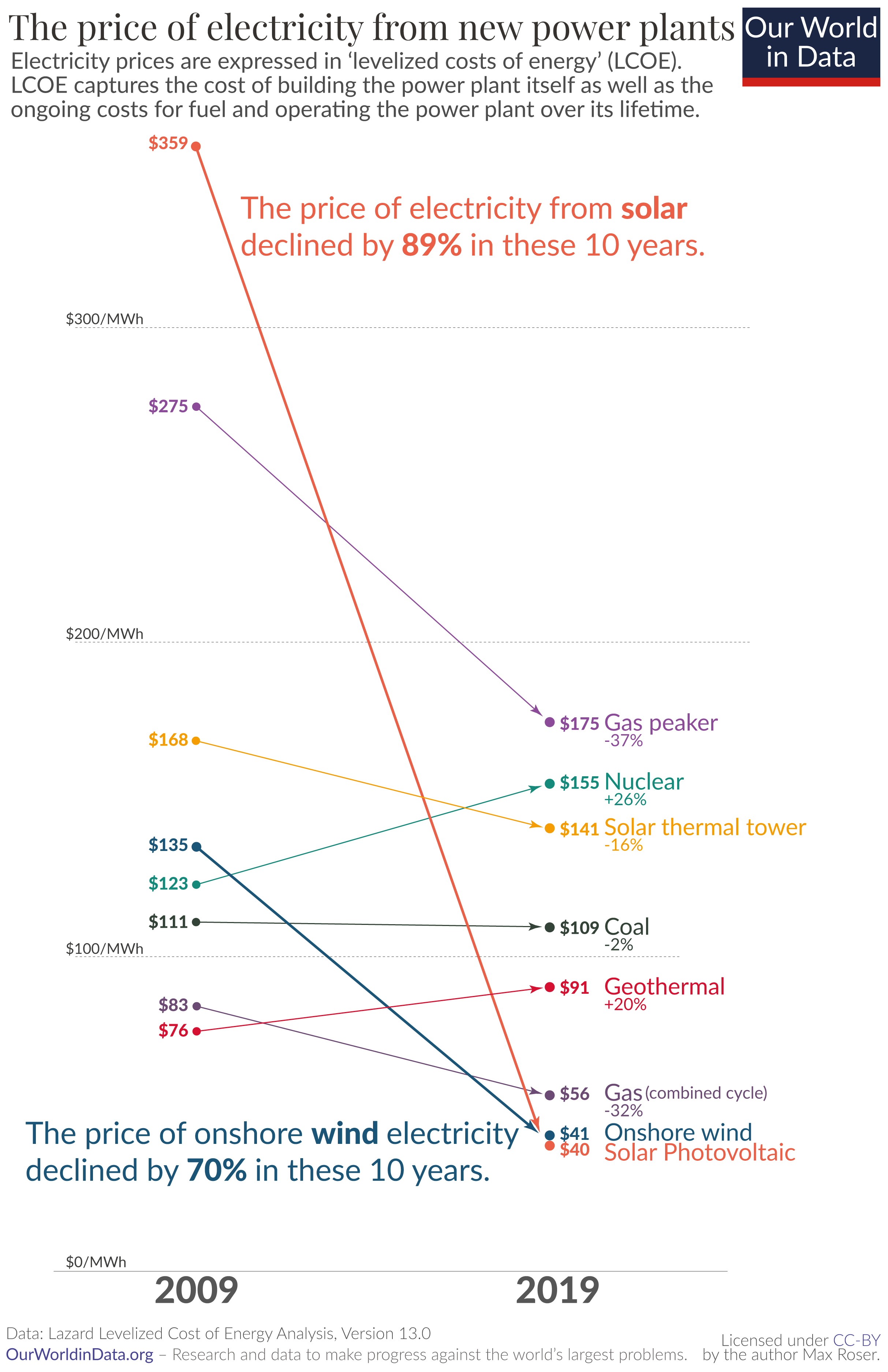
The price of electricity from new power plants – 2009 vs. 2019

Our World in Data had a great piece on the impact of “learning curves”/”experience curves” in the production of electricity from renewable sources.

Fossil fuel costs are driven by the cost of fuel and the operating costs of the plant. The key cost in a renewable plant on the other hand is the cost of the technology (e.g. the solar cell).

The moment we talk about the cost of technology, however, we get into the realm of learning curves. As installation and adoption of technology grows, we become more efficient. For an analogy, think of the impact of Moore’s law for semiconductors.

That, in turn, leads to a graph that looks like this. Solar has become the cheapest form of electricity and we aren’t done yet.

This graph doesn’t yet solve all our problems. In areas where the weather is volatile, we still have to factor in costs of storage. But, again, storage technology also follows the experience curve. So, even if storage is expensive now, things will look very different in a decade.

There’s a lot to love about renewable energy outside of the impact on its planet. Solar and Wind powered electricity are also the safest sources of energy by a distance.


Thanks to experience curves, adopting renewable energy around the world is well on its way to becoming the obvious choice.

And that’s fantastic.

Wearing blinders

There are understandable negative connotations to the term “wearing blinders.” The dictionary definition is – “to be able only to see things one way and unwilling or unable to consider other possibilities”

Being narrow minded and obstinate is not helpful or constructive as a general rule.

But, in the spirit of considering other possibilities, I have been mulling another definition of wearing blinders – “to ignore the world around us and focus only on the path ahead of us.”

Wearing blinders 2.0 – if you will.

I’ve found this way of thinking about wearing blinders particularly helpful in approaching social media. If you’re finding utility on your favorite social platform, that’s fantastic.

Just remember to wear blinders, compare yourself to no one, and focus on the path ahead.

Wishing us bad luck

“From time to time in the years to come, I hope you will be treated unfairly, so that you will come to know the value of justice. I hope that you will suffer betrayal because that will teach you the importance of loyalty. Sorry to say, but I hope you will be lonely from time to time so that you don’t take friends for granted.

I wish you bad luck, again, from time to time so that you will be conscious of the role of chance in life and understand that your success is not completely deserved and that the failure of others is not completely deserved either. And when you lose, as you will from time to time, I hope every now and then, your opponent will gloat over your failure. It is a way for you to understand the importance of sportsmanship.

I hope you’ll be ignored so you know the importance of listening to others, and I hope you will have just enough pain to learn compassion. Whether I wish these things or not, they’re going to happen. And whether you benefit from them or not will depend upon your ability to see the message in your misfortunes.”

| John Roberts, US Supreme Court Justice at a High school commencement address.


A wish that is unusual, important, and powerful – all at once.

Mind blown

I started reading Debt by David Graeber yesterday. I am still making my way through the second chapter and I am already mind blown.

In the first chapter, he made me questions my pre-conceived notions about debt. And, in the half of second chapter so far, he’s begun methodically taking apart the story we’ve been told about money evolving from the barter system.

After years of thinking about barter as the origin of money, I’ve begun to appreciate the flaws in this explanation brought to light by years of rigorous anthropological study.

Again, mind blown.

A decade ago, I remember reading a note about reading in a Robin Sharma book (ha – very meta) that resonated. The idea (paraphrased) was – “Somewhere out there is a book that will change your life. You just don’t know which. So, keep reading”

A decade later, the only quibble I have with this quote is that it grossly underestimates the impact great books can have on our lives.

Books have changed my life multiple times over the years. And they have done so at a frequency that has been unmatched by any other source of learning.