
“You are strong because you are imperfect. You are wise because you have doubts.” – Clementine Churchill
I thought this was beautifully articulated. A wonderful reminder that our scars, follies, and insecurities make us the human beings we are.
“You are strong because you are imperfect. You are wise because you have doubts.” – Clementine Churchill
I thought this was beautifully articulated. A wonderful reminder that our scars, follies, and insecurities make us the human beings we are.
I was jotting down my end of workday reflection recently. I had a niggling feeling that I’d gotten less than I hoped.
But, when I looked up at the “done” list, I found that the opposite was true.
I had started the day hoping to get 2 priority tasks done. But, halfway through the day, encouraged by my progress, I added 3 more items to the list. I only got through 1 of them.
There’s a lesson here about happiness being a function of reality AND expectations. This is definitely true when planning our priority list for a day. The more ambitious our list, the unhappier we will be.
The other lesson is about how quickly we adjust to wanting more. It takes discipline and self-awareness to stop ourselves when we hit enough.
In our priority lists and otherwise.
A common trend among leaders I’ve learned a lot from is their willingness to dig into the details. Different folks chose to engage in different kinds of details. But, they almost always cared deeply about some detail.
This means lots of curiosity, feedback, and micromanagement.
Micromanagement is simply the flip side of this desire to engage with the details. And, while some do a good job minimizing it, it never goes away. It’s part of the package.
Two lessons I’ve learnt about this –
(1) Be aware of the details your manager/leader care about. Expect to be micromanaged – but, as part of the process, expect to learn a lot.
(2) The degree of micromanagement is inversely proposal to their trust in your competence. Over time, the degree of micromanagement should go down. Else, it is time to reflect about how well you’re converting the feedback into learning.
I chuckled when I saw this image of exercise themed new year resolutions.
It illustrates how resolutions/themes are easy to set and difficult to follow through.
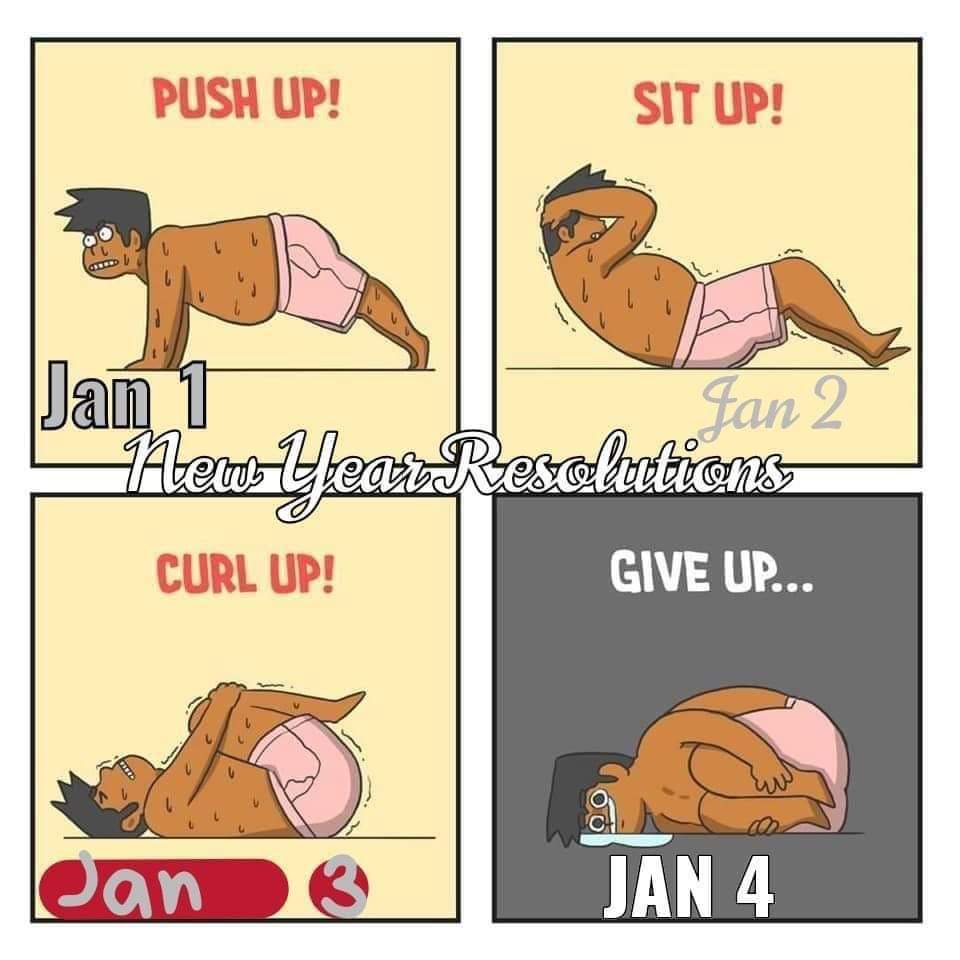
It hit home because wellness was one of my 2 themes this year. But, unlike past year, the theme I’ve chosen to focus on is building a reliable self-care system during the year.
Looking forward to seeing how the system building theme works. More to follow.
I was sharing some feedback on a teammate recently and was trying to articulate what made them special. I realized it was their ability to be both plainspoken and constructive.
It is wonderful when people around us are plainspoken. It means we are in an environment that fosters the care and authenticity required to be so.
But, when they combine being plainspoken with constructiveness, the ensuing collaboration and positive momentum is irresistible.
(H/T Deb Liu for a great post on being plainspoken)
We watched 14 Peaks* recently. There are 14 mountains with summits greater than 8,000 meters (“eight thousander). 14 Peaks follows Nepalese climber Nirmal “Nims” Purja and his team in their successful attempt to climb all eight thousanders in 7 months.
The previous record was 7 years.
Nims wanted this project to be a source of inspiration for all humankind – a triumph of skill, grit, and endurance. As everyone he spoke to said it was impossible, he called the initiative “Project Possible.”
He achieved all those aims. It was definitely a triumph of skill, grit, and endurance. But, it was a lot more than that. There were a couple of moments where the team went out of their way to help climbers in trouble – putting their own project and lives at risk.
There was, however, one moment that stood out to me. The setting was Mount K2 – the second tallest mountain in the world and one of the deadliest mountains in the world. The existing groups of climbers on K2’s base camp had been thwarted by the weather. They describe the mood in the camp as depressed.
Then Nims and the Project Possible team arrived. They got the team re-energized with a party that evening in the mountain. The next day, Nims laid out the plan and expressed his confidence in his team’s ability to scale the mountain. There were some inevitable naysayers. But, Nims was a picture of confidence and optimism.
The Project Possible team scaled K2 in the next 3 days. And, 20 other climbers followed in their footsteps.
Nims talked about the importance of optimism and confidence in leaders earlier. It was one of those moments which showed him walking the talk beautifully.
*Note: The film was nice – without being great. It would have benefited with more visual guides for the viewers to put these insane achievements in context. The feats in the movie were extraordinary and made it worth the watch.
A habit that I’ve made half-hearted attempts to change in the past two years is picking up the phone first thing in the morning and opening up/checking my (personal) email.
I describe my efforts as half-hearted because I wasn’t committed to it. I’d occasionally think about changing it. Then, I’d slip into familiar patterns the next morning and feel particularly good about getting out of bed with my inbox cleared.
Half-hearted commitments are exercises in self-sabotage because you don’t do much to change your environment to make change happen. So, you slip back to old ways and then make (reasonable sounding) excuses for yourself. Ergo self-sabotage.
Such exercises don’t seem to do much damage in the short run – seem being the operative word.
Every time we make a half-hearted commitment where we don’t follow through, we reduce our belief in our ability to commit. Our integrity gets compromised – one daily excuse at a time.
So, I spent some time thinking about this habit over the past 3 weeks. After wrestling with it for a bit, I’ve come to realize that what annoys me isn’t just the checking email first thing in the morning. It is the stunning lack of depth that the act of checking inspires.
And, after years of pruning sources of shallow engagement in my day, this might just be the final frontier (as is the case with bottlenecks, I’ll find out after I prune this).
So, I’ve finally made the commitment to changing my habit. This means getting to work fixing my environment. This is a mix of guidelines (move any checking/browsing onto a bigger screen) as well as changes – e.g., ensuring there are books everywhere I usually slip into checking/browsing on the phone, changing up my morning routine.
I expect it to be two steps forward and one step back for a while as I iterate.
Looking forward to seeing how it goes.
In the first part of the past decade, I used to pick 3 areas/themes I wanted to prioritize as part of my annual review. I had mixed success with them. Some years, they worked out great. In others, they didn’t at all.
The only common factor in my successful attempts that I identified was simplicity.
There were years when I had a hard time remembering my themes and sub-themes. A recipe for failure.
So, I’ve gradually simplified both my templates and my goals. I don’t expect to see more than 2 priority areas. If there are more than 2 and if they’re hard to remember, they’re unlikely to get done.
This drives home an important related idea. If I struggle to remember a list of goals I deem important, imagine how hard it is for our teams and organizations to remember lists of priorities.
Simplicity in prioritization and communication go a long way in helping us get things done.
I was thinking about an anecdote* from a book by late Vanguard founder John Bogle. This was an exchange Bogle witnessed at a party given by a billionaire on Shelter Island in New York.
The late novelist Kurt Vonnegut informed his pal, Joseph Heller, that their host, a hedge fund manager, had made more money in a single day than Heller had earned from his wildly popular novel Catch-22 over its whole history.
Heller responded – “Yes, but I have something he will never have…enough.”
This is an incredibly powerful quote in the context of money. The question that follows as we think about the new year is – what about other aspects of our life?
Are we seeking wealth of a different nature – an awesome financial investment? Or is it status? Social media followers? A promotion?
These questions bring us to 2 central questions –
(1) What game(s) are we playing?
(2) When will we have enough?
Best to define what winning is like before we start playing.
*I’ve shared it a few times on this blog – but not enough. :-)
The 10 question annual reflection is a longstanding ALearningaDay tradition. I recommend doing it in 3 steps:
i) Carve out an hour in the coming days to “look back and look forward.” It helps to do this in a quiet place with no distractions or interruptions.
ii) Work with a list of 10 questions that make you think. For a starter list, I’ve shared the 10 questions I asked myself below (also available to print as a doc or PDF by downloading from this folder).
iii) Archive your questions and notes for next year. Check in with them over the course of the year and read them before you start next year’s reflection. Looking at what was top-of-mind a few years later is also guaranteed to make you grin. :-)
“Sometimes, we need to just take a step back and look back at how the pieces fell. When we do that, we see what was important and what never was.”
(1) What are the top 2 themes/memories/moments I will remember 2021 for?
(2) What were the 2 biggest lessons I learnt in 2021?
(3) We learn from a mix of 3 sources – i) taking action and reflecting on our experiences, ii) people, and iii) books/synthesized information. What did my mix look like in 2021? How do I plan to keep this going in 2022?
i) Action + reflection:
ii) People:
iii) Books/synthesized info:
“Show me your schedule and I’ll show you your priorities.”
(4) Looking back at how I spent my time in 2021, what were the top 2-3 areas/buckets + processes/outcomes I prioritized (Examples: Career – prioritized ABC project or getting a raise, Health – prioritized more outdoor exercise or losing 10 pounds)? Did what I prioritize align with what I intended to prioritize/were there any surprises?
(5) What are the top 2 areas/buckets + processes/outcomes I intend to prioritize in 2022?
(6) What do I most need to learn in 2022 and how do I plan to do this?
“How we hope it works: Commit → Take action
How it actually works: Commit → Fail → Recommit x 20 → Fail x 20 → Recommit → Take action”
(7) What are habits/checkpoints I have in place to recommit to my priorities? (E.g. weekly/monthly check in)
(8) What have I got planned in 2022 to prioritize rest and renewal (e.g. holiday plans, weekend activities, hobbies)?
“If you have built castles in the air, your work need not be lost; that is where they should be. Now put the foundations under them.”
(9) Health, money, and relationships are foundational to the quality of our lives on this planet. What are my guiding principles or habits as I think of these dimensions in 2022?
Health:
Money:
Relationships:
(10) Do I have a personal philosophy, a set of principles or virtues that I want to live my life by? If not, would I consider putting together a first version?
And, if I do have them, what have I learnt about them in my attempts to live them? Do I plan to evolve them in 2022?
(Notes:
– “What I value” can be a way of stating our personal philosophy/principle.
– Virtues are values we actually embody. Inspired by the code of the Samurais, the difference is what we believe (values) vs. what we do (virtues).
– Our values become virtues when living them costs us money or something valuable that we need to trade-off)

