
The Code Breaker

I’m making my way through Walter Isaacson’s “The Code Breaker.” It is the story of Nobel Prize winning scientist Jennifer Doudna and her pioneering work in CRISPR gene editing.

I don’t yet have much in the way of lessons learnt from the book as much as gratitude for such an in-depth take into the research process of one of the greatest breakthroughs of all time. The iterative process of discovery, the collaboration between Doudna and Emmanuelle Charpentier and their respective research teams is a nice combination of fascinating, inspiring, and riveting.

The story illustrates the power of bringing together people with curiosity, single-minded determination, resilience, and a willingness to collaborate on thoughtful hypothesis driven experimentation.

It is a great reminder of an enduring idea – high quality teams, led by strong and capable leaders, can accomplish amazing things.
Not what they seem

When asked about government subsidies, billionaire Elon Musk said “Delete them all.”

Marc Andreessen made waves when he funded Adam Neumann – who previously magically converted over $20 Billion in investments to a company worth $4 Billion – $350M pre-product to fix the housing crisis.

For years, Dan Price – the CEO of Gravity payments – built a massive social media following around leaders doing the right thing.

That’s all on one hand.

On the other…

… Tesla and SpaceX would not exist today if it weren’t for government subsidies. Tesla alone is estimated to have received over 2 billion dollars in government support.

…the same Marc Andreessen said he’s “IMMENSELY AGAINST” the development of ~130 apartment units in his elite town because they’d “MASSIVELY decrease” home values.

…Dan Price is being investigated for rape and multiple counts of sexual assault.

While such inconsistencies are especially commonplace amongst those with extreme fame, wealth, and power, they are on display all around us.

Two implications for us:

(1) Remember that things aren’t what they seem.

(2) Don’t listen to what people say. Watch what they do.

Feedback – 1% and 99%

One of our executives said this about feedback – “All feedback is between 1% and 99% accurate.”

It is a line that has stuck with me in the past months as I process feedback I receive and help others process feedback they receive.

All feedback is 1% and 99% accurate. It is on us to listen, decide which parts are accurate, and then respond with action where necessary.

No over-reaction necessary.

The choice map in one word

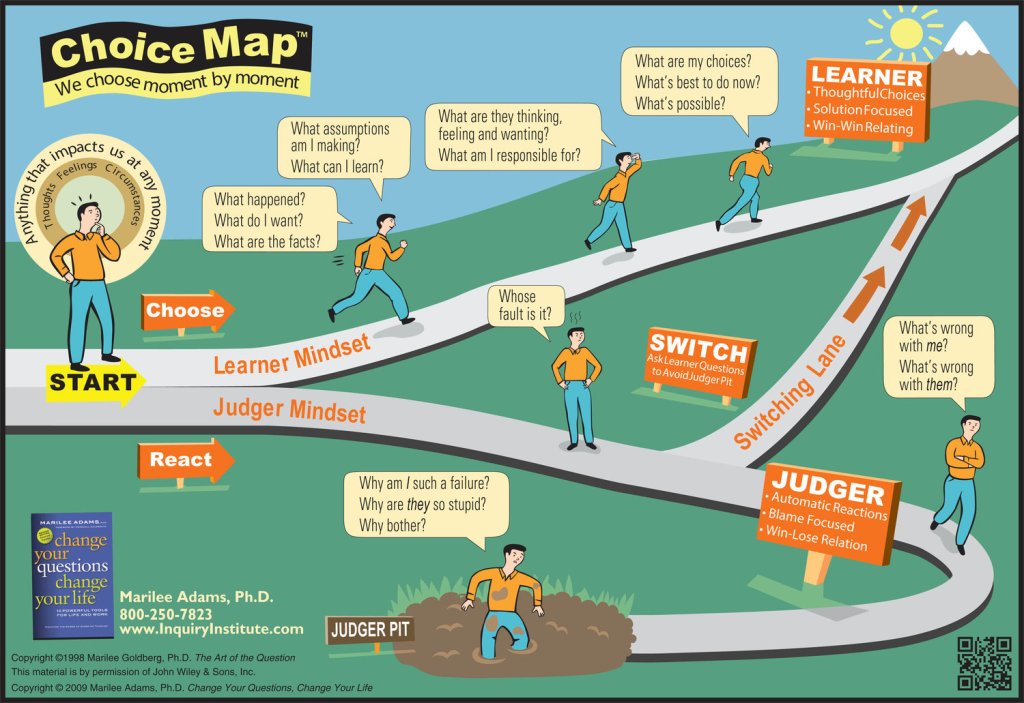
Years after first reading about it, I keep coming back to the Marilee Adams’ Choice Map from time to time. It is the single best illustration of Carol Dweck’s “growth mindset” in action. Dr. Adams’ map shows the difference between asking “learner” questions and “judger” questions.

I was recently thinking about this map and realized that the difference between the two can be boiled down into one word – constructive.

The learner path is constructive because it creates forward momentum and energy. The judger path, on the other hand, has the exact opposite energy. It sucks all energy and takes us straight to that judger pit.

The judger path is all about the reaction. The learner path is all about the response.

A simple idea in theory.

Transformational in practice.

Being in the driver seat of our journey

The challenge of being in the driver seat in our journey = figuring out the balance between…

figuring out where want to go,

looking at the map,

driving in silence,

driving while engaging in conversations or with content,

focusing hard on the terrain,

asking for help,

taking a break to eat, stretch, or rest,

and looking at the rear-view mirror.

There’s no right answer or right mix. Some days or weeks demand something very different from those that came before.

It’s just on us to adapt as necessary.

And make the most of the experience while we’re at it.

Clues that you might not be trying hard enough

Seth shared a post today that resonated deeply


Clues that you might not be trying hard enough

You usually succeed

You rarely feel like an imposter

You already know what you need to know

You’re confident it’s going to work


If you’re not feeling stretched or dancing with uncertainty often enough, you are probably not learning.

A wonderful reminder. Thanks for sharing, Seth.

Business strategy x macroeconomic conditions

When the macroeconomic conditions are great, focus on growing faster than the growth of the category.

When the macroeconomic conditions aren’t great, focus on growing market share.

Of course, the challenge with strategy isn’t simply knowing what to do, it is figuring out how to execute against it with discipline and consistency.

As in life.

Walking every day

We’re all walking every day on this journey we call life.

Some days, the terrain is uphill.

On others, the terrain is downhill.

Both present different kinds of challenges. Going downhill, for example, feels great. But it also strains our ankles.

On some days, the terrain feels uphill. And on others, it feels downhill.

So much of our ability to make progress in this life lies in our willingness to just show up and keep walking – regardless of the nature of the terrain and how we feel on any given day.

Our discipline, mental fortitude, and ability to keep perspective help us transcend these variables and extenuating circumstances – both of which are ever present.

They help us find the strength we need to pick our direction and keep walking.

And then show up again tomorrow regardless of how good or bad today was or felt.

It is harder than it sounds.

But then again, life is difficult.

It is only when we accept this truth do we learn to transcend it.

My Shot

Lin Manuel Miranda’s Hamilton is an incredible musical – especially so if you have even a passing interest in American history. It is a masterpiece that combines fantastic storytelling, captivating actors, and riveting lyrics. One of my favorite pieces in the musical is “My Shot.”

“My Shot” is the song that best captures the spirit of Alexander Hamilton – his seeming unlimited reserves of drive, confidence, and belief.

“I’m just like my country, I’m young scrappy and hungry. I am not throwin’ away my shot.”

There are many reasons this song resonates deeply with me. But two reasons stand out more than every other.

First, it is a song that has immigrant spirit written all over it. The hunger, drive, and almost desperate desire to prove himself and “make it” comes through beautifully.

And second, notice how the lyrics don’t say “I’m going to take my shot.” Instead, they say “I am not throwin’ away my shot.” That bit of framing with a focus on not losing (vs. winning) speaks to how powerful a motivator it is.

There’s something very powerful about that framing in our lives too. We all are given shots at making an impact over the course of our lives and careers. Maybe we’re staring at one of those shots right now.

It is on us to pay attention to these opportunities when they come our way and do our very best to not throw away those shots.

They won’t all result in home runs. But, every once a while, one of them will. And that’ll make all prior effort worth it.