The Metro rail project in Chennai is building new stations all over the city. At every one of these construction sites, the temporary walls have the tag line – “Inconvenience today for a better tomorrow.”
It is an idea that is applicable to every aspect of our life.
Our long term well-being is a function of our ability to consistently embrace inconvenience.
A friend was reflecting on COVID-19 and the impact it had on the many social events he felt socially obligated to attend.
In his words – “One of the most amazing things about the past 2 years is that we managed to get through so many life events – births, deaths, marriages, puberty, and so on – without needing to make a big deal about all of them.”
He shared that the biggest thing he took away from all of this was that he’d be better off optimizing for quality in terms of the relationships and events he prioritized over quantity.
It resonated. Opting for quality and focus always feels counter intuitive.
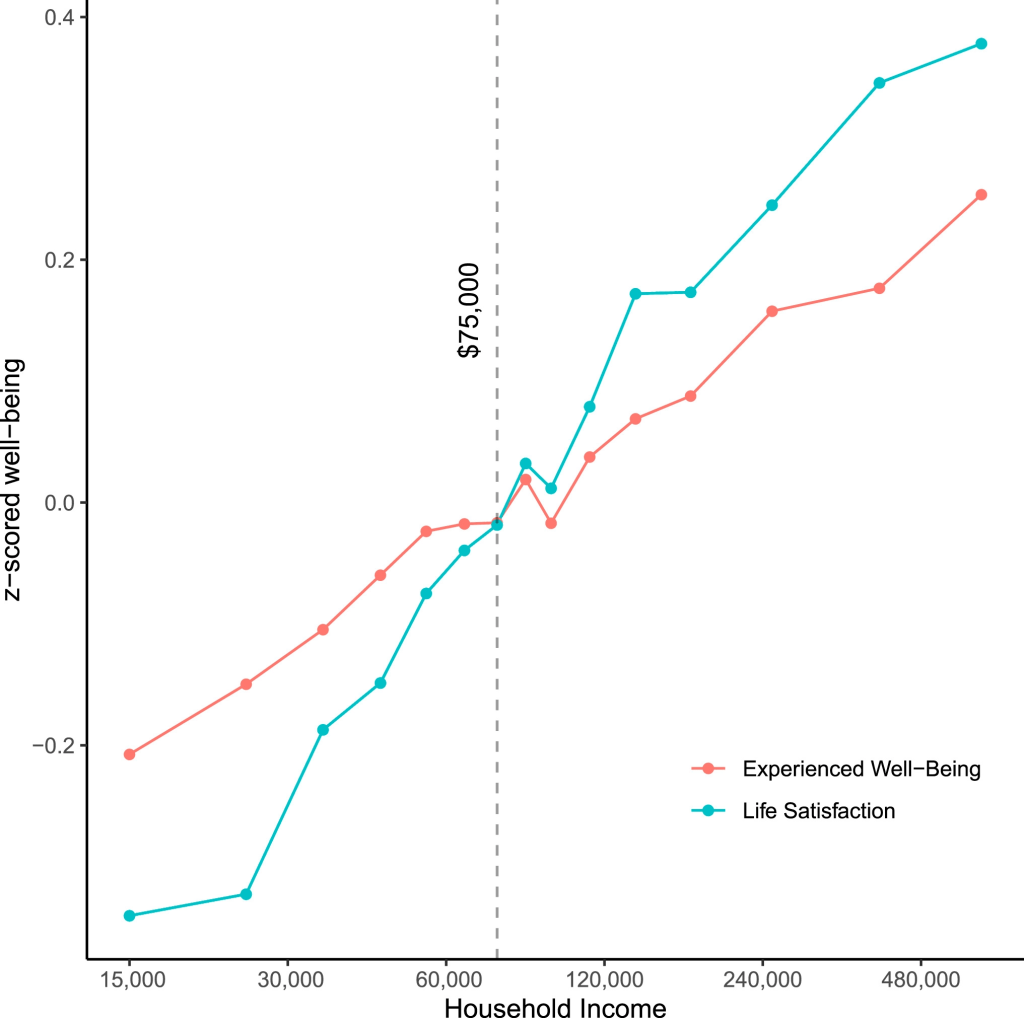
A popular study attempting to understand the relationship between money and happiness posited that there was a plateau in happiness once income reached $75,000. A recent study by Wharton professor Matthew Killingsworth – drawing on reports from over 30,000 professionals in the US – that used a continuous scale to measure well-being instead of the binary scale in the past studies found no evidence of this $75,000 plateau.
Instead, experienced well-being and life satisfaction rose with income.
So did positive feelings (confident, good, inspired, interested, and proud) relative to negative feelings (afraid, angry, bad, bored, sad, stressed, and upset).
The relationship was logarithmic instead of linear. This means the difference in well-being in families that earned $20,000 vs. $60,000 would be similar to the difference between those earning $60,000 vs. $180,000. This means marginal dollars matter less the more one earns – i.e., you see much larger jumps in well-being when you grow income from $20,000 to $60,000 vs. $60,000 to $100,000.
In short, money contributes to quality of our life in a big way. The more money the better. And we do hit diminishing returns – however, that point is likely well above $75,000 and likely varies a lot based on where you live.
We were waiting outside a building to get an immigration item done. There was a friendly lady selling coconut water.
Unlike other coconut water sellers, however, she didn’t ask us to buy coconut water. Instead, she gestured toward a few plastic stools she had around her stand.
Many took her up on the offer. She was friendly and approachable and conversed with anyone who was willing. A few minutes in, she’d ask if they wanted coconut water. After enjoying her hospitality, it was much harder to say no. And given the strength of the sun in Chennai, it isn’t a very hard sell in the first place.
We asked her about her business and she shared that she sold 100-150 coconuts on most days nowadays (with higher expected revenues in the summer). Some quick math brought us to a conservative estimate of 50,000 INR per month in profits – a solid business.
That got us reflecting on her business fundamentals/strategy. She had a good product that was conducive to the environment. She then had a fantastic location with strong top-of-the-funnel awareness.
Building on these strong fundamentals, she then had a differentiated freemium strategy. Her free offering was the seating in front of her cart. She then maintained a strong upsell rate – optimized further by her approachability.
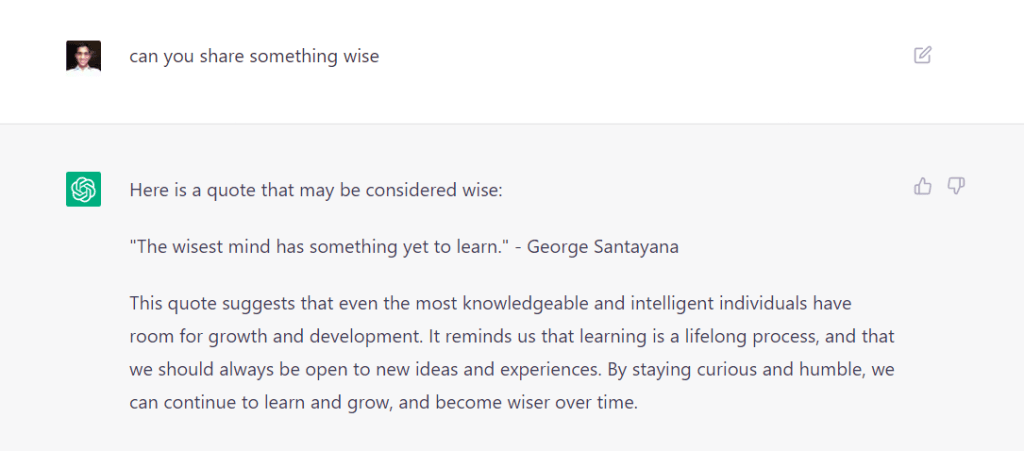
“The wisest mind has something yet to learn.” – George Santayana
This quote suggests that even the most knowledgeable and intelligent individuals have room for growth and development. It reminds us that learning is a lifelong process, and that we should always be open to new ideas and experiences. By staying curious and humble, we can continue to learn and grow, and become wiser over time.
The catch? This post was written by Artificial Intelligence.
I’ve been sharing a learning/observation every day for over 14 years on my blog. Even so, there are days when I find myself scraping the bottom of the barrel thinking of something useful to write.
After the mind-blowing experience of playing with Open AI’s Chat GPT however, I’m beginning to wonder if those days are history. Getting a new quote every time I asked “can you share something wise?” made for an incredible product experience.
Goodbye writer’s block? (and welcome all sorts of unintended consequences)
We first listened to “Victoria’s Secret” – a new single by Jax a couple weeks back and have listened to it a lot since. Few singles have inspired as much deep conversation in our household as this one. Here are the lyrics.
God I wish somebody would have told me When I was younger that all bodies aren’t the same Photoshop itty-bitty models on magazine covers Told me I was overweight I stopped eating, what a bummer Can’t have carbs and a hot girl summer If I could go back and tell myself When I was younger, I’d say, psst
I know Victoria’s secret And girl you wouldn’t believe She’s an old man who lives in Ohio Making money off of girls like me Cashing in on body issues Selling skin and bones with big boobs I know Victoria’s secret She was made up by a dude (dude) Victoria was made up by a dude (dude) Victoria was made up by a dude
I wish somebody would’ve told me that thighs of thunder Meant normal human thighs The fucking pressure I was under To lose my appetite And fight the cellulite With hunger games like every night If I could go back and tell myself When I was younger, I’d say, hey dummy
I know Victoria’s secret And girl you wouldn’t believe She’s an old man who lives in Ohio Making money off of girls like me Cashing in on body issues Selling skin and bones with big boobs I know Victoria’s secret She was made up by a dude (dude)
Thanks to this, our 6 year old will likely think twice before falling prey to body shaming.
I’m grateful to Jax for sharing this with the world. We need more songs like this.
The difference between relationships between kids, young adults, and grown-ups lies in the ability of the folks involved to resolve conflict with conversation.
Kids tend to resolve conflict with tears, tantrum, and manipulation. Young adults tend to avoid conflict where possible and prefer to avoid face to face conversations (hence break ups over text). It takes grown-ups to sit across each other, listen, and reason.
The nature of any given relationship isn’t a function of age – age and maturity aren’t correlated. It is instead defined by the maturity of the parties involved.
As a result, a very small percentage of relationships between adults fall into the “grown-up” category.
When we watch at a high performing soccer/football team, our eyes naturally follow the work done on the ball. Intricate passes, skillful ball control, and powerful shots.
But a lot of top level football players and teams are capable of skill once they have the ball. Great teams become so because of the work they do off the ball.
Great teams work hard to press their opponents into giving away control of the ball, they get into great positions to receive passes from their teammates, and they keep pace with their opponents during a counter attack.
The work done off the ball – a result of tremendous effort on the training ground – make all the heroics in the spotlight possible.
I didn’t know what this word was until I read this morning’s edition of “The Daily Difference.” It gave voice to something I felt strongly about without fully appreciating why.
You may not recognize the spelling, but they likely fill your cabinets and your trash too.
Tchotchkes (CHOTCH-kee) sneak into our lives in the forms of:
Trade show swag
Birthday party goodie bags
Corporate bric-a-brac
Fast food toys
So while it may seem harmless to accept them, it’s not.
“Plastic is made from fossil fuels, which release carbon dioxide that warms our Earth. And, believe it or not, most plastic cannot be recycled even when you put it in a recycling bin.” (Excerpt from our free kids’ book Generation Carbon: It’s time to start, page 31)
So, think sustainable if you’re in charge of the office gifts (or any gifts) this holiday season. And if someone offers you some junk, say no. If enough gets turned back in, companies will stop giving them away.
Books (including The Carbon Almanac), gift cards, and food are all better choices than pens, drink cozies, and mouse pads.