A few months ago, I wrote a letter to an incoming MBA student a few months ago in an attempt to help incoming students prepare for their 2 years at school. It was my attempt at providing a framework with which to approach this 2 year journey. I tried staying away from specific advice in that post as the assumption was that the framework ought to work for everyone.
Today, however, I’m going to dig into my first year process and provide specifics on how I spent my first year. Given the MBA is a $200,000 investment (not counting opportunity costs in lost income), I was very curious about any specific “process” advice at this time last year. And, I was generally left disappointed as most of the advice I found online was the in the “feels-good-but-useless” category – e.g. find your passion, build great relationships, travel, dream, take risks, etc. This post has a lot of inherent personal bias as it is what worked for ME – so please take these notes with healthy doses of salt. And, yes, this’ll be long and dense.
As I’ve outlined in the previous post, there are 6 priorities at business school – Academics, Career, Extra-curriculars, Social, Framily (close friends and family), You. I’ll go through what I’ve learned as I’ve approached these at school.
1. Academics.
a) Finding classes.
– Making a plan. Spent 4 hours during Winter break going through every course that I’d be interested in. After making the list, I tallied all feedback I’d received about Professors whose classes I should take. I went about creating a rough 2 year plan. I haven’t stuck to it. But, as always, the act of making a roadmap helped a lot.
– Understand historical bidding statistics. We have a bidding system – so, I spent time understanding the points spent on the course-in-question in the past and also looked at the average rating of the Professor. With this data, I could easily spot the over-valued and under-valued courses. My takeaway – use data where possible and invest in understanding the system.
– Ask for recommendations. I asked most 2nd years I met in the early days for top course recommendations. This helped a lot.
b) Attending classes.
– Show up. I think I missed just two classes through the year. That helped a lot.
– Be 100% present. My natural ADD makes it difficult to keep focus throughout a class. So, I worked out a simple forcing mechanism – sit in front. This helped ensure I didn’t spend my time mucking around on my phone or laptop and also ensured I fed off the Professor’s energy. This worked most of the time and that’s what I was shooting for.
– Come prepared and participate. This is part of the “be 100% present” idea. Participation is an extension of that. Now, I think I was FAR better prepared in my Fall quarter than later quarters. After the first couple of weeks, I began getting a sense of the level of depth required and that helped calibrate.
c) Group meetings.
– Align on expectations if possible. Always helpful to have a conversation upfront if you feel there might be misalignment on goals and priorities. I can think of a couple of experiences when having this conversation would have helped.
– Don’t count group meetings as study time. Same concept as work meetings – use this for discussion, agreement and decisions. Don’t count as solo study time. Bring value to a group meeting (very hard to do sometimes)
– No need to be the lead in every group. Continuing of the previous thread, if you find others taking the lead in some groups, let them. Just make sure you do the same in some other. What goes around comes around..
d) Preparing for exams
– Don’t waste money on textbooks. I didn’t use them. But, I know of people who did. So, this might just be me. I found the course pack and readings to be more than sufficient.
– Attend review sessions only if absolutely necessary. I went for very few. When I did, I often chose a video as you can skip through most parts.
– 30 hours. I found that roughly 30 hours of study per course was sufficient to grasp the concepts and do well. This is roughly 3 hours per week. But, for most people, you see spikes towards the end of the quarter.
– Summarize lectures – single best learning. My strategy professor suggested we spend time after every class summarizing what we learnt. I’d read about this technique earlier and never tried it. While I didn’t strictly do it every class/week, I made sure I did it every time I studied. This typically happened when an assignment came due – the assignment naturally required knowledge of what had been taught in the prior couple of weeks. So, instead of diving into the answers of the assignment, I’d go back and make sure I summarized lectures first. This was an amazing move as it made for my notes for revision before the exam. And, in exams where we were only allowed a cheat sheet, this made the process really simple.
2. Career. I’ve covered my process in detail in lessons learnt from internship recruiting. I just have 2 adds –
– Don’t view classmates as competition. Be of help to each other. We grow up conditioned to compete. Think of your classmates as temporary “path sharers.” Good things happen once you do the work. Be nice to each other – the world will roll on without you.
– Start a prep group. We had a 4 person tech group that met nearly every week for 10 weeks. It was one of the best things we did.
3. Extra-curriculars.
– Understand why you’re doing extra-curriculars. Different people do these for different reasons. Some career switches like adding a note to their resume about a relevant professional club. Some want to test leadership. Some others want to meet people. There’s many reasons to do it. My reasons were straightforward – I am driven by people, learning and impact. Extra-curriculars have helped work on ideas that combine all 3. They’re a fantastic opportunity to learn more about yourself, how you lead, how you work in teams, etc. I spend a significant amount of time on extra-curriculars and it has been a highlight of my school experience.
– Don’t be a flake. Once you commit to a leadership role, keep up that commitment. It is not just because everyone remembers flakes and all those you work with might have a strong say in a future career opportunity. It is simply because it is the right thing to do.
– If you’re unable to do work, communicate and apologize. Worst case scenario – it happens.
– Run good team meetings. Most team members hate team meetings. That’s because they’re generally run badly. I’ve tried hard to run good team meetings – this means preparing hard, using the time meaningfully and following up. I’ve tried to set the norm of 100% participation early and have tried to earn my team members’ time. Really useful skill to learn and hone.
– Learn how to build great teams with peers. The best part about school is you work on projects with peers. If you can learn how to build high functioning teams with peers who’re only doing this out of personal motivation, I believe you can build great teams everywhere. Working on teams to lead the incoming student orientation week, our technology club and two other initiatives has been an education in itself.
4. Social. This is heavily biased as it comes from the point of view of an introvert.
– Look to build long term relationships, not network. Building long term relationships take time. So, take the time and be patient.
– Invest in really getting to know as many people as you can. One of my wiser friends once said business school is where you’ll meet the highest proportion of people who are both interesting and interested in you. It is very true. In my case, I’ve tried setting up 3-4 coffee conversations every week. They aren’t ever over coffee. Every time I meet someone who I’d like to get to know better, I just put some time on their calendar (typically between classes), walk with them and swap stories. Many of these just turn out to be one-time meetings but some become really nice relationships. As with these things, it takes two hands to clap.
– Maximize high quality social events. Hanging out with 100 people in a bar is what I term a “low quality” social events. Any time you meet people and talk about the weather is low quality as well. 1:1 or small group conversations that involve talking about things that matter to you are high quality. Maximize.
– For low quality social events, “HELL YEAH!” or no. If it isn’t a “HELL YEAH!”, I don’t show up. (I did warn you this is very introvert biased)
– Find ways to meet random people. It is easy to shut off and find your own clique. I created an open event for my entire class last quarter on a Friday evening . 12 people showed up – a few of whom I’d never spoken to. That was a win. Good reminder to do more of those.
5. Framily. My past life was outside the US. So, most of these notes are directed to staying in touch with family and friends who live far away.
– Hang out with family when working/doing chores. I do a lot of conversations with family over breakfast, dish washing, and other such chores. Thanks to FaceTime, it is really easy to prop Mom up on the desk while I’m doing my thing. We’ve spoken a lot more during school days (as I often have flexible schedules) as a result.
– Set aside time on Saturday morning to catch up with friends. While I wasn’t the most proactive friend in the fall quarter, I always made sure I had time set aside on Saturday mornings for catch up calls. That helped a lot.
– Work on projects with people who matter and/or set up recurring calls. My friends and I work on a charity together. That means we catch up every 2 weeks and that helps a lot. Every few months, we set up a big google hangout as an extension to our bi-weekly call. In a couple of special cases, I set up recurring calls.
6. You.
– This is the single most important priority. Nothing matters more. If you’re not taking care of yourself, you’re likely doing it wrong.
– I count my wife in this priority. It helps me prioritize time with her. I don’t do nearly as good a job as I’d like to. But, I work hard on it as it is the single hardest challenge I’ve faced in school.
– A 515am-915pm routine on weekdays really helps. As my wife leaves for work in the morning, I generally sync with her. So, this means up by 515am, morning routine and freshen up till 7am. I count 7am-530pm as my work day and plan study, activities and meetings between these slots. I’m generally back by 6, we either head to the gym or go for a run around 615 and then have dinner together. I try not to touch work or email after 7pm. I don’t do nearly as well I’d like to. But, we do sleep by 930 or so. This means social nights are rare. But, you’ve got to make trade-offs and I’ve generally prioritized time with my wife.
– Own your calendar. I generally schedule all my group meeting and catch up invites. This helps me allow for blocks of time to do work and also ensures I don’t take any meetings after 6pm. I’ve only had to make exceptions about 4 times in the year – that’s not bad at all.
– Chill on Saturday afternoons and evenings and plan social stuff on Fridays. I try hard to switch off on Saturdays as Sunday is typically a full work day since assignments tend to be due on Monday. It doesn’t always happen but I try very hard to keep Saturdays free to just hang out at home with my wife. So, that means I try and plan social stuff on Fridays so we both can participate.
– Sleep 8 hours, meditate, eat healthy and exercise. Being disciplined about the rest of my life has meant I haven’t really had to compromise on this. There have been times when I’ve slept lesser than I’d have liked. But, all in all, I’ve tried and kept a normal routine including, of course, blogging every morning. :-)
– Optimize for energy. There were, of course, many crap days when I felt really low on energy. On these days, I generally aimed to sleep as early as possible and do less. My productivity is generally 2x on good energy days. And, I generally optimized for this.
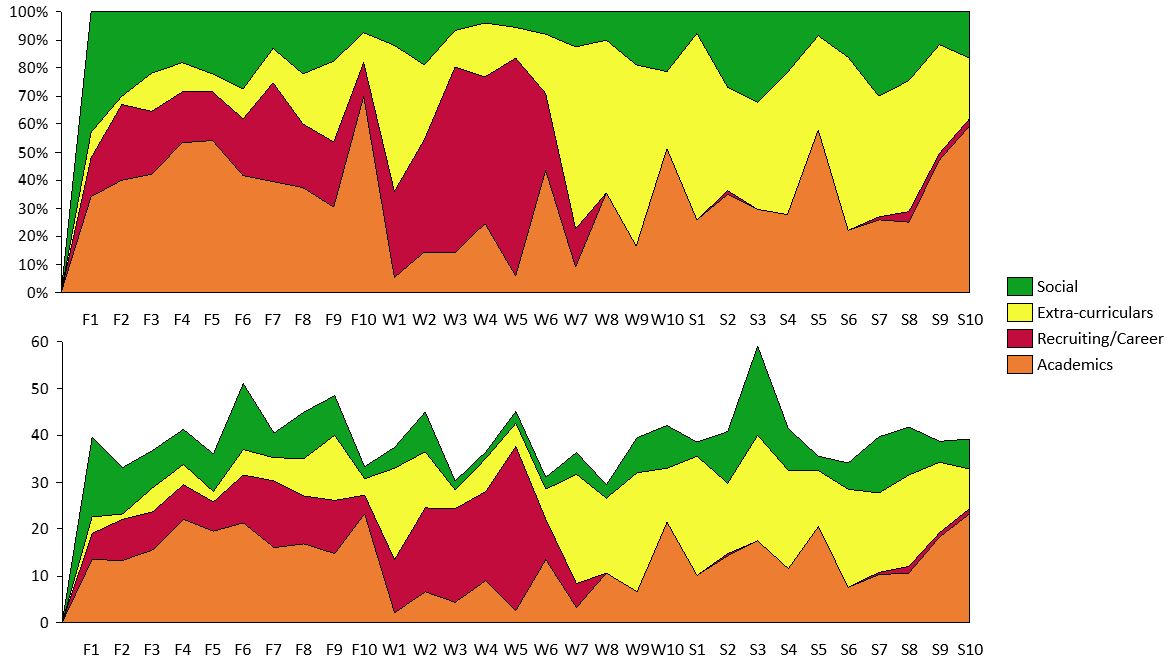
So, what does this all mean in terms of time spent? I thought I’d show what all of these notes looked like in action. I’ve written about this a few times – but, aside from just recording meetings, I generally record productive time on my calendar. If I’ve spent 90 mins studying but felt like I did 60 mins of productive work, I generally store that on my calendar. At the end of the week, I add up the time spent on each priority and look at how I spent my week. It is always very illuminating. Over time, I added more nuance – e.g. tracking group time vs. solo study time, etc. As I could go on about this topic for hours, I thought I’ll share 2 graphs and what they mean.
 These 2 graphs show how I spent time in the year. I don’t track time spent with framily or with wife/myself. This is strictly for the “work” part of my life. It is an approach that’s added incredible value considering the time investment (roughly 30 mins per week). I’ve continued to do this in my internship and it is among the better things I do. A few notes –
– Both graphs have the same data – the top graph is a 100% graph while the bottom is in absolute hours.
– F1 = 1st week in the Fall quarter. W = Winter, S = Spring
– As you can see, my internship search ended week 6 of the Winter quarter and nearly all of that time got replaced by extra-curriculars (and a little bit more social – but not much more)
– I generally get about 35 “productive” hours in a week. This number assumes meetings are productive. I try to make sure they are. But, of course, this is chainsaw art and not fine – it is granular enough to work for my purposes.
– My academic numbers don’t include 12 hours spent in classes. I take that as a base-case. So, that’s roughly 47 of the roughly 65 hours I spend working (11 hours)
– As you can see, my academic hours spike around weeks 9 and 10. I spent a lot more time studying in the Fall. I took 3 courses (1 less than the usual 4 course load) in the Winter – even so, I didn’t study all that much in the Winter.
– I have some more nuanced stats but won’t spend any more time on this. I geek out on this stuff and I recognize that it isn’t for everyone.
– I have written a lot about prioritization in school. And, hopefully, this brings those ideas to life.
Finally, since this post is all about my personal advice, I’d like to finish with 3 ideas I’ve found useful –
1. Spend energy and time on things you value or consider important. The first step here is to determine which of these priorities matter to you. Academics, for example, clearly matters to me. It doesn’t for many. But, understanding what matters to you is the first step to allocating your energy and time – your most valuable resources. Everyone who goes to a decent program will tell you that it often gets overwhelming. I think of it as preparation for life as a business leader. If you just walk out of school learning to prioritize things that matter, that’s a great lesson to learn.
2. You can’t win them all. Business school can often feel like high school. You can easily spend hours worrying about your popularity, social standing and/or what you are missing out on (a.k.a FOMO or fear of missing out). The first step here is to acknowledge that school is the same as life – you aren’t going to get on with everyone and not everyone’s going to like you. That’s okay. Just be yourself. Everyone else is taken.
3. No one owes you anything. It is tempting to walk in thinking that the school owes you a great experience for the fees you paid, that your group mates owe you for your selfless dedication and so on. I think a better way to approach this is to just remind yourself that nobody owes you anything. You’re in a great environment that you can mould to suit your needs and style. That, in itself, is a great opportunity. Like all good things, your experience is what you make of it. Make it meaningful, make it count.
—
I’m sure this post a few typos and errors. I’ll get to fixing them as I read it again (have to run now!) /hear from you over the next few days. I might add a few notes as well over the next few days.
I know it is long. As always, I hope it is worth it.