‘Nature is quantum, goddamn it! So if we want to simulate it, we need a quantum computer.’
Those words from Richard Feynman’s keynote in the “First Conference on the Physics of Computation” was what researchers in the then nascent field of quantum computing needed to hear. It gave the field the boost that it needed to begin a multi-decade long search for the first working quantum computer.
Classical computing. In 1948, MIT Professor Claude Shannon published a landmark paper — “A Mathematical Theory of Communication.” In this paper, he laid out the basic elements of communication (transmitter, channel, receiver, etc.) and popularized the term “bit” as a unit of information.
The bit remains the building block of the computers and phones that we use today. And, thanks to Shannon’s model and breakthroughs from numerous other researchers, we were able to use computers to solve many hitherto unsolved problems.
However, there classical computers cannot tackle very complex problems because it would require insane amounts of computation. For example, cryptography relies on the fact that no classical computer can break a large number into its various prime factors (e.g. 15 has 2 prime factors — 3 and 5) easily. A 232 digit large number took scientists two years to factor using hundreds of classical computers.
So, why can quantum computers do more? Super position and Entanglement. Classical computers encode and manipulate information as strings of binary digits — 1 or 0. Quantum bits, on the other hand, can exist in a superposition of the states 1 and 0. This means that a qubit’s state could be 1 or 0 with some probability.
Next, to perform computation, these qubits must exist in an interdependent state where changing the behavior of one can affect the other — this is called entanglement. This means that operations on qubits count more than on simple bits. While computational resources increase linearly as we increase the number of bits on classical computers, they increase exponentially on quantum computers. So, adding an additional qubit roughly doubles the computation power => a 50 qubit computer has 2⁵⁰ computational power than 1 qubit computer.
Error rate. The challenge, however, is error rate. Random fluctuations, from extra heat in qubits for example, can change the state of a qubit and derail the calculation. So, quantum computing can only live up to its potential if all the qubits work “in coherence.”
This is a problem because a high error rate takes away any benefits of using a quantum computer.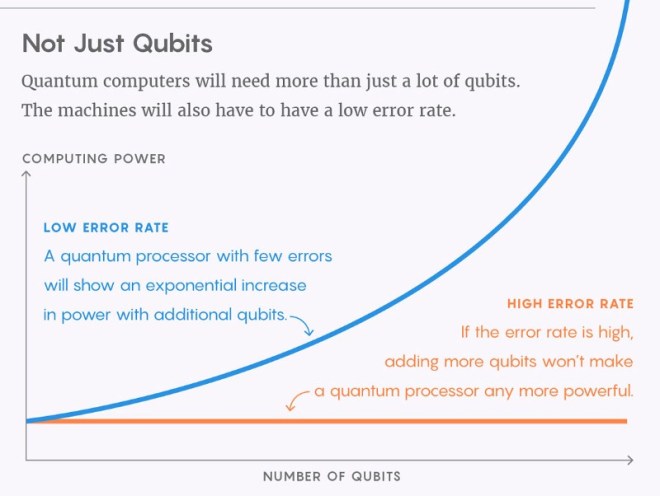
(Source and thanks: Quanta Magazine)
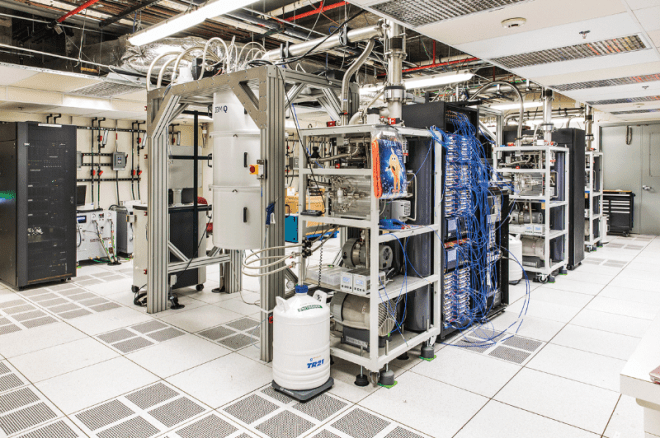
Reasons for optimism and pessimism. 2017 was a year that brought reasons for optimism with it. IBM announced that they had created a 50 qubit quantum computer. Google and Microsoft have also been investing heavily. In addition, IBM has made a 5 qubit computer available to researchers since 2016 for free.
(Source and thanks to: Technology Review)
While all this is good, there hasn’t yet emerged a solution to get around the error rate. While some researchers believe error rates will be the reason quantum computers will never make it to the mainstream, researchers around the world are working hard on the problem. Some believe the solution will be finding a way to work with the noise rather than to eliminate it. Could there, for example, be quantum algorithms that will enable us to generate results despite the noise? There is no guarantee we’ll find a solution however.
The next hairy question is which problems will quantum computers help us solve. While there’s a debate here, it is clear it won’t be a cure all for all sorts of problems. Besides if a quantum computer’s error rate is hard to predict and if its calculations can’t be checked, how can we conclude that the problem is solved right?
We have more questions than answers at this point.
Where does all this leave us? I really struggled with putting this post together. I postponed writing it for 2 straight weeks despite reading and watching the articles and video below at least a couple of times because I wasn’t sure I understood it well enough to write about it. I finally decided I’d ship my draft today no matter what.
That, in some ways, gets to the challenge with quantum computing. It is hard to understand how it works, why it is better and, thus, what it could do.
My layman’s synthesis, then, is as follows –
- After nearly four decades of research, we’ve made a lot of progress in quantum computing in the past 3 years. This is thanks to our ability to build quantum computers with more potential computing power than any classical computer.
- Quantum computers will not replace classical computers. Instead, we will use them to help us solve certain kinds of problems. For example, they may help us make progress in understanding the workings of complex chemical reactions which may, in turn, help us cure challenging diseases. They may also do better at complex optimization problems than the best deep learning algorithms.
- However, realizing this potential requires us to figure out how to deal with the “coherence” problem that results in error rates.
- There are various groups working on solving error rates. The solution might be to build algorithms that work despite them. As a result, getting more researchers and programmers to work on quantum computers is going to be key. That said, there is no guarantee that we will find a solution.
It feels like we’re still a couple of decades away from quantum computers hitting the mainstream. But, making such predictions on technology I barely understand is likely foolhardy anyway.
So, I’ll end with a note on the topic. All my reading led me to the conclusion that the way to think about the outlook on quantum computing is simply to think of it as a superposition of optimism and pessimism. :)
Links for additional reading
- Shor’s algorithm to solve factorization with quantum computers — on Wikipedia
- Hello Quantum World — on MIT Technology Review
- Serious quantum computers are here — what are we going to do with them? — on MIT Technology Review
- Outlook is cloudy on the era of quantum computing — on Quanta Magazine (a must read)
- What sort of problems are quantum computers good for? — on Forbes
- Quantum computing explained by an IBM researcher — on YouTube
- The Exponential View — a newsletter by Azeem Azhar