
Irrigation and wine

I was at a celebrated winery recently where they explained their approach to making wine. I knew little about making wine. So, it was all new.

One idea that I found fascinating was that they refused to irrigate their plants. The grapes are planted on a hill with limestone 10-15 feet below the ground. Limestone is known for holding moisture. So, the roots need to make it to the limestone and get the moisture directly from the limestone.

Our guide explained that this lack of irrigation defines their wine’s taste and character. The harder the plants have to work, the more resilient they become. And the more resilient they become, the more likely they create strong wine.

Much like how we our character gets shaped too.
Halloween and Diwali

A friend once described Halloween as similar to an American version of Diwali.

Growing up, Diwali was the most fun festival of them all. Diwali meant fireworks, well-lit homes, hanging out with our neighbors, and sharing sweets.

We celebrated our first real Halloween yesterday as our kids are now old enough to both understand and be excited about “trick or treat.” We ended up joining a group of kids and parents from around our new neighborhood who were doing the same, walking up to decorated homes, and saying hi to all the neighbors who gave our kids candy.

Absent the fireworks, it did remind me of Diwali growing up.

I’ve spent nearly as many years away from India as I have growing up. And, in all these years spent across various continents, I’ve always stumbled upon similar traditions – with no exceptions.

Lost in all the conversation, political discourse, and (typically) rhetoric about our differences is the fact that we’re all human. And, no matter the color of our passport or our skin, we all crave love, safety, and belonging.

So, it is no surprise that there are similar traditions wherever there are humans.

Ubuntu.

I am because we are.

Permission to stop feeling bad

“Sorry is what people say when they want permission to stop feeling bad.”

I heard this quote on “The Morning Show” recently. It made me pause.

There are apologies that fail the moment you hear them. These fail because they sound insincere.

Then there are others that sound heartfelt. But, they could still sound empty if they don’t result in change. It’s those empty apologies that this idea captures.

It got me reflecting about the times I’ve said sorry of late. Did I say it because I wanted permission to stop feeling bad?

It is a powerful question.

I hope to eliminate that brand of sorry from my life.

Color match

We bought a home recently (a story for another day) and have been attempting to touch up a few spots around the home. These spots are spread across multiple rooms – each painted with slightly different variations of the main color.

We heard Home Depot’s paint department had the capability (courtesy of Behr) to do a “color match.” All you need to do is take a bit of the wall, have a machine scan the color, and you will know what shade it was painted.

It sounded perfect.

5 attempts later, we’ve realized that color match doesn’t work. It would have been more effective to just pick a new color and paint these walls.

So, that’s what we’re doing now.

Lessons in painting a home aside, it is a great reminder of the fact that it is sometimes easier to start over on a project rather than attempt to paper over existing cracks.

Long memory for mistakes

Our default state is to pay disproportionate attention to our mistakes and carry them (and all the associate embarrassment and disappointment) with us for long periods of time.

As a result, we end up having a long memory for mistakes and a short memory for the learning that came from it.

This turns out to be to counter productive. We learn best when we have a short memory for mistakes and a long memory for the learning.

Let the embarrassment and disappointment go.

Let the learning stay.

Remote and hybrid opportunities

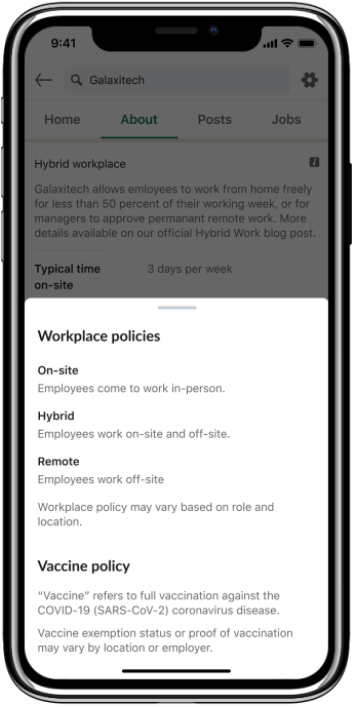
I shared a post earlier today on LinkedIn sharing some of the features our team has been working on to help jobseekers find remote and hybrid opportunities.

This was a fascinating project because it is a fascinating time for anyone interested in understanding the future of work. Here’s the short form version.


Many are taking a pause to re-think how and why they work, and are pursuing roles based on what they really want out of a job, like more flexibility. We’ve been hard at work to help people discover opportunities that match their on-site, hybrid and remote work preferences on LinkedIn. Here are 3 fascinating bits of early data:

(1) Of all job searches utilizing the new on-site/hybrid/remote filters, 65% are for remote jobs  
(2) Of new job postings featuring these workplace policies, 1 in 4 are remote (!).
(3) Of companies who have updated their Company Page with these policies so far, we’re seeing 45% list they are hybrid, 32% remote and 23% onsite.

We hope these features helps when you look for your next opportunity.

Much gratitude to the wonderful 100+ person team that came together to make this happen.


Every time I see the stats on remote, I’m reminded of just how much impact COVID-19 has had on the world. All our long-held assumptions about the need to show up at an office everyday to get work done have been overturned.

“The times they are a changin.”

Progress happens unevenly

When we seek to make progress on priorities that matter, the curve of progress often doesn’t follow the curve of action.

We need continuous action over long periods of time to experience significant progress. That progress, however, doesn’t come linearly.

You don’t understand a subject for the longest time. And then it all begins to click.

You can’t seem to get that stroke right for the longest time. Suddenly, it happens.

Your capability doesn’t seem to translate to income for the longest time. Until it does.

Gradually, then suddenly.

The important thing is to keep plugging away.

Focus and politics – an Indra Nooyi note

“Focus on the job you’re doing, don’t focus on the next few jobs. Understand the company’s politics, but don’t play in the politics. And put your hand up for the toughest assignments. That’s when you’ll get noticed.” | Indra Nooyi

I thought this was fantastic advice.

It is so easy to get caught up in planning ahead and lose sight of the job at hand.

And, it is just as easy to get caught up in the politics. Understand it, but don’t play it is a note that is about as wise as they come.