
#OurWorldIsAwesome – Edition 25 | Context on this series – we live in a beautiful world and National Parks are akin to the crown jewels of this planet. These landscapes remind us of the fine balance and complexity woven into the fabric of the world around us. Every time I spend a while inside one of these places, I’m reminded of how precious that balance is, and how much it matters that we try to understand the complexity and our own small role within it.
I think that’s what awe really is. We reach for the word “awesome” in the moments something helps us see our own insignificance — and windows into nature do that for me every time. So this is my small way of sharing it, and passing it along.
Banff was Canada’s first national park, and one of the very first anywhere — the second oldest surviving park in North America, after Yellowstone.
Interestingly, Banff wasn’t established with a grand vision of protecting the wilderness. It started with an argument. In 1883, railway workers found hot springs in the Bow Valley, and the fight over who owned them — and who had the right to profit from them — got messy enough that the government stepped in and set the land aside. Conservation won, almost by accident.
On most lists of the most beautiful places on earth, Banff lands in the top five, and you can see why the moment you see one of the glacial lakes. This is the Peyto Lake.
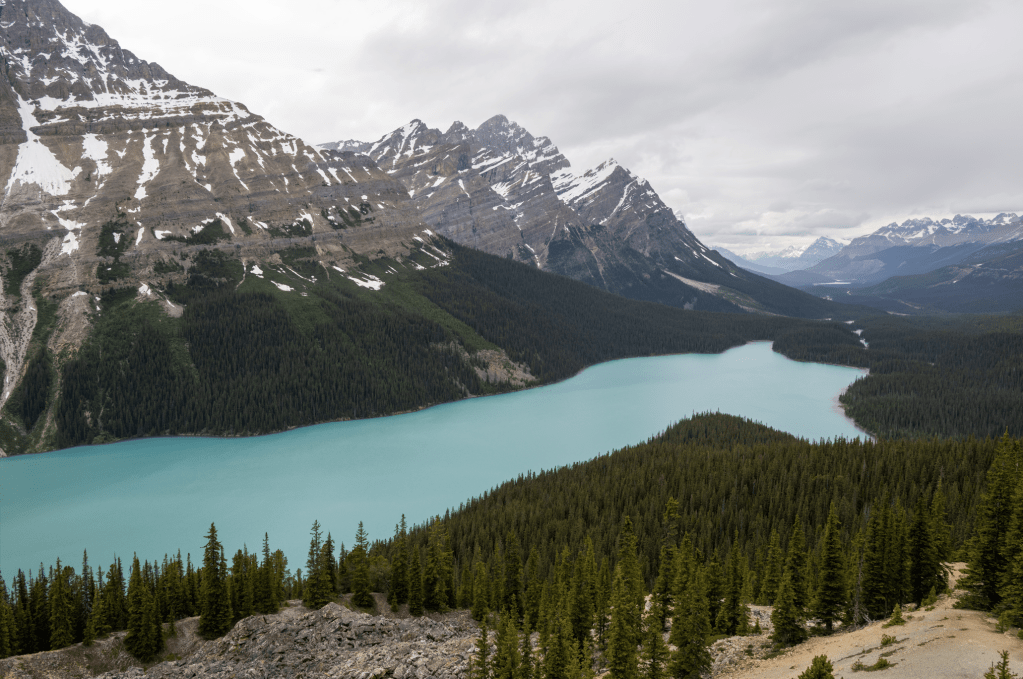
That impossible blue isn’t a trick of the camera — it comes from rock flour, fine rock ground up by the glaciers and left suspended in the water, scattering the light back as turquoise.
Lake Louise looks similarly splendid (while remaining a frigid 4 degrees Celsius even in the summer) after a hike that involves traversing through snow in the summer.

Then you pair those lakes with peaks you can climb. At Moraine Lake, the Valley of the Ten Peaks rises straight out of the water.

I also loved the many wildlife crossings that have been built in Banff that you can see on the drive. I learnt that there are over 40 overpasses and underpasses built across the Trans-Canada Highway, now so grown over with grass and trees that they look like natural hills.
We didn’t see much wildlife near them as there were far more people than animals at Banff. But the crossings themselves were remarkable because animal-car collisions here have fallen more than 80% since the crossings went in.
Banff National Park earns its place as one of the most beautiful places on this planet. I hope to go back.
 A Learning a Day