
If you’re on the lookout for reasons to complain, you are 100% guaranteed to find what you are looking for… and a side portion of unhappiness with it.
It is a reliable 2-for-1 deal.
If you’re on the lookout for reasons to complain, you are 100% guaranteed to find what you are looking for… and a side portion of unhappiness with it.
It is a reliable 2-for-1 deal.
Ravi Gupta, an investor, shared a post that I’m sure I’m going to be talking about in the weeks to come. It resonated deeply. Thank you, Ravi, for sharing.
Recently, Bill Gurley tweeted a proverb that was shared with him.
“Every morning in Africa, a gazelle wakes up. It knows it must run faster than the fastest lion or it will be killed. Every morning in Africa, a lion wakes up. It knows it must outrun the slowest gazelle or it will starve to death. It doesn’t matter whether you’re a lion or a gazelle. When the sun comes up, you’d better be running.”
I think there are two important concepts for entrepreneurs that come from this:
(1) Speed: How soon do you have to face reality?
(2) Severity: What is the cost of ignoring it?
The lion and the gazelle have to face reality every day, and the cost of ignoring it is death. That’s a powerful combination. For many startups that have a lot of runway, it can feel like they have the opposite combination. With 3-4 years of cash, they don’t have to face the reality of the markets (private or public) for many years. Plus, the cost of ignoring market realities now seems low. Employees are not leaving in droves. Financial plans have been revised downwards, so business performance seems fine when compared to the revised budgets. Importantly, every other startup seems to be doing the same thing.
This seems reasonable on the surface. But it’s not. It’s dangerous. It’s dangerous because it allows you to have standards that prioritize feelings over performance. This is a path to mediocrity. If you don’t think this applies to your company, look at your financial plan for 2023. Does it represent excellent performance? Does it require you to make significant progress on the things that keep you up at night about your business? Does it increase your chances of long-term market leadership? Does it put you on a path to consistently beating Rule of 40 at scale? Or is it just a set of numbers that will allow you to tell yourself, your team, and your board that you are “beating plan”?
James Astill wrote a piece that I think about all the time. In the article, he wonders why American children are so good at swimming and so bad at math. He comes to the conclusion that schools are too busy teaching kids to feel good about their math performance rather than actually teaching them how to do math. At the same time, he notices that his children’s swim instructors are similarly supportive to the math teachers, but with completely different results. He observes that the swim instructors have an advantage over the math teachers. They have been blessed with an unforgiving standard: the water. Here’s the closing sentence from his piece: “If their instructors had focused on making them feel good about swimming, instead of on making them swim, they could have drowned.”
If you’re a startup founder or leader, embrace reality. Outperforming a middling financial plan doesn’t matter. Neither does having slightly better performance than a bunch of other startups that aren’t ever going to be great.
What matters is moving your company towards excellence. What does that mean? Look at your 2023 plan and be honest with yourself about whether your revenue growth justifies your cost base. If it doesn’t, either make the hard decision on costs now or find the big bet on product that will give you a chance to fundamentally alter your growth trajectory in 2024 and beyond. Most companies are treating 2023 as a mulligan year with hopes that the market improves in 2024 and brings growth back. None of us know whether it’s going to be easier or harder to grow in 2024. All we know is that hoping that it’s easier is not a great strategy.
Don’t let a long runway lower the bar for your company. High standards are a gift that you give your team.
And remember – the real competition is the water.
15 years ago, South Australia’s energy mix was driven primarily by coal and gas. Then, the world started paying attention to a revolution driven by its citizens – rooftop solar installations began taking off toward the middle of the last decade.
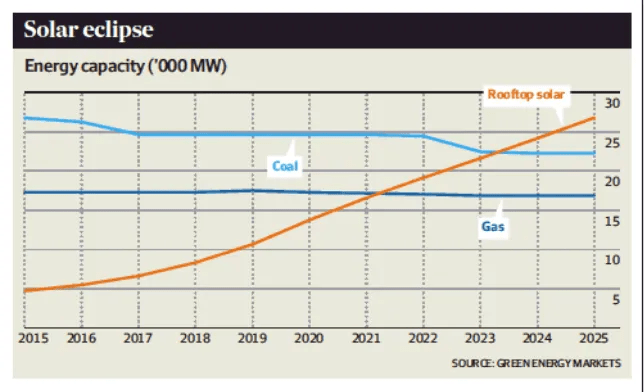
Rooftop solar is unique – it is modular and easily incorporated into existing infrastructure. And, like all great energy innovations, it gives power to the people (in this case, literally). And the people of South Australia voted for this with their feet… and their rooftops.
As a result of this and investments in wind energy, the share of energy in South Australia is now 80% renewables. That is an insanely fast transition that shows us what is possible. During the summer (ending February), rooftop solar often powered over 90% of the total demand (more here).

A similar movement might be happening in China too. Additional capacity from Rooftop solar in China in 2022 was more than the USA, Germany, and the UK combined.

Fascinating to watch a once-in-a-lifetime energy transition unfold.
I was mulling the importance of adversity and sadness in inspiring perspective. Then, a good friend reminded me of this Quote from The Count of Monte Cristo – “There is neither happiness nor misery in the world; there is only the comparison of one state with another, nothing more. He who has felt the deepest grief is best able to experience supreme happiness.”
It is a beautiful articulation of a powerful idea – do we experience anything without comparisons?
I met a doctor who specializes in sports injury say “motion is lotion.”
He was trying to make a simple point – unless you’re dealing with a severe injury, most other issues are best solved by a focus on mobility.
Moving our body helps it heal.
Motion is lotion – catchy and useful.
One of the fascinating things about this life is that we often talk about ideas like “quick wins” that imply we can quickly get going on the easy stuff.
In reality, we typically need to get to the hard stuff first to then get to the easy stuff. At least the easy stuff that counts anyway.
I think of this every time I think about the act of building a team and getting the team going. It takes a good 6 months of consistently choosing the hard stuff – tough conversations, tough decisions, and so on – before things settle and the team begins moving in the direction we want.
And, for what it’s worth, I’m not even sure the easy stuff exists. I think we just get so good at dealing with the hard stuff as a team that we take on the next thing and the thing after with relative ease.
Perhaps that’s the secret. Getting to the hard stuff first makes the hard stuff that follows… easy.
 A Learning a Day