
Awareness = our ability to see things as they are vs. how we want them to be.
Month: August 2022
If it isn’t a hell yeah
One of my favorite posts from Derek Sivers teaches a simple lesson – “If it isn’t a HELL YEAH, it is a no.”
Derek wrote it in context of events and new projects. The more we say no to things that don’t matter, the more space we get for things that do.
It is one of those lessons that applies well beyond new projects and events however. It works fantastically well for smaller everyday decisions.
If it isn’t a hell yeah, just say no.
And don’t say yes when you want to say no.
It shows.
Notification settings
In an age where our phones are ever present, one of the highest leverage things we can do is to take control of our notification settings.
Choose what you want to be notified for, when you want to be notified, and how.
The more intentional and the more granular our choices, the better.
Not choosing is also choosing.
The deeper we dig
We were watching a Disneynature special called “Ghost of the mountains.” It chronicled the arduous challenges a film crew endured in their quest to capture rare footage of a snow leopard family on the Tibetan plateau.
We love watching shows about wildlife and nature. And this special brought to light just how challenging these shows are to produce. People go to great lengths to capture incredible footage. We’re incredibly lucky to be recipients of the end product.
It is just the same when we dig deeper into other pleasures in our lives.
The deeper we dig, the more we realize how lucky we are.
Disproportional reaction
When a person’s reaction to a particular stimulus feels disproportional in its intensity, it is either a result of a want of a basic need (sleep or food) or a perceived attack on something they consider to be part of their identity.
Best shop practice
“I am not particularly anxious for the men to remember what someone else has tried to do in the past, for then we might quickly accumulate far too many things that could not be done … Hardly a week passes without some improvement being made somewhere in machine or process, and sometimes this is made in defiance of what is called “the best shop practice.” | Henry Ford
Every once a while, organizational memory can be problematic.
The key lies in not just documenting successes and failures but making the effort to establish causal understanding.
The more we attempt to understand cause and effect, the better our experiments become.
Process, outcomes, goals, systems
I’ve thought about the tension between processes and outcomes a lot over the years. On the one hand, outcomes are lagging indicators while processes are leading indicators. That naturally lends itself to advice along the lines of “focus on the process.”
But while the process is a leading indicator, a focus on the process alone doesn’t guarantee we’re headed in the right direction.
That leaves us with a conclusion that holds for most good things in life – when in doubt, replace the “or” with an “and.”
Combine a focus on process by keeping our eye on an outcome that helps us understand if the process is working.
Combine a focus on creating a good system with a goal that help us understand if we’re making progress.

We dissolve the tension by embracing it.
H/T Melodie for the illustration
Open book
Thanks to our experiences with examinations in school early in our life, we sometimes think of life as a series of closed book tests.
In truth, however, it is more similar to a series of open book tests with fewer and fewer questions. It is less about remembering things and a lot more about knowing where to look and whom to ask.
And, over time, it is developing a child-like curiosity to keep asking questions… and then learning to ask better ones.
The license saga
I lost a wallet recently and needed to replace my driving license.
I got my temporary license and was told my card would arrive in 2-3 weeks. I called the DMV 4 weeks later. After a long wait, I was told that it had been mailed to an older address. Not clear why. But, as it still had mail forwarding enabled since I’m still within a year of moving, it wasn’t clear why this would be a problem.
The kind person on the phone explained she had no idea what happened. But I could call error processing and ask them to resend it.
I did. After an hour’s wait, I was told that I couldn’t apply for error processing yet as I was on day 24 since the card was mailed. I needed to call them back after day 30.
Could I request them to just send it on day 30? Nope. Process.
I called them back a couple days after day 30. After the customary 1 hour wait (after 2 days of attempts to get on the wait queue), the person on the phone realized I was on a visa. The right department wasn’t error processing, it was legal presence.
So I called legal presence. 1 hour later, I was finally connected to someone who could help. She said she’d processed it. “If all went well”, I’d receive it in 2-3 weeks.
It was a fascinating experience. 4 hours of waiting could easily have been shortened with better instructions and possibly avoided with slightly better process.
But the incentives involved here mean the optimization function isn’t a good user experience.
A good reminder of the primacy of incentives in shaping our experiences. That and the futility of getting annoyed at such experiences.
Focus on what you control.
The “Breaking down a” series
Lindsay Brownell and Zach Frechette had a fascinating article on The Collaborative Fund’s blog titled “Breaking Down A Tesla.”
They started with 2 questions:
(1) Automakers around the world are trying to catch up with Tesla. But are Tesla’s cars actually “good” in their stated mission to accelerate the world’s transition to renewable energy?
(2) What are Tesla’s cars actually made of and are those materials better than their gas guzzling competitors?
They follow up with a detailed breakdown of the many parts of a Tesla.
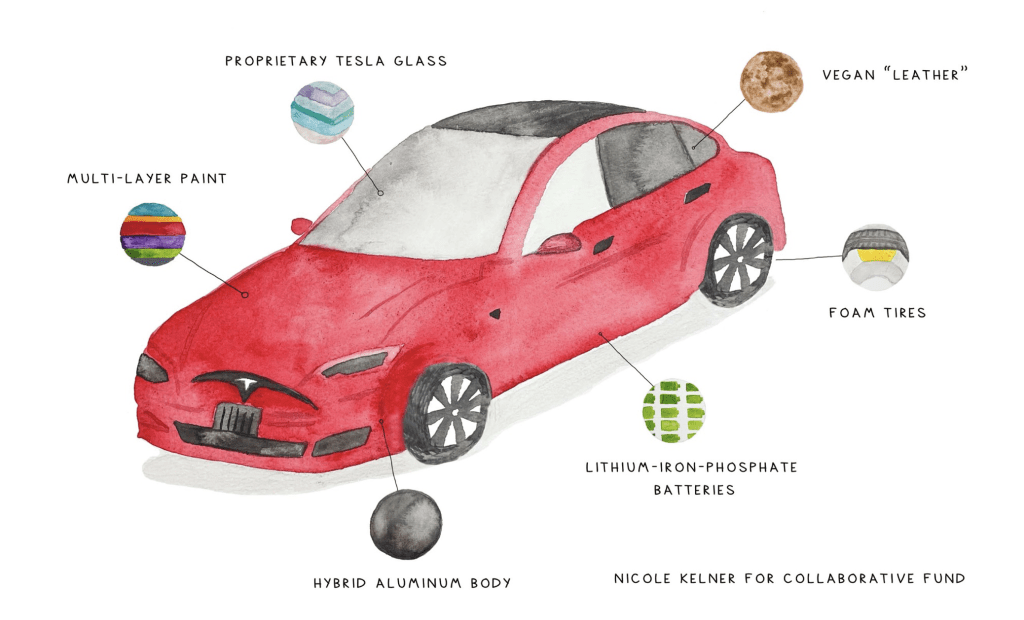
This detailed analysis reveals that Tesla’s decisions do demonstrate a commitment to sustainability. These choices are, in fact, good for the environment.
My fascination for their post is less about this specific breakdown. Instead, as I read this post, I began thinking about the many items we use in our lives and how they’d fare in such a thoughtful analysis.
Luckily, the Collaborative Fund team are thinking along the same lines and have promised a series of follow up posts breaking down other everyday objects.
I can’t wait to see what I’ll learn in these upcoming posts.
Much gratitude, team. Great work.
 A Learning a Day