
“Whatever pain you can’t get rid of, make it your creative offering.” | Bittersweet by Susan Cain
It resonated.
“Whatever pain you can’t get rid of, make it your creative offering.” | Bittersweet by Susan Cain
It resonated.
Seth shared a post today that resonated deeply
Clues that you might not be trying hard enough
You usually succeed
You rarely feel like an imposter
You already know what you need to know
You’re confident it’s going to work
If you’re not feeling stretched or dancing with uncertainty often enough, you are probably not learning.
A wonderful reminder. Thanks for sharing, Seth.
When the macroeconomic conditions are great, focus on growing faster than the growth of the category.
When the macroeconomic conditions aren’t great, focus on growing market share.
Of course, the challenge with strategy isn’t simply knowing what to do, it is figuring out how to execute against it with discipline and consistency.
As in life.
We’re all walking every day on this journey we call life.
Some days, the terrain is uphill.
On others, the terrain is downhill.
Both present different kinds of challenges. Going downhill, for example, feels great. But it also strains our ankles.
On some days, the terrain feels uphill. And on others, it feels downhill.
So much of our ability to make progress in this life lies in our willingness to just show up and keep walking – regardless of the nature of the terrain and how we feel on any given day.
Our discipline, mental fortitude, and ability to keep perspective help us transcend these variables and extenuating circumstances – both of which are ever present.
They help us find the strength we need to pick our direction and keep walking.
And then show up again tomorrow regardless of how good or bad today was or felt.
It is harder than it sounds.
But then again, life is difficult.
It is only when we accept this truth do we learn to transcend it.
Lin Manuel Miranda’s Hamilton is an incredible musical – especially so if you have even a passing interest in American history. It is a masterpiece that combines fantastic storytelling, captivating actors, and riveting lyrics. One of my favorite pieces in the musical is “My Shot.”
“My Shot” is the song that best captures the spirit of Alexander Hamilton – his seeming unlimited reserves of drive, confidence, and belief.
“I’m just like my country, I’m young scrappy and hungry. I am not throwin’ away my shot.”
There are many reasons this song resonates deeply with me. But two reasons stand out more than every other.
First, it is a song that has immigrant spirit written all over it. The hunger, drive, and almost desperate desire to prove himself and “make it” comes through beautifully.
And second, notice how the lyrics don’t say “I’m going to take my shot.” Instead, they say “I am not throwin’ away my shot.” That bit of framing with a focus on not losing (vs. winning) speaks to how powerful a motivator it is.
There’s something very powerful about that framing in our lives too. We all are given shots at making an impact over the course of our lives and careers. Maybe we’re staring at one of those shots right now.
It is on us to pay attention to these opportunities when they come our way and do our very best to not throw away those shots.
They won’t all result in home runs. But, every once a while, one of them will. And that’ll make all prior effort worth it.
The games we play in our lives require us to take actions to make progress toward certain objectives. Some of these objectives makes us money. Others aim to make us happier or healthier or both.
It becomes easier to make progress in these games once we think of the world in terms of systems and levers.
For example, imagine we set ourselves an objective to lose weight. If we thought about our body as a calorie management system, we’d realize that there are 2 levers to losing weight:
(1) Eat fewer calories
(2) Expend more calories
If we then asked ourselves which lever is more effective, we’d quickly conclude that the best way to lose weight is to eat fewer calories. We can then map this lever to a set of actions – e.g., fast intermittently or cut sugar, etc.
We’ve now reduced a vague prompt to a potential list of concrete actions we can take.
This applies to every other objective in our life. To build our strategy, we need to map out the system, understand the levers, and figure out which lever we should focus on.
Then we just need to outdo ourselves by executing with discipline and consistency.
Every once a while, we get to witness something that is incredible. I think the energy transition that is unfolding right now falls under that category.
The Bloomberg team shared a couple of charts that tell a powerful story. Renewable power (wind and solar) are beginning to get on an exponential growth curve. They are already at 13% of global power generation and those numbers are going to look very different at the end of this decade.
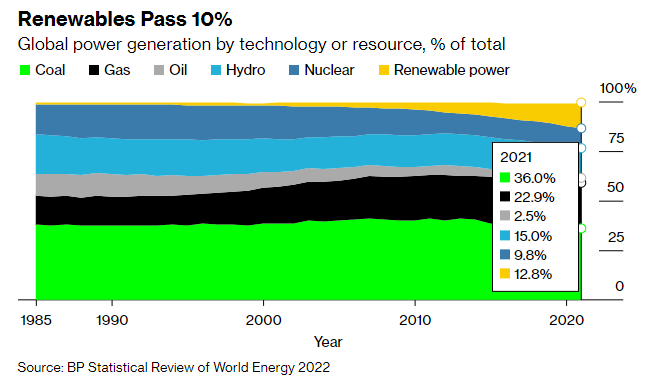
Check out that exponential growth curve. It is a pity that nuclear has stagnated as it is still significantly better than some of the other sources on offer. More on that another time.

When we talk about energy transitions, someone always asks the “what about China question?” China’s adoption of renewable power generation in the past decade has been blistering.

This is all fantastic news. As this transition accelerates, our storage capacity will get better. It is a virtuous cycle.
And it is only going to get faster as renewable power continues to become cheaper. We are already at the point where it doesn’t make financial sense to not build a new solar or wind power plant to generate electricity.

And, incredibly, electricity from renewables continues to become cheaper.

Lithium-ion batteries are working to keep up as well.
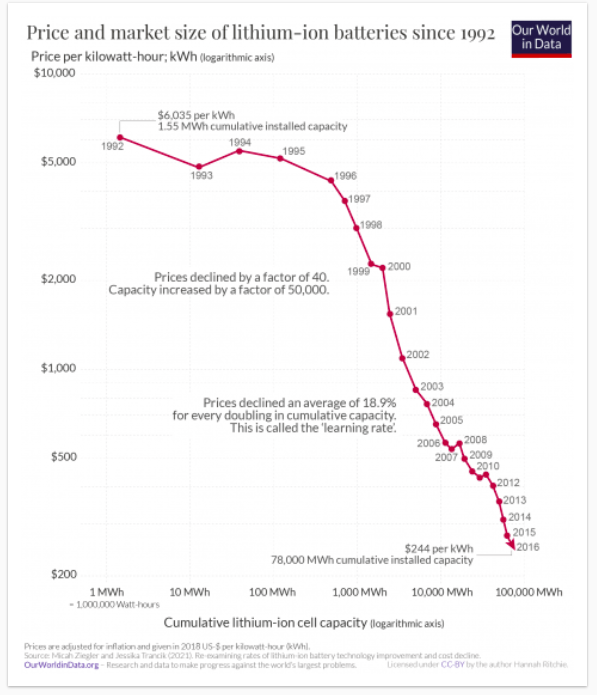
Incredible.
Our propensity to make an error of judgment is directly proportional to how desperate we feel in our quest for the outcome of the moment.
I have a simple 4 x 6 months framework when I think of jobs in product management and other similar roles in technology.
It takes 6 months to get on top of the details and figure out what we want to do.
In months 7-12, we begin notching up our first set of wins and feel “in flow” (assuming some competence :-)).
Months 13-18 is when we’re on top of our game. We notch up some more wins as we reach the top of our learning curve.
In months 19-24, we realize we’ve stopped learning. It is now time to figure out what comes next.
Of course, the specifics of every person’s timeline may be a bit different (e.g., 18 months to 24 months to 30 months). But the arc tends to be consistent.
It’s just helpful to know what to expect.
It takes years of deliberate practice to show up as someone with “natural talent.”
 A Learning a Day