
Taking it personally and not doing it enough

Ben Horowitz has shared some phenomenal posts on leadership over the years. A teammate reminded me of a post that I consider one of the best of the lot today- “What’s The Most Difficult CEO Skill? Managing Your Own Psychology.”

As he outlines the unique challenges of leading a company – tough job, nobody to blame, too much broken, lonely – he shares a powerful note on one of two mistakes he sees CEOs make.

“1. They take things too personally

2. They do not take things personally enough

In the first scenario, the CEO takes every issue incredibly seriously and personally and urgently moves to fix it. Given the volume of the issues, this motion usually results in one of two scenarios. If the CEO is outwardly focused, she ends up terrorizing the team to the point where nobody wants to work at the company any more. If the CEO is inwardly focused, she ends up feeling so sick from all of the problems that she can barely make it to work in the morning.

In the second scenario, in order to dampen the pain of the rolling disaster that is the company, the CEO takes a Pollyannaish attitude: it’s not so bad. In this view, none of the problems are actually that bad and they needn’t be dealt with urgently. By rationalizing away the issues, the CEO feels better about herself. The problem is that she doesn’t actually fix any of the problems and the employees eventually become quite frustrated that the Chief Executive keeps ignoring the most basic problems and conflicts. Ultimately, the company turns to crap.

Ideally, the CEO will be urgent yet not insane. She will move aggressively and decisively without feeling emotionally culpable. If she can separate the importance of the issues from how she feels about them, she will avoid demonizing her employees or herself.”


This is powerful because this isn’t just applicable to leading a company. It works just as well in our own lives too. Learning to care enough about the problems to give it our best without emotionally attaching ourselves to the outcome turns out to be the wisest way forward.
Don’t Look Up and the Goat

There’s a great anecdote from the sets of “Don’t Look Up.” Jennifer Lawrence, Jonah Hill, and a few others of the star studded cast regularly referred to Meryl Streep as the GOAT.

In one of the photoshoots a few days in, Jennifer referred to the Goat.

And Meryl said – “That’s right, just tell the old goat where to go.”

“Meryl, you know GOAT means greatest of all time, right?”

“Oh! No!”


On the one hand, this was clearly awkward. One of those moments that illustrates how important it is to ensure newbies understand the jargon we use in our day-to-day.

But on the other hand, I was touched by Meryl Streep’s lack of ego. That she just assumed the rest of the cast referred to her as an “old goat” says a lot about her.


Don’t Look Up is a hilarious satire – it tells the story of two low-level astronomers who go on a giant media tour to warn mankind of an approaching comet that will destroy planet Earth. Poignant, funny, and powerful all at once.

Expecting more

I was jotting down my end of workday reflection recently. I had a niggling feeling that I’d gotten less than I hoped.

But, when I looked up at the “done” list, I found that the opposite was true.

I had started the day hoping to get 2 priority tasks done. But, halfway through the day, encouraged by my progress, I added 3 more items to the list. I only got through 1 of them.

There’s a lesson here about happiness being a function of reality AND expectations. This is definitely true when planning our priority list for a day. The more ambitious our list, the unhappier we will be.

The other lesson is about how quickly we adjust to wanting more. It takes discipline and self-awareness to stop ourselves when we hit enough.

In our priority lists and otherwise.

Details and micromanagement

A common trend among leaders I’ve learned a lot from is their willingness to dig into the details. Different folks chose to engage in different kinds of details. But, they almost always cared deeply about some detail.

This means lots of curiosity, feedback, and micromanagement.

Micromanagement is simply the flip side of this desire to engage with the details. And, while some do a good job minimizing it, it never goes away. It’s part of the package.

Two lessons I’ve learnt about this –

(1) Be aware of the details your manager/leader care about. Expect to be micromanaged – but, as part of the process, expect to learn a lot.

(2) The degree of micromanagement is inversely proposal to their trust in your competence. Over time, the degree of micromanagement should go down. Else, it is time to reflect about how well you’re converting the feedback into learning.

Exercise themed new year resolutions

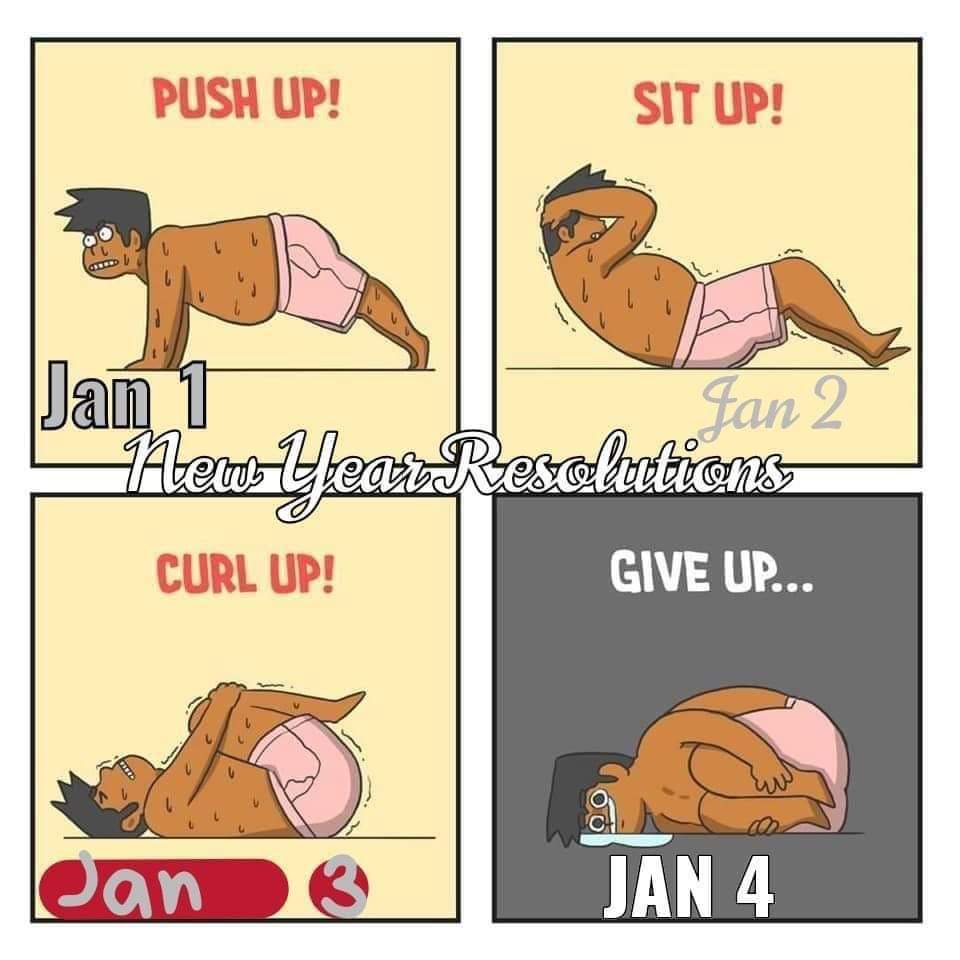
I chuckled when I saw this image of exercise themed new year resolutions.

It illustrates how resolutions/themes are easy to set and difficult to follow through.

Simi Garewal on Twitter: "They are more human than us..  https://t.co/BE5VVxS1gl" / Twitter

It hit home because wellness was one of my 2 themes this year. But, unlike past year, the theme I’ve chosen to focus on is building a reliable self-care system during the year.

Looking forward to seeing how the system building theme works. More to follow.

Plainspoken x constructive

I was sharing some feedback on a teammate recently and was trying to articulate what made them special. I realized it was their ability to be both plainspoken and constructive.

It is wonderful when people around us are plainspoken. It means we are in an environment that fosters the care and authenticity required to be so.

But, when they combine being plainspoken with constructiveness, the ensuing collaboration and positive momentum is irresistible.

(H/T Deb Liu for a great post on being plainspoken)

14 Peaks

We watched 14 Peaks* recently. There are 14 mountains with summits greater than 8,000 meters (“eight thousander). 14 Peaks follows Nepalese climber Nirmal “Nims” Purja and his team in their successful attempt to climb all eight thousanders in 7 months.

The previous record was 7 years.

Nims wanted this project to be a source of inspiration for all humankind – a triumph of skill, grit, and endurance. As everyone he spoke to said it was impossible, he called the initiative “Project Possible.”

He achieved all those aims. It was definitely a triumph of skill, grit, and endurance. But, it was a lot more than that. There were a couple of moments where the team went out of their way to help climbers in trouble – putting their own project and lives at risk.

There was, however, one moment that stood out to me. The setting was Mount K2 – the second tallest mountain in the world and one of the deadliest mountains in the world. The existing groups of climbers on K2’s base camp had been thwarted by the weather. They describe the mood in the camp as depressed.

Then Nims and the Project Possible team arrived. They got the team re-energized with a party that evening in the mountain. The next day, Nims laid out the plan and expressed his confidence in his team’s ability to scale the mountain. There were some inevitable naysayers. But, Nims was a picture of confidence and optimism.

The Project Possible team scaled K2 in the next 3 days. And, 20 other climbers followed in their footsteps.

Nims talked about the importance of optimism and confidence in leaders earlier. It was one of those moments which showed him walking the talk beautifully.

*Note: The film was nice – without being great. It would have benefited with more visual guides for the viewers to put these insane achievements in context. The feats in the movie were extraordinary and made it worth the watch.

Checking – an exercise in self-sabotage

A habit that I’ve made half-hearted attempts to change in the past two years is picking up the phone first thing in the morning and opening up/checking my (personal) email.

I describe my efforts as half-hearted because I wasn’t committed to it. I’d occasionally think about changing it. Then, I’d slip into familiar patterns the next morning and feel particularly good about getting out of bed with my inbox cleared.

Half-hearted commitments are exercises in self-sabotage because you don’t do much to change your environment to make change happen. So, you slip back to old ways and then make (reasonable sounding) excuses for yourself. Ergo self-sabotage.

Such exercises don’t seem to do much damage in the short run – seem being the operative word.

Every time we make a half-hearted commitment where we don’t follow through, we reduce our belief in our ability to commit. Our integrity gets compromised – one daily excuse at a time.

So, I spent some time thinking about this habit over the past 3 weeks. After wrestling with it for a bit, I’ve come to realize that what annoys me isn’t just the checking email first thing in the morning. It is the stunning lack of depth that the act of checking inspires.

And, after years of pruning sources of shallow engagement in my day, this might just be the final frontier (as is the case with bottlenecks, I’ll find out after I prune this).

So, I’ve finally made the commitment to changing my habit. This means getting to work fixing my environment. This is a mix of guidelines (move any checking/browsing onto a bigger screen) as well as changes – e.g., ensuring there are books everywhere I usually slip into checking/browsing on the phone, changing up my morning routine.

I expect it to be two steps forward and one step back for a while as I iterate.

Looking forward to seeing how it goes.