Discipline problems and clarity problems

When we struggle to follow through on our hopes of building a new habit, our default reaction is to blame it on a lack of discipline.

While discipline is sometimes the culprit, I’ve found that we often fail to clarify why that new habit matters. Developing a new habit requires us to break old ones. And, it is hard to do that without clarity on why the juice will be worth the squeeze.

It takes thought and effort to develop that clarity – significantly more effort than it takes to make the commitment.

But, the presence of that clarity can help us summon the discipline we need.

Discipline problems are often clarity problems.

Opposite reactions and an inner compass

We were getting out of a parking lot on our bikes recently. Our 4 year old was having some difficulty maneuvering her bike. A man who was waiting for her to turn to get into his car gave me an exasperated look.

Once she managed to get out and cross the road, I noticed folks in one of the cars that was waiting give her and us a warm smile.

I’ve experienced this a few times as a parent over the years. A year or so ago, we saw this play out in the seats in front of us on a flight. Our then one and a half year old tapped on the seat in front of him just as we were getting seated. In response, the man in front of him told him off.

I tried reminding him that he’s just one and a half and is just getting seated. “My kids didn’t behave this way when they were small” – he shot back and continued to grumble for the next ten minutes about having to sit in front of misbehaving kids.

Another passenger in the same row tried reminding him that the offending kid was all of eighteen months. He also shared that he missed his kid while he was traveling and gave us kind smiles.

To no avail.

They finally moved seats a few minutes later.

Such experiences remind me that we perceive situations differently. This perception is a result of our mindset, our environment, and our previous experiences.

They also serve to remind me of the importance of an inner compass. The more dependent we are on the approval and perception of others, the more likely we’ll find joy and tranquility absent in our days.

Deciding to paint a masterpiece

“You can’t really decide to paint a masterpiece. You just have to think hard, work hard, and try to make a painting that you care about. Then, if you’re lucky, your work will find an audience for whom it’s meaningful.” | Susan Kare, designer of the original Mac interface.

Filed as a beautiful reminder of the idea that you never know if a good day is a good day. So, just keep swimming, keep swimming

(H/T: The Practice by Seth Godin)

Rules and exceptions

I posted about a proposal to improve government systems a few days ago. I received notes from a couple of folks in response either empathizing or reminding me that government systems are bad as a rule because we don’t have any options.

I also posted about the first rule of giving good advice yesterday – don’t give advice unless it is asked. Two moms wrote in wondering/suggesting if moms should be an exception. :-)

All of these notes are valid.

As a rule, government systems suck. But, there are plenty of exceptions. We’ve all experienced them. California DMVs, for example, are known for poor service. And, yet, there’s a DMV close by which is outstanding. Similarly, the government of Singapore could compete with any high performing corporation in its ability to manage processes.

As a rule, it is helpful to not give advice unless it is asked. A lot of time and energy is wasted in doing so. But, there are times when the rules don’t apply. People sometimes need to hear what they don’t want to hear.

Every rule has exceptions. Those exceptions often prove the rule.

And, perhaps most interestingly, the opposite of a good idea is often a good idea.

Archetypical cycle and the internet

I haven’t synthesized what I’ve taken away/learnt from yesterday. But, I found myself reminded of a few notes I’ve thought about in the past:

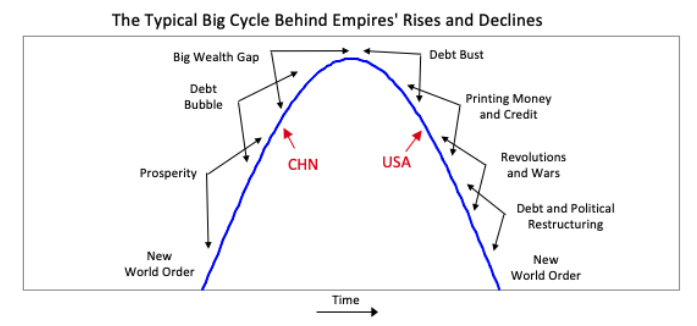
(1) Ray Dalio’s powerful post about “archetypical cycle of internal order and disorder.” It is a long read but it points to his framework for the rise and decline of empires.

(2) The description of the internet as a giant machine that simply gives people what they want. That then led me to continue to think about the societal cost of algorithmic feeds and the resulting fracture of newspaper business model resulting in the drive to serve never-ending niches.

(3) And, related, Morgan Housel’s note – “Tell people what they want to hear and you can be wrong indefinitely without penalty” – is a beautiful articulation of a powerful and sometimes sad truth.

Dissents

There is a tradition in the US Supreme Court for justices in the minority to write a “dissent.”

I used to wonder why these mattered until I read Ruth Bader Ginsberg’s note on dissents – “Dissents speak to a future age. It’s not simply to say, ‘My colleagues are wrong and I would do it this way.’ But the greatest dissents do become court opinions and gradually over time their views become the dominant view.”

It is a beautiful articulation of why dissents matter.

It is also a useful reminder about playing the long game on disagreements that matter to us.

Government applications and ETAs

I recently sent in my passport for renewal.

A few days later, I began wondering if everything was okay. I hadn’t heard anything from the company processing the passport or the consulate. After some mucking around, I realized there was no online portal where I could check the status either.

Great.

Coincidentally, an email arrived the next day confirming their receipt of my application. They shared that it was now “processing.”

I have no idea when I will receive the next update.

Unlike visas/work permits/immigration documents, renewing my passport doesn’t cause anxiety. But, such documents are important and delays in processing can be painful. For example, my driver’s license was stuck in processing recently and I had no idea why till I went to a DMV and requested their help to resolve it.

I think there’s an easy way for our experience with government applications to by so much better. This product would have 3 requirements:

1) A place online where I can check my status
2) An ETA (estimated time of arrival) for processing my application and an explanation if the ETA has changed
3) Any issues or options to expedite it (e.g. “pay money here to process is quicker” or “no options – please just wait”)

These 3 requirements wouldn’t solve every problem. But, I think they’d go a long way in making the experience significantly better.

Failures of kindness

“So: What do I regret? Being poor from time to time? Not really.

Working terrible jobs, like “knuckle-puller in a slaughterhouse?” (And don’t even ASK what that entails.) No. I don’t regret that.

Skinny-dipping in a river in Sumatra, a little buzzed, and looking up and seeing like 300 monkeys sitting on a pipeline, pooping down into the river, the river in which I was swimming, with my mouth open, naked? And getting deathly ill afterwards, and staying sick for the next seven months? Not so much.

Do I regret the occasional humiliation? Like once, playing hockey in front of a big crowd, including this girl I really liked, I somehow managed, while falling and emitting this weird whooping noise, to score on my own goalie, while also sending my stick flying into the crowd, nearly hitting that girl? No. I don’t even regret that.

But here’s something I do regret:

In seventh grade, this new kid joined our class. In the interest of confidentiality, her Convocation Speech name will be “ELLEN.” ELLEN was small, shy. She wore these blue cat’s-eye glasses that, at the time, only old ladies wore. When nervous, which was pretty much always, she had a habit of taking a strand of hair into her mouth and chewing on it.

So she came to our school and our neighborhood, and was mostly ignored, occasionally teased (“Your hair taste good?” — that sort of thing). I could see this hurt her. I still remember the way she’d look after such an insult: eyes cast down, a little gut-kicked, as if, having just been reminded of her place in things, she was trying, as much as possible, to disappear. After awhile she’d drift away, hair-strand still in her mouth.

At home, I imagined, after school, her mother would say, you know: “How was your day, sweetie?” and she’d say, “Oh, fine.” And her mother would say, “Making any friends?” and she’d go, “Sure, lots.”

Sometimes I’d see her hanging around alone in her front yard, as if afraid to leave it.

And then — they moved. That was it. No tragedy, no big final hazing.

One day she was there, next day she wasn’t.

End of story.

Now, why do I regret that? Why, forty-two years later, am I still thinking about it? Relative to most of the other kids, I was actually pretty nice to her. I never said an unkind word to her. In fact, I sometimes even (mildly) defended her.

But still. It bothers me.

So here’s something I know to be true, although it’s a little corny, and I don’t quite know what to do with it:

What I regret most in my life are failures of kindness.” | George Saunders’ commence speech at Syracuse University in 2013


Beautiful. It resonated.

Doctor Katalin Karikó

Doctor Katalin Kariko’s story has all the ingredients of a fascinating Netflix/Amazon limited series show. As a young biology student in 1976, she was fascinated by the potential of messenger RNA to create vaccines and drugs. After her PhD, she moved to the United States to realize this dream, fell out with her first boss at Temple University (who attempted to get her deported) before getting a job at UPenn.

But, she was struggling with getting grants as there were significant obstacles with making mRNA work in practice. Faced with bosses losing patience, a cancer diagnosis, and immigration issues, she decided to take a demotion with a salary less than that of a lab technician rather than lose her job.

A chance meeting with a respected immunologist – Drew Weissman – who had just moved to UPenn researcher changed everything. She found a partner who believed in her and was willing to fund her research and collaborate. By 2005, they had found a safe way to use mRNA in vaccines. They published a paper announcing this and this was followed by… the sound of crickets. No one seemed to be paying attention.

But, someone was. In 2010, Derrick Rossi, a Stanford post doc, had co-founded a company called “Moderna” with the goal of using their findings.

In 2013, UPenn rejected her request for Professorship again and laughed her out of the room when she said she’d be accepting an SVP position at a small Germany company – BioNTech – that had been licensing their technology. “They don’t even have a website” – they said.

We all know how it has played out. But, it took 44 years from when she first decided to dedicate her career to mRNA, 25 years after she took a demotion, and 15 years after publishing a paper that will probably result in a Nobel prize before it all began to work out.

There are so many lessons from this heroic story. But, one that that stood out for me was about how it often takes decades before becoming an overnight sensation.

Inspirational.