We’re replacing your quarterly bonus with a lottery

“We’re replacing your quarterly bonus of ~$350 with a lottery.

The prizes are exciting. There are 1300 prizes with the grand prize at $100,000. But, the remaining 89,000 or so of you go back home with nothing. 

Oh, and to be eligible for the lottery, you need perfect attendance through the quarter. Getting sick is forbidden.

It’s exciting!”

The United Airlines Executive team shared these plans with their 90,000 union workers. The only surprise was that it took them 3 days to back track. It must be hard to appreciate the importance of ~1500 extra dollars in the year when you make upwards of ~$50M as a team.

It is easy to sit on the outside and question the intelligence and competence of the team that came up with this. But, it is likely the team is full of smart, qualified and generally accomplished people.

I’ve found it better to acknowledge that smart groups are capable of making dumb decisions if the culture of the group isn’t right. The truest manifestation of culture is in a decision making process. And, how a company hands out incentives, promotions and treats its employees and customers is the culture in action. This decision, then, points to a broken decision making process.

If you want to fix a group’s behavior, fix the culture. And, while that’s easier said than done, examining the decision making process is likely a good place to start.

Going to be friends

I’d shared a post about a reflection from the movie Wonder earlier this week. It turns out that I received another special gift from the movie – a song called “We’re going to be friends.”

I also stumbled on a cover of the same song by a contestant on “Voice”  that has been stuck with me.

http://www.youtube.com/watch?v=h1kYF9nyNAM

The song brought back a rush of memories and emotions as it is about those moments when you realize that you’ve found a friend. I thought of many such moments in the years past when “I could tell we’re going to be friends.” As our lives progress, many of the happiest memories we have are in the company of friends. It somehow gets harder to make great friends over the years. I think that is because friendship requires us to take a chance on people. And, perhaps our propensity to do so decreases as get older.

But, even so, when it does happen, it is a special feeling.

Some of the folks I thought about are still very close, some less so and some not at all. And, yet, every one of them helped me along the way in this journey.

I am very grateful for all those who took that chance on me.

Clarity over completeness

It is natural to want to be complete when communicating your work. You understand, better than anyone else, the kinds of assumptions and caveats that go into the results. They shouldn’t be taken at face value and, more importantly, there are eleven edge cases that you thought of.

However, communication isn’t about you. Instead, it is entirely about the receiver and how what you write or say fits in their context. There is the rare situation when their context demands all the assumptions, caveats and edge cases.

But, for everyone else, we need to focus on clarity over completeness.

If the purpose of our communication is to bring them along or tell our story (and it generally is that), it needs to start with clarity.

(H/T to the wiser friend who gave me this advice)

Wonder, perspectives and standing ovations

Wonder is a 2017 movie about Auggie, a child with facial deformities, going to school for the first time in fifth grade. It is one of the most beautiful movies I’ve watched in a while.

The most beautiful thing about the movie is its depiction of perspectives. It shows similar events from the points of view of Auggie, his sister and her best friend. It is a master stroke as you begin to realize that the story isn’t just about Auggie (it just as easily could be) and connect deeply with other characters in the movie. And, it brings to life the idea that every person has their own challenges and viewing them based on their perspective and experiences would likely transform your view about them.

As a result, it is but natural that the overarching theme of the movie is kindness – “When given the choice between being right or being kind, choose kind.” But, a line that stayed with me is reflection from Auggie at the end – “Maybe the truth is, I’m really not so ordinary. Maybe if we knew what other people were thinking we’d know that no one’s ordinary, and we all deserve a standing ovation at least once in our lives.”

It is poignant and true. Everyone around us has struggles of their own. And, everyone does deserve a standing ovation at least once in our lives.

Planning for the middle

The problem with career and life plans is that they don’t work as per plan. But, that doesn’t render the act of building plans useless.

The trick, at least in my mind, is cultivate the habit of planning without ever obsessing about plans. And, the key to a good planning process is to be crystal clear about long term direction and short term process.

Doing so helps us avoid the trap of getting too caught up about the middle. Planning for the middle years of a 3-5 year or longer plan is a thankless task. There is no way you’re going to be able to predict the exact path and attempting to do so will likely only close you to possibilities. Planning for these middle years is also a recipe for unnecessary stress and disappointment.

When you’re at the beginning, don’t obsess about the middle, because the middle is going to be difference once you get there.

Awareness of the context

There’s a time to go slow. There’s a time to go as fast as you possibly can.

There are times when talking is helpful. And, there are times when it is best to stay silent and listen.

There are moments when it is worthwhile to try your luck. And, then there are times where it is best to be conservative.

There are situations when being gritty and persistent is helpful. Then, there are situations where it is best to quit and try something else.

The good news is that it is always a good time to approach things with a learner’s mindset. But, beyond mindset, the success of most things we do is dependent on the context. Even an action with the best of intentions and planning can be completely back fire when out of context.

The questions, then, are – are we being intentional about developing our awareness of the context we are in? How good are we at being context aware through the course of a day?

And, in the spirit of a learner’s mindset, what could we learn to get much better?

3 lessons from The Power of Moments

Here are 3 lessons I’m hoping to internalize from “The Power of Moments” by Chip and Dan Heath.

  1. EPIC – Elevate, Pride, Insight, Connection – and paying attention to transitions and milestones. Great moments trigger one of –
    • Elevation: That moment when you reached the top of a hill you were trying to climb and saw the view for the first time or when someone blew you away by their inspiration or thoughtfulness. Typically this involves surprises (e.g. an awesome customer service experience when things went bad), raised stakes or sensory appeal. (Nugget: Companies spend a disproportionate amount of time dealing with customers who give 1 and 2 out of 10 in feedback surveys. Elevating the positives – 4-6 – earns you ~9x more money and benefit than fixing the negative.)
    • Pride: That moment when you received a standing ovation or recognition for something you did.
    • Insight: When an insight crystallized and changed how you saw the world. These moments don’t come easily – they often require us to “trip” over the truth thanks to powerful experiences or questions.
    • Connection: When you felt deeply connected to everyone around you.

And, we are most likely to trigger one of elevation, pride, insight and connections during transitions, milestones and “pits” (or negative experiences). Interestingly, First Round Capital had a nice article about how Warby Parker excels in making moments matter by paying attention to every part of the employee lifecycle. That was a textbook example of putting these ideas in action.

2. Excellent mentorship = High expectations + Assurance + Direction + Support. This applies to great parenting as well. The key step in this is process is giving direction by designing levels. Designing levels that get people excited to make progress is what video games do well. Fitbit is a great example of using levels to motivate users too – 10,000 steps was an arbitrary landmark until Fitbit came along.

3, Responsiveness is the key to strong relationships. Relationships are about shared values. A group’s humor reflects these shared values – it is why inside jokes are a key part of every functioning group. The key value that strong relationships share, then, is responsiveness – i.e. that you are attuned to the other person.
For example, the simple idea to get physicians to ask patients “what matters to you as part of this treatment” revolutionized children’s healthcare in Scotland. Physicians and patients connected like never before because they’d taken the time to understand each other.
The question for us – Do we understand what matters to the people we care about? Deep questions, thus, are a great way to get to know people and can be powerful relationship building moments.

In the spirit of meaningful endings, I’ll end with a paraphrased quote from the book I’d shared a few weeks ago. It summarizes the importance of moments beautifully.

In the short term, we often choose to fix problems over creating moments. In the long term, that backfires. Moments are not a means to the end, they are the end. They are what we remember in the end.

What Is Going On In Ridesharing?

Strategy is best understood when you take a holistic look at what is going on. It is hard to parse the complete rationale for good strategic moves in isolation. But, take a step back, zoom out and the view becomes a lot clearer. That is definitely the case when weighing moves in ride sharing these days.

News broke this week that Uber is planning on selling its South East Asia unit to rival Grab. This is similar to what they did in China with Didi. So, it seems to make sense.

But, in the spirit of stepping back, let’s take a look at the state of global ridesharing relationships.

Once you look at this, is it any surprise to hear Uber might be partnering with Grab?

Uber, Softbank, Didi, Grab are part of a web of relationships that brings together some of the biggest global ridesharing players. This is particularly important for Grab at a time when its battle with Go-Jek is intensifying in Indonesia – one of the most important South East Asian markets. Go-Jek is armed with a partnership with Waymo (Google’s autonomous car unit) thanks to its latest funding round.

Now, such battles in the ride sharing world are expensive and distracting. Why have Grab fight Uber AND Go-Jek? Especially when it is Softbank’s money at stake?

Didi is the global ride-sharing powerhouse. In an August note on cars titled “From Daimler to Didi,” I’d called out the fact that I was long Didi in the global ride-sharing game.

In the race to dominate ride sharing, Uber raised massive amounts of funding and attempted to obliterate its rivals. Didi, on the other hand, took a different approach. It first merged with its biggest rival in China, then persuaded Uber to get out of the country (in return for a 20% stake) and has since been using its war chest of funds to invest in ride sharing networks in South East Asia (Grab), the Middle East (Careem), Europe and Africa (Taxify). Didi may be creating the ultimate network of ride sharing services.

For the longest time, ride-sharing seemed to be a battle between two opposing styles personified by Travis Kalanick of Uber and Jean Liu of Didi. While Travis focused on a testosterone fueled fight, Jean Liu used her considerable deal making acumen and an almost collaborative approach to competition to sway the pendulum decisively toward Didi.

In the ride-sharing world, 2017 was as much about the self-destruction of Uber as it was abotu the rise of a dominant Didi. A newly added $9.5 Billion Dollar war chest has since been deployed to make acquisitions like 99 Taxis in Latin America, investments in bike-sharing, car-sharing and autonomous cars. Didi – without question, is the world’s foremost ride sharing superpower.

Didi has handled its rise with style and PR smarts. The firm’s PR engine has ensured all attention has been focused on Jean Liu, its popular President. Jean Liu, with her impressive deal making acumen, has also been the anti-Travis figure that ride-sharing and Didi needed. Here’s an example excerpt from a recent piece on Wired that served as both a profile about Didi’s ambitions as well as Jean Liu –

Where Uber and its US peers talk of upending established economic models, she wants Didi to be seen as a calming force. “You talk about why we’re different from Silicon Valley firms, why we don’t just talk about disruption,” she says, suggesting some tech companies are insulated from the real-world risks her drivers and passengers face. “When you order something from an e-commerce company you don’t expect to be killed or robbed, right? In this business, you do.”

“You cannot afford to be disruptive, if you haven’t thought about everything,” Liu says finally, summing up the anti-Uber philosophy that will guide her during the battles ahead. “I think the key is: be humble. And be open minded. And not to think you know everything.”

Very. Smart.

So, what lies ahead in the world of ride-sharing? I suspect the Softbank playbook would look something like –

  • Uber does indeed go ahead with selling its Asia Pacific operations to Grab.
  • Uber also sells its India unit to Ola to focus on North America and Europe.
  • Didi, on the other hand, would have plenty on its plate with China, South America (99 Taxis) and Africa (Careem, Taxify).
  • Over time, we’d see more consolidation with Didi possibly buying Grab and operating à la P&G/Unilever/Volkswagen.

As it stands right now, the main obstacle to the success of this global ridesharing happy family dream is Waymo.

Why Waymo matters – understanding the real battle. To understand why Waymo matters, we must step back further. There are two massive upcoming changes in the world of transportation –

  • Internal combustion engines to electric
  • Human driven to autonomous

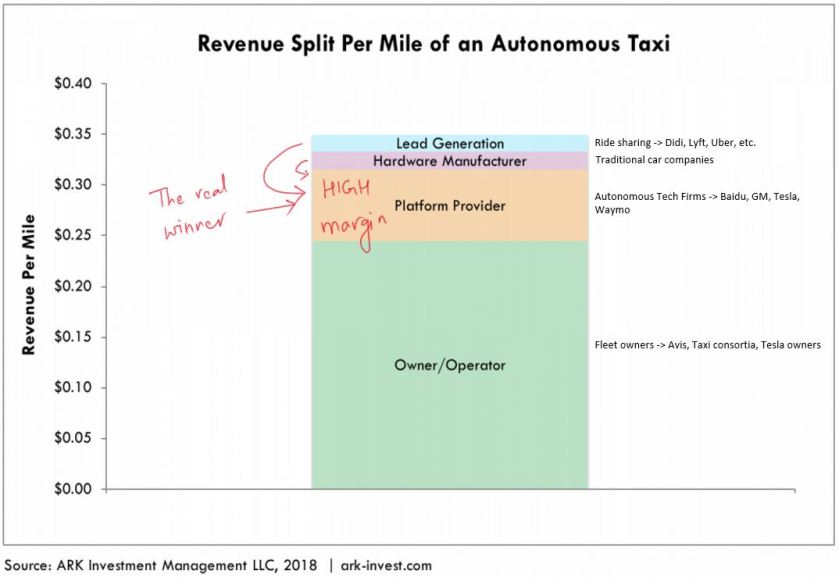
While traditional car companies are focused on staying relevant in the era of the electric car, the end-game is likely going to be all about ensuring survival in the age of the autonomous vehicle. Here, it helps to take apart a useful speculative analysis by Ark Invest on the revenue per mile from autonomous cars. They predict the following –

  • 70% of revenue goes to fleet operators (e.g. Avis, taxi companies)
  • 20% of revenue goes to platform providers (e.g. Waymo, Baidu, Tesla, etc.)
  • 5% to hardware manufacturers (e.g. traditional car companies)
  • 5% to lead generators (e.g. Didi, Lyft, Uber, etc.)

However, these are just revenue projections. Traditional car companies and fleet owners stand to simply provide the commoditized hardware. The winner, in terms of profitability, is going to be provider of the software platform. With more autonomous test miles In California in 2017, Waymo is perfectly positioned to be that platform.

But, that’s assuming ride-sharing companies (and traditional car manufacturers) are content being “lead generators.” Everyone will want to move up the food chain.
This is also where ride-sharing companies are uniquely positioned to compete with Waymo/Google. Building the world’s best machine driven platform requires engineering prowess AND vasts amounts of data. Google may boast the engineering prowess but ride sharing companies possess treasure troves of data. While Google will get a taste of some of that via its partnership with Go-Jek and Lyft, it will be be tough to compete with a partnership that shares data across Didi, Careem, Taxify, Grab and Uber.

And that, to me, is the game Softbank is playing to win.

Links for additional reading

  • Uber planning to sell South East Asia unit to Grab – on CNBC
  • Waymo Go-Jek – on Reuters
  • Didi buys 99 – on Bloomberg
  • Didi raised $9.5B in 2017 – on Quartz
  • From Daimler to Didi – on Medium (prior Notes by Ada)
  • Didi’s global ambitions (part Jean Liu profile)- on Wired
  • Autonomous car revenues per mile – on Ark Invest
  • Autonomous miles in California – on The Verge

Molars

We learnt recently that the onset of molars is a period that most toddler’s parents remember for a while. It is a toddler’s first experience with sustained pain over a couple of days and it is understandably hard for both the child and the parents.

During this experience, I found myself reflecting about the onset of my molars. I definitely don’t remember them. But, I’m sure that mustn’t have been easy for my parents. And, yet, I haven’t ever explicitly thanked them for my crankiness, crying fits and general annoyance (thanks mom). Neither would it have been the dominant strategy for my mom to expect me to do so.

It was then that I began to internalize one of the more fascinating lessons – and there’s no lack of competition – emerging from this parenting journey. Parenting would suck if we walked around with expectations. Parenting, like most – if not all – things we do, is a selfish act. And, having expectations is our attempt at pretending it isn’t.

Then again, this lesson isn’t really about parenting. A simple equation to understand what drives our happiness is reality over expectations. We work hard at improving the numerator by working hard on our careers and lives every day. In the race to do so, it is easy to forget that we can shape the denominator by working on our mindset.

As with all equations, it turns out that working on the denominator matters just as much.