Self taught and self talk

As we grow, the proportion of our learning that is self taught increases. There are a few reasons for this.

First, completing formal education removes formal teachers and cohorts who’re going through what we go through. Second, work doesn’t lend itself naturally to coaching. So, it is on us to teach ourselves the skills we need. And, finally, we hopefully understand ourselves more and our able to absorb what we need from the world and tailor our curriculum to suit our needs.

The good news is that, with a bit of practice, we can become pretty good teachers. But, the bad news is that it requires us to master the art of good self talk.

We’ve all experienced this with our teachers. We’ve had great teachers who have so much wisdom to dispense that we hang on to every word they say. But, we’ve also had teachers who’ve played havoc with our self esteem.

Well, we can have the same effect on ourselves except ours is multiplied by a million given the amount of time we spend with ourselves.

There’s a lot that can be written about self talk. But, it boils down to one question – how do you respond to going through something disappointing? 

There tend to be three responses – running away from the situation, accepting the facts and beating ourselves up or focusing on the learning and moving on. The most important first step is understanding which of these is your default response. Not too long ago, mine involved beating myself up. And, as you might imagine, the consequences of understanding it and, over time, fixing it, are immense.

The war against coal is over

Scott Pruitt, the Chief of the Environment Protection Agency, said today that “The war against coal is over.” He would be rolling back a rule to limit greenhouse emissions from existing power plants today. They can go back to producing coal.

He is right in a sense. The war against coal is indeed over – but, for reasons different than he thinks.

As Stanford Professor Tony Seba explains, The cost of solar has moved from $100/Watt in 1970 to $0.33/Watt in 2012 – a 303x decline. Solar prices go down roughly ~11% every year. Compared to fossil fuel sources which have gotten more expensive, Solar’s costs have improved between 1800x and 5000x. As a result, the install base has doubled every year since 2000.

Everything I’ve read on behavioral economics has taught me that the best way to get us to make better decisions is to align the environment and incentives. Solar is getting cheaper and it will soon become a no-brainer, economically, for the world to switch to solar. I am optimistic about this happening in the next decade.

And, I am excited for that and the end of the war on coal.

How to: Network

 Networking is one of those words that inspires strong reactions. Most words that are perceived as business jargon get that reaction. 
 
It also doesn’t help that there are a lot of myths about how networking is best done. I’ve seen posts about people claiming to know networking “gurus” who work a long and information filled spreadsheet while also seeing notes from others who refuse to network (in the traditional sense at least) and are successful anyway
 
To understand how to do something, we must understand what it means, why it matters and what the basic principles that govern it are.
 
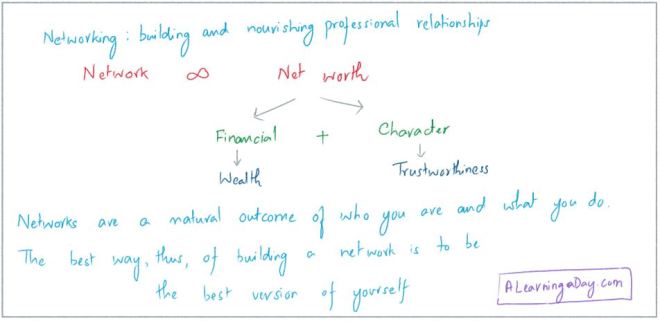
What it means: Networking is building and nurturing professional relationships.
 
Why it matters: As with our personal lives, building and nurturing meaningful professional relationships helps both our career advancement and our happiness. Our network helps advance our careers and businesses as we can call on favors or help at crucial times. And, they help our happiness because, well, we are human.
 
Principles: Your network is directly proportional to your net worth. And, your net worth is a combination of two things – your financial net worth and your character net worth. Let’s break these down. 
  • Financial net worth: This is a reflection of how wealthy you are. There are very few billionaires who have difficulty calling for professional favors. 
  • Character net worth: This is a reflection of your character. Think about people at work and in your community who are held in great respect by a lot of people. These folks can call on a network simply because of the value they’ve added to others’ lives by being good people. I think the sign of a good character is the presence of integrity. Integrity comes from the latin word “integer” which means whole. Stephen Covey defined it as the ability to make and keep commitments. The beauty about folks who make and keep commits is that they walk their talk and talk their walk. As a result, they are consistent and whole. And, that consistency over time builds the sort of trust that brings people together.
Breaking these down leads to a couple of interesting questions. For instance, are these correlated? Does character net worth typically bring financial net worth? If I had to hazard a guess based on what I have observed, I’d say the correlation is loose. 
 
Second, is one better than the other? Albert Einstein famously said – “Try not to become a man of success. Rather become a man of value.” But, I don’t think there’s a right answer here. It depends on what matters to you.
 
How toOnce you understand the principles that drive something, it is easy to figure out what you need to do. In this case, there are 2 ways you can go about building professional networks – 
  • Become wealthy. Assuming you’re focused on legal ways, either build skills that are valuable or build an organization that solves a problem for a large number of people.
  • Become a person of character. If you consistently give before you get and earn trust, a network is just a natural outcome.
My synthesis is that networking is not something you need to do because a network is a natural outcome of what you do and who you are. If you can simply be focused on becoming and being the best version of yourself, a network will follow. 
 
The best networks are not pursued, they ensue.

China and AI

One in 3 billion dollar companies is now founded in China. Thinking about what’s going on and what lies ahead inevitably leads to a discussion around the Chinese government’s focus on AI and why the discussion matters to us. I thought I’d focus on 3 notes I took away.

First, the Chinese government’s goals in investing in artificial intelligence are likely both around leading technology while also using AI to build the world’s most powerful surveillance state. Check this video on the Daily Mail’s website. (still below)

Second, we will all feel the consequences of living in a world where facial recognition becomes commonplace. Consider a few examples –

  • FindFace, an app in Russia, compares snaps of strangers with pictures on VKontakte, a social network, and can identify people with a 70% accuracy rate.
  • Facebook’s bank of facial images cannot be scraped by others, but the Silicon Valley giant could obtain pictures of visitors to a car showroom, say, and later use facial recognition to serve them ads for cars.
  • Even if private firms are unable to join the dots between images and identity, the state often can. China’s government keeps a record of its citizens’ faces (as detailed above); photographs of half of America’s adult population are stored in databases that can be used by the FBI. Law-enforcement agencies now have a powerful weapon in their ability to track criminals, but at enormous potential cost to citizens’ privacy.
  • Employers can already act on their prejudices to deny people a job. But facial recognition could make such bias routine, enabling firms to filter all job applications for ethnicity and signs of intelligence and sexuality.
  • For example. researchers at Stanford University have demonstrated that, when shown pictures of one gay man, and one straight man, the algorithm could attribute their sexuality correctly 81% of the time. Humans managed only 61%. In countries where homosexuality is a crime, software which promises to infer sexuality from a face is an alarming prospect.
    (Note: the researcher went on record to say this study was all about proving a point)

Finally, it is tempting to disengage from the futurist debates around AI. For most of us, we’re working hard at our jobs, then trying to put in a good shift at home and take care of our health along the way. Maybe, if we’re lucky, we get to have a hobby or two. On the side, we hear all this buzz about various billionaires fighting each other on the prospects of AI. Is it going to lead to humanity’s doom? Is it going to bring forth the utopia where we work on better kinds of jobs? Why should we care?

In a thought provoking essay on how to think about these futurist debates, Cathy O Neil makes a telling point (lightly edited) —

“For the average person there is no difference between the singularity as imagined by futurists and a world in which they are already consistently and secretly shunted to the “loser” side of each automated decision. For the average person, it doesn’t really matter if the decision to keep them in wage slavery is made by a super-intelligent AI or the not-so-intelligent Starbucks Scheduling System. The algorithms that already charge people with low FICO scores more for insurance, or send black people to prison for longer, or send more police to already over-policed neighborhoods, with facial recognition cameras at every corner — all of these look like old fashioned power to the person who is being judged.

Ultimately this is all about power and influence. The worst-case scenario is not a vindictive AI or Sergey Brin not getting to celebrate his two-hundredth birthday. In the worst-case scenario, e-capitalism continues to run its course with ever-enlarging tools at its disposal and not a skeptical member of the elite in sight.”

Well said.

Longer note on Medium or LinkedIn.

Heimat, Naturopathy, Nobels, and Factory Farming – Saturday Quartz goodness

Every Saturday morning, I look forward to spending time reading the Quartz newsletter. I thought they outdid themselves this morning and I thought I’d share these notes with you.

On Saturdays, one of the lead journalists or editors pens a 4-5 paragraph Editorial of sorts. It is always thought provoking. Today’s struck a similar chord to my note a few days ago about Nobel prizes being a celebration of science.


Good morning, Quartz readers!

Even if you’re not a scientist or literary critic, you likely couldn’t help but notice that this week was Nobel Prize week(the last prize, in economics, will be announced Oct. 9). Though most people may not remember any winner’s name next month, these 10 laureates will walk as demigods among colleagues for the rest of their lives.

They will also walk past more than a few raised eyebrows.

Awarding a prize to a few humans for such grand achievements is inherently unfair. Prizes by nature require arbitrary limitations; the science Nobels, for instance, don’t recognize large collaborations, and are restricted to anachronistic categories (where’s the technology Nobel?). Interpretations of achievement are subjective; the peace Nobel seems to reward hope more than actual peacemaking, with US president Barack Obama and Colombian president Juan Manuel Santos. And prejudice complicates the entire picking process; science Nobels overwhelmingly go to white men (women have won 18 of 593 prizes), while the literature Nobel has been criticized for excluding worthy contenders—such as Leo Tolstoy—that don’t fit the Swedish Academy’s political world view.

But as our attention careens between disasters, massive sporting spectacles, and overhyped entertainment awards, there’s still something valuable in setting aside a week to celebrate knowledge itself. Other disciplines have their “Nobels” too, like the Fields Medal in mathematics or the Turing Award in computer science. But it is only the Nobel Prize that manages to draw attention from beyond the ivory tower, turning even the man and woman in the street to marvel at our ever-growing pyramid of human invention and ingenuity—in a vital counterbalance to calls from politicians to reject “experts.”

Arbitrary and subjective as they may be, prizes and competitions seize the public’s attention precisely because they give us heroes. They make people care about abstract subjects through the story of an individual, even if our desire for role models is flawed to begin with. Critics of the Nobel Prize, often journalists or academics, tend to take a zero-sum approach when they decry the Prize’s selection flaws. But perhaps a better approach would be to shed light on even more prizes and deserving individuals on the frontiers of human knowledge, instead. After all, Nobel week doesn’t have to be the only week each year when we celebrate what it means to be an advanced species.—Akshat Rathi


In addition the editorial note, they bring together some of the most noteworthy articles from the week. I try to read a couple and skim a few more. Here are a few that were, in equal parts, fascinating.

China’s blockchain ambitions—politics be damned. In a journey from Inner Mongolia’s bitcoin mines to a palatial villa for the Beijing’s bitcoin elite, Joon Ian Wong parses the reason why China has become dominant in the stateless cryptocurrency, and why its corporate establishment is now taking aim at the underlying technology.

Snapchat has become the perfect tool for understanding tragedy. The social network makes a surprisingly effective window into real-time news events—especially when disaster strikes. Mike Murphy reveals the deeply intimate perspective of Snap Maps, surfacing user views from Las Vegas, Catalonia and Mexico City, even after the news trucks leave.

An ex-“healer” sees the light. Information bubbles don’t just block political discourse, they filter out scientific evidence—and can end up endangering people’s health. Akshat Rathi profiles a former naturopath turned skeptic for a look at how even thoughtful people can end up blinded by false belief.

Germans are increasingly obsessed with “Heimat.” Anxiety over globalization, digitization, and migration has spurred a nationwide soul-search about the concept of “homeland.” At Reuters, Andrea Shalal explores Germany’s surging demand for dirndls, cuckoo clocks and detective novels.

How Breitbart took white nationalism mainstream. BuzzFeed reporter Joseph Bernstein takes a damning behind-the-scenes look at the right-wing US website, its editor Steve Bannon, and the billionaire Mercer family that funds it, based on a cache of emails exchanged within the site’s inner circle.

WANTED: Two piglets named Lucy and Ethel. Why is the FBI is hunting down escaped baby pigs from Smithfield Foods, the world’s biggest pork producer? At the Intercept, Glenn Greenwald examines the ties between the US government and Big Food, and explores animal rights activists’ powerful new tool: virtual reality experiences of factory farming.


Thank you, Quartz team, for shipping quality content daily. Thank you for all you do to make us think.

The impact of beef and mutton on land use

I learnt about the very negative impact of beef on the environment a few years back and have since worked on near eliminating it from my diet. But, it is always impactful to look at charts that demonstrate just how negative this impact is. Our World in Data posted a fantastic article on land use by food type recently that did just that.

This chart alone tells the story.

We often wonder if there are little things we can do to help save the environment. This chart points to we could do.

And, given the impact involved, it might just be a big thing in the long run.

PS: This is also why I’m so excited about the development of lab grown meat.

Best decision in the past 5 years?

Think about the best decision you’ve made in the past 5 years.

Now, say it aloud.

Great.

Did the outcome from the decision work out well?

If the answer to this was yes, it is likely you, like most people, are conflating decisions and outcomes.

A wise friend asked me this question recently. And, my instinct was to pick a decision that worked out well, too. I missed a couple of great decisions that didn’t have good outcomes in the short run.

Good decisions aren’t the same as good outcomes. Good decisions may not have good outcomes in the short run. But, in the long run, things tend to work out.

This is a powerful lesson in decision making. I’ve also found it to be a powerful lesson in how to be happier. A focus on process, in this case decision making, helps us keep our outcomes in perspectives. Regardless of the outcome, if it was a bad process, we learn how to run a better process. And, if we ran a good process, we learn to ignore the short term outcome and focus on the long term. We win either way.

Fruit flies and a celebration of scientific research

The New Yorker has a wonderful article about the message of the 2017 Nobel Prize in Medicine. Every year, the Nobel prize committee deliberates about the message they send when they pick one scientist over another. This year’s winners were not on any of the betting lists as most predictions bet on “applied research” that targets a specific, ongoing scientific problems – e.g., curing cancer. In picking this year’s winner, the Nobel committee sent a powerful message about the importance of basic scientific research.

This year’s prize, in other words, is a kind of rebuke. Basic science is under siege, particularly in the United States. Congressional Luddites love to highlight federally funded projects that, according to their own stunted definitions, pursue meaningless questions that don’t readily translate into talking points for a public that is intent on curing cancer or preventing Alzheimer’s disease. It is possible that, in today’s political environment, Hall, Rosbash, and Young would never have received money for their research. After all, do we really need to know what makes a fruit fly tick?

But, as the Nobel committee made clear this morning, the science that informs and occasionally upends our understanding of human health and disease often comes from unexpected places. Ohsumi used yeast cells to explore autophagy, but a similar garbage-disposal system exists in you and me. Similarly, studies of the circadian rhythm in flies have shed light on the genes and proteins that synchronize our own bodies with the day; they may lead to treatments for a wide range of maladies, from jet lag to obesity to heart disease. The joy of science is to learn for learning’s sake; whatever wondrous insights emerge may then be used to address the problems that we confront in our daily lives. The message embedded in today’s Nobel Prize announcement couldn’t come at a better moment—or a more fraught one.

In creative endeavors, we don’t solve always problems by taking the obvious route. Studying fruit flies and yeast cells don’t seem like meaningful questions. Until, of course, they do.

I am thankful to all these incredible researchers who’ve dedicated their lives to helping us understand how the world works. We’ve made more progress in this regard in the last 150 years than we made in all of the past millennia combined. And, the Nobel prizes are a celebration of that.

Congratulations to the winners and to everyone in the scientific community.

Compounding habits

Let’s take a collection of habits that could be part of your work day today.

  • Starting the day by writing and committing to 3 priorities
  • Having a quick map of the meetings for the day
  • Batch scheduling your appointments
  • Doing the pre-read
  • Sending the pre-read
  • Showing up on time
  • Scheduling time to think without interruption
  • Checking your notifications less
  • Carrying yourself with positive energy
  • Seeking to understand
  • Responding to communication in a timely manner
  • Being present in meetings
  • Eating healthy
  • Prioritizing relationship building by making time for walks, catch ups and coffee
  • Writing clearly – in emails and documents
  • Taking a step back and looking at the big picture
  • Switching off

Many of these are small and simple habits. And, yet, every one of these, individually, can make a marked difference to our productivity.

Our effectiveness is simply a combination of our habits at work. The trick lies in the fact that these habits don’t simply add up. Their effect compounds as we add more of these to our fold. Suddenly, days become consistently productive and people begin to understand that your presence signals momentum and effectiveness.

The beauty about the journey toward effectiveness is that we don’t suddenly become effective with one drastic change. We get there one small habit at a time. And, of course, we can start doing that today.

We first make our habits and, then, our habits make us.

First things

What are the first things you do when you wake up in the morning? What are the first things you do when you show up to work?

In both cases, we have choices. For example, as soon as we wake up, we can –

  • Roll over and check email
  • Give our partner a hug
  • Think about what we’re grateful for
  • Roll over and check our Facebook feeds
  • Write down our plans for the day
  • Open up our work email or laptop
  • Take a deep breath and take in the fresh air
  • Do some stretches

We all have some action we default to. This default action, in turn, has far reaching consequences through the day. For starters, it determines the mindset and energy we start the day with. And, that combination of mindset and energy determines the quality of our thoughts and actions through the day.

Like most defaults, our default first actions are powerful.

Choose them intentionally, we must.