Plant trees now

Plant trees now. Plant them well before you need the fruit.

If we aren’t careful, our life and careers can become an exercise of searching for answers to the question – “But, what can I do to make that happen now?” This could be about looking to build a strong collection of referrals to a job we want. It could also be about meeting the desire to work on a fulfilling side project. But, we can rest assured that the moment we ask the “But, what can I do now?” question, it is already too late.

It is impossible to find the perfect referral for a job we want tomorrow, unrealistic we will find a great story filling that gap in our application for our essays to university day after and unlikely we will get healthy enough to pass our annual physical in a week.

But, how could we have known?

By teaching ourselves to think longer term and continuously investing in ourselves and others. Every minute we spend thinking long term is a minute spent planting trees. Every minute we spend investing in our growth or that of others is also a minute spent planting trees. This includes all the time we spend studying, connecting, helping, thinking and working toward becoming our best self. This isn’t about moving toward specific goals as much it is moving in their direction. Want to be a healthy person? Start today by making small changes to your lifestyle. Want to work in virtual reality in year? Start today by connecting with people in Virtual Reality with no intention but to learn about what they do.

There isn’t a shortcut to this. There’s no point looking back at lamenting un-planted trees either. For a more healthy, fulfilling life, we need to plant more trees than we’ll ever need. As the Chinese proverb goes, the best time to plant them was twenty years ago. However, if we let that pass us by, there’s no point in fretting.

After all, the second best time is today.

Drinking enough water

Are you drinking enough water? A friend went down the path and stumbled onto something insightful – the more you drink water, the quicker you feel thirsty. Suddenly, drinking enough water becomes very easy.

I think this is the case with most things in life – both good and bad. It is how you’d describe addiction.

Sadly, the moment I said addiction – you probably pictured one of tobacco, drugs or alcohol. But, it need not be the case. Here are 5 alternative worthwhile addictions –

1. Enough sleep
2. Healthy food
3. Exercise
4. Journaling
4. Reading books

Somehow, we’ve come to associate the items with the list with that experience of eating greens as a child. But, all you need to do is give one of these a shot. For example, just try reading a great non-fiction book that you’d like to read this week. I’d be surprised if you aren’t already excited about the next.

When I started reading regularly a few years ago, I did it to check a box – read 30 minutes at least on 4 weekdays. But, then, a couple of books in, I could feel myself getting excited about the insights I was picking up. Suddenly, the world didn’t look or feel the same again. I wanted more. Years later, books still continue to deliver and continue to keep shaping how I think of the world. I just finished listening to “The Accidental Superpower” – a gripping book on Geopolitics. It has changed how I think about the world. I am also listening to “Shoe Dog” by Nike founder Phil Knight. It is as beautifully written, authentic and inspiring a listen as they come.

I can say this for every one of these addictions.

The friend who shared her water insight wondered why people don’t share that drinking enough water gets easier over time.

So, I thought I’d take a cue from her and do just that with you today. Doing the good stuff may feel hard at first. But, it gets easier. It also gets better. And, most importantly, it feels great.

And, if someone ever tells you otherwise, send me an email on rohan at rohanrajiv.com and I’ll help set that right.

PS: If you are ever wondering about whether you are drinking enough water, simply take a look at your pee.

Our body and science. Crazy awesome. I agree.

Extreme preparation – The 200 words project

Roald Amundsen and Robert Scott had contrasting approaches in their race to be the first to reach the South Pole. Scott hoped for the best-case scenario. He had one thermometer and one ton of food for 17 men for the trip. He also stashed supplies for the return journey in one spot marked by a single flag (easily missed if they went off course). Amundsen, on the other hand, prepared for every scenario with multiple thermometers, three tons of food and planted 20 markers around their return supplies. Roald Amundsen exemplified extreme preparation and read obsessively for his journey whereas Robert Falcon Scott did the bare minimum.

While Amundsen’s team made history, Robert Scott’s team tragically died due to fatigue, hunger and frostbite.

In their analysis of great businesses and leaders, Jim Collins and Morten Hansen found that the ones that executed most successfully did not have any better ability to predict the future than their less successful counterparts. Instead, they were the ones who acknowledged they could not predict the unexpected and therefore prepared better.

As simple as this sounds, perhaps it is worth asking ourselves before our next meeting – did we do the reading?

Outstanding leaders embrace a paradox of control and non-control. On the one hand, they understand that they face continuous uncertainty and that they cannot control, and cannot accurately predict, significant aspects of the world around them. On the other hand, they reject the idea that forces outside their control or chance events will determine their results; they accept full responsibility for their own fate. – Jim Collins and Morten Hansen, Great By Choice


Source and thanks to: Great by Choice by Jim Collins and Morten Hansen

(The 200 words project involves sharing a story from a book/blog/article I’ve read within 200 words)

Dreams for granted

Look at your life right now. How much of your life is dreams you’ve taken for granted?

Maybe it is owning that nice car.

Or, perhaps, it is living with a partner you fell in love with.

It could also be that college education.

What about your job? Your kid? Your lovely home? Or, that neighborhood?

But, every time you realized a dream, you were probably off thinking about the next one. Got into college? Seems like we should think about getting that job. Got that job? Maybe it is time to start worrying about that career. It is a never ending cycle.

And, as we run like ferrets from one day to the next, it is easy to forget that most of what we take for granted today was the stuff of our dreams a few years ago. Now, there always is a reason to be dissatisfied. There is always someone around us with the fancier home and the bigger car. But, it is easy to forget that our biggest dreams as kids revolved around wanting to earn our own money and to make our own decisions. And, voilà! Look at how well that turned out.

There will always be that next dream. While pursuing these dreams makes our life what it is, just for today – let’s stop for a moment, look around, take a deep breath and give thanks to this life. Perhaps, as we look around, we’ll realize that we should stop spending as much time in the future that we’re dreaming about.

For, it is very likely that we are already living a life that is the stuff of our dreams.

Notes on responses

16 notes on responses –

1. An immediate response to a situation is a reaction. A response, on the other hand, is a reaction after some thought and consideration. This ability to find space between a situation and a response is what Stephen Covey described as “being proactive.” It is an important part of what makes us human. We have the freedom to choose.

2. Anything that affects us is our problem. And, if it is our problem, it is our responsibility to choose a response.

3. Is there ever a right response to a problem? I don’t think so. There is, however, a “best case” response to a problem for a particular person. Different situations affect people in different ways. I have been in situations where others’ responses made no sense to me. But, I’ve been in just as many situations where I could see that my response to a situation made no sense to others. Our past experiences play a big role in our reactions. So, it is often hard to predict the results of the reaction unless you’ve seen someone (or yourself) react to something similar before.

4. More often than not,  a “best case” response involves proper deliberation and a measured, non-attached response.

5. A non-attached response isn’t the same as one without emotion. Non-attachment involves emotion involved in the process – in dealing with the situation, weighing the process and picking what feels like the best outcome. It just means we don’t attach any emotion on the result of our actions.

6. There is no point judging our responses to a situation. Asking “why do I feel this way?” or saying “I should not be feeling this way” are just ways of denying how we feel. The first step to solving any problem is to accept it. And, denial of any sort gets in the way of acceptance.

7. The DABDA framework for dealing with our emotions is pretty powerful. DABDA describes the 5 stages of coping with something difficult – denial, anger, bargaining with ourselves, depression, acceptance. It has its issues. For example, any response could be described as denial. But, limitations aside, it does a good job on walking us through the process.

8. As humans, we care about resolving situations. Uncertainty messes with our psyche. That’s why learning to respond in a measured manner involves learning some very powerful life lessons. It teaches us to be patient by demanding it of us.

9. Emotional reactions to tough situations can work. But, they rarely do. There is a lot of power in controlled emotion. But, the key word there is controlled.

10. A fantastic response that I’ve seen work in most situations is to find humor in them – especially the kind that involves taking yourself less seriously. In the book “The Art of Possibility,” the authors call it “Rule No.6 – Don’t take yourself so damn seriously.” That said, humor only comes naturally to few people. For the rest of us, it is hard work. :)

11. There are alternate ways to diffuse the tension of course. Another is to simply treat every system as a game and to focus on simply gaming the system. This is less about humor and more about making solving problems fun. Having difficulty getting your kid to eat vegetables? See if you can make it into a game where you try multiple approaches until you solve the problem.

12. The other side of all this is to pick a very small list of things that you seek to maximize. Of course, this is easier said than done and it comes a lot easier to some than others. The important thing isn’t the method. There is enough choice out there for us to pick one that suits our style. The important thing is to pick.

13. Related to not judging ourselves, the worst thing we can do is be harsh to ourselves when we are experiencing emotions. This generally leads to a bad cycle of guilt and shame that lead absolutely nowhere. Reflecting on our reactions generally sucks. We always learn something less flattering about ourselves. We have to learn to reflect without judgment. And, the way to do that is to focus on what we are learning about ourselves and our quirks.

14. The hardest thing about responding well to situation is keeping perspective. If you are reading this, it is likely that most problems you face are variants of first world problems. That doesn’t mean they need to be discounted. Anything that effects us is a problem after all. We just need to remember that we have far fewer excuses to be unhappy. We don’t really know what difficult is.

15. There is no replacement for thoughtfulness. This isn’t limited to responses alone, of course. Also, a tool to aid thought is writing. When in difficulty, write things down. It helps clarify our thinking.

16. Watching ourselves respond to situations is a fantastic learning experience. I had a recent situation where I definitely was making a mountain out a molehill. And, I soon realized that the problem was the not the situation but my reaction to it. And, being upset with myself wasn’t going to solve. Instead, I learnt that the intensity of my reaction was a reflection of how much I cared. Now, I just needed to design a thoughtful, constructive response. And, I was glad for the ability to put all this thought about responses into a tiny situation. So much better to do it in practice versus attempting to learn it at a situation equivalent to a world cup final.

Finally and most importantly, it got me to think about 16 lessons about responses. And, for that I am grateful.

First thing

What is the first thing that gets thrown out of the window when things get busy or difficult?

In my life, it used to be either sleep or exercise a few years ago. I know folk who would point to a good diet or reading good books. And, then there are others who would probably point to time with family.

The first thing thrown out of the window is very instructive because it generally points to the thing we take for granted. If we take our health for granted, we’d probably throw sleep, exercise or food. If we take our growth for granted, we’d probably throw books or learning. And, if we take our relationships for granted, we’d ignore them while we are busy.

All of these are the easy choices. That’s why we let go of them so easily when push comes to shove. But, more often than not, easy is a good proxy for wrong.

Every one of these falls under the “important and not urgent” bucket. And, we’ll never get to the important investments if all we do is fight fires every day. Furthermore, the challenge with many of these investments is that, unlike the urgent stuff, it doesn’t feel like our effort is paying off for the longest time.

Until it does.

Confusion matrix

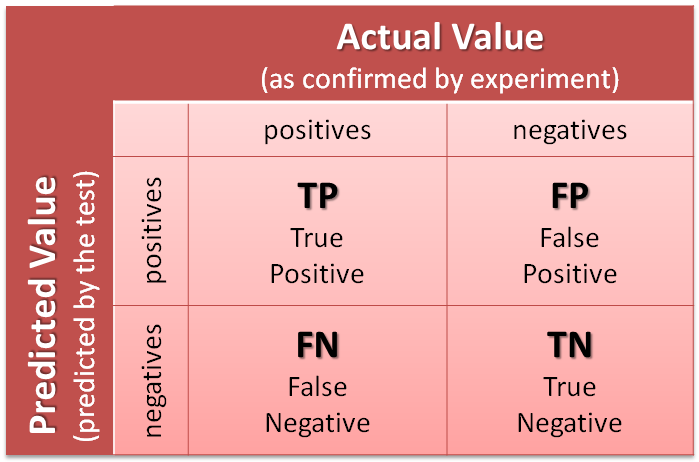
A confusion matrix is a simple and powerful tool to understand the effectiveness of a classification system. We see classification systems all around us. These are simply systems that classify things or people into two categories. Health screenings for diseases, baggage and X-ray systems at the airport and even our gut reaction to people we like or dislike are all classification systems.

The confusion matrix is a representation of the performance of our classification system. There are four outcomes of a classification system.

Let’s say our baggage screening system flags a bag, there can be two outcomes – safe or dangerous. A “True Positive” is when the system correctly flags a dangerous bag. A “False Positive” is when the system falsely flags a safe bag. False positives are called “Type I” errors.

Next, a “False Negative” is when the system doesn’t flag a dangerous bag. The terminology gets a bit confusing here. The simple translation of a false negative is that the negative predicted was false. These are called “Type II” errors. Finally, a “True Negative” is a correctly predicted safe bag.

Source and thanks to: Codeproject.com

Based on these 4 metrics, we can now construct a good picture of the quality of the classification system. Some of the common metrics are –

1. Prevalence – how often in our sample do we find a yes? (True Positives + False Negatives) / Total of all 4
2. Accuracy – how often is the classifier correct? = (True Positives + True Negatives) / Total of all 4
3. False positive rate – when it is actually no, how often does it predict yes? = False Positives / (False Positives + True Negatives)
4. True Positive rate or Recall – when it is actually yes, how often does it predict yes? = True Positives / (True Positives + False Negatives)
5. Precision – when it predicts yes, how often is it correct? = True Positives / (True Positives + False Positives)

These metrics typically give us the health of a classification system. There isn’t one “standard” for what the health should be. Ideally, you want as small a false positive and false negative rate as possible. But, building hyper accurate systems is very expensive – especially in cases where the prevalence is low. So, it comes down to what trade offs we are willing to make. For example, a cancer test that has a high false positive rate is problematic since it unnecessarily jeopardizes the health and happiness of someone falsely flagged. However, all cancer tests need to have very low false negative rates. This is why healthcare systems often set up less accurate preliminary screenings before moving us over to advanced expensive screenings that have higher accuracy.

If you’re ever wondering if a classifier is working well, just plot the confusion matrix. And, more importantly, when you take important medical tests, understand the False Positive and True Positive rates.

PS: It takes a repeated, intentional study of the Confusion matrix to feel comfortable with it. It is called the “Confusion” matrix for a reason.

Helped me out list

We all work on projects – both personal and professional. The most common projects are searching for a job or applying to university or graduate school. But, we work on other personal development projects too. During these projects, we connect with people for help and support. Some of these are people we know and some tend to be random strangers who help. My suggestion – make a “Helped me out list.”

It doesn’t matter if the person helped you a lot or a little bit – put them all on the “Helped me out list.” And, at the end of the project, regardless of how it turns out, reach out to every one of these folk and let them know how it went. Nothing fancy required. A short update will do. A thank you will be a wonderful addition.

First, people who take the time to respond to others, especially people they’ve never met, love hearing about the outcome of that conversation. Second, from personal experience, you only hear back once every hundred or so times. So, every follow up conversation is very memorable. Finally and most importantly, if you’ve reached out to a person for help once, there is a non zero chance that you will reach out to them again.

Besides, it is horrible practice to only reach out to people when you need something from them. I can think of two situations in the past year where I felt on either side of that table. In one case, I only seemed to be reaching out to this person asking for help. And, on the other, I seemed to only be hearing from someone when they needed my help. I was acutely aware of both and it just felt bad.

There are two principles at work here. First, plant more trees than whose fruit you’ll ever need. Second, plant them long before you need the fruit. This is hard to do right. You will definitely get a few wrong and they will feel painful. I certainly have gotten a few wrong over the years. But, over time, your percentages will get better.

A “Helped me out” list is a great way to improve those percentages.

Choice vs Tension

Choice is the act of selecting or making a decision when faced with two or more possibilities. Tension is the state of being stretched tight. In a decision making context, this stretch is often between two ideas seemingly in conflict. A sign of great decision making is the ability to distinguish between choice vs tension.

There are many time when we need to choose between options. Picking a restaurant, credit card or car require us to choose. However, there aren’t as many situations where we need to choose as we think there are. Most decisions, especially difficult ones, require us to embrace tension rather than a choice.

Should we be push ourselves or be content?
Must we focus or should we diversify?
Should we build toward the long term or the short term?
Must we create profits or value?
Should we pursue quality or quantity?

Every one of these tough questions (and many more) is a false choice. They look like straight-forward A or B questions. But, they aren’t. Each of these are examples of natural tensions. We can’t do one of these at the expense of the other. We have to do both. So, how do we tell the difference?

A wise friend once shared – “Whenever I am faced with such a dilemma, I ask myself [very deeply] what it would take to replace OR with AND.”

We must embrace the tension.

Lady Gaga’s product advice – The 200 words project

A few years ago, one of YouTube’s product leads was giving Lady Gaga a private look at some proposed UX revisions. Lady Gaga was visiting Google to be interviewed and was a YouTube power user. The team had mocked up a few designs – one of which that had a “premium” style look.

Immediately, Lady Gaga stopped the product manager and said, “No, keep YouTube looking shitty.”

Gaga elaborated to explain that, as a community product, it was important that YouTube didn’t lose the authenticity of the product in an effort to upgrade the look and feel. A creator or fan needed to feel like their “fingerprints” could be left on the site and that the site would be different for their participation. Incrementing a view count, commenting to a creator, “liking” a video, leaving a response – all of these features were meant to increase the feeling of accessibility and engagement and to allow folks to feel “I WAS HERE AND I MATTER.”

Keep usability separate from shine. And, remember who or what you are optimizing for. Thanks Lady Gaga.

Looking “shitty” isn’t an excuse for poor design but it is important to remember that product design is about producing emotion and spurring actions. Product designs optimize for usability and not how they look when framed and hung on a wall. – Hunter Walk


Source and thanks to: VC Hunter Walk’s blog

(The 200 words project involves sharing a story from a book/blog/article I’ve read within 200 words)