Fixed self descriptions

We all have self descriptions – a script that runs in our heads when we face challenges. For some, it is versions of “I am smart and tend to figure things out.” For others, it could be “I am very dedicated to a cause I choose” or “I don’t give up easily.”

These self descriptions tend to focus on fixed attributes – smart, beautiful – or fluid attributes – persistence, loyalty, dedication. I have found a strong correlation between fixed attributes and swings in confidence levels. That’s because fixed attributes aren’t easily changeable. So, if you consider yourself smart and spend time with folks who you think are smarter, your confidence could be rattled. However, hang out with people who are more persistent and you will likely find yourself to be more inspired to be more persistent. This ties with Carol Dweck’s idea of the fixed vs. growth mindset. Fixed descriptors leave no room for growth in our minds.

The easy way to identify the difference is that fixed self descriptions are results oriented while growth/fluid self descriptions tend to be process oriented. “I am smart” versus “I will persist to figure it out.” “I am very good looking” versus “I generally work hard to present myself well.”

This insight has implications for us as givers just as much as receivers. When we compliment people, do we compliment results or processes? After all, our self descriptions generally come from what we hear about ourselves from parents and friends.

What we think and say matters – being thoughtful isn’t an option, it is a responsibility.

self descriptionsImage Source

The Wright brothers’ lean startup – The 200 words project

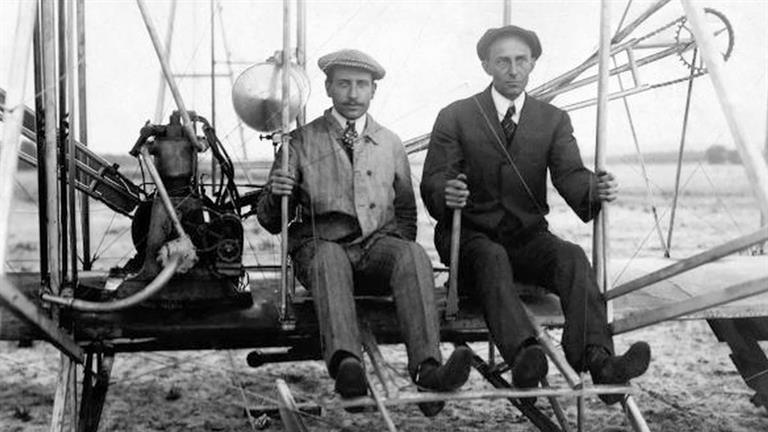
After initial successes with a printing press and an aerodynamic bicycle, Wilbur Wright became interested in flying machines. He requested the Smithsonian museum for all materials on flying machines. The more he read, the more he believed his brother and him could be the inventors of flying machines. However, the others in the field were experts who had an enormous head start. The favorite was a team led by Samuel Langley, secretary of Smithsonian institution, funded by the government.

But, while all the other inventors focused their energy working in laboratories building powerful engines to get the machine in the air (versus keeping it flying), the Wright brothers focused on gaining real flying experience. They developed a feel for the product by spending most of their time testing their designs out. They frequently crashed, iterated based on user, i.e. their, feedback and kept getting better. They, then, built the three-axis control around the mental model of a pilot as a bicyclist who would learn to balance the aircraft with practice.

The rest, as they say, is history. They were likely among the first product managers who used the agile methodology / lean approach to building products.

Key to the Wright brothers success was that their competitors over-valued stability and tried to design wings in a V-shape to compensate for gusts of wind. But, Wilbur decided to think in terms of a bicycle – inherently uncertain but dependent on the rider. The pilot had to learn to work with the wind. = paraphrased from Mastery by Robert Greene

Wright brothersImage Source


Source and thanks to: Mastery by Robert Greene

The real cost of weak promises

The real cost of “weak” promises (weak = promises we don’t intend to keep) is that we take our word less seriously, one weak promise at a time.

When viewed in the short term, this doesn’t necessary hurt us much. But, over time, this compounds into us completely losing trust in our own word. The danger lies in the compounding, of course.

The solution?

Don’t say yes when you want to say a no.

If it isn’t a HELL YEAH, it probably is a no.

If you find yourself faced with a promise you regretted making, keep it anyway.

If you do decide to break it, call it out loudly instead of slinking away into the darkness. You should feel the pain when you don’t keep commitment.

We learn to trust ourselves by keeping one promise at a time. And, if you can’t trust yourself, why should anyone else?

promisesImage Source

Defining trust

I love simple definitions and came across a fantastic one on trust on a friend’s blog yesterday. This friend’s post was inspired by a post by LinkedIn CEO Jeff Weiner –

Trust equals consistency over time. There’s no shortcut for either.

That is a fantastic definition – 100% true.

My only add would be that this definition illustrates beautifully the importance of integrity. Integrity is all about making and keeping commitments. This is so hard to do because of our propensity to make commitments we don’t intend to keep. It is only when we demonstrate integrity that we have the sort of consistency that builds trust.

There definitely are no shortcuts.

trust

We’ll make it work

We’ll make it work conveys two ideas – “We’re in it together” and “This is a commitment.”

There are many substitute responses to “We’ll make it work” – “I’ll try,” “We’ll try,” “Perhaps we can try make that happen,” “Let’s hope we can make it happen,” etc. None are as powerful. The beauty about “We’ll make it work” is that it galvanizes both sides.

And, if you don’t want it to galvanize both sides and really make a commitment, just say no.

There are those few times when you might want to use “try” as a cop out response or as a genuine attempt at communicating the uncertainty around things you don’t control.

But, for the most part, it is on us to avoid mucking around with weak promises.

Image Source

A conversation with Clay Christensen

In what will go down as among the most thoughtful gifts I will ever receive, a close friend got me 20 minutes on Clay Christensen’s calendar. We are the average of those we spend time with. And, aside from close friends and family, Clay Christensen is one of those folks I’ve spent a lot of time with – thanks to his generosity in sharing his wisdom via his book. Just recently, I had written about how their personal cultures had gone such a long way in helping me define my own. In that post, I’d mentioned that Clay didn’t know I exist.

Source

I have reached out to most of my favorite authors and interviewed them in the past few years. But, somehow, I stayed away from reaching out to Clay. Maybe it was because I knew he had a stroke and didn’t want to impose. Maybe it was because I felt I might be a bit disappointed if I never heard back. Either way, I didn’t do it. So, it was a real surprise when this friend forwarded his response to a note she’d left on his website about how I’d been inspired by his work to create “The Good Life sessions” at school. This was a true honor – it is always special meeting someone who has influenced you much more than they realize.

Our conversation revolved around purpose and the themes of “How Will You Measure Your Life?”

On his process of figuring out what mattered to him. Clay is a devout follower of the Mormon faith and his curiosity revolved around whether what he’d read about his faith was true. His experiences led him to experience what he considered a central teaching – if you do your duty, you will have opportunities to amplify your good work. And, that believe has been a constant through his life.

However, he didn’t want his book to be shut off as a religious book. So, he left this portion out (I always wondered why – it took me a long while to figure out how to build a process). In the process of attempting to convey some of his ideas, he had to dig deep to uncover principles that would apply to people of all faiths and belief systems.

On whether “don’t let life happen to you – instead, be intentional and thoughtful as you make your choices” is what he intended readers to take away. Absolutely. The principle here is to understand the resource allocation process. In his class, he teaches a case about resource allocation at Intel. Even though they were attempting to make a shift in the business to a lower profit per unit chip, they were still allocating resources based on “Gross margin per wafer.” This antiquated metric made it hard to make the shift they wanted. So, if managers want to drive change in organizations, you have to be fully aware of the resource allocation process.

Applying that to our personal life, this means understanding how we allocate resources. There are many forces that put pressure on our limited time and energy. For example, most of us habitually prioritize careers over families – even if careers are not that important to us. We can’t let life happen to us.

On parenting and the idea of quality time vs. quantity time. Clay talks a lot about parenting in his book. His reaction to this question was that quality vs. quantity time is the wrong categorization. Instead, first, we must ask ourselves if we are allocating time and energy to our children consistent with how we will measure our lives. And, as parents, our guiding question should be – “Are we working together toward building something or am I simply doing all the work for my children?” A natural following question is – “At the end of our time together, do my children have more confidence to tackle the hard things?”

Looking back, he shared that one of his children’s favorite memories was building kayaks. They didn’t seem to remember what they did with these kayaks. But, building them and tackling the associated challenges was a hugely memorable experience.


I found the idea that Clay had to dig deep to find principles that worked everywhere so as to make sure his wisdom reached people of all faiths and beliefs fascinating. It is, in my opinion, what made that book incredibly compelling – if you are ready for it. His pursuit of principles has inspired my own principle to find integrative principles that cut across all parts of our life. My leadership one pager was a result of a such a pursuit.

Thank you, Clay, for taking the time. And, thank you, for all your generosity. It all means more than I can express.

The shrinking circle of influence

I have many all-time favorite Stephen Covey concepts (that he managed to pack them all in one book is nothing short of wonderful) and the one for the day is the circle of influence.

circle of influence

In short, we all have a circle of influence with things we control and a circle of concern with things we don’t control. We get to choose what we focus on and, in doing so, we shrink or grow our respective circles. So, if you spend all your time thinking about things you don’t control – bad politics, global climate change – you will feel powerless and less inclined to do anything valuable. Spend more time on what you can influence, however, and you will feel your circle of influence grow.

A couple of days ago, I found myself feeling aware of a certain dissatisfaction that was brewing within. I had just spent an hour mulling various such issues – politics, the planet, immigration system issues. I had, in effect, shrunk my circle of influence. There are a couple of interesting takeaways from this idea –

  1. The illusion of control is an important aspect of our happiness. I say illusion because that is really what it is. We have far less influence over our lives than we think we do. But, it is important to believe we do.
  2. Even if we have far less influence in our lives than we think we do, we have a lot more influence than we often give ourselves credit for. Small things we do can have tremendous, even global, ripple effects. So, it remains a bit of paradox – we are neither as powerless or as powerful as we think we are.
  3. The quality of our lives is directly proportional to the amount of time we spend in our circle of influence.
  4. I believe the reason morning routines are very powerful for the reason that they involve us focusing on our circle of influence. By doing things we fully control – meditate, journal, etc. – we walk into the day feeling more in control.
  5. Related, but different – I think this is why waking up early is incredibly powerful. Wake up late and your attention can easily be captured by what other people want from you.

Spend more time in your circle of influence.

2 way growth

Disenfranchised parents, leaders, and teachers are often those who walked into the experience expecting 1-way growth. 1-way growth is when your world view revolves around the idea that you have plenty of wisdom to pass on. And, your kids/subordinates are will now be delighted to benefit from your experience. Sure, they may teach you a few tricks. But, how many new tricks can you teach an old dog? Beside, will the old dog really have time to learn given how much old dog wisdom there is to pass down?

As you might imagine, this affliction hits families a lot harder than in the workplace. As parents, it is tempting to think raising a child, who starts off entirely dependent on you, is all about passing on your wisdom. It is hard to imagine that a little human being can have an agenda or path of his/her own.

Khalil Gibran in, “On Children,” puts it beautifully –

They come through you but not from you,
And though they are with you yet they belong not to you.

You may give them your love but not your thoughts,
For they have their own thoughts.
You may house their bodies but not their souls,
For their souls dwell in the house of tomorrow,
which you cannot visit, not even in your dreams.
You may strive to be like them,
but seek not to make them like you.
For life goes not backward nor tarries with yesterday.

It all comes back to the idea that love is the willingness to extend oneself for your own and another’s growth.

Demonstrating true love as a parent, teacher or leader is primarily about caring enough to learn and grow through the experience. True teaching doesn’t occur when we set out to teach. True teaching occurs when the recipient is willing to learn and be influenced.

And, it is only when you are willing to be influenced do you have a shot at influencing others.

Image Source

Persist or not? – The 200 words project

We are told that persistence is a great trait to have. But, at what point does persistence become stupidity?

Before entrepreneur and musician Derek Sivers started CDBaby.com, he spent two years promoting various projects. The projects always felt uphill and progress came with massive effort.

When he started CDBaby.com, the first internet store for independent musicians to sell their songs, it felt like a hit song. People loved it and, suddenly, all previously locked doors opened. Based on his experiences, Derek cautions us against the idea that success comes from being persistent. Instead, he insists it comes from persistently improving on an idea that customers love.

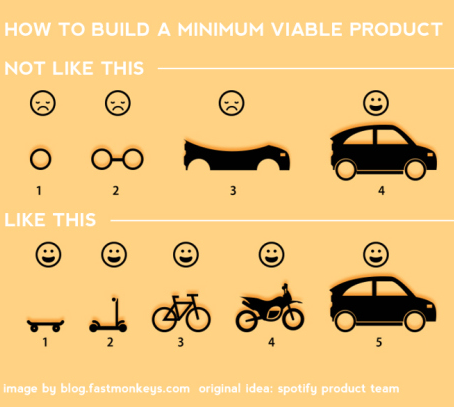
Derek’s advice is aligned to the advice on building a “minimum viable product.” As the image below shows, the way to build an MVP is to keep attacking the customer problem with lower effort approaches and, then, iterating to build a sophisticated solution

mvp, persistence,
Image Source

Present each new idea or improvement to the world. If multiple people are saying, “Wow! Yes! I need this! I’d be happy to pay you to do this!” then you should probably do it. But if the response is anything less, don’t pursue it. – Derek Sivers


Source and thanks to: Anything You Want by Derek Sivers

The Great Salmon Run

The Great Salmon Run is a part of another David Attenborough + BBC special called “Nature’s Great Events.” This episode profiles millions of pacific salmon making an incredible journey from the sea to the mountain streams where they were born, to reproduce.

great salmon runImage Source

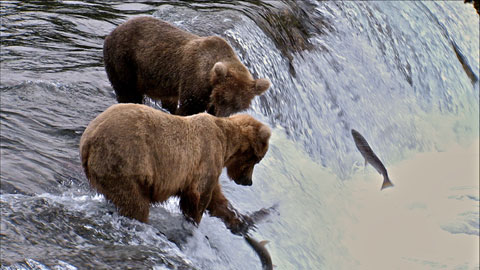
The event is very important to the entire ecosystem. As the salmon make their way upstream, they provide much needed food to the grizzly bears who make their way down the mountain to fatten up for the winter.

Image Source

They keep traveling up till they reach the exact spots where they were born. Here, they reproduce and die – the effort involved in making the 4000 odd kilometer journey is all too much. Even in death, however, they are crucial. The grizzlies again benefit greatly from the easy prey along with the animals around the forests. These animals often leave dead salmon near the trees – this, in turn, provides vital nitrogen and minerals for the trees in the forest. And, the dead salmon in the water provide necessary nutrients for the new born fish they spawned.

It is an incredible documentary.

Every time I watch these documentaries, I wonder if these events will last beyond the next two decades. Global warming is fundamentally changing the pattern of the ocean currents. Pesticides and plastics in the water, on the other hand, are making conditions harder for the fish. Every time we mess with a part of the ecosystem, we end up messing with the entire web that is dependent on the one piece we affected. This is the part that makes me sad.

On the up side, I hope more people watch these documentaries and understand that the threats around climate change are real. Maybe we could all begin by taking small steps to instill more environment friendly behaviors, where possible. Maybe if a few more of us paid attention to recycling, if a few more of us kept our eyes open to the prospects of saving energy, then we will go on to make more energy friendly decisions when the stakes get bigger.

We might soon be left with no choice but to do just that.