Seeing yourself as you could be

If you want to be calm under pressure, just start describing yourself (to yourself) as someone who is incredibly calm under pressure.

This transformation won’t take place over night. But, the next time things go wrong (and, don’t worry, they will), you might catch yourself reacting to the mishap. When you do, write down what you learn about yourself. After a few such experiences, you will feel the psychological trigger coming and start learning to take control of your response. And, a few more such incidents later, you will actually feel very calm under pressure. After all, you are one of those people who is calm under pressure.

As human beings, we care about being consistent with who we think we are. This makes labels incredibly powerful. Some of the smartest coaches of sports teams are very quick to label their players as the “best in the world.” It doesn’t matter if they are. It just matters that they begin behaving like they are the best in the world. Sir Alex Ferguson was famous to label Manchester United players as those who had the strength of character to snatch a victory in the last minute of a game. It didn’t matter if a player showed up at United yesterday. He’d suddenly find himself capable of doing exactly that. It was a self fulfilling prophecy.

A big part of being a great leader is bringing out the best in people. For that, we have to learn to see people, not just as they are, but as they could be. And, we’re best served if we begin doing that with ourselves.

Getting mission statements right – MBA Learnings

We looked at a few mission statements in our Values Based Leadership class –

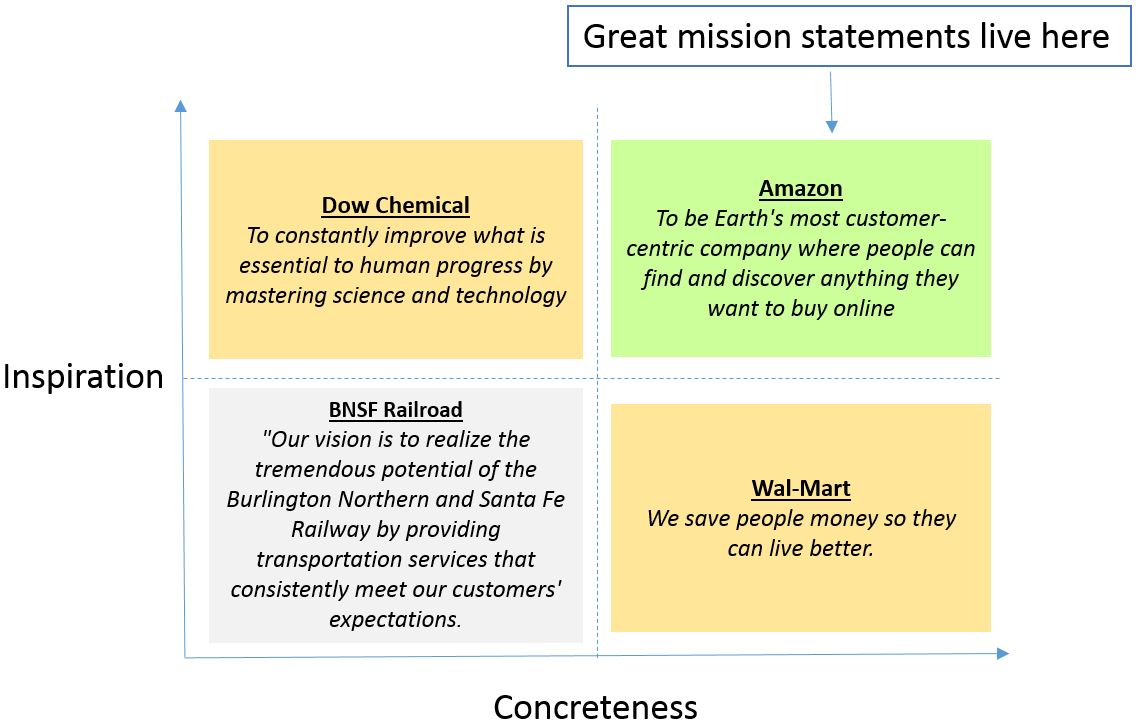
Wal-Mart: We save people money so they can live better.
Burlington Northern and Santa Fe Railroad: Our vision is to realize the tremendous potential of the Burlington Northern and Santa Fe Railway by providing transportation services that consistently meet our customers’ expectations.
Dow Chemical: To constantly improve what is essential to human progress by mastering science and technology

As we went through these statements, the comments that followed were around the following lines –
– The Wal-Mart mission is really concrete. It is the sort of statement that can be used whenever Wal-Mart faces a tough decision. Any product or personnel decision could be brought back to the fact that Wal-Mart exists to save people money.
– The Burlington Northern and Santa Fe Railroad mission felt like a non-mission statement. You could easily replace their name and industry with a different company and industry and it could still “work.” That’s a problem.
– Dow Chemical did very well on inspiration. But, how concrete is it? Can the mission statement actually be used in daily decision making?

Bringing it all together, we realized that great mission statements have 2 characteristics –
1. Inspiration. Some inspire with a transcendent purpose and others inspire with a bold goal. Regardless, the inspiration factor gives people a reason to come to work everyday.
2. Concreteness. Concreteness makes the vision easy to understand and apply to daily decisions.

Mission statements, as a result, are an important and, yet, often neglected resource for building culture, improving employee motivation and decision making. What is an example of a great mission statement? I love Amazon’s statement – “To be Earth’s most customer-centric company where people can find and discover anything they want to buy online.” Really inspiring and, yet, very concrete. If there was ever a decision to be made, it is clear that the customer would be first priority.

(Note: I’ve used mission and vision statements interchangeably to convey the larger point)

Mission statements

This learning had immediate applicability for me. I thought of 3 teams I am working with and thought about the various levels of clarity in our purposes. And, voila, it turned out that the team where I felt most stuck was the one with the least clarity around the mission statement.

It is a relatively simple fix. And, it is one we ought to get right.

Ser Allister Thorne on leadership

My wife and I caught up with the 4th season of ‘A Game of Thrones’ over the past few days as it is finally available on the iTunes store. This would normally lead to a few rants about HBO’s antiquated approach to content distribution online. But, not today.

In one of the (many) war scenes in the season, Ser Allister Thorne says this to Jon Snow –

“Do you know what leadership means, Lord Snow? It means that the person in charge gets second guessed by every clever little twat with a mouth. But if he starts second guessing himself, that’s the end. For him, for the clever little twats, for everyone.”

As much as I despise Thorne’s character, I thought this observation on leadership was particularly insightful.

I’ve observed this over and over again. The idea “often mistaken, but never in doubt” is regularly used in jest. But, it is one of those characteristics that I find to be essential in leadership. No matter what you do, you’re always going to be second guessed. Yes, sure, an ability to listen to reason and change course matters. But, if you’ve just set sail, the right course is almost never clear. More often than not, conviction and self-belief matter more.

And, I’m not just talking about leading teams. This applies just as well to just leading ourselves..

Building teams that innovate – learning from history

I am reading “The Innovators: How a Group of Hackers, Geniuses, and Geeks” Created the Digital Revolution.” I realized I didn’t know much about the early history of the digital age and have, so far, found it fascinating. I’m still only 25% into the book and am beginning to see a trend in how innovative teams that shaped the digital age were built.

1. Multi-disciplinary teams. Great technology breakthroughs were not made by a group of computer scientists working together. Instead, they involved groups of theoretical physicists, chemists and programmers who came together. This was the case in the creation of the early computers at University of Penn and in the case of the semiconductor at Bell Labs.

Bell Labs was a great example of a place that was simply bustling with innovative ideas. Its DNA was built on the fact that it kept exposing scientists to others with different expertise. Steve Jobs was so inspired by Bell Labs that he designed the Pixar headquarters (and, perhaps, Apple, too?) to mimic Bell Labs. At the Pixar headquarters, you are forced to bump into others from different parts of the organization at the large Atrium. It is, as Jobs described it, a place that “promoted promoted encounters and unplanned collaborations.”

2. An intersection of science and the arts. Ada Lovelace, John von Neumann, Steve Jobs were examples of people who brought together two seemingly unconnected disciplines. This is, in some ways, related to point 1 but still worth a separate call out. All 3 were credited with visionary thinking that shaped the digital age and, perhaps, it was only made possible by their position at that intersection.

3. Teams that combined individual genius and great team spirit. We like building tales of the individual inventor. But, great inventions were largely built by teams. What is distinctive about nearly every one of these teams is that they combined individual genius (often one or two within the group) and great team spirit from working really well together. Not all these times lasted long because of recurring issues around ego, but when they did, they worked fantastic.

This point is a great guide to anyone looking to build a great team. You want to encourage individual genius in your team and, at the same time, do your best to foster team spirit. It always feels safer to just bring people whose egos don’t clash. But, then, you lose edge. And, edge is often what make teams great.

Listening to and listening for

When people choose to listen, there are two types of listening that take place – “listening to” and “listening for.”

“Listening for” is the most common form of listening and means listening is being done for a purpose. Common purposes are affirmation, adulation, communicating politeness and, sometimes, the desire to make a good impression.

“Listening to” is the sort of listening when someone really listens to understand. It involves being willing to having your point of view changed by the views of the other person. This sort of openness necessitates a positive self image, however.

It is impossible to “listen to” someone when you feel insecure (Notice, I say “feel,” not “are” – for the purpose of this discussion, we’re going to deal with the feeling of insecurity). And this has 3 important implications for us as communicators.

First, it is in our interest to make people feel comfortable and secure. This is another way of saying that it is in our interest to be genuinely nice. To really “be” nice, we have to care and have to be prepared to listen ourselves. We have to also learn how to ensure people feel completely secure and at ease about where they stand in our eyes. This means ensuring we don’t take nice things from people around us for granted, this means ensuring we communicate happiness and this means not being an insensitive jerk.

Second, we have to learn to communicate any issues that are blocking us from being truly open. Sometimes, a feeling of doubt or unease about our equation with the person we’re speaking to can act as a communication barrier. Talk about it. Else, it will show.

Third, we have to make it a habit to have the difficult conversation. As leaders, it is important to make the process of giving feedback habitual. No one on your team should feel like it is a big deal if you say something needs improvement. Similarly, in our lives, it is in our best interest to have the difficult conversations and break the peace for a little while. If we want to be able to listen without judgment and communicate without judgment, we need to be open. And, effective communication is all about habitually building environments where openness is welcomed.

Final 2 notes –
1. Notice how any conversation about other people listening to you begins with you being open yourself. Having others listen to you is one of the purest forms of leadership. And leadership requires you to take charge of creating an ideal environment – in this case, that would be an environment of openness.
2. Communication only occurs when people really listen to you. In order for them to listen to you and not just listen for affirmation, you need to ensure you do whatever it takes to create that environment of openness. This will not always work. Sometimes, despite your best efforts, communications will break down. That’s okay – we only control the process, not the results. Let’s nail the process.

The ladder of control – The 200 words project

Here’s this week’s 200 word idea thanks to 99u.com.

David Marquet, Captain of the USS Santa Fe, followed a leadership principle – push authority to as low a level as possible. Under normal practice, officers would “request permission to” perform operations such as submerge the ship. The captain would approve and the officer would carry out the task.

David insisted his officers move up the ladder of control (below), stop asking permission, and instead state “Captain, I intend to submerge the ship” to which he would respond, “very well.” Initially, he had a lot of questions for the officers about whether it was safe, whether the preconditions were met, whether the team was ready, and whether it was the right thing to do. With time, he asked fewer and fewer questions as the officers learned to provide that necessary information at the same time they stated their intent.

The immediate and obvious benefit was that with this small shift in language, just a few words really, the officers became the driving force behind the submarine’s operations.

Perhaps we ought to consider moving our teams up the ladder of control as well..

Ladder of control

Source and thanks to: http://www.EBSketchin.com

‘Moving people from “request permission” to “I intend to…” raised them one rung on the ladder of control, from passive followers doing what they were told at the bottom to proactive engaged leaders, crafting the future, at the top. ‘ | David Marquet

Understanding management debt

Ben Horowitz, the former CEO of Opsware and now-successful venture capitalist, has a great post on management debt. He offers a slightly deeper explanation in his excellent book – The Hard Thing About Hard Things.

I have been thinking about management debt over the past few months but didn’t have a term for it. I am now able to put the word into context and would like to share some of my lessons.

Management debt is when a leader or manager (I will stick to “leader” for simplicity) takes a call that works better for the short term than for the long term. Any such decision is equivalent to the leader taking a loan for a short term pleasure and will require the leader to pay it back with interest. The rates of interest on certain kinds of management debt are really high. In his blog post, Ben details 3 situations where he’s seen management debt –

1. Putting two in a box – Trying to keep two talented folks in his company during a reorganization by making them co-heads.
2. Over compensating a key employee when she has a better job offer because she is key to a current project.
3. No performance management or feedback process – leading to surprises when things don’t work well.

I haven’t managed a billion dollar company and, while I am sure my experiences don’t compare to those of Ben Horowitz, I have found myself guilty of using management debt multiple times without realizing it on multiple projects. And my lessons are as follows.

I. Define culture early – it is hard to change. Culture is set by a set of principles that defines your approach to work. This needs to be defined really early or things get really messed up down the line. One such example is a project I’ve lead for nearly 3 years – when we started, we took a scrappy approach towards getting things done. I figured that the focus ought to be to just get results and we’d find time later to define how we’d like to do it better. So, we took nearly a year to define our values, ways of working, etc., and just kept the habit going. And, you know what? 1.5 years later, we still haven’t gotten past our scrappiness. Heck, we don’t even know what our values are.

The extent of the damage is evident because another member this team and I are also part of 3 other project teams and we behave differently in those. Culture is powerful and is hard to change once it is set. I am still not clear how to solve the problem with the culture issues in this project – clearly, I’m still paying the interest on my management debt.

2. Create a 6 month feedback process. I’ve worked on projects where there was an attempt at weekly performance management and then run projects with no performance management. I find that a 6 month feedback process is reasonable and important. 1-3 month feedback can work okay on short engagements but feedback systems shorter than that become carrot-and-stick systems in my view and don’t give people enough time to get comfortable. If you think this is hard to do in a busy day job, I can assure this is harder when you are working on a project(s) in addition to your day job on weekends with limited time. That said, it is important. Else, you are just taking on more debt. And, I have learnt that the interest on this one is costly.

3. Create a list of management principles. As I’ve been thinking about 1 and 2, I’ve realized that what I am missing is a list of management principles. I have an implicit list but it’s clearly not been enough to provide clarity. These management principles will help you stay true to your goals and will ensure you are firm and insistent on the right things. Once you have these principles defined, don’t compromise.

I am going to explore this topic in greater depth over the next few months. More to follow on setting culture, designing feedback processes, developing management principles, and the like.