
A few weeks ago, I wrote about why queues form. The one line answer is that they form because of statistical fluctuations and dependent events. The concept is simple – if your presence at a meeting is dependent on the previous meeting and the average time in the meeting is variable, it is likely that you’ll have people waiting for you, on average.
There’s a really cool application of this principle when it comes to checkout lines in stores and supermarkets. Multiple line checkouts are woefully inefficient.
So, if the supermarket next door replaced multiple checkout lines and replaced it with 1 line, it could reduce your waiting time to approximately 1/3rd your normal waiting time. Why? Because longer lines minimize variability. If you are stuck in a short queue with 2 coupon sharks who take forever to pay, your average waiting time becomes very long. Such variability is minimized in a single queue as it is unlikely you have a coupon shark at every checkout counter.
The beauty about 1 line queue systems is that it also feels fair. We all hate it when we see that other queue go much faster. The downside, however, is that single queues can look and “feel” really long. So, the conventional wisdom is to have multiple queues because long lines can turn off customers.
Whole Foods in Manhattan, however, decided to just ignore the conventional wisdom ten years ago and implement the more efficient single queue checkout. It has worked fantastically well for them. And, now you know why.
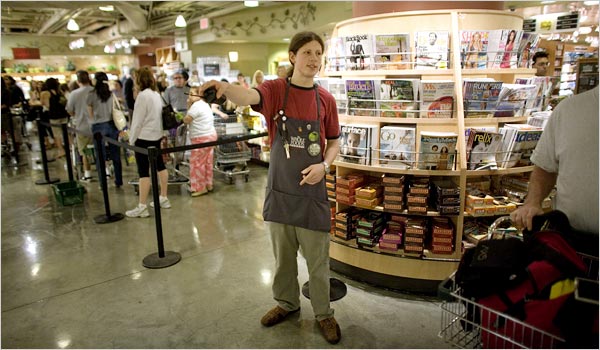 (a line manager at Whole Foods Manhattan who makes sure people move quickly to the nearest open register)
 A Learning a Day